
Nature’s Brightest Treasures: The Ultimate Guide to Orange Gemstones (2026)
Home
News And Media Nature’s Brightest Treasures: The Ultimate Guide to Orange Gemstones (2026) SHOP NOWHome
News And Media Nature’s Brightest Treasures: The Ultimate Guide to Orange Gemstones (2026) SHOP NOWJun, 09, 2026 by Archit Mohanty 0 Comments
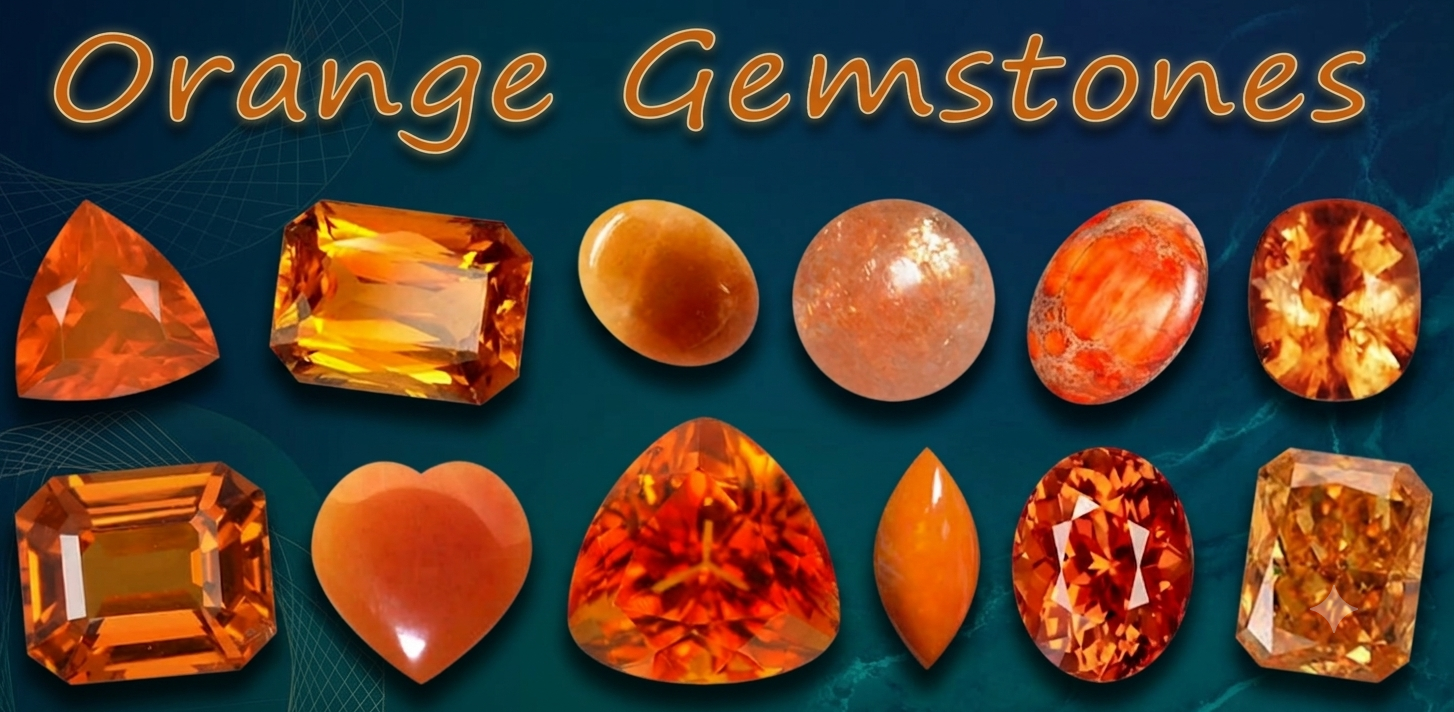
Orange gemstones capture the warmth of a sunrise and the fiery energy of autumn leaves. From the rarest fancy diamonds to affordable citrine, these vibrant gems have fascinated collectors, jewelers, and royalty for centuries.
This guide explores the science, history, and market value of nature’s most radiant orange treasures, while helping you discover where to buy and sell these remarkable stones.
The orange color in gemstones arises from specific trace elements and crystal lattice defects. Understanding these mechanisms helps gemologists authenticate stones and determine their origin.
Orange diamonds owe their color primarily to isolated nitrogen atoms (C-centers) and a characteristic absorption band near 480 nm. These nitrogen-related defects modify the diamond's transmission window, allowing orange wavelengths to dominate and produce their rare orange appearance.
Orange sapphires derive their color from a combination of iron (Fe³⁺), chromium (Cr³⁺), and yellow color centers within the crystal structure. The interaction of these elements and defects creates hues ranging from yellow-orange to reddish-orange.
Citrine obtains its color from iron impurities, specifically Fe³⁺ ions that substitute for silicon in the quartz lattice. These iron ions selectively absorb light, producing the gem's characteristic yellow to orange coloration.
Fire opal gets its vivid orange body color from microscopic inclusions of iron oxide (Fe₂O₃). These tiny particles dispersed throughout the silica structure impart the gemstone's distinctive red-orange appearance.
Imperial topaz owes its prized golden-orange to pinkish-orange hues to the presence of chromium (Cr³⁺) and iron (Fe³⁺), together with oxygen vacancies in the crystal lattice. The interaction of these defects and impurities creates its exceptional coloration.
Spessartine garnet is colored by manganese (Mn²⁺) occupying octahedral sites within the crystal structure. Crystal field transitions associated with manganese are responsible for the gem's vibrant orange to reddish-orange colors.
Sunstone derives its orange body color and characteristic aventurescence from metallic copper nanoparticles and inclusions. These copper platelets scatter and reflect light, producing the sparkling orange and reddish-orange effects that make sunstone unique.
The Gemological Institute of America (GIA) has extensively documented these color mechanisms, particularly for diamonds, where the 480 nm absorption band is responsible for the vast majority of natural unmodified orange hues.
Natural orange diamonds are among the most exceptional gems on Earth. According to GIA research, “orange diamonds are among the rarest when they have unmodified hues”. Their color derives from isolated nitrogen atoms (Type Ib diamonds) combined with the 480 nm absorption band, creating a pure orange bodycolor without brownish modifiers.
Famous Examples:
The Orange Diamond – 14.82 carats, Fancy Vivid Orange, sold at Christie’s Geneva in 2013 for $35.5 million ($2.4 million per carat)
The Pumpkin Diamond – 5.54 carats, Fancy Vivid Orange, discovered in Central Africa and worn by Halle Berry at the 2002 Oscars
Scientific classification: Most natural yellow diamonds are colored by N3 defects (“cape” diamonds), while orange diamonds are linked to C-centers and H3 defects. The “480 nm band diamonds” category includes both pure orange and color-change chameleon diamonds.
Market value: Orange diamonds command premium prices, often exceeding pink and blue diamonds in per-carat value. Fancy Vivid Orange specimens regularly sell for over $1 million per carat at auction.
Shop natural diamonds on CaratX: www.caratx.com
Sapphire, the gem-quality variety of corundum (Al₂O₃), occurs in every color except red (which is ruby). Orange sapphires range from delicate peach to intense tangerine.
The Legendary Padparadscha: The name derives from the Sinhalese word for “lotus blossom,” reflecting its unique pinkish-orange to orange-pink hue.
Color debate: Gemologists disagree on the exact boundaries of Padparadscha. Some insist on “salmon” or “sunset” hues, while others accept a broader pinkish-orange spectrum.
Geographic origins: Sri Lanka (Ceylon) is the traditional source, but significant deposits have been found in Madagascar, Tanzania, and Vietnam.
Explore orange sapphires on CaratX: www.caratx.com
Citrine is the transparent, pale yellow to brownish-orange variety of quartz. Despite its abundance in the market, GIA notes that “the finest citrine colour is a saturated yellow to reddish orange free of brownish tints”.
Madeira Citrine: Named after Madeira wine, this deep reddish-orange variety is the most prized.
Geographic sources: Brazil is the primary producer, with significant mining in the state of Rio Grande do Sul. Madagascar, Spain (Galicia), and Zambia also produce quality citrine.
Hardness: 7 on the Mohs scale, making it suitable for all jewelry types including rings.
Affordability: Citrine offers excellent value, often available at $5–20 per carat for fine material. British Geological Survey (BGS) publishes annual mineral production statistics that track quartz (including citrine) global output.
Fire opal is a noncrystalline hydrated form of silica (SiO₂·nH₂O) with a distinctive orange-to-red bodycolor caused by iron oxide inclusions.
Unique properties: Unlike precious opal, fire opal typically lacks play-of-color (iridescence), though some specimens exhibit minor spectral flashes.
Geographic sources: Mexico (Querétaro, Jalisco, Michoacán) produces the world’s finest fire opals. Significant discoveries have also been reported in Madagascar’s volcanic deposits.
Scientific research: A 2024 study published in the Journal of Gems & Gemmology documented that “the colours of the red and orange body coloured massy opals seem to be related to increasing iron concentration”.
Care considerations: Fire opals contain 3–10% water content. Avoid sudden temperature changes, ultrasonic cleaners, and steam cleaning.
Imperial Topaz is the rarest and most valuable variety of topaz, distinguished by its vivid reddish-orange to golden-orange hues.
Historical significance: Topaz has been mined in Brazil’s Ouro Preto region since 1768. The “Imperial Flame” crystal, one of the largest specimens ever discovered, originated from these mines.
Gemological properties:
Refractive index: 1.629–1.641 (higher than colorless topaz)
Pleochroism: Medium orange-light orange
Fluorescence: Yellow or orange under long-wave UV light
Sources: Brazil (Minas Gerais) is the primary source. Pakistan’s Ghundao Hill and Russia’s Ural Mountains also produce Imperial Topaz.
Anniversary gem: Imperial Topaz is the traditional gemstone for 23rd wedding anniversaries.
Discover Imperial Topaz on CaratX: www.caratx.com
Spessartine is a manganese-aluminum silicate garnet [Mn₃Al₂(SiO₄)₃] that exhibits the most vibrant orange hues in the garnet family. The term “Mandarin Garnet” specifically refers to the bright yellowish-orange to orange-yellow spessartine from Madagascar.
Color mechanism: The orange color originates from Mn²⁺ (manganese) ions in the octahedral sites of the garnet crystal lattice.
Hardness: 6.5 to 7.5 on the Mohs scale.
Distinctive properties: Spessartine often contains eye-visible inclusions, though clean stones are highly prized.
Sources: Namibia, Nigeria, Madagascar, and the USA (Ramona, California). The Smithsonian’s National Gem Collection includes exceptional Zambian specimens.
Melo pearls are the rarest pearls in the world, produced by the Melo melo sea snail (Volutidae family) found in the South China Sea and off the coast of Vietnam and Thailand.
Distinctive features:
No nacre – Unlike traditional pearls, Melo pearls are non-nacreous, composed of calcite and aragonite
Flame patterns – Unique chatoyant “flame” structures visible on the surface
Porcelain-like luster – Similar to conch pearls
Colors: Ranging from pale orange to deep burnt orange, with intense saturated specimens commanding the highest prices.
Rarity: No pearl farming exists for Melo pearls; all are wild-harvested, making them more valuable than many natural saltwater pearls.
Market value: Fine Melo pearls can exceed $50,000 per carat, with larger specimens (20+ carats) reaching auction prices over $200,000.
Sunstone is a plagioclase or orthoclase feldspar that exhibits aventurescence, a glittery schiller effect caused by reflective mineral inclusions.
Scientific classification: According to GIA, “Sunstone is a member of the feldspar group. Both the orthoclase and the plagioclase feldspar species boast a sunstone variety”.
Oregon Sunstone: The official state gemstone of Oregon since 1987. This copper-bearing labradorite feldspar contains native copper inclusions that create both aventurescence and orange-to-red body colors.
Color mechanism research: A 2024 study in the Journal of Gems & Gemmology systematically examined “the existence and optical influence of variably shaped metal-nanoparticle inclusions in feldspar crystals” as the cause of Oregon sunstone’s distinctive coloration.
Additional sources: India produces aventurine feldspar with red-brown bodycolor, and Ethiopia has recently yielded new copper-bearing sunstone material.
Browse sunstone and other feldspars on CaratX: www.caratx.com
The global colored gemstone market has experienced significant digital transformation, enabling sellers to reach B2B and B2C buyers across continents. CaratX provides a specialized marketplace for diamond and gemstone trading.
CaratX Seller Plan – Sell jewelry internationally to buyers worldwide.
B2B and B2C Capabilities – Reach 18+ international countries.
Competitive Pricing – Transparent fee structure for marketplace participants.
Register as a Seller: www.caratx.com/register
Shop Natural Diamonds – Extensive inventory of certified loose diamonds.
Shop Gemstones – Unbeatable prices on colored gemstones including all varieties mentioned in this guide.
Secure Transactions – Trusted platform with buyer protection.
Start Shopping: www.caratx.com
For complete details about CaratX’s pricing plans and fee structure: https://caratx.com/generic-pages/launch-your-products-on-caratx
A: Natural orange diamonds with unmodified hues are the rarest, followed by Padparadscha sapphires and Melo pearls. According to GIA, “orange diamonds are among the rarest when they have unmodified hues”.
A: Yes. Natural untreated stones command premium prices. Many orange sapphires on the market are beryllium-diffusion treated, which GIA research has documented extensively. Always request a gemological certificate from reputable labs (GIA, AGS, IGI, etc.).
A: Citrine offers the best value at $5–20 per carat for fine quality. Its hardness of 7 makes it suitable for all jewelry types.
A: Some varieties show color sensitivity. Citrine can fade with prolonged UV exposure, while Imperial Topaz is generally color-stable. Fire opal should not be stored in direct sunlight due to potential dehydration.
A: Use warm soapy water and a soft brush. Avoid ultrasonic cleaners for fire opal, spessartine garnet (inclusion-prone stones), and melo pearls. Steam cleaning is safe for diamonds, sapphires, and citrine.
A: Padparadscha is a specific pinkish-orange to orange-pink hue originally from Sri Lanka, named after the lotus blossom. Not all orange sapphires qualify as Padparadscha, which remains a point of debate among gemologists.
A: Yes, CaratX partners with trusted certification laboratories to ensure authenticity. Visit www.caratx.com for current inventory.
Orange gemstones represent some of nature’s most spectacular creations, each with unique geological origins and optical properties. Whether you’re a collector seeking the rarest orange diamond, an investor evaluating fancy color sapphires, or a jewelry enthusiast looking for affordable citrine, understanding the science and market dynamics is essential.
For the latest inventory of natural diamonds, orange sapphires, citrine, fire opal, imperial topaz, spessartine garnet, and sunstone all at competitive international prices visit CaratX.
Start your gemstone journey today:
www.caratx.com – Buy natural diamonds and gemstones
www.caratx.com/register – Start selling internationally (18+ countries)
CaratX Pricing – View seller plans and fee structure.
Follow CaratX for more insightful and educational content about diamonds, gemstones, and international jewelry trading.
Aug, 06, 2022
Aug, 06, 2022
Nov, 13, 2025

0 Comments
Please login to leave a reply.