

Small Diamond Prices Show Early Signs of Recovery: A Detailed Market Analysis for May 2026
Home
Education Blog Small Diamond Prices Show Early Signs of Recovery: A Detailed Market Analysis for May 2026 SHOP NOWHome
Education Blog Small Diamond Prices Show Early Signs of Recovery: A Detailed Market Analysis for May 2026 SHOP NOWJun, 09, 2026 by Archit Mohanty 0 Comments
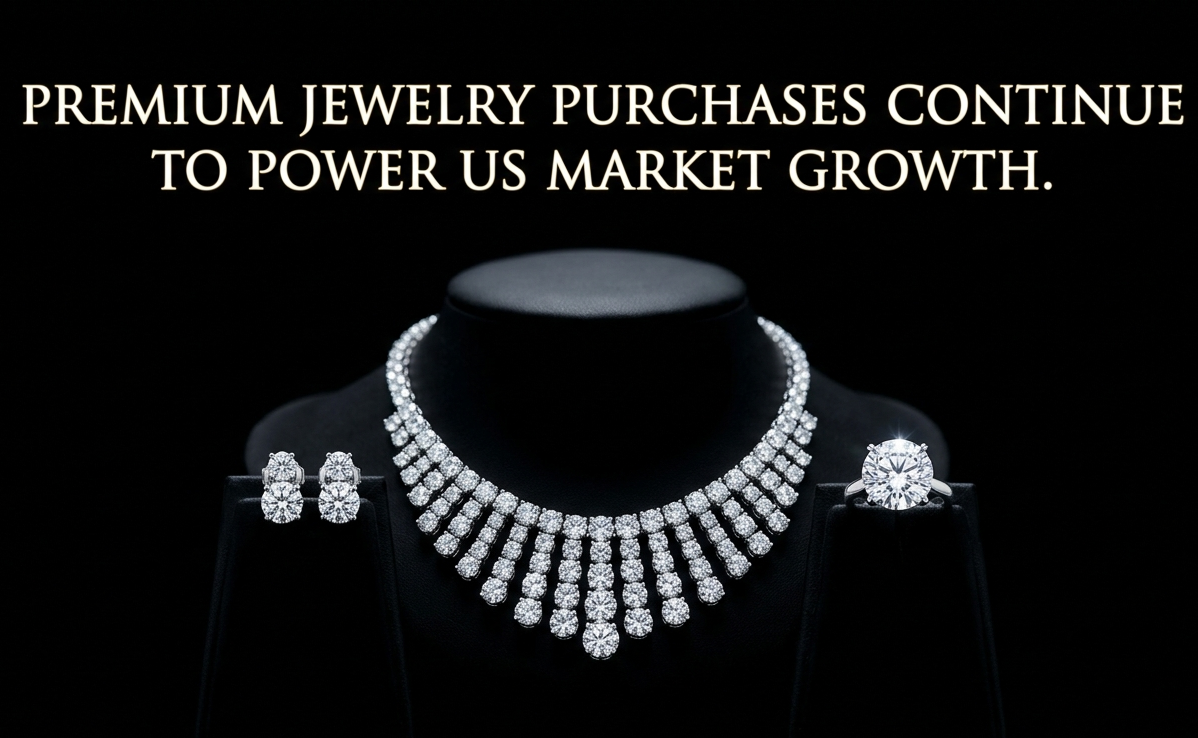
After a prolonged period of turbulence caused by macroeconomic headwinds and shifts in consumer behavior, the global diamond market is finally showing encouraging signs of stabilization. According to the latest data from industry benchmarks and retail trend analytics, May 2026 marked a pivotal month, particularly for smaller, premium-quality diamonds.
While the market remains selective and cautious, the price action in the 0.30-carat and 0.50-carat segments suggests that supply-demand dynamics are slowly realigning.
For investors, jewelers, and B2B buyers on platforms like CaratX, understanding these granular shifts is key to capitalizing on the emerging opportunities.
The most significant development in May was the rebound in smaller diamond categories. According to the Diamond Index, which tracks asking prices for round, D-H, IF-VS2 premium goods, the figures broke a downward trend:
0.30-carat diamonds saw a month-on-month increase of 2.1% in May.
0.50-carat diamonds followed suit, rising by 0.9%.
While these figures represent a welcome reversal, context is crucial. Prices for 0.30-carat stones remain approximately 27.6% below last year’s levels, indicating that while the bleeding has stopped, the market is still in the early stages of healing.
Industry analysts attribute this recovery to tightening supply chains. The number of 0.30-carat diamonds available on the Trade network fell by more than 50% since January, primarily due to aggressive production cuts at the mining level. This supply contraction is meeting opportunistic demand from high-end brands seeking bargains in "collection-quality" smaller stones.
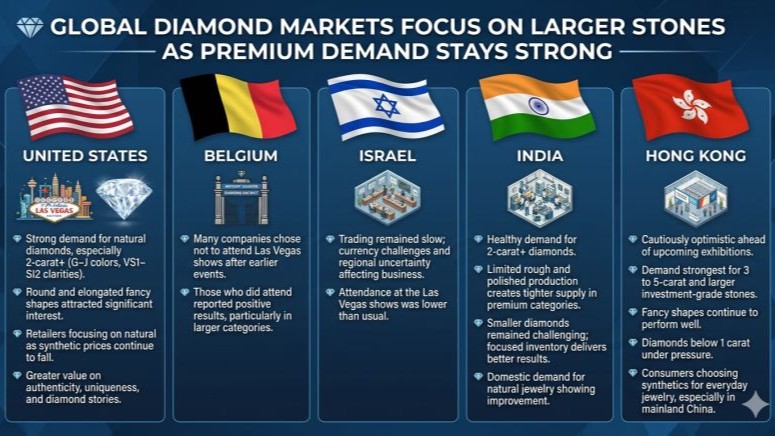
While smaller diamonds are stabilizing, the engine driving the entire industry remains the United States jewelry market. Data from Tenoris, the leading retail trend analytics firm, reveals a fascinating divergence in consumer behavior.
Key US Retail Data for May:
Total jewelry sales grew by 1.8% year-over-year.
Average spending per purchase surged by 19.6%, indicating that while unit volume is static, the value of each transaction is rising rapidly.
May’s standout event was Mother’s Day, which generated nearly one-third of the month’s jewelry revenue. In the week leading up to the holiday:
Diamond jewelry sales rose 1.8% .
Average spending per item jumped nearly 20% .
The National Retail Federation (NRF) projected record Mother’s Day spending of $38 billion** in 2026, with jewelry remaining the single largest category at **$7.5 billion, outpacing electronics and special outings.
One trend is becoming impossible to ignore: the premium segment is decoupling from the mass market.
Tenoris data indicates a "K-shaped" recovery trajectory:
Above $2,500: Unit sales increased by roughly 20%. Consumers are buying better pieces.
Below $2,500: Double-digit declines are prevalent.
This trend is also visible in the gold market. Gold jewelry revenue rose by 4.7% despite lower unit volumes. Necklaces and fashion rings were the strongest performers, driven by emotional gifting and a focus on quality over quantity.
For businesses looking to tap into this premium demand, the CaratX Seller Registration portal offers direct access to high-net-worth international buyers across 18+ countries.
The recovery narrative cannot be fully understood without acknowledging the continued expansion of laboratory-grown diamonds (LGDs) .
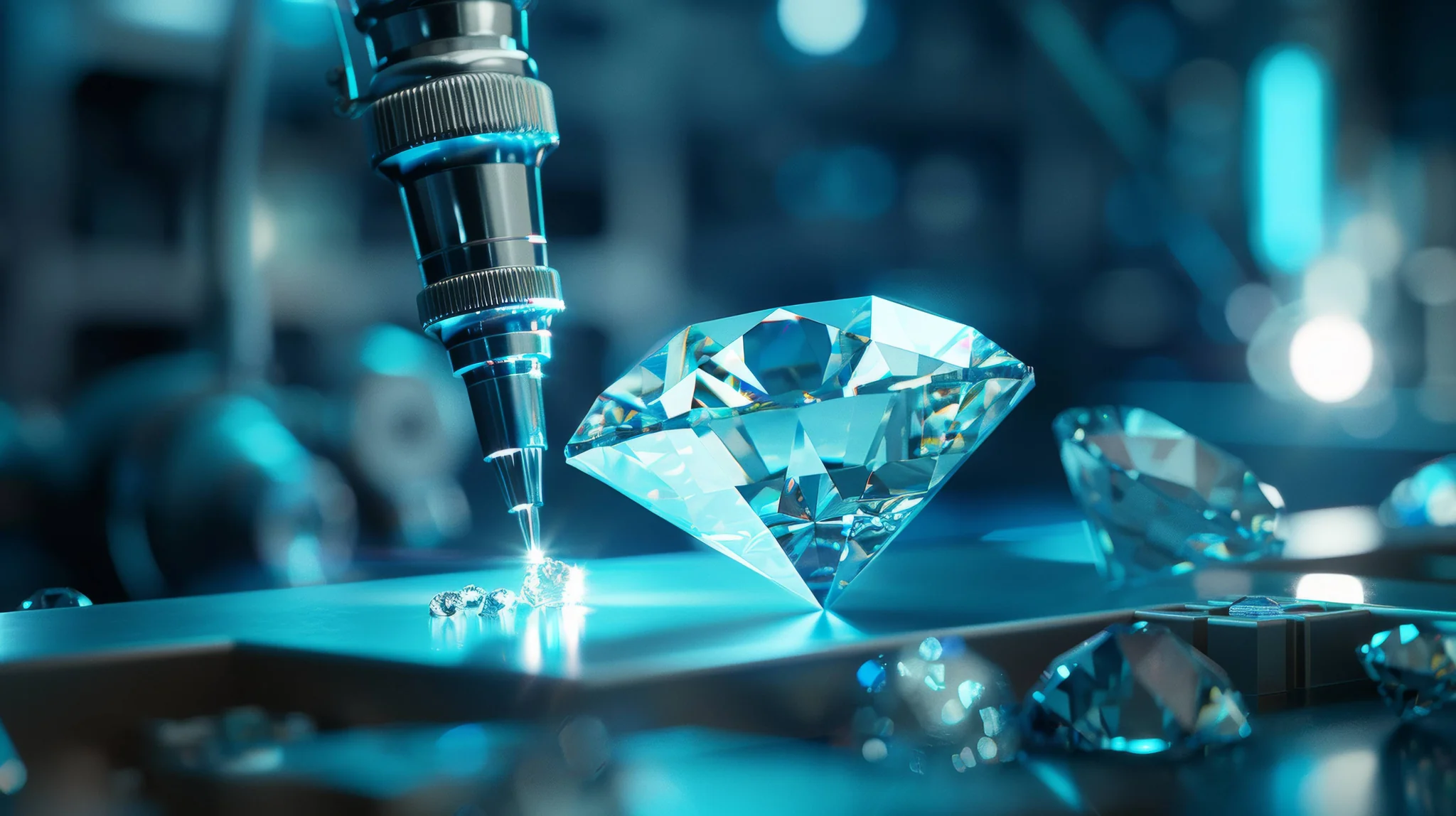
The technology behind LGDs has matured significantly. The two primary methods dominate the market:
CVD (Chemical Vapor Deposition): A diamond seed is placed in a chamber filled with carbon-rich gas (methane). The gas is heated to plasma, causing carbon atoms to rain down and crystallize layer by layer.
HPHT (High Pressure High Temperature): Mimicking the earth's mantle, carbon is subjected to extreme pressure (5-6 GPa) and heat (1,300-1,600°C) to form a diamond.
While natural diamonds carry the heritage and scarcity premium, lab-grown stones have captured significant market share in the lower-priced jewelry segment. Industry analysts note that LGDs are eroding demand for natural diamonds, particularly in the mass-market engagement ring sector, where they now account for over 50% of unit sales in the US.
However, the natural diamond sector maintains a strategic advantage: value retention. GIA research emphasizes that while synthetic diamonds are chemically identical, their prices have collapsed by 14%+ year-over-year, whereas premium natural goods are showing resilience.
The recovery in small diamond prices is being actively engineered by producers.
According to leading analyst Paul Zimnisky, global natural diamond supply is forecast to rebound only moderately to around 105 million carats in 2026. This is down from over 150 million carats just nine years ago.
De Beers cut its 2026 production guidance to 21–26 million carats (down from 26–29 million).
Petra Diamonds placed its Finsch mine into business rescue, while the Ekati mine faces insolvency protection.
This supply discipline is deliberate. By throttling production, major miners are forcing a correction in the polished inventory pipeline, which is why we are seeing the index stabilize for smaller goods.
1. The "New Normal" is Premium As noted by Edahn Golan of Tenoris, the market has shifted permanently. Consumers are buying fewer pieces but spending more on each. Luxury jewelry is outperforming fashion jewelry.
Shop Natural Diamonds at CaratX to capture this premium demand.
2. B2B Opportunities Abound For sellers, the recovery is a signal to diversify inventory. While 1-carat stones remain soft, the tightening supply of 0.30ct and 0.50ct goods creates a potential short-term supply gap.
Register as a Seller on CaratX to move inventory to 18+ international countries.
3. Ethical Sourcing and Traceability Modern buyers, particularly Millennials and Gen Z, demand transparency.
Explore CaratX Gemstones for ethically sourced, certified materials.
Q: Are small diamonds a good investment right now? A: The 2.1% rise in 0.30ct stones indicates a price floor has been reached. While they are not yet back to 2024 highs, the supply cuts suggest they may be undervalued for wholesale buyers looking to hold inventory.
Q: Why are premium diamonds recovering faster than commercial goods? A: Because the US consumer is trading up. High-income shoppers are still buying, but they are avoiding mass-market "bread and butter" diamonds in favor of distinct, high-quality, or larger center stones.
Q: Does CaratX offer B2B payment solutions? A: Yes. CaratX facilitates seamless B2B payments for diamonds, jewelry, and gemstones, allowing secure international transactions between verified sellers and buyers. Check CaratX Pricing Plans.
Follow CaratX for more insightful and educational content. Start selling your diamonds and jewelry internationally today.
Aug, 06, 2022
Aug, 06, 2022


0 Comments
Please login to leave a reply.