
Introduction:
Coral jewelry represents one of nature’s most fascinating contributions to the world of adornment. Unlike the vast majority of gemstones that are mined from the earth’s crust, coral is an organic gemstone a material created by living marine organisms. This fundamental distinction places coral in the exclusive company ofpearls, amber, and ivory as materials born from biological processes rather than geological formations.
The story of coral jewelry is inextricably linked to the story of the coral polyp a tiny marine animal that, through its collective efforts over centuries, builds intricate calcium carbonate structures that become the raw material for some of the world’s most cherished ornaments.
From the ancient Mediterranean to modern luxury boutiques, coral has captivated humanity with its vibrant colors, organic warmth, and deep cultural significance.
AtCaratX, we understand the enduring appeal of coral and other fine gemstones. As a leading B2B and B2C marketplace connecting sellers with buyers across 18+ international countries, we offer a curated selection ofnatural gemstones,diamonds, andjewelry.
Whether you are a seller looking toregister and start sellingor a buyer seekingnatural gemstones at unbeatable prices, CaratX is your trusted partner in the world of fine jewelry.
The Science Behind Coral: How Nature Creates Gemstones
The Coral Polyp:
To understand coral jewelry, one must first understand the remarkable creature that creates it. Coral polyps are tiny, soft-bodied marine animals related to jellyfish and sea anemones. These organisms, typically measuring just a few millimeters in diameter, possess a simple vase-shaped body with a mouth surrounded by tentacles that contain nematocysts stinging cells used for capturing prey and defense.
What makes coral polyps extraordinary is their ability to extract calcium from seawater and combine it with carbon dioxide to build a hard calcium carbonate (CaCO₃) skeleton.
This process, known as calcification, occurs at the subcellular level, where amorphous calcium carbonate nanoparticles are first deposited and then crystallize into aragonite, the crystalline form of calcium carbonate that gives coral its characteristic structure.
The Formation of Gem-Quality Coral -
The coral used in fine jewelry comes from a specific group of corals known as precious corals, primarily from the genusCorallium. Unlike reef-building corals that form massive structures in shallow tropical waters, precious corals grow in deeper, colder waters, typically at depths ranging from 10 to 300 meters below the surface.
The most renowned species isCorallium rubrum, found predominantly in the Mediterranean Sea and along the adjacent Atlantic coast. Other species are found in the central and western Pacific Ocean, particularly in Japanese and Taiwanese waters.
The growth of precious coral is remarkably slow. Research using the method has shown that radial growth rates range from 0.21 to 0.60 millimeters per year, meaning a single branch of coral can take decades or even centuries to reach a usable size. This slow growth, combined with centuries of harvesting, has made high-quality coral increasingly rare and valuable.
Composition and Physical Properties -
Gem-quality coral is composed primarily of calcium carbonate (CaCO₃) in the form of aragonite or calcite, with trace amounts of organic matter and pigments. The red coloration prized in coral jewelry comes from carotenoid pigments organic compounds that give coral its distinctive warm hues.
The physical properties of coral make it both beautiful and delicate:
Hardness: 3 to 4 on the Mohs scale
Specific Gravity: 2.6 to 2.7
Refractive Index: 1.486 to 1.658
Luster: Vitreous to dull in its natural state, achieving a high waxy or vitreous luster when polished.
The relative softness of coral comparable to calcite means that coral jewelry requires careful handling and maintenance, a topic we will explore in detail later in this guide.
For those interested in exploring the full range of gemstone options available,CaratXoffers a diverse selection ofnatural gemstonesandnatural diamondsto suit every preference and budget.
A Journey Through Time: The History of Coral Jewelry
Ancient Origins and Prehistoric Use -
The human fascination with coral stretches back to prehistoric times. Archaeological evidence indicates that Mediterranean red coral (Corallium rubrum) was already in use by the end of the 6th millennium BC. Coral inlays and ornaments have been discovered in Celtic tombs dating from the Iron Age, and coral beads have been found in ancient Egyptian burials.
In ancient Egypt, coral was valued as a precious material, with coral from the Red Sea being used for beads and ornaments. The value placed on coral is evidenced by historical records showing that fine coral could be valued at one hundred drachmae a substantial sum in the ancient world.
The Classical World: Coral in Greece and Rome
The ancient Greeks and Romans held coral in especially high esteem. Greek mythology associated coral with the blood of Medusa, and the material was believed to possess protective powers against evil enchantments. Roman children wore coral necklaces as talismans for protection, a practice that continued through the Middle Ages.
The Roman naturalist Pliny the Elder documented the economic importance of red coral, noting its value and the extensive trade networks that had developed around it. According to Pliny, Indians prized coral as highly as the Romans valued pearls. The price edict of Diocletian (AD 301) set prices for first and second quality coral at two thousand and one thousand denarii per pound respectively.
The Medieval and Renaissance Periods -
During the Middle Ages, coral continued to be valued not only for its beauty but also for its perceived mystical and medicinal properties. Coral was believed to:
Ward off evil spirits and the “evil eye”
Protect against disease and poison
Heal wounds and calm the soul
Promote fertility and vitality
The Renaissance physician Paracelsus prescribed coral necklaces as preservatives “against fits, sorcery, charms, and poison”. In Christian symbolism, red coral came to represent the sacred blood of Christ.
The Global Coral Trade -
By the first millennium AD, significant trade in red coral had developed between the Mediterranean and the East. Coral was transported along routes from Egypt through southern Yemen to Indian and Pakistani ports, where it was exchanged for textiles and other precious goods.
During European expansion, coral became a key Italian currency in trade with West Africa. Today, red coral remains a symbol of identity for certain West African communities.
In the 19th century, coral experienced a surge in popularity in Europe and North America. Women and girls across all social classes wealthy, working-class, and enslaved wore coral jewelry, which was far more accessible and affordable than gold or gemstones.
The Victorian era, in particular, saw coral used extensively in conventional jewelry, often carved into naturalistic shapes.
The Varieties of Coral: A Spectrum of Ocean Colors
Red Coral (Corallium rubrum) -
Red coral is the most celebrated and valuable variety of precious coral. The speciesCorallium rubrum, found primarily in the Mediterranean Sea, produces the deep, rich red to reddish-orange hues that have captivated civilizations for millennia. The finest red coral displays an intense, uniform color without spots, bands, or cavities.
The color of red coral ranges from pale pink to deep oxblood red, with the deepest reds being the most prized. The red coloration is due to carotenoid pigments incorporated into the calcium carbonate skeleton during the coral’s growth.
Pink Coral -
Pink coral, often referred to as “angel skin” coral, occupies a special place in the coral spectrum. Its delicate, pastel hues range from pale blush to deeper rose tones. Like red coral, pink coral is formed byCoralliumspecies and shares similar physical properties.
White Coral -
White coral, ranging from soft white to cream in appearance, is the most common shade of coral. While less valued than red coral, white coral offers a clean, elegant aesthetic that pairs beautifully with a variety of settings. White coral is primarily composed of calcite with small amounts of organic material.
Orange Coral -
Orange coral offers warm, inviting shades ranging from salmon to vibrant orange. This variety adds a distinctive pop of color to jewelry designs and is valued for its unique warmth.
Black Coral -
Black coral is a rare variety that differs significantly from other precious corals. Unlike red, pink, and white corals, which are composed primarily of calcium carbonate, black coral consists mainly of organic matter a horn-like proteinaceous material. When polished, black coral takes on a smooth, dark, luxurious appearance.
Gold Coral -
Gold coral is another rare variety, prized for its distinctive golden hue. Like black coral, gold coral is primarily composed of organic matter rather than calcium carbonate.
The Rarity Factor -
The most sought-after coral is genuine, untreated coral with even coloring and no fissures, spots, bands, or cavities. Deep red coral is the rarest and most valuable hue. As natural coral resources become increasingly depleted, high-quality specimens are becoming ever more precious.
For those seeking to acquire or sell high-quality coral and other gemstones, CaratX provides a comprehensive marketplace connecting sellers and buyers across 18+ international countries.Register as a sellerto reach a global audience of B2B and B2C buyers.
Coral in Jewelry:
Popular Jewelry Types -
Coral’s versatility makes it suitable for a wide range of jewelry applications:
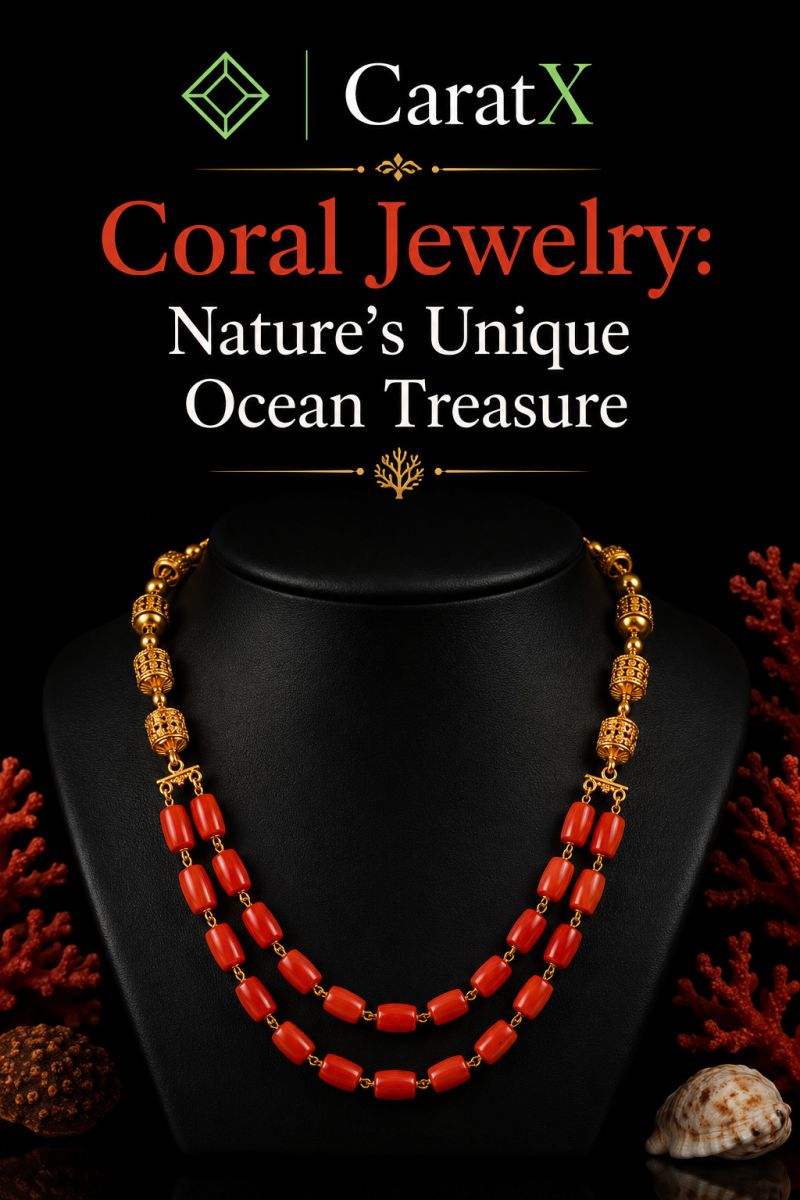
Necklaces: Coral beads and pendants create striking necklaces that range from casual to formal.
Bracelets: Beaded bracelets and cuff designs showcase coral’s warm colors.
Earrings: Studs, drops, and dangle earrings highlight coral’s beauty.
Rings: Coral set in rings makes a bold statement.
Carved Ornaments: Intricate carvings transform coral into works of art.
Cutting and Shaping -
Due to its relative softness and opacity, coral is typically cut en cabochon (in a smooth, domed shape) or used to make beads. Coral can also be carved into intricate shapes, a practice that has been particularly popular in Asia and Europe.
Enhancement Treatments -
Most coral used in jewelry undergoes some form of enhancement to improve its appearance and durability:
Bleaching: White coral is typically bleached to achieve a uniform color.
Waxing: Pink coral is often treated with colorless wax.
Stabilization: Orange coral is stabilized with plastic to improve durability.
Dyeing: Red coral may be dyed to deepen its color.
Bleaching Black Coral: Black coral is frequently bleached to create gold coral.
All these enhancements are generally permanent and will not be affected by normal cleaning or cutting.
Identifying Genuine Coral -
With the value of genuine coral, imitations are common. Common coral imitations include:
Dyed marble.
Red glass
Red plastic
“Gilson coral” (made from calcite powder with dye)
To distinguish genuine coral from imitations, look for:
Concentric lines similar to wood grain, indicating growth patterns
Reaction to acid – genuine coral effervesces (fizzes) when exposed to dilute acid due to its calcium carbonate composition.
Warm feel – genuine coral feels warm compared to cold glass imitations.
Caring for Your Coral Jewelry: Preservation Tips
Understanding Coral’s Vulnerability -
Coral’s beauty comes with a responsibility for careful maintenance. With a Mohs hardness of only 3 to 4, coral is significantly softer than most gemstones and requires special attention.
Coral is:
Easily scratched by harder materials.
Susceptible to heat damage.
Vulnerable to acids found in perfume, sweat, and cosmetics.
Porous and can absorb liquids and chemicals.
Proper Cleaning Methods -
To clean coral jewelry safely:
Wipe gently with a soft, damp cloth.
Avoid harsh chemicals – no chlorine, alcohol, ammonia, or nail polish remover.
Never use ultrasonic cleaners or jewelry dips.
Do not soak coral – a brief rinse in warm, soapy water is acceptable, but soaking can damage the material.
Storage Recommendations -
Proper storage is essential for preserving coral jewelry:
Store separately from other gemstones to prevent scratches.
Use a cloth bag or individual pouch.
Keep in a dry place at room temperature.
Avoid direct sunlight which can cause fading.
Wearing Precautions -
Remove coral rings when washing hands or applying cosmetics.
Apply perfume and lotions before putting on coral jewelry.
Avoid extreme temperatures.
Be mindful during physical activities that could cause impact or abrasion.
The Future of Coral -
The Threat to Coral Populations -
The long history of coral harvesting has taken a significant toll on natural coral populations. The slow growth rate of precious corals often less than 0.5 millimeters per year in diameter means that overharvesting can deplete populations for generations.
The IUCN Red List has classifiedCorallium rubrumas Endangered (EN) in the Mediterranean Sea. Japanese red coral, pink coral, and white coral are listed as Near Threatened (NT) on Japan’s Ministry of the Environment Red List.
The Differentiation of Precious Coral from Reef Coral -
A crucial distinction in conservation efforts is between precious coral (used in fine jewelry) and reef coral. Precious corals grow in deep, cold waters and are less impacted by global warming and ocean acidification. Reef corals, which form the foundation of tropical reef ecosystems, are considerably more threatened by climate change and are not generally used in jewelry.
As the CIBJO Coral Commission has emphasized, precious coral is “not only a heritage to be guarded, but a living industry that should be developed”. The industry has focused on responsible environmental stewardship and sustainable harvesting practices.
At CaratX, we are committed to supporting ethical and sustainable practices in the jewelry industry. Our marketplace connects buyers and sellers while promoting transparency and responsible sourcing.Learn more about our platformand how we are shaping the future of the jewelry trade.
Coral in Culture and Spirituality -
A Universal Talisman
Across cultures and centuries, coral has been revered as more than just a decorative material. Its perceived spiritual and protective properties have made it a universal talisman:
Ancient Egypt: Coral was used in jewelry and believed to have protective qualities.
Greece and Rome: Coral was worn as protection against evil and danger.
India: Coral was believed to possess mystical and medicinal properties.
China: Coral symbolized wealth, longevity, and official promotion.
Tibet: Coral (churu) is considered an auspicious material, particularly potent for women, believed to strengthen the blood and support health.
Christianity: Red coral symbolized the sacred blood of Christ.
Healing Properties and Folk Medicine -
Traditional medicine has long attributed healing properties to coral:
Treatment of intestinal spasms, sleeplessness, and bladder stones.
Purification of blood and counteraction of poison.
Protection against disease.
The ancient Irish used coral to treat scrofula.
Coral in Literature and Art -
Coral’s cultural significance extends into literature and art. In 19th-century Europe and North America, coral was so ubiquitous that it appeared in literature across social classes. Coral jewelry belonged to free Black persons of various classes and to enslaved Black persons.
Today, coral continues to inspire artists and designers. The intricate beauty of coral, combined with its rich cultural history, makes it a material that transcends mere ornamentation to become a statement of heritage, spirituality, and connection to the ocean.
The Coral Jewelry Market Today -
Market Size and Growth -
The global market for coral jewelry continues to show resilience and growth. The global red coral jewelry market was valued at USD 0.75 billion in 2024 and is projected to reach USD 1.08 billion by 2031, growing at a compound annual growth rate of 5.60%.
Factors Driving the Market -
Several factors contribute to the enduring appeal and market value of coral jewelry:
Rarity: The slow growth and declining availability of high-quality coral increase its value.
Cultural Significance: Coral’s deep cultural roots across multiple civilizations ensure continued demand.
Unique Aesthetic: Coral’s organic warmth and distinctive colors cannot be replicated by synthetic materials.
Investment Value: High-quality coral jewelry is increasingly viewed as an investment.
Craftsmanship: The specialized skills required to work with coral add to its value.
Regional Markets -
The coral jewelry market shows distinct regional characteristics:
Mediterranean: Traditional center of coral fishing and manufacturing, with coastal towns in Italy and southern France maintaining centuries-old craft traditions.
Asia: Major market for coral jewelry, particularly in China and Japan, where coral is highly valued culturally.
North America: Significant market for coral jewelry, with strong demand for both contemporary and antique pieces.
Africa: Red coral remains a symbol of identity for certain communities.
The Future of the Coral Jewelry Market -
The future of the coral jewelry market depends on balancing demand with sustainable practices. The industry faces challenges including:
Depleting natural resources.
Regulatory pressures.
Competition from imitations and synthetics.
The need to attract young artisans to continue traditional skills.
However, opportunities exist in:
Innovation in design and craftsmanship.
Growing appreciation for organic and natural materials.
The expanding global market for luxury goods.
For sellers looking to enter or expand in the coral jewelry market,CaratXoffers a global platform to reach buyers across 18+ international countries.
Register as a sellerto start selling your jewelry to a worldwide audience.
AtCaratX, we are proud to be part of this rich tradition, connecting sellers and buyers across 18+ international countries. Whether you are a seller looking toregister and start sellingor a buyer seekingnatural gemstones at unbeatable prices, we invite you to explore the world of fine jewelry through our marketplace.
The story of coral jewelry is far from over, it continues to evolve with each generation of artisans, collectors, and admirers who recognize the unique beauty of this ocean treasure.
Recommended Reads from CaratX -
Expand your knowledge of the jewellery world with these carefully selected articles from our blog. each one complements the themes of coral, organic gems, and timeless adornment:
A Glimpse into Jewelry in Ancient Cultures – Discover how coral, pearls, and other organic materials were treasured by civilisations from Egypt to Rome, and how their symbolic meanings still influence modern design.Read the full article
The Rise of Colored Gemstones: A New Era of Luxury Jewelry – Explore the growing demand for vibrant gemstones, including coral, and understand what makes coloured organic gems stand out in today’s market.Read the full article
The Definitive Guide to H‑FH Gemstone Treatment – Since coral is often treated to enhance its colour and durability, this guide explains the science behind common enhancements a must‑read for any buyer or seller of treated organic gems.Read the full article
Natural Diamond Colour Types – A Complete Guide – Colour is the most important value factor for coral too. This guide helps you appreciate how colour grading works for all gemstones, organic or not.Read the full article
Frequently Asked Questions -
1. Is coral a gemstone or an animal?
Coral is neither fully one nor the other. The coral animal (polyp) creates a calcium carbonate skeleton that becomes the gemstone material. Coral is classified as an organic gemstone a gem material derived from living organisms.
2. Is coral jewelry expensive?
The price of coral jewelry varies widely based on color, quality, size, and origin. Deep red, untreated coral of high quality is the most expensive and can command premium prices. White coral is generally more affordable. The global red coral jewelry market was valued at USD 0.75 billion in 2024.
3. How can I tell if my coral jewelry is real?
Genuine coral displays natural growth lines (fine parallel striations), effervesces (fizzes) when exposed to dilute acid, and feels warm to the touch compared to glass imitations. If you’re unsure, consult a qualified gemologist.
4. Can I wear coral jewelry every day?
While you can wear coral jewelry daily, it requires careful handling. Coral is soft (Mohs hardness 3-4) and can be easily scratched or damaged. Remove coral jewelry when washing hands, applying cosmetics, or engaging in physical activities.
5. How should I clean my coral jewelry?
Clean coral jewelry by wiping it gently with a soft, damp cloth. Avoid harsh chemicals, ultrasonic cleaners, and jewelry dips. Never soak coral jewelry.
6. Is coral harvesting sustainable?
Sustainable harvesting of coral is a complex issue. While some coral species are endangered, the precious coral industry has implemented measures including depth and size limits, bans on destructive harvesting methods, and scientific research to inform management.
7. What does the color of coral mean?
Different coral colors have different cultural associations. Red coral has been associated with protection, vitality, and the sacred blood of Christ. Pink coral (angel skin) is prized for its delicate beauty. White coral symbolizes purity. Black coral offers a dramatic, sophisticated appearance.
8. Can coral jewelry be repaired?
Coral jewelry can be repaired, but due to coral’s softness and porosity, repairs should be performed by experienced jewelers who specialize in organic gemstones. Simple repairs like restringing beads are relatively straightforward.
The Complete Guide to Natural Diamonds – Learn about the 4Cs, diamond formation, and how to select the perfect natural diamond for your needs.Explore natural diamonds at CaratX
How to Start Selling Jewelry Internationally – A comprehensive guide for jewelry sellers looking to expand their business to global markets.Register to start selling
The B2B Jewelry Marketplace: A New Era in Wholesale Trade – Understand how digital marketplaces are transforming the wholesale jewelry industry.
Conclusion:
Coral jewelry represents a unique intersection of nature, art, history, and culture. From the tiny polyp that builds its calcium carbonate skeleton over centuries to the skilled artisan who transforms that material into a work of wearable art, coral jewelry embodies a remarkable journey.
The warm, organic beauty of coral whether deep oxblood red, delicate angel skin pink, pristine white, or rare black continues to captivate jewelry lovers around the world. Its rich cultural history, spanning from prehistoric Europe to ancient Egypt, from classical Rome to imperial China, speaks to something universal in the human appreciation for the ocean’s treasures.
As we look to the future, the coral jewelry industry faces important challenges in balancing tradition with sustainability. The slow growth of coral, combined with centuries of harvesting, demands responsible stewardship.
Scientific research, thoughtful regulation, and industry commitment to sustainable practices are essential to ensure that future generations can continue to appreciate and enjoy this remarkable organic gemstone.