
When you think ofpearls, you probably imagine something timeless, classy, and beautiful. And you’re not wrong. For millennia, pearls have symbolized purity, wisdom, and the ocean’s hidden artistry. But beneath their luminous surface lies a complex world of quality factors that determine why one pearl might be worth a hundred times more than another that looks similar to the untrained eye.
TheGemological Institute of America (GIA)the world’s foremost authority on gemstone grading created something called the 7 Pearl Value Factors™ to help everyone, from jewelers to first-time buyers, understand what makes one pearl worth more than another. This system, developed over 70 years of groundbreaking research on pearls, provides a systematic approach to evaluating a pearl’s various quality factors through consistent methodology and common terminology.
Understanding these seven factors isn’t just for industry professionals, it’s for anyone who lovespearlsand wants to choose something truly special. Pearls aren’t just jewelry. They’re little stories of the ocean, of patience, and of natural beauty.
In this guide, we’ll decode each of the GIA’s 7 Pearl Value Factors, explore what makes exceptional pearls stand out, and show you how to make informed decisions whether you’re buying your first strand or adding to a growing collection.
A Brief History of Pearl Grading -
Before diving into the seven factors, it’s worth understanding how we got here. The idea of devising apearlclassification system similar to GIA’s 4Cs system for diamonds first appeared inGems & Gemologyin 1942. The author suggested that pearls could be grouped into several categories gem quality, extra-fine quality, fine quality, good quality, fair quality, imperfect, and poor quality based on factors including shape, luster, surface blemishes, color distribution, and iridescence.
This approach was significantly refined by GIA’s Richard T. Liddicoat Jr., who in 1967 proposed a new system based on seven pearl value factors. Continued refinement eventually resulted in the development of GIA’s current pearl classification system, launched in 1998. Today, the GIA 7 Pearl Value Factors have been widely adopted throughout the pearl industry for classifying and describing pearls.
The Science Behind Pearl Formation -
To truly appreciate these quality factors, you need to understand how pearls are formed.Pearlsbegin as a biological defense mechanism. When an irritant such as a grain of sand or a parasite enters an oyster, mussel, or mollusk, the creature secretes nacre, crystalline layers of aragonite and conchiolin, to coat the intruder. Over 2 to 7 years, this process creates the luminous gem we cherish.
Natural pearlsoccur when the irritant accidentally enters the mollusk. When humans introduce the irritant, the result is a cultured pearl. Remarkably, only about 1 in 10,000 wild oysters produce natural pearls. Over 99% of modern pearls are cultured.
The nacre formation process plays a critical role in pearl growth, as its structure influences other value factors such as size, shape, luster, and surface quality. Nacre thickness and continuity also affect a pearl’s durability. This is why nacre quality is one of the seven essential factors.
The GIA 7 Pearl Value Factors™ —
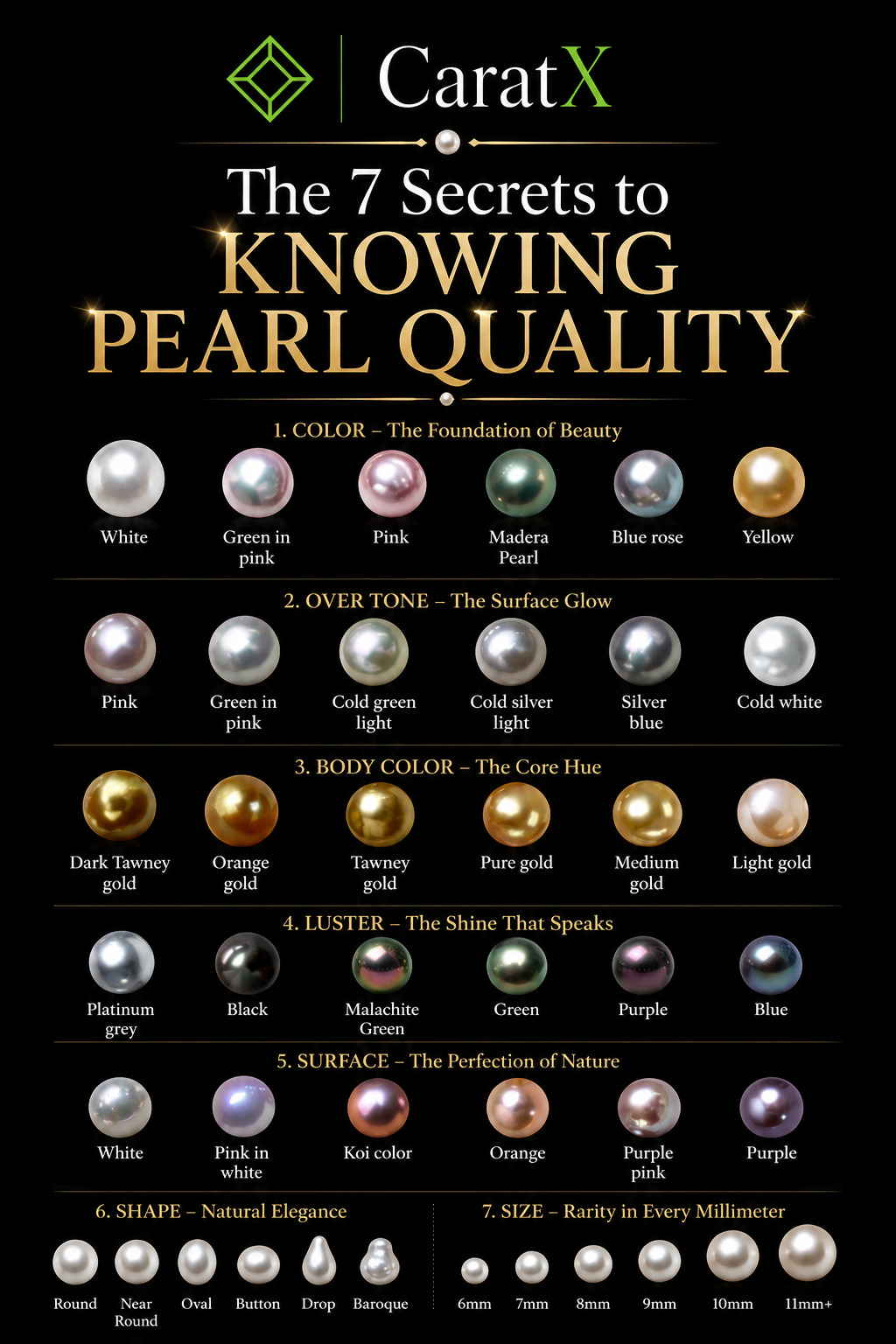
1. Size -
“Bigger is usually better” isn’t just a saying, it’s a fundamental principle of pearl valuation. When other value factors are equal, larger pearls are rarer and more valuable than smaller pearls of the same type.
Pearl size is expressed in terms of diameter measured in millimeters. One millimeter is about 1/25 of an inch. But here’s what makes size so fascinating: each 0.5mm increase in diameter requires approximately 6 to 12 additional months of nacre deposition. This means a 9mm Akoya pearl is relatively common, while a 12mm version is approximately 10 times rarer.
Different pearl varieties come in different size ranges:
Akoya pearls: Typically 2mm to 10mm
Freshwater pearls: 2mm to 15mm
Tahitian pearls: 8mm to 16mm
South Sea pearls: 8mm to 20mm (the largest of all cultured pearls)
For investors and collectors, large pearls have shown appreciation of approximately 5-8% annually. If you’re looking for investment-grade pieces, you can exploreCaratX’s Luxury Pearl Collectionfor exceptional large specimens.
Browse Investment-Grade Pearls on CaratX
2. Shape -
Perfectly round pearls are the classic look everyone wants. And for good reason round is the most difficult shape to culture, making it the rarest cultured pearl shape and generally the most valuable.
GIA categorizes pearls into eight basic shapes:
Round — Perfectly spherical
Semi-round — Almost round, with minor variations
Button — Flattened round
Drop — Teardrop-shaped
Pear — Pear-shaped
Oval — Elongated round
Baroque — Irregularly shaped
Circled — With concentric rings or grooves
The three main categories are spherical, symmetrical, and asymmetrical (which includes semi-baroque and baroque).
But here’s where it gets interesting: well-formed pear, oval, or baroque cultured pearls are also prized by pearl lovers.
Baroque pearls those funky, unique shapes are surging in popularity for their artistic appeal. They’re bold, artsy, and really stand out. The roundness of a pearl depends on how evenly the mollusk secretes nacre around the nucleus.
For a deeper dive into pearl shapes, theUniversity of Gemologyoffers excellent educational resources.
Discover Unique Baroque and Designer Pearl Jewelry on CaratX
3. Color -
Pearls aren’t just white! Natural and cultured pearls occur in a broad range of hues from warm colors like yellow, orange, and pink, to cool hues like blue, green, and violet. Pearl colors tend to be muted, with a soft, subtle quality.
GIA identifies three components of pearl color:
Bodycolor: The pearl’s dominant overall color (e.g., white, cream, pink, gold, black).
Overtone: One or more translucent colors that lie over the bodycolor (e.g., rose, green, blue).
Orient: A shimmer of iridescent rainbow colors on or just below a pearl’s surface.
All pearls display bodycolor, but only some show overtone, orient, or both. Golden South Sea pearls are among the rarest and most valuable. Tahitian pearls are famous for their exotic dark colors, with “peacock” being a particularly prized color range.
The law of supply and demand determines the value of certain pearl colors at any given time. If supplies of high-quality pearls displaying a preferred color are low, their prices can rise to unusually high levels. Fashion trends and cultural traditions can also influence color preferences.
Explore Pearls in Every Color on CaratX
4. Luster -
Of the seven pearl value factors, luster might be the most important. Luster is what gives a natural or cultured pearl its unique beauty. It measures the intensity and sharpness of light reflected from a pearl’s surface.
The better the luster, the sharper and brighter the reflection on the pearl’s surface. Great luster makes a pearl glow like it’s lit from within. GIA defines four categories of luster:
Excellent: Reflections appear bright and sharp.
Very Good: Reflections appear bright and near sharp.
Good: Reflections are bright but not sharp, and slightly hazy around the edges.
Fair: Reflections are weak and blurred.
Poor: Reflections are dim and diffused.
Different pearl varieties have different standards for luster. For instance, Akoya pearls are known for their exceptionally sharp, mirror-like luster, while South Sea pearls have a softer, more satiny sheen.
Luster is closely related to nacre quality, if the nucleus is visible under the nacre, or if the pearl has a dull, chalky appearance, you can assume the nacre is thin. According to GIA research, pearls with Excellent and Very Good lusters demonstrate superior nacre quality.
Shop High-Luster Pearls on CaratX
5. Surface -
Pearls are natural, so they’re not always perfect. Likecolored gemstones, most pearls never achieve perfection. Some might show abrasions that look like a series of scratches on the surface, a flattened section that doesn’t affect its basic shape, or an irregular ridge that looks like a crease or wrinkle.
The fewer bumps, spots, and surface irregularities a pearl has, the higher its quality. Surface characteristics have less effect on the pearl’s beauty and value if they are few in number, or if they are minor enough to be hidden by a drill-hole or mounting.
However, if surface characteristics are numerous or severe, they can affect the durability of the pearl and severely depress its value.
One interesting surface feature is hammering, a hammered metal appearance (or faceted appearance) that exhibits distinct shallow dents or flats. This feature is often seen on baroque pearls and can make luster appear softer than it is due to the dispersion of reflections. This surface feature is commonly associated with very rapid pearl growth.
The GIA evaluates surface quality through visual observation without magnification under suitable lighting conditions, ensuring consistency across all classifications.
Find Clean-Surface Pearls on CaratX
6. Nacre -
Nacre is the layer that forms around the pearl’s core and it’s arguably the foundation upon which all other quality factors depend. Nacre formation plays a critical role during a pearl’s growth, as its structure influences other value factors such as size, shape, luster, and surface quality.
Thicker, high-quality nacre means a pearl that’s stronger and has a deeper, more beautiful glow. Thin nacre appears chalky and chips easily. Luster and nacre quality are closely related if the nucleus is visible under the nacre, or if the pearl has a dull, chalky appearance, you can assume that the nacre is thin. This affects both the luster and the durability of the pearl.
In May 2025, GIA announced an expanded nacre scale for all pearl classification reports. The new nacre scale contains five classification ranges:
- Excellent
- Very Good
- Good
- Fair
- Poor
These classifications are based on the evaluation of structural or textural nacre features found either on the surface or sub-surface levels of the pearls. This update was prompted by trade requests and feedback, establishing a nacre scale more aligned with other quality factors.
For bead-cultured pearls, GIA uses real-time microradiography equipment to measure nacre thickness when the nacre appears thin or when requested by the client. If the thickness of the nacre coating is too thin to sustain normal wear, this fact is always disclosed in the comments of all reports.
Shop Pearls with Exceptional Nacre Quality on CaratX
7. Matching -
Matching is super important when buying a strand or a pair of earrings. You want the pearls to look alike in size, shape, color, and luster so they feel like a perfect set.
Jewelry designers sometimes deliberately mix colors, shapes, and sizes for unique effects, but for most pearl strands, earrings, or other multiple-pearl jewelry, the pearls should match in all the quality factors.
Matching is evaluated across all seven factors:
Size: Pearls should be within a narrow size range.
Shape: Consistent shape throughout the strand.
Color: Matching bodycolor, overtone, and orient.
Luster: Uniform luster across all pearls.
Surface: Consistent surface quality.
Nacre: Matching nacre quality and appearance.
For high-end pearl strands, matching is an art form that requires sorting through thousands of pearls to find those that complement each other perfectly. This is why well-matched strands command premium prices.
Explore Perfectly Matched Pearl Strands on CaratX
Pearl Types and Their Quality Characteristics -
Different types of pearls have different quality characteristics and value ranges:
Akoya Pearls -
Cultured in Japan and China, Akoya pearls are known for their exceptional luster and perfectly round shapes. They typically range from 2mm to 10mm and are available in white, cream, and pink bodycolors with rose or silver overtones.
South Sea Pearls -
Cultured in Australia, Indonesia, and the Philippines, South Sea pearls are the largest of all cultured pearls, reaching up to 20mm. They are known for their satiny luster, thick nacre, and warm golden and white bodycolors. Their uniquely large size, silky luster, and greater nacre thickness make them more attractive and durable.
Tahitian Pearls -
Cultured in French Polynesia, Tahitian pearls are famous for their exotic dark colors from black and gray to green and blue. The “peacock” color range a dark bodycolor with green and pink overtones is particularly prized. They range from 8mm to 16mm.
Freshwater Pearls -
Cultured primarily in China, freshwater pearls offer incredible value. Each mollusk produces dozens of pearls, making them more affordable. They come in a wide range of colors and shapes, though excellent luster is more difficult to achieve with freshwater pearls.
Explore All Pearl Types on CaratX
How GIA Classifies Pearls -
GIA’s pearl classification process is rigorous and standardized. Every GIA laboratory location that provides pearl services uses the same classification system and meticulously matched master sets to produce repeatable results.
The classification process includes:
Identification: Determining whether the pearl is natural or cultured.
Classification: Evaluating the seven value factors.
Documentation: Providing a detailed report with digital images.
The GIA Cultured Pearl Classification Report includes a detailed classification based on the GIA 7 Pearl Value Factors size, shape, color, nacre, luster, surface, and matching. This report is specifically for the three major types of cultured pearls: Akoya, South Sea, and Tahitian pearls.
Practical Tips for Buying Pearls -
1. Prioritize Luster -
Of all the value factors, luster is the most important to a pearl’s beauty. Look for pearls with sharp, bright reflections.
2. Consider Nacre Quality -
Thicker nacre means better durability and deeper luster. If a pearl looks chalky or you can see the nucleus, the nacre is too thin.
3. Check Surface Quality -
Examine pearls under good lighting. A few minor blemishes are acceptable, but numerous or severe surface characteristics can significantly reduce value.
4. Evaluate Matching -
For strands and pairs, ensure the pearls are well-matched in all quality factors. Mismatched pearls can make even expensive pearls look ordinary.
5. Buy from Reputable Sources -
Always purchase from trusted sellers who can provide GIA reports or other certification. CaratX connects buyers with trusted sellers from over 16 countries.
6. Consider Mixing Colors and Types -
While single-color strands are still the most common, mixing pearl colors and types is a fresh way to wear pearls. Multicolor strands often contain rare colors because it’s too difficult to find enough of them to create a whole strand.
Shop Certified Pearls on CaratX
Recommended Reads from CaratX -
The Ultimate Guide to Pearl Quality: Decoding GIA’s 7 Value Factors & Where to Find Exceptional Pearls— A comprehensive deep-dive into pearl quality factors and where to find the best specimens.
A Detailed Guide to the Real Reasons Pearls Come in Different Colors— Understand the science behind pearl coloration and what makes certain colors rare and valuable.
CaratX Marketplace — Shop Natural Diamonds, Gemstones, and Pearls— Explore thousands of certified natural and cultured pearls from trusted sellers across the globe.
Sell Jewelry Internationally with CaratX— Join CaratX’s marketplace to start selling to B2B and B2C buyers in 18+ international countries.
About CaratX -
CaratXis a global B2B and B2C marketplace connecting the diamond, gemstone, jewelry, and pearl industry. We bring thousands of unique jewelry pieces, loose diamonds, gemstones, and pearls from over 16 countries and 200+ artisan sellers. Whether you’re buying your first pearl strand or selling to international buyers, CaratX provides the platform and tools to make it happen.
Start selling to diamonds in 18+ International countries:www.caratx.com/register
Sellers register on CaratX marketplace to start selling to B2B and B2C buyers:www.caratx.com/register
Sell Jewelry Internationally through our CaratX seller plan:https://caratx.com/sell-on-caratx
Shop gemstones from our CaratX marketplace at unbeatable prices:https://caratx.com/search?query=gemstones
Shop natural diamonds:https://caratx.com/search?query=Natural
More details about our Pricing:https://caratx.com/sell-on-caratx
Frequently Asked Questions -
Q1: Why are freshwater pearls so much less expensive than Akoya or South Sea pearls?
A: Freshwater cultured pearls are one of the jewelry world’s biggest bargains. Production is so large that lovely lustrous examples are affordable, particularly in off-round shapes. One reason they are plentiful is that each mollusk produces dozens of pearls, unlike some others which only grow one pearl per shell.
Q2: Why do pearl strands have knots in between each pearl?
A: Knots help prevent you from losing all your pearls if the string breaks. Experts recommend knots in between each pearl to prevent them from rubbing against each other.
Q3: I have a strand of pearls that shows too much string — can it be fixed?
A: Over the years, the string stretches and weakens. Your pearls can easily be restrung. Just ask your local jeweler for restringing services.
Q4: What is the difference between natural and cultured pearls?
A: Natural pearls occur when an irritant accidentally enters a mollusk. Cultured pearls are created when humans intentionally introduce the irritant. Natural pearls are extremely rare — only about 1 in 10,000 wild oysters produce them.
Q5: How can I tell if a pearl has good luster?
A: Look for sharp, bright reflections on the pearl’s surface. Excellent luster pearls reflect light clearly and appear to glow from within. If reflections are dim or blurred, the luster is poor.
Q6: What does “nacre thickness” mean and why does it matter?
A: Nacre thickness refers to the depth of the nacre layer deposited around the pearl’s nucleus. Thicker nacre means better durability and deeper luster. Thin nacre can make a pearl look chalky and can chip easily.
Q7: What are the most valuable pearl colors?
A: Value depends on supply and demand, but golden South Sea pearls and peacock-colored Tahitian pearls are among the rarest and most valuable.