
Gemstoneshave captivated humanity for millennia. Their vibrant colors, natural beauty, and mesmerizing sparkle have made them symbols of wealth, power, and love across cultures and civilizations. But behind every stunning gemstone lies an ancient and precise art: the art of gem cutting.
The way a gemstone is cut its shape, facet arrangement, and finish determines not only its aesthetic appeal but also its value, durability, and the very way it interacts with light.
In this guide, we will explore the most important gemstone cuts, from the mathematically precise Brilliant Cut to the romantic Heart Cut and the ancient Cabochon. Whether you are a collector, a jewelry enthusiast, or a seller looking tosell jewelry internationally, understanding gemstone cuts is essential to appreciating the beauty and craftsmanship behind every piece.
The Science and Art of Gem Cutting -
Gem cutting, or lapidary, is the process of shaping rough gemstone material into polished, faceted gems. The craft dates back thousands of years. Lapidaries originated around 3000 BC during the Bronze Age, when the earliest techniques of sawing, drilling, faceting, and polishing were first developed. These early craftspeople transformed rough stones into breathtaking jewels through techniques that have evolved over centuries.
Today, gem cutters use sophisticated machinery and computer-aided design to optimize light performance, color, and weight retention. Yet the fundamental principles remain the same: a well-cut gemstone should maximize brilliance (the reflection of white light), fire (the dispersion of light into spectral colors), and scintillation (the sparkle seen when the stone moves).
TheGemological Institute of America (GIA)has established the most widely recognizeddiamond cut grading system, which evaluatesround brilliant diamondsbased on seven components: brightness, fire, scintillation, weight ratio, durability, polish, and symmetry. These factors are combined to assign a grade ranging from Excellent to Poor. For coloredgemstones, cut quality is equally important, though grading standards vary more widely due to the diversity of materials and cutting styles.
The Four Main Cutting Styles -
According to the International Gem Society, there are four main cutting styles that form the foundation of modern gem cutting: Brilliant, Step, Mixed, and Fantasy cuts.
Brilliant Cut:
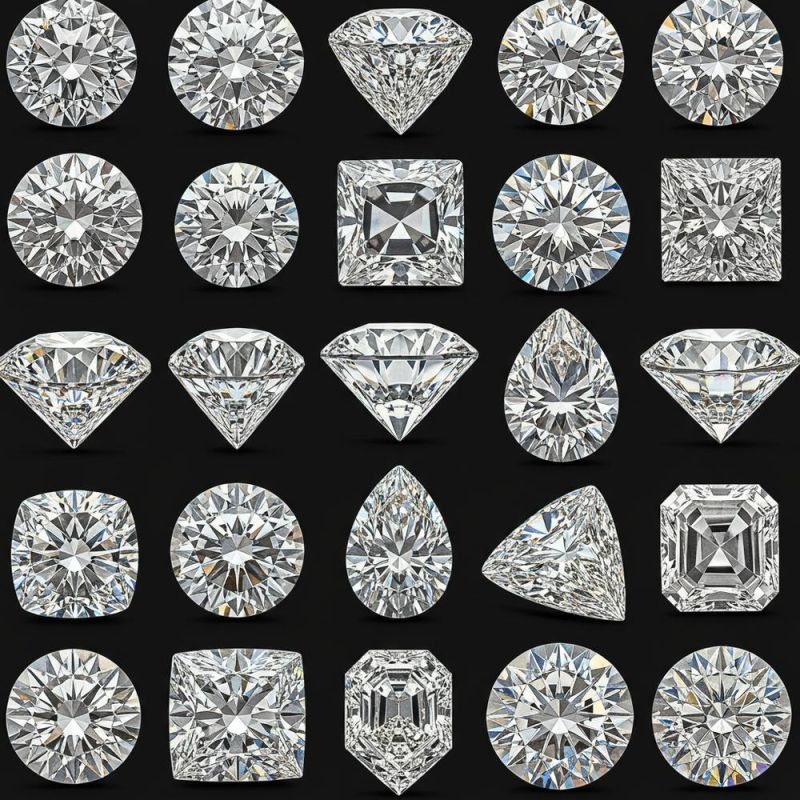
Thebrilliant cutrepresents the pinnacle of light optimization in gemstone cutting. This style uses triangular and kite-shaped facets that spread outward from the center like rays of light, creating maximum brilliance, fire, and scintillation.
The standardround brillianthas exactly 58 facets 33 on the crown (top) and 25 on the pavilion (bottom). The mathematical precision of this cut ensures that almost all light entering the stone bounces back through the top, creating the dazzling sparkle thatdiamondsare famous for.
Roughly 9 out of every 10 stones cut today use the brilliant style. For diamonds specifically,round brilliant cutsalone account for about 75% of all sales. The brilliant cutting style isn't limited to round stones, it works beautifully on various shapes includingoval,pear,marquise, and theprincess cut, which was invented in 1980 and quickly became the second most popular diamond cut.
The GIA'sdiamond cut grading systemapplies specifically to the standardround brilliant diamond, evaluating brightness, fire, scintillation, weight ratio, durability, polish, and symmetry.
Step Cut:
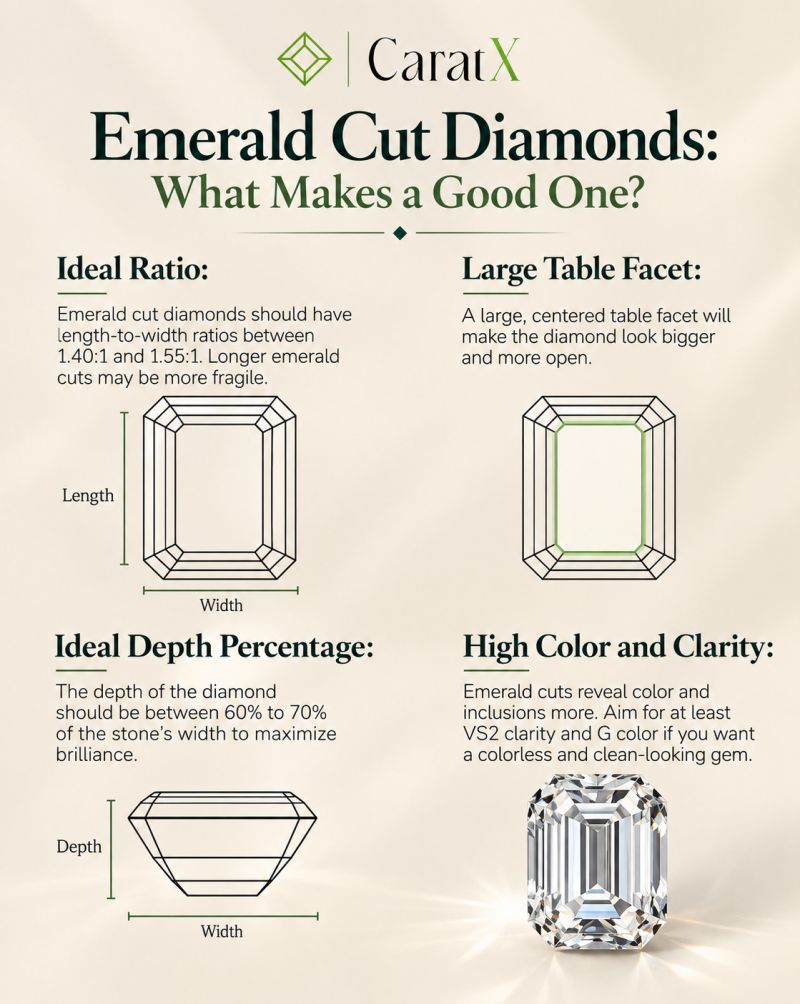
Step cutstake a completely different approach to gem cutting. Instead of maximizing sparkle, they create sophisticated "hall-of-mirrors" effects. These cuts feature rectangular facets arranged in parallel rows that resemble a staircase hence the name "step cut".
Theemerald cutis the most famous step cut, with 58 facets arranged in three distinct sections. While it shows less fire than brilliant cuts, it offers something equally valuable: a window into the stone's interior. This makes clarity extremely important in step-cut gems, as inclusions become more visible. Step cuts are usually reserved for clear gemstone rough with outstanding color.
The emerald cut dates back to the 1500s, when stonecutters discovered that "stepped" facets gave the soft and brittle emerald more stability. The term "emerald cut" wasn't used until the 1920s during the Art Deco period. Developed by Joseph Asscher in 1902, the Asscher cut is a square version of the emerald cut with cut corners.
Mixed Cut:
Mixed cuts combine a brilliant-cut crown with a step-cut pavilion, or vice versa. This approach offers significant advantages: the brilliant crown maximizes sparkle and obscures minor clarity issues, while the step-cut pavilion allows for better weight retention and color saturation.
Fantasy Cuts:
Fantasy cutsbreak all the traditional rules of gem cutting. These innovative designs, pioneered by master cutters like Bernd Munsteiner in the 1970s, feature concave facets, unusual geometries, and artistic expressions that transform gemstones into wearable works of art.
Detailed Guide to Popular Gemstone Cuts -
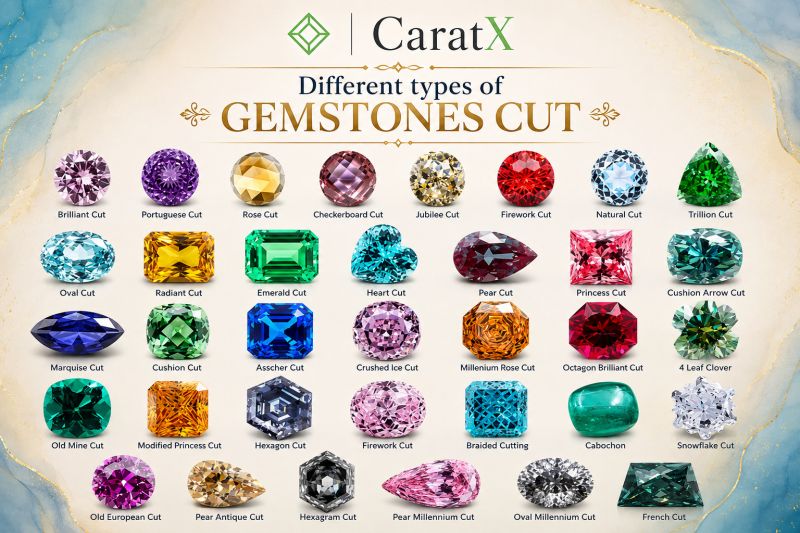
Brilliant Cut -
TheBrilliant Cutuses numerous facets arranged in a specific geometric pattern to create exceptional sparkle and brilliance. It is the most popular cut fordiamondsand works well for manycolored gemstones. The round brilliant is the most common, but the brilliant style also appears in oval, pear, marquise, princess, and cushion shapes.
Best for: Diamonds and gemstones with high refractive index
When buying a round brilliant diamond, look for a GIA cut grade of Excellent or Very Good to ensure optimal light performance.Shop natural diamondswith certified cut grades at CaratX.
Rose Cut -
TheRose Cutis a historic cutting style that dates back to the 16th century. It features a flat bottom and a faceted, dome-shaped top with radiating triangular facets that come to a point. Therose cutwas the most prominent cutting style in Europe during the 16th and 17th centuries, alongside the brilliant cut.
This cut creates a soft, vintage appearance with a subtle shimmer rather than the intense sparkle of a brilliant cut. Today, rose cuts are experiencing a revival inantique-style jewelry.
Best for: Vintage-inspired jewelry, colored gemstones.
Historical note: The Cheapside Hoard, discovered in London in 1912, contains numerous examples of rose-cut colored stones from the 17th century.
Portuguese Cut -
ThePortuguese Cutfeatures multiple layers of facets typically two or three rows on both the crown and pavilion that create exceptional sparkle and depth. This cut is characterized by its intricate facet pattern that gives the gemstone a distinctive, multi-dimensional appearance.
A notable example is thePortuguese Diamond, a 127.01-carat Asscher-cut diamond in the National Gem Collection at the Smithsonian Institution. While the Portuguese Cut is named for its association with Portuguese jewelry traditions, the famousPortuguese Diamonditself has no actual connection to the country.
Best for: Larger gemstones where the intricate facet pattern can be fully appreciated
Checkerboard Cut -
The Checkerboard Cut uses a pattern of square-like facets arranged in alternating directions, creating a unique reflective effect reminiscent of a checkerboard. This cut is often used for colored gemstones likecitrine,amethyst, and rock crystal.
The checkerboard pattern creates an interesting interplay of light and shadow, making it a popular choice for statement jewelry pieces.
Best for: Colored gemstones, cocktail rings, artistic jewelry.
Trillion Cut -
TheTrillion Cut(also spelled Trilliant) is a three-sided triangular cut that looks modern and elegant. The trillion was first designed in Amsterdam by Leon Finker in 1978 as a triangular version of the square-shaped radiant cut.
Trillion-cutgemstones feature brilliant-style facets that maximize sparkle within the triangular shape. They are often used as side stones in three-stone rings or as the center stone in contemporary designs.
Best for: Modern jewelry designs, three-stone rings, accent stones
Shopping tip: Explore gemstonesin various cuts including trillion at CaratX's marketplace.
Emerald Cut -
TheEmerald Cutis renowned for its long, step-like facets and clean, sophisticated appearance. Originally developed in the 1500s to cut emeralds without damaging the brittle stone, this cut features a rectangular shape with cut corners.
Theemerald cut'sparallel facets create a "hall-of-mirrors" effect that showcases the gemstone's clarity and color. While it shows less fire than brilliant cuts, it offers an elegant, understated beauty that has made it a favorite forengagement ringsandfine jewelry.
The emerald cut gained particular popularity during the Art Deco movement of the 1920s and 1930s, when geometric designs were in vogue.
Best for: Diamonds, emeralds, and gemstones with excellent clarity.
Shopping tip: Browsenatural diamondsin emerald and other cuts at CaratX.
Heart Cut -
TheHeart Cutis the ultimate romantic shape, often used inringsandpendants. This fancy cut features two rounded lobes separated by a cleft at the top and a point at the bottom.
Technically a modified brilliant cut, the heart shape typically has 59 facets and requires exceptional skill to execute symmetrically. The heart cut carries meaning that no other shape can claim as directly, it is the universal symbol of love rendered in the world's most enduring material.
Best for: Engagement rings, anniversary gifts, sentimental jewelry.
Symbolism: The heart shape has been associated with love and romance since ancient times.
Cabochon Cut -
The Cabochon Cut is the oldest and simplest gemstone cut, featuring a smooth, rounded surface without facets. Derived from the French word "caboche," this cut refers to a shape that has a highly polished curved face.
The cabochon is not really "cut" but rather ground and polished using diamond grit or paste. This ancient technique has been used since prehistoric times to reveal the true beauty of rough stones.
Cabochons are commonly used for opaque or translucent gemstones that exhibit special optical phenomena:
Asterism (star effect) in star sapphires and star rubies.
Iridescence in opals.
Adularescence in moonstones.
Chatoyancy (cat's eye effect) in tiger's eye.
The cabochon allows these gemstones to display their natural beauty without the artificial enhancement of faceting. As lapidarists often say, they "finish what Nature forgot" but in the case of cabochons, perfection has already been achieved.
Best for: Star sapphires, rubies, opals, moonstones, turquoise, and other gemstones with special optical effects.
Choosing the Right Gemstone Cut -
Selecting the right cut for a gemstone depends on several factors:
1. The Gemstone's Properties -
Refractive index: High-RI stones like diamonds benefit from brilliant cuts that maximize light return.
Color saturation: Step cuts like the emerald cut showcase color beautifully.
Clarity: Brilliant cuts can hide inclusions; step cuts reveal them.
Durability: Softer stones like emeralds benefit from the protective step cut.
2. The Desired Aesthetic -
Maximum sparkle: Choose a brilliant cut.
Elegant sophistication: Choose a step cut like the emerald or Asscher.
Vintage romance: Choose a rose cut or cabochon.
Modern statement: Choose a trillion or checkerboard cut.
Romantic sentiment: Choose a heart cut.
3. Practical Considerations -
Weight retention: Some cuts waste more rough material than others.
Durability: Sharp corners (like in princess cuts) can be prone to chipping.
Setting options: Some cuts work better with certain jewelry settings.
Your Gateway to the Global Gemstone Market -
AtCaratX, we connect the diamond, gemstone, jewelry, andpearlindustry on a premier B2B and B2C marketplace. We bring thousands of unique jewelry pieces, loose diamonds, gemstones, and pearls from over 16 countries and 200+ artisan sellers.
For Buyers -
Shop natural diamondsfrom certified sources.
Explore gemstonesin every cut imaginable at competitive prices.
Shop jewelryfrom artisan sellers worldwide.
For Sellers -
Register as a sellerto access buyers in 18+ international countries.
Sell jewelry internationallythrough our specialized marketplace.
List your certified diamondsand reach a global audience.
CaratX is the exclusive marketplace where your products won't get lost among electronics or clothing this is a specialized platform where serious buyers shop for jewelry.
Recommended Reads from CaratX -
The 2026 Fancy Shape Diamond Market Revolution: Global Shifts Are Redefining the 2‑Carat+ LandscapeAn in-depth analysis of the shifting fancy-shaped diamond market. Discover why elongated shapes (oval, marquise, and emerald cut) are outperforming rounds in the 2-carat-plus segment.Read Full Article
Beyond Diamonds: Unveiling the 9 Gemstones Rarer Than Diamonds and Why They Command FortuneExplore nine gems that are even rarer than diamonds, including Painite (once the world's rarest mineral) and the color-changing alexandrite. A must-read for serious collectors and investors.Read Full Article
The United States: A Treasure Trove of Gemstones – A Complete Guide to Mining, History, and BuyingA comprehensive guide to America's rich gemstone heritage. From the rivers of Montana to the deserts of Arizona, discover over 50 commercially viable gem species and minerals found across the U.S.Read Full Article
The Guide to the Anatomy of an Oval Diamond: Cut, Clarity, and Carat InsightsA deep dive into the anatomy of the oval diamond. Learn how the table, crown, girdle, pavilion, and other key components affect brilliance, fire, and overall light performance in this increasingly popular shape.Read Full Article
The Most Sold Diamond Jewelry in the World: A Market Analysis for 2026A data-driven market analysis for 2026. Discover how engagement rings dominate 70–80% of diamond jewelry sales and explore regional consumer preference differences across global markets.Read Full Article
Frequently Asked Questions -
What is the most popular gemstone cut?
The round brilliant cut is the most popular gemstone cut, accounting for approximately 75% of all diamond sales.
What is the difference between a gemstone's shape and its cut?
Shape refers to the outline of the gemstone (round, oval, square, etc.), while cut refers to the arrangement of facets and the quality of craftsmanship. A round brilliant and a round emerald cut have the same shape but different facet arrangements.
Which cut makes a diamond look the biggest?
Shallow cuts or cuts with larger surface areas relative to their depth (like the emerald cut or oval cut) can make a diamond appear larger for its carat weight.
What is the oldest gemstone cut?
The cabochon cut is the oldest gemstone cut, dating back to prehistoric times.
Why are some gemstones cut as cabochons instead of faceted?
Gemstones that exhibit special optical phenomena like asterism (star effect), chatoyancy (cat's eye effect), or iridescence are typically cut as cabochons to showcase these natural features.
What is the best cut for an engagement ring?
The best cut depends on personal style. Round brilliants offer maximum sparkle, emerald cuts offer timeless elegance, and heart cuts offer romantic symbolism. Princess cuts and cushion cuts are also popular choices.
Does GIA grade cuts for all diamond shapes?
Currently, GIA only provides cut grades for standard round brilliant diamonds. However, they do provide detailed reports for fancy shapes that include information on proportions and finish.