
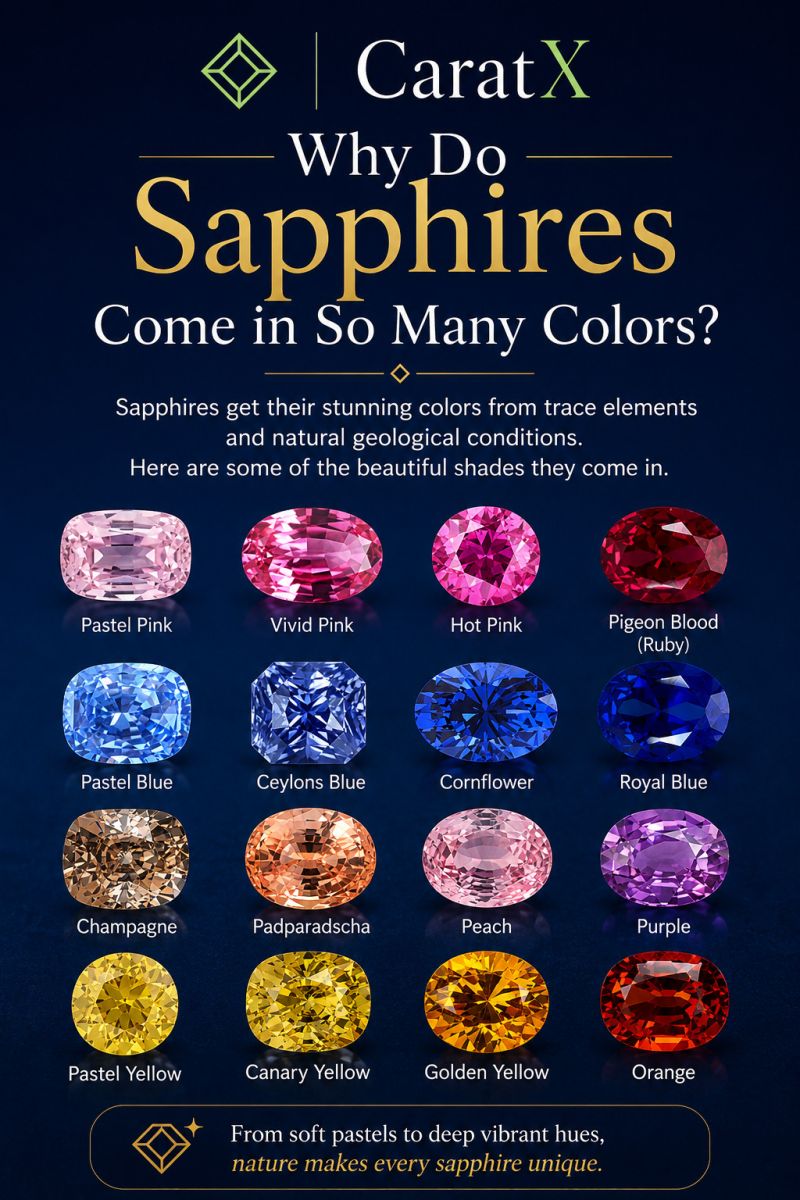
When most people hear the word “sapphire,” they immediately picture a deep, velvety bluegemstone, the kind that has adorned royalty for centuries and famously graced theengagement ringof Princess Diana. But here’s a secret that surprises even many jewelry enthusiasts: sapphires come in virtually every color of the rainbow.
From sunny yellow to passionate pink, from vibrant green to the rare and coveted peach-orange of padparadscha,sapphiresoffer a natural color palette that rivals any gemstone family. But what causes this extraordinary diversity? Why does the same mineral produce such dramatically different colors?
The answer lies deep within the atomic structure of the gemstone itself, a fascinating story of trace elements, crystal chemistry, and the incredible forces that shape our planet.
The Foundation:
To understand whysapphirescome in so many colors, we must first understand what a sapphire actually is.Sapphireis a variety of the mineral corundum, which in its pure state is composed of crystallized aluminum oxide (Al₂O₃). In this pure form, corundum is completely colorless.
Pure corundum doesn’t absorb any light from the far ultraviolet to the mid-infrared range. It has an excellent transmission window that can achieve good transparency between approximately 0.18 and 5 µm. Neither the aluminum ions (Al³⁺) nor the oxygen ions (O²⁻) arrayed in the corundum lattice structure absorb light in the visible region of the spectrum.
So where does all that color come from? Impurities.
When trace amounts of other elements replace some of the aluminum atoms in the corundum crystal lattice during the gemstone’s formation, they alter its optical properties and produce color. These impurities often just a few hundredths of a percent of the gemstone’s total composition are responsible for the entire rainbow of sapphire colors.
As theGemological Institute of America (GIA)explains, “Most corundum contains color-causing trace elements”. The specific elements present, their concentrations, and their chemical interactions determine the final color we see.
The Science of Color: How Trace Elements Create Color
The color of asapphireis determined by trace amounts of elements substituting for Al³⁺ in the corundum crystal lattice. These impurity ions interact with light through several mechanisms:
Intervalence Charge Transfer (IVCT) – Electrons are transferred between ions of different elements, absorbing specific wavelengths of light.
Crystal Field Transitions – Electrons in the impurity ions absorb light and jump to higher energy levels.
Color Centers – Structural defects in the crystal lattice trap electrons and absorb light.
The most important mechanism for blue sapphires is intervalence charge transfer, where an electron transfers between Fe²⁺ and Ti⁴⁺ ions. This process absorbs specific wavelengths of light, leaving the complementary color visible to our eyes.
The Colors of Sapphire: A Complete Breakdown
Blue Sapphire –
Blue is the color most people associate withsapphires, and for good reason, it’s the classic. The blue color of sapphire is primarily caused by the presence of both iron (Fe) and titanium (Ti) in the corundum crystal lattice.
The mechanism is a charge transfer between Fe²⁺ and Ti⁴⁺ ions. When light hits the gemstone, an electron transfers from the iron ion to the titanium ion, absorbing light in the red and yellow parts of the spectrum. What remains is the beautiful blue we see.
The more iron the corundum contains, the darker the blue. Only a few hundredths of a percent of iron and titanium can cause the color. The exact shade of blue from light cornflower to deep royal blue depends on the precise concentrations and ratios of these elements.
Interestingly, recent research by GIA has revealed that silicon also plays a crucial role in the coloration of blue sapphires. Detailed analyses of sapphire from Montana’s Yogo Gulch deposit show that without silicon, Yogo sapphire would not be blue. Silicon enables the pairing of titanium with iron, creating the blue coloration.
The blue color is commonly related to the Fe²⁺-Ti⁴⁺ intervalence charge transfer, andblue sapphirestypically show a strong absorption band at around 580 nm.
Yellow Sapphire –
Yellowsapphiresget their sunny color primarily from iron (Fe) , specifically Fe³⁺ ions replacing Al³⁺ in the corundum structure. The yellow color in natural yellow sapphires is confirmed to be caused by Fe³⁺ impurity.
Yellow sapphire usually owes its color to O⁻ ions (hole centers) alone or interacting with Fe³⁺. The concentration of iron and the specific oxidation state of the iron ions determine the intensity and shade of yellow.
Yellow sapphires have become extremely popular as an alternative September birthstone, offering a brilliant, sunny disposition at a generally more accessible price point than their blue counterparts.
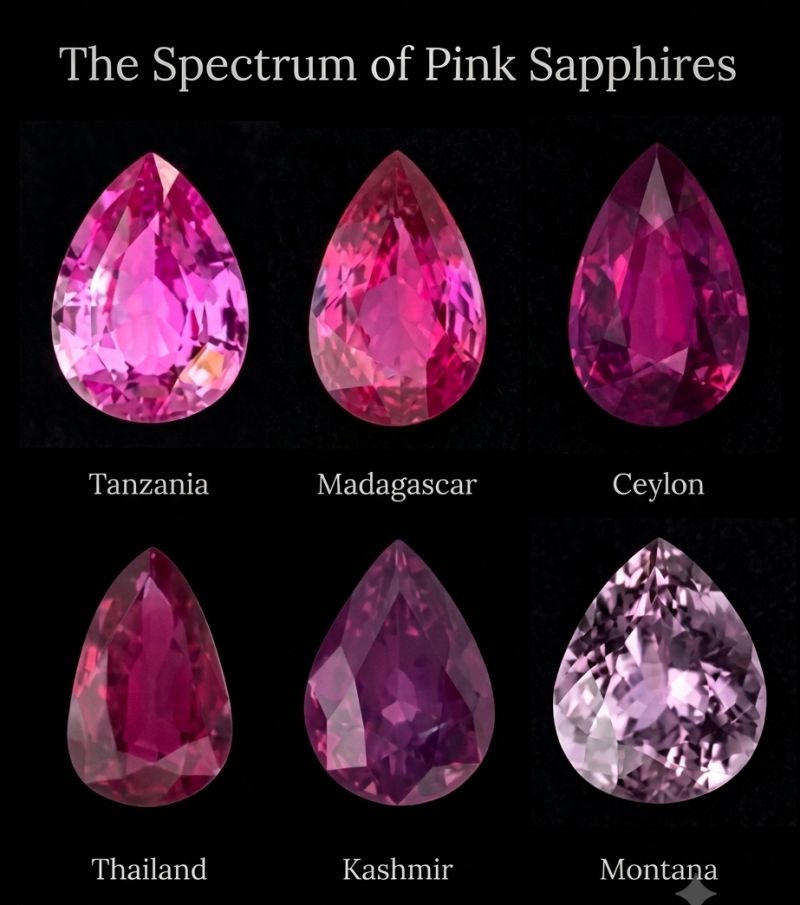
Pink Sapphire –
Pink sapphiresget their delicate rosy color from chromium (Cr) , specifically Cr³⁺ ions. The same element that colorsrubiesred causes pink sapphires to blush, it’s simply a matter of concentration.
Rubies contain more chromium (roughly 0.5%) than pink sapphires (roughly 0.05%). The addition of trivalent chromium colors a corundum gem pink or red, we call itpink sapphireif it’s pink, and ruby if it’s red.
The higher the chromium concentration, the stronger the pink. Fine-quality, unheated pink sapphires are becoming increasingly scarce in the market.
Green Sapphire –
Greensapphiresget their color from a combination of iron and other elements. Green sapphires contain a mixture of blue and green colors.
The green color typically arises from Fe²⁺/Fe³⁺ charge transfer. The specific combination of iron in different oxidation states, along with other trace elements, creates the sophisticated green hues ranging from “mint” to “forest”.
Greensapphiresoffer an earthy, sophisticated alternative to emeralds but with superior durability sapphire ranks 9 on the Mohs hardness scale, compared to emerald’s 7.5-8.
Orange & Padparadscha Sapphire –
Orangesapphires, and especially the legendary padparadscha sapphires, represent some of the most fascinating color chemistry in the gem world.
Padparadschasapphiresare a rare and valuable pinkish-orange to orangey-pink color. The name comes from the Sinhalese word for “lotus flower”.
The color of padparadscha sapphires is due to the combination of Cr³⁺ (producing the pink hue) and Fe³⁺ (producing the yellow hue). The great color variability of untreated and treated samples is due to the large variation of iron and chromium contents, as well as the concentration of color centers.
As the American Gem Society explains, padparadschasapphiresare corundum with trace elements of chromium and iron added chromium is also the element that gives rubies their red hue.
These are the rarest form of sapphire corundum, making them among the most sought-after and valuable colored gemstones in the world.
Purple Sapphire –
Purplesapphires show beautiful violet shades due to combinations of chromium, iron, and vanadium. The specific interactions between these elements create the purple hue.
The purple color can be produced by Cr³⁺ in combination with Fe²⁺-Ti⁴⁺ charge transfer. The exact shade depends on the concentrations and ratios of these various chromophores.
Color-Change Sapphire –
Somesapphiresexhibit a fascinating phenomenon called color change, they appear one color in daylight or fluorescent lighting and a different color under incandescent light.
The most common color change insapphiresis from blue in daylight to purple under incandescent light. This effect is caused by trace elements Cr³⁺ and V³⁺.
The color-change effect occurs because different light sources have different spectral compositions, daylight has more blue wavelengths, while incandescent light has more red and yellow wavelengths. The sapphire’s absorption spectrum interacts differently with these different light sources, resulting in different perceived colors.
White (Colorless) Sapphire –
When corundum forms with no significant trace elements to cause color, it remains colorless, known as white sapphire.
Colorless corundum is actually quite rare in nature. Colorlesssapphireswere once popular diamond imitations and have staged a comeback as accent stones in recent years.
Like allsapphires, white sapphire ranks 9 on the Mohs scale, making it extremely resistant to scratches and daily wear.
The Role of Formation Conditions -
The color of a sapphire isn’t determined solely by which elements are present how and where the sapphire formed also matters significantly.
Sapphiresform in two main types of geological environments:
Basaltic Sapphires -
These form in basaltic rocks and typically have high iron and titanium concentrations, and low chromium. They tend to produce blue and yellow sapphires. Basaltic sapphires have high Fe, Ti, and Ga concentrations with no or low V and Cr.
Metamorphic Sapphires -
These form in metamorphic rocks and typically have low iron and gallium values and higher chromium concentrations. They tend to produce pink, purple, andpadparadscha sapphires.
The oxidation state of the environment during formation also affects color. Dark blue sapphires crystallize under strong reducing conditions. Heat treatment can alter these oxidation states and change the color.
Heat Treatment and Color Enhancement -
Manysapphireson the market today have been heat-treated to enhance or change their color. Heat treatment is an ancient practice that has been used for thousands of years to improve the appearance of gemstones.
Heat treatment can:
Lighten overly dark stones.
Deepen pale stones.
Remove undesirable brown or gray tones.
Create new colors entirely.
For example, the heat treatment of near-colorless “geuda” sapphires produces blue stones because naturally occurring inclusions of rutile and spinel in the corundum dissolve at high temperatures. Under oxidizing conditions, heat treatment can change the oxidation state of iron and titanium ions, affecting the color.
However, some color changes can be unstable. Yellow and padparadscha sapphires can sometimes fade when exposed to light and/or heat due to unstable color centers.
Why Sapphires Are So Special -
Beyond their incredible color diversity, sapphires possess qualities that make them truly exceptional gemstones:
Exceptional Durability -
Sapphireranks 9 on the Mohs hardness scale, making it the second hardest natural substance known to science, just one point below diamond. This durability makes sapphires perfect for all types of jewelry, including engagement rings that are worn daily.
Natural Rarity -
High-quality Kashmir and Ceylon sapphires are rarer than most large D-color diamonds. Untreated, natural sapphires are becoming increasingly scarce.
Historical Significance -
The name “sapphire” is derived from the Greek word “sappheiros” and the Hebrew word “sappir,” meaning “blue stone”. Sapphires have been associated with royalty, romance, and religion for over two millennia.
Conclusion:
The extraordinary color diversity ofsapphiresis a testament to the incredible complexity of nature. What begins as pure, colorless corundum transforms into a rainbow of gemstones through the subtle addition of trace elements iron, titanium, chromium, vanadium and the intricate chemical interactions between them.
Whether you’re drawn to the classic blue of a Ceylonsapphire, the sunny warmth of a yellow sapphire, the passionate pink of a chromium-rich stone, or the rare and coveted peach of a padparadscha, there’s a sapphire color for every taste and style.
And the science behind these colors? It’s a beautiful reminder that even the smallest impurities just a few hundredths of a percent can create the most breathtaking beauty.
Frequently Asked Questions -
Q1: What makes a sapphire blue?
A: Blue sapphires get their color from iron and titanium impurities. The color is caused by a charge transfer between Fe²⁺ and Ti⁴⁺ ions in the corundum crystal lattice.
Q2: Are rubies and sapphires the same mineral?
A: Yes! Both rubies and sapphires are varieties of the mineral corundum (Al₂O₃). Ruby is simply red corundum, colored by chromium. All other colors of corundum are called sapphire.
Q3: What causes pink sapphires?
A: Pink sapphires are colored by chromium (Cr³⁺). The same element colors rubies red pink sapphires simply contain less chromium (about 0.05%) than rubies (about 0.5%).
Q4: What is the rarest sapphire color?
A: Padparadscha sapphires, the pinkish-orange to orangey-pink variety are considered the rarest and most valuable sapphires.
Q5: Can sapphires change color?
A: Yes! Some sapphires exhibit a color-change phenomenon, most commonly going from blue in daylight to purple under incandescent light.
Q6: Does heat treatment affect sapphire color?
A: Yes. Heat treatment can lighten, darken, or completely change sapphire colors. It’s a common and accepted practice in the gem industry.
Q7: Why are some sapphires yellow?
A: Yellow sapphires get their color primarily from iron (Fe³⁺) impurities.
Q8: What makes a sapphire green?
A: Green sapphires are colored by a combination of iron in different oxidation states (Fe²⁺/Fe³⁺ charge transfer).
Shop Gemstones at CaratX– Browse our marketplace for natural sapphires and other fine gemstones at unbeatable prices.
Shop Natural Diamonds– Explore our collection of certified natural diamonds.
Sell Jewelry Internationally– Join CaratX and start selling to buyers in 18+ international countries.
Sapphire Search– Find the perfect sapphire for your collection.
Follow CaratXfor more insightful and educational content about gemstones, jewelry, and the global diamond trade.
Recommended Reads from CaratX -
Fancy Sapphires: The Colorful Side of the Sapphire World– Explore the full spectrum of fancy sapphire colors, from yellow to padparadscha, and discover what makes each hue unique.
Not All Blues Are the Same: A Deep Dive into Sapphire, Spinel, Diamond & Tanzanite– Understand the subtle differences between blue gemstones and what makes sapphire special.
The World's Top 10 Most Popular Gemstones: A Complete Guide to Their History and Beauty– Discover where sapphires rank among the world’s most beloved gemstones.
The 31‑Hue Wheel: The Ultimate Guide to Gemstone Colour Grading– Learn how gemstones like sapphire are professionally graded and evaluated using the 31-hue color reference system.
Beyond the Hue: A Connoisseur's Dive into Why Colour is Everything in Gemstones, But Not the Only Thing– Dive deeper into what makes color the most important factor in gemstone value.