
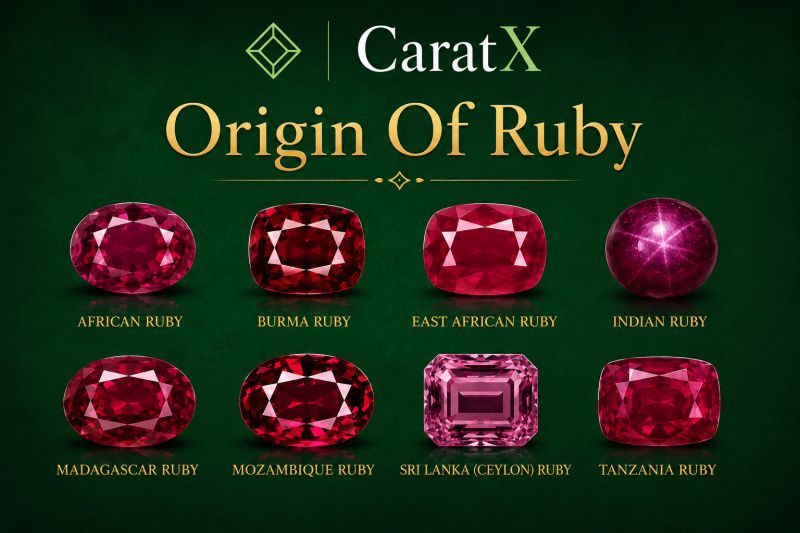
Fewgemstonescapture the imagination quite like the ruby. As the red variety of the mineral corundum,rubyhas been treasured for millennia as one of the most valuable gemstones on Earth second only to diamond in hardness and unmatched in its fiery red brilliance. But not allrubiesare created equal. Where a ruby is mined profoundly influences its color, clarity, inclusions, and overall beauty.
This guide explores how origin shapes a ruby's character, taking you on a journey from the legendary mines of Myanmar to the modern discoveries in Mozambique and beyond.
The Science Behind Ruby's Color -
Before examining specific origins, it's essential to understand what gives ruby its mesmerizing red color.Rubyis composed of corundum (aluminum oxide) in its purest form. The vibrant red hue comes from trace amounts of chromium that become part of the mineral's crystal structure. The strength of a ruby's red depends on how much chromium is present, the more chromium, the stronger the red color.
Chromium can also cause fluorescence, which adds to the intensity of the red color. This fluorescence is particularly pronounced in marble-hosted rubies, which typically have low iron content. Iron can suppress fluorescence, makingrubiesappear darker and less intensely red. This scientific distinction is the foundation for understanding why rubies from different origins exhibit such varied appearances.
According to theGemological Institute of America (GIA), the finest rubies have a pure, vibrant red to slightly purplish red color, with vivid color saturation that is not too dark. The purest, most intenserubycolor has historically been called "pigeon's blood".
Major Ruby Origins:
Myanmar (Burma) –
For centuries, the Mogok Stone Tract in Myanmar (formerly Burma) has been the world's premier source of fine rubies. The mines in this region have been producing rubies since at least the 6th century, with reports of these gems dating back to the Shan Dynasty. Even Marco Polo made note of these remarkable stones during his travels.
What Makes Burmese Rubies Special:
Burmese rubies are famous for their rich, intense red color with a soft, glowing appearance. This is largely due to their marble-hosted geological origin. Marble has low iron content, sorubiesthat form in marble lack iron, allowing their red fluorescence to shine through. The result is a vivid, slightly purplish red with strong saturation the classic "pigeon's blood" color.
Under ultraviolet light (including sunlight), Burmese rubies fluoresce a strong red, adding an extra glow that makes them highly prized. Common inclusions in Burmese rubies include fine rutile "silk" needles, calcite crystals, and banded particulate clouds.
Why They're So Valuable: Fine untreated Burmese rubies of good size rank among the most expensive gemstones on Earth. Their historical significance, combined with their exceptional color and fluorescence, makes them the gold standard by which all other rubies are measured.
Mozambique –
While Mozambique has producedrubiessince the Portuguese colonial period (1498-1975), it didn't emerge as a major player in the global ruby market until the early 21st century. The 2009 discovery of the Montepuez ruby deposit in the northern province of Cabo Delgado marked a turning point.
Today, the Montepuez mine is recognized as one of the world's largest and most productive ruby mines, producing approximately 10 million carats of rubies in 2022 alone.
What Makes Mozambique Rubies Special:
Mozambiquerubiesbridge the gap between the classic sources of Burma (highly fluorescent, low iron) and Thailand/Cambodia (weakly fluorescent, high iron). Their iron content ranges from nearly as low as Burmese marble-type rubies to as high as rubies from basalt-related deposits.
The finest Mozambique rubies are characterized by an intense, pure red color comparable to Burmese ruby. They are also known for their exceptional clarity, often requiring minimal enhancement. The material from the Maninge Nice area displays purplish red to red colors with even coloration, high transparency, and good luster.
Common Inclusions: Mozambique rubies typically show three distinctive types of solid crystals: transparent greenish amphibole crystals with stubby to elongated shapes, and pseudohexagonal frosty mica crystals.
Sri Lanka –
Sri Lanka, formerly Ceylon, remains one of the single most important sources for fine gemstones.Rubymining in Sri Lanka goes back more than 2,500 years. The island is nicknamed "Ratnadeepa," meaning "Island of Gems".
What Makes Sri Lankan Rubies Special:
Sri Lankanrubiesare typically lighter in color, ranging from pinkish-red to medium red. Many stones that would be considered rubies in Sri Lanka are classified as pink sapphires by American standards. The color is never as saturated as that of Burmese ruby in fact, ruby from Sri Lanka tends to be pink rather than red.
However, what Sri Lankan rubies lack in intensity, they make up for in clarity. These stones often have excellent transparency and are prized for their clean appearance. Characteristic inclusions include rutile needles, graphite, ilmenite, apatite, and zircon crystals with surrounding radioactive damage halos.
Star Rubies: Sri Lanka is one of the best sources of alluvial "star" rubies cabochon-cut stones that display a six-rayed star effect due to oriented rutile needle inclusions.
Vietnam –
Since 1983, gem-qualityrubieshave been recovered from the Luc Yen and Quy Chau mining areas in northern Vietnam. Literally millions of carats of ruby and fancy sapphires have been mined in Vietnam since November 1989.
What Makes Vietnamese Rubies Special:
Vietnam is a source of marble-hosted rubies, similar to those from Myanmar. The gemological properties of Vietnamese rubies are consistent with those from Mogok and other marble-type localities.Rubiesfrom Vietnam often display a rich, pigeon's blood red hue that rivals even the finest stones from Myanmar.
Colors and Characteristics: Vietnamese rubies range from red to purple-pink colors with high fluorescence. The most notable internal features include blue color zones, swirl-like and angular growth features, bluish "clouds," and inclusions of rod-like calcite and pyrrhotite, as well as the rare mineral nordstrandite.
Tanzania –
Tanzania offers a fascinating variety of ruby sources, each with distinct characteristics. The Longido district is one of the longest-known ruby occurrences in Africa, with rubies discovered about 100 years ago.
What Makes Tanzanian Rubies Special:
Longido: The deposit is famous for its "ruby-in-zoisite," consisting of large red corundum crystals in a striking green zoisite matrix, often speckled with black amphibole spots. Facet-qualityrubiesfrom Longido display red to purplish-red colors similar to high-quality Mozambican rubies. Microscopic observations reveal dense needle-like and triangular inclusions, distinct growth lines, and color banding.
Winza: Rubiesfrom the Winza region are highly transparent with high color brightness and saturation, often produced in large grain sizes. They are characterized by high chromium and high iron content.
Morogoro: Appreciable amounts of good-color, translucent to transparent rubies have recently emerged from the Morogoro area.
How Origin Affects Ruby Value -
Color
Color is the most significant factor affecting a ruby's value. The finestrubieshave a pure, vibrant red to slightly purplish red color. Rubies that are too orange or too purplish are considered less desirable.
Myanmar: Produces the benchmark "pigeon's blood" red.
Mozambique: Offers intense pure red to purplish-red.
Sri Lanka: Lighter red to pinkish-red.
Vietnam: Strong red to pinkish-red with high fluorescence.
Tanzania: Bright red to purplish-red.
Inclusions -
Inclusions in a ruby affect its transparency. Inclusion-free rubies are practically nonexistent, so a ruby's value partly depends on how visible its inclusions are. However, inclusions can also serve as a "fingerprint" that helps gemologists determine a ruby's origin.
Myanmar: Fine rutile silk, calcite crystals, banded clouds.
Mozambique: Amphibole crystals, mica booklets.
Sri Lanka: Rutile needles, graphite, apatite, zircon.
Vietnam: Blue color zones, calcite, pyrrhotite, nordstrandite.
Tanzania: Dense needle-like inclusions, growth lines, color banding.
Fluorescence -
Fluorescence, the emission of red light under ultraviolet exposure, can make a ruby's color appear even more intense.
Marble-hosted rubies (Myanmar, Vietnam, parts of Tanzania): Low iron, high fluorescence, intensely red.
Basalt-hosted rubies (parts of Mozambique, Thailand): Higher iron, weaker fluorescence, darker colors.
The Science of Origin Determination -
Gemologists use a combination of techniques to determine a ruby's geographic origin. According to GIA research, origin determination relies on analyzing inclusions and trace element chemistry.
Key Factors in Origin Determination:
Inclusion Scenes: The types and arrangements of inclusions serve as a "fingerprint" for each origin.
Trace Element Chemistry: The ratio of chromium to iron (Cr/Fe) is particularly diagnostic. Higher chromium and lower iron produce more saturated red colors.
Fluorescence Patterns: The intensity of red fluorescence varies by origin based on iron content.
Color Zoning: Distinctive color patterns can indicate specific origins.
For marble-hosted rubies (Myanmar, Vietnam, Tajikistan, Afghanistan), origin can often be determined from inclusions and trace element chemistry, though there can be areas of overlap. For high-iron rubies, origin determination is typically more straightforward.
The Modern Ruby Market -
Therubymarket has undergone significant transformation in recent years. While Burmese rubies remain the most prestigious, the emergence of Mozambique as a major supplier has democratized access to high-quality rubies. Today, rubies from Mozambique compete directly with Burmese stones in terms of color and clarity.
Key Market Trends:
Mozambique has become the world's most productive source for gem-quality ruby.
Unheated rubies command premium prices, with Mozambique producing a significant percentage of unheated material.
Heat treatment is common for commercial rubies to improve color and clarity.
Origin certification from laboratories like GIA, SSEF, and Gübelin adds significant value.
Caring for Your Ruby -
Rubyranks 9 on the Mohs scale of hardness, making it exceptionally durable and suitable for everyday wear. However, proper care ensures your ruby remains beautiful for generations:
Clean with warm soapy water and a soft brush.
Avoid harsh chemicals and ultrasonic cleaners.
Store separately from harder gemstones like diamonds.
Have your ruby professionally inspected periodically.
Shop Natural Diamonds –https://caratx.com/search?query=Natural
Shop Gemstones –https://caratx.com/search?query=gemstones
Sell Jewelry Internationally –www.caratx.com/register
Sell to B2B and B2C Buyers –www.caratx.com/register
Seller Plan for International Sales –https://caratx.com/generic-pages/launch-your-products-on-caratx
Pricing Details –https://caratx.com/sell-on-caratx
Follow CaratXfor more insightful and educational content about the world of gemstones and jewelry.
Start selling to diamonds in 18+ international countries – www.caratx.com/register
Recommended Reads from CaratX -
Enhance your gemstone knowledge with these carefully curated articles from the CaratX blog. Each piece dives deeper into the topics we've explored in this guide:
The Guide to Ruby Quality: How to Identify, Price, and Buy the World's Most Precious Gemstone A comprehensive breakdown of ruby grading covering everything from geological formation and origin characteristics to the 4Cs of color, clarity, cut, and carat weight.Read the full guide here
Mozambique Rubies: How a New Discovery is Reshaping the Global Gemstone Market An in-depth look at how Mozambique emerged as a global powerhouse, and why its rubies now rival the legendary "pigeon's blood" stones from Myanmar.Explore the Mozambique ruby boom
One Ruby, Many Origins: How Geography Sculpts Nature's Most Captivating Red Gem This article directly complements our topic today examining how the unique geology of Myanmar, Mozambique, Sri Lanka, Vietnam, and Tanzania creates distinctly different rubies.Discover how geography shapes rubies
How Fake Rubies Are Grown in a Lab (and How to Spot Them!) Essential reading for any buyer. Learn the difference between natural, treated, and synthetic rubies, and master the telltale signs of laboratory-grown stones.Learn to spot lab-grown rubies
Beyond the Hue: A Connoisseur's Dive into Why Colour is Everything in Gemstones, But Not the Only Thing A masterclass in color theory for gemstones covering tone, saturation, and hue which is critical for understanding why certain origins command higher prices.Master gemstone color evaluation
Frequently Asked Questions -
Q: Which ruby origin is the most valuable?
A: Rubies from Myanmar (Burma), particularly from the historic Mogok region, command the highest prices due to their legendary "pigeon's blood" color, strong fluorescence, and historical significance.
Q: Are Mozambique rubies as good as Burmese rubies?
A: The finest Mozambique rubies rival Burmese rubies in color and clarity. While they may not have the same historical cachet, they offer exceptional quality at more accessible price points.
Q: What is "pigeon's blood" ruby?
A: "Pigeon's blood" is a trade term for the most prized ruby color—a pure, vibrant red with a slight purplish undertone and vivid saturation. Historically associated with Burmese rubies, the term is now used more broadly.
Q: How can I tell where a ruby is from?
A: Determining a ruby's origin requires laboratory analysis by a qualified gemologist. Factors include inclusion scenes, trace element chemistry, fluorescence patterns, and color zoning.
Q: Do all rubies have inclusions?
A: Yes, inclusion-free rubies are practically nonexistent. Inclusions are a natural feature that can help identify a ruby's origin and confirm it's natural rather than synthetic.