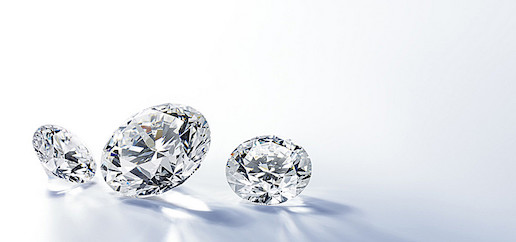

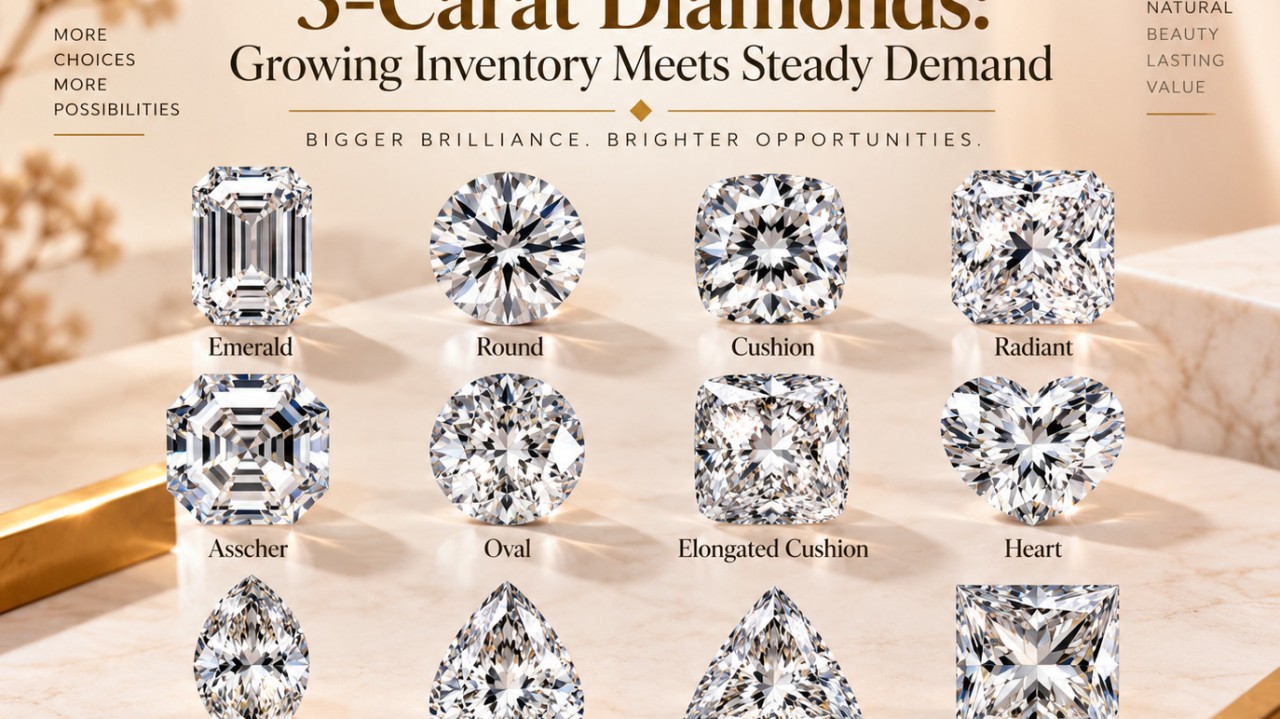
The 3-carat diamond segment is defying the broader turbulence in the global diamond industry. While smaller stones face relentless price pressure fromlab-growncompetition and softening consumer demand, the market for 3-carat and larger diamonds tells a markedly different story: inventory is rising, sales are growing, and demand remains steady.
For retailers, wholesalers, and savvy buyers, this creates a rare window of opportunity but only for those who understand the forces at play.
This analysis breaks down everything you need to know about the 3-carat diamond market in 2025, from inventory trends and shape preferences to the diverging paths ofnaturaland lab-grown stones.
Whether you are a jewelry retailer sourcing inventory, a diamond wholesaler expanding your catalogue, or a discerning buyer looking for exceptional value, this guide provides the intelligence you need to navigate this dynamic segment.
The Big Picture: Why 3-Carat Diamonds Are Bucking the Trend
The global diamond industry has endured what analysts describe as one of the most severe and prolonged crises in modern history. Prices for smaller diamonds have collapsed0.5-caratstones fell over 20% in 2025 alone, hammered by the explosive rise of lab-grown diamonds and weakening luxury consumption in key markets like China. Yet the 3-carat-plus category has remained remarkably stable.
According to the Diamond Index, the3-caratindex edged up 0.3% in 2025, continuing its recent pattern of stability. This is not a booming market, but it is a resilient one and that resilience is built on a fundamental reality: large, high-quality natural diamonds are genuinely scarce, and the buyers who want them are not easily deterred by macroeconomic headwinds.
The Natural Diamond Council (NDC) reports that average consumer spending onnatural diamond jewelleryrose 25% year-over-year to $4,063 in 2025, while the average carat weight per item increased from 1.65 carats to 1.86 carats.
This trend toward larger, higher-value purchases directly benefits the 3-carat segment. Affluent consumers are not abandoning diamonds they are consolidating their spending into fewer, more significant pieces.
Inventory Trends:
Retailers are entering 2026 holding more 3-carat and larger diamonds than at any point in recent years. Industry data confirms that 3-carat diamond stocks are up by a high single-digit percentage so far this year, reflecting both improved supply from mining operations and a strategic decision by retailers to position themselves for the growing demand for statement-size stones.
This inventory build-up is not a sign of oversupply. It reflects a deliberate alignment between supply and demand. Unlike the smaller diamond categories, where inventory gluts have forced painful price cuts, the 3-carat market has absorbed increased supply without destabilising prices. The reason is straightforward: production of large, high-quality rough diamonds is structurally constrained.
The Journal of Gems & Gemmology notes that traditional diamond mining faces increasing difficulty and rising costs, with a lack of new resource discoveries leading to a volatile decline in global natural diamond production. The diamond mines that produce large, gem-quality rough stones are aging, and no major new sources have come online to replace them. This supply constraint provides a natural floor for 3-carat prices that smaller diamond categories simply do not enjoy.
For sellers looking to expand their inventory with certified 3-carat diamonds, the current environment offers both depth and transparency. The key is sourcing from verified suppliers who can provide proper documentation and grading reports.
Platforms that specialise in large-stone trading rather than generalist marketplaces offer the specialised infrastructure that high-value transactions require.
Ready to sell to 18+ international markets? Register as a CaratX sellerand access a dedicated marketplace for diamonds, gemstones, and fine jewellery.
Sales Performance:
Sales of 3-carat and above diamonds from January to August 2025 outpaced the same period in 2024, according to trade data. This growth is particularly notable given the broader contraction in diamond jewellery sales. While total US natural diamond jewellery sales volume declined in certain months, thehigh-value segment has remained a consistent performer.
The De Beers Diamond Acquisition Study reveals that average purchase prices rose 25% to $4,063, with the average carat weight climbing to 1.86 carats. The NDC's trend report similarly shows that sales volume for natural-diamond center stones in the 2- to 2.24-carat range advanced 10% year-over-year. The momentum is clearly shifting toward larger stones.
This is not purely a pricing story. It is a structural shift in consumer behaviour. Younger, wealthier buyers particularly Gen Z consumers, who are now the fastest-growing segment of diamond buyers are gravitating toward larger, more distinctive stones. They are also increasingly self-purchasing, with over 40% of women's natural-diamond jewellery sales by value coming from self-purchases.
For retailers, this means the 3-carat category is no longer a niche offering for the ultra-wealthy. It is becoming a core component of the high-end inventory mix. Those who invest in 3-carat and larger stones whether natural or lab-grown are positioning themselves for a demographic shift that will define the next decade of diamond retail.
Shape Trends: Oval Diamonds Are Rewriting the Rules
The most striking development in diamond shape preferences in 2025 is the rise of the oval cut and nowhere is this more pronounced than in the lab-grown diamond segment.
In August, lab-grown oval diamonds outsold rounds for the first time in several key markets. The trend data is unambiguous:ovalsearches on Rapaport Trade rose 42.1% year-over-year, from 1.88 million in 2024 to 2.67 million in 2025. BriteCo's research confirms that oval was the most popular shape for lab-grown diamonds in 2025, with the average lab-grown centre diamond for an engagement ring growing from 1.31 carats to 2.45 carats between 2019 and 2025.
The natural diamond market has been slower to embrace the oval revolution but it is catching up.Round brilliant diamondsstill dominate natural diamond purchases, representing 62% of units sold in 2025, with oval at 14%. However, the trajectory is clear. Oval shapes represented 21.5% of engagement ring sales in 2022 and rose to 33% by 2025, while round's share declined from 59% to approximately 36% over the same period.
This divergence between natural and lab-grown shape preferences is instructive. Lab-grown diamond buyers who tend to be younger and more focused on visual impact per dollar are driving the oval trend because oval cuts offer a larger visual footprint per carat.
A 3-carat oval diamond can appear significantly larger than a 3-carat round brilliant, making it an attractive option for buyers who want maximum presence. For those looking to shop oval lab-grown diamonds, the visual advantage is particularly compelling.
For natural diamond buyers, the round brilliant remains the default choice, prized for its proven liquidity and universal appeal. But the growing acceptance of ovals in the natural segment suggests that shape diversification is no longer a niche strategy, it is becoming a mainstream expectation.
Explore certified natural and lab-grown diamonds on theCaratX marketplaceand find the perfect stone for your inventory or collection.
The Lab-Grown vs. Natural Divide: Two Markets, Two Realities
The 3-carat diamond market cannot be understood without acknowledging the profound divergence between natural and lab-grown stones. These are no longer variations of the same product, they are distinct markets with different economics, different consumers, and different trajectories.
The Natural Diamond Council's "Laboratory-Grown Diamond Facts" report paints a stark picture of the lab-grown market's economics. The average price of a 1.5-carat lab-grown diamond has plummeted 86%, from $10,750 in 2015 to $1,455 in 2025.
Wholesale prices for 1-carat VS1 F-G-H colour lab-grown diamonds have fallen 95% since 2018, while retail prices have dropped 76%. Average retail margins, meanwhile, have jumped from 85% in 2018 to over 500% today.
These figures are not a condemnation of lab-grown diamonds, they are a description of a maturing manufacturing industry. Lab-grown diamonds are mass-produced in essentially limitless quantities, and prices are converging toward production costs. For consumers who prioritise size and visual impact over rarity and resale value, this is excellent news. A 3-carat lab-grown diamond that might have cost $28,900 in 2020 now retails for approximately $3,900 less than one-eighth of its former price.
The natural diamond market operates on entirely different principles. Scarcity, not production capacity, drives value. The GIA's decision to stop using the traditional 4Cs colour and clarity system for lab-grown diamonds instead categorising them as "premium" or "standard" further reinforces the distinction between the two product categories. The message from the industry's foremost grading authority is clear: natural and lab-grown diamonds are not interchangeable, and they should not be marketed as such.
For retailers, this divergence creates both challenge and opportunity. The challenge is educating consumers without confusing them. The opportunity is serving two distinct customer segments with tailored offerings. Sellers who can articulate the value proposition of each category and who source from trusted, certified suppliers will thrive in this bifurcated market.
Start selling diamonds in 18+ international countries with aCaratX seller plantailored to your business. From loose diamonds to finished jewellery, our marketplace connects you with B2B and B2C buyers worldwide.
Pricing Dynamics: What 3-Carat Diamonds Actually Cost in 2025
Understanding pricing in the 3-carat diamond market requires distinguishing between natural and lab-grown stones, and between wholesale and retail channels.
Natural 3-carat diamonds have shown remarkable price stability. The RAPI for 3-carat stones edged up 0.3% in early 2025, continuing a pattern of minimal volatility. While the broader RAPI for 3-carat goods crept up only marginally, the stability itself is significant in a market where smaller stones are experiencing double-digit declines. The price floor for natural 3-carat diamonds is supported by genuine supply constraints, you cannot manufacture more of them.
Lab-grown 3-carat diamonds tell a very different story. Prices have fallen dramatically and continue to decline. A 3-carat lab-grown diamond that retailed for nearly $29,000 in 2020 now sells for under $4,000.
Wholesalelab-grown diamondprices fell an additional 37% year-on-year in the third quarter of 2025 alone. For buyers who prioritise size and aesthetics over investment value, this represents extraordinary value. For sellers, the key is managing margins carefully and avoiding inventory obsolescence.
The pricing divergence has important implications for inventory strategy. Natural diamond inventory holds value; lab-grown inventory depreciates. Retailers who understand this distinction can structure their purchasing accordingly holding natural diamonds for longer-term appreciation while turning lab-grown inventory more quickly to capture margin before prices fall further.
For those looking to source diamonds at competitive wholesale prices, accessing a transparent marketplace with real-time pricing and verified sellers is essential. The difference between a well-sourced 3-carat natural diamond and an overpriced one can easily be 20-30%, a margin that determines whether a retail sale is profitable.
Consumer Behaviour: Who Is Buying 3-Carat Diamonds?
The profile of the 3-carat diamond buyer has evolved significantly. It is no longer exclusively the domain of older, ultra-wealthy collectors. Three distinct consumer segments are driving demand:
Self-purchasing women represent the fastest-growing category. Over 40% of women's natural-diamond jewellery sales by value now come from self-purchases, according to the NDC. These buyers are typically purchasing for themselves, celebrating career milestones, significant birthdays, or simply rewarding themselves. They tend to be more knowledgeable about the 4Cs and more focused on quality than on brand.
Gen Z couples are redefining engagement ring expectations. They are increasingly choosing lab-grown diamonds for the engagement ring, 70% of engagement ring diamonds were lab-grown in 2025, up 14% from 2024, while reserving natural diamonds for future anniversary or milestone purchases. This generational shift is reshaping the entire category.
Affluent collectors and investors continue to drive demand for the highest-quality natural 3-carat stones. These buyers are less affected by economic cycles and more focused on rarity, provenance, and certification. They understand that a GIA-certified 3-carat D-flawless diamond is a store of value in a way that smaller stones are not.
For sellers, understanding these segments is critical. The marketing message that works for a self-purchasing Gen X woman is entirely different from the one that resonates with a Gen Z couple or an affluent collector. The 3-carat market rewards segmentation and punishes generic approaches.
Shop certified natural diamondswith full GIA documentation onCaratX. Every listing is verified, and every transaction is protected.
Selling on CaratX:
The 3-carat diamond market rewards sellers who have access to the right inventory, the right buyers, and the right infrastructure. CaratX was built specifically for this segment, a specialised marketplace for diamonds, gemstones, jewellery, and pearls that connects sellers with verified B2B and B2C buyers across 18+ international markets.
CaratX offers multiple seller plans designed to match different business models and scales:
CaratX Loose Diamonds (Free) : Ideal for sellers testing the waters, offering 2 active listings with a 1% transaction fee for B2B loose diamond sales and 15% for B2C transactions.
CaratX Jewelry Seller ($795/year) : Designed for jewellery brands, with 150 active listings, priority email support, and a 12% transaction fee across B2B and B2C channels.
CaratX Go-To-Market ($2,000/month) : For high-volume sellers, featuring 1,000 active listings, advanced analytics, a premium storefront, and a competitive 6.5% transaction fee.
Enterprise (Custom) : Unlimited listings, dedicated support, and custom analytics for the largest operations.
Each plan includes bank-level security, automated payment processing, fraud detection, and international shipping support. Sellers also gain access to detailed analytics that show which listings are performing, where buyers are located, and what price points are converting.
For sellers focused on the 3-carat segment, CaratX offers a distinct advantage: a buyer base that is actively searching for large stones. Unlike general marketplaces where diamond listings compete with electronics and clothing, CaratX is a dedicated destination where serious buyers come specifically for diamonds and fine jewellery.
Register now to start selling onCaratXand reach buyers in 18+ international markets.View pricing detailsto choose the plan that fits your business.
The Road Ahead: What to Expect in 2026 and Beyond
The 3-carat diamond market enters 2026 with a foundation of stability that much of the broader diamond industry lacks. Several trends will shape the segment in the coming year:
Supply will remain constrained. The structural shortage of large, gem-quality natural diamonds is not a temporary condition, it is the result of decades of underinvestment in exploration and the aging of major mines. This supply floor will continue to support natural 3-carat prices.
Lab-grown will continue to gain share in the engagement ring category, but natural diamonds will retain their dominance in the high-end, investment-grade segment. The two categories will increasingly operate as separate markets with separate value propositions.
Oval shapes will continue their ascent, particularly in the lab-grown segment where visual impact per carat is a primary purchase driver. Natural diamond buyers will gradually adopt oval shapes as well, though round will remain the dominant shape for the foreseeable future.
International markets will drive growth. India has overtaken China to become the world's second-largest diamond jewellery market, capturing 12% of global demand. As diamond demand grows in emerging markets, the 3-carat segment will benefit from a broader base of affluent buyers.
For retailers and wholesalers, the message is clear: the 3-carat diamond market is not just surviving the industry downturn, it is positioning itself for the recovery. Those who build inventory now, while prices are stable and supply is available, will be best positioned to capture demand as the market evolves.
Recommended Reads from CaratX
Expand your diamond market knowledge with these related guides and resources:
The Art of Buying Loose Diamonds: Your Buyer's Guide— Master the 4Cs and learn how to purchase loose diamonds with confidence.
Lab-Grown vs. Natural Diamonds: The Ultimate 2025 Buyer's & Seller's Guide— The definitive comparison of cost, quality, and value.
Diamond Carat Size Guide: Charts, Real-Life Examples & Buying Tips— Understand what carat really means and how to use size charts effectively.
All You Need to Know About Oval Cut Diamond— Why ovals are dominating the fancy shape market and how to evaluate them.
The Geometry of Brilliance: Why Length-to-Width Ratio Dictates Diamond Beauty and Value— The mathematical secret behind fancy shape aesthetics and resale value.
Global Diamond Markets Show Strength in Premium Categories in 2026— Data confirming the 3-carat+ segment's stability and the premium vs. commercial divergence.
Jewelry Sellers, Adapt or Struggle: How to Stay Profitable in 2025— How CaratX helps sellers bypass traditional costs and reach global buyers.
Shop certified natural diamonds on theCaratX marketplaceand register as a seller to reach buyers in 18+ international countries.
Frequently Asked Questions -
Q: Are 3-carat diamonds a good investment?
Natural 3-carat diamonds, particularly those with GIA certification and high colour/clarity grades, have historically retained value better than smaller stones. However, diamonds should not be viewed as a pure financial investment, they are a store of value and a source of enjoyment. Lab-grown 3-carat diamonds should not be considered investments, as their prices continue to decline with manufacturing efficiencies.
Q: What is the price difference between natural and lab-grown 3-carat diamonds?
The price difference is substantial and growing. A natural 3-carat diamond of good quality may retail for $40,000-$80,000 or more, depending on the 4Cs. A comparable lab-grown 3-carat diamond may retail for $3,000-$6,000. The gap is approximately 90% or more.
Q: Which shape is best for a 3-carat diamond?
There is no single "best" shape, it depends on your priorities. Round brilliants offer maximum brilliance and liquidity. Ovals offer a larger visual footprint per carat and are increasingly popular, especially in lab-grown. Emerald cuts offer a unique, elegant look but require higher clarity grades. The right choice depends on the buyer's preferences and the intended use.
Q: How do I verify that a 3-carat diamond is natural?
The only reliable way to verify a diamond's origin is through a grading report from an independent laboratory such as GIA. The report will state whether the diamond is natural or laboratory-grown. Never purchase a significant diamond without a report from a recognised grading authority.
Q: Can I sell 3-carat diamonds internationally?
Yes. CaratX connects sellers with buyers in 18+ international countries. The platform handles currency conversion, international shipping, and payment processing, making cross-border sales straightforward.Register as a sellerto get started.
Q: What is the minimum certification required for a 3-carat diamond?
For any diamond of 3 carats or above, a GIA Diamond Grading Report is strongly recommended. For lab-grown diamonds, an IGI or GIA report confirming the stone's origin and quality is essential. Certification protects both buyer and seller and is a prerequisite for most international transactions.