
Introduction:
Rubyis the most valuable variety of the corundum mineral species, which also includessapphire. This extraordinary gemstone can command the highest prices of any colored gemstone, with per-carat prices for fine-quality rubies rising consistently and breaking auction records year after year. In ancient Sanskrit, ruby was calledratnaraj, or "king of precious stones," a title it has earned through its rarity, hardness (second only to diamond), and mesmerizing beauty.
But what truly sets one ruby apart from another in terms of value? The answer, overwhelmingly, is color. While clarity, cut, carat weight, treatment, and geographic origin all play significant roles in determining a ruby's worth, color is universally recognized as the most important quality factor. A ruby's color can mean the difference between a modest gemstone and one that sells for millions at auction.
In this guide, we'll explore why color matters so much, how the other value factors interact with color, and what you need to know before buying or selling a ruby. Whether you're a seasoned gem collector, a jewelry professional, or someone simply fascinated by the allure of this magnificent gemstone, understanding ruby color is essential.
Why Color Is the Most Important Value Factor for Ruby -
When gemologists and traders evaluate a ruby, color is the first thing they assess and often the last. TheGemological Institute of America (GIA), the world's foremost authority on gemstone grading, states unequivocally that color is the most significant factor affecting a ruby's value. For better-quality material, slight differences in color can make significant differences in value. For top-color ruby that's also free of eye-visible inclusions, the price rises even more.
The reason color carries such weight is simple: ruby's very identity is defined by its red hue. The trace element chromium is what causes ruby's red color, and the strength of that red depends on how much chromium is present. Unlikediamonds, where colorlessness is prized, orsapphires, which come in a rainbow of hues, a ruby's desirability is intrinsically tied to the intensity, purity, and saturation of its red.
The Color Spectrum of Ruby -
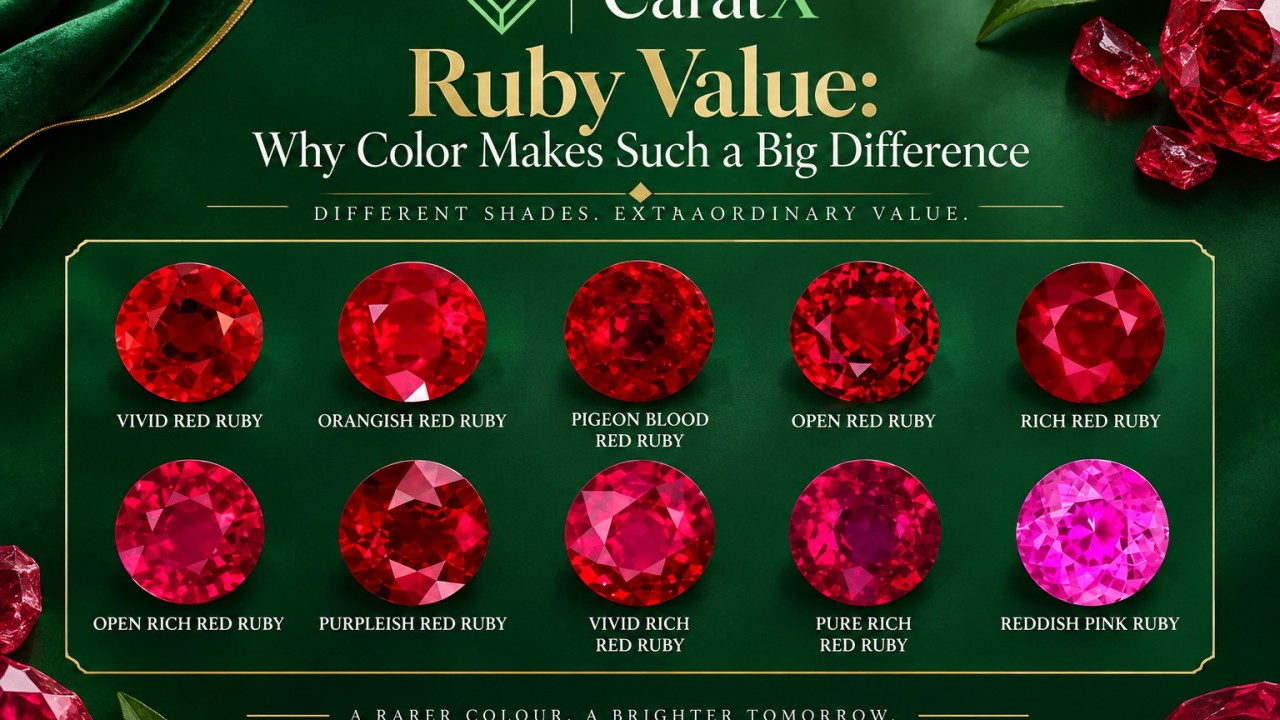
Vivid Red:
Thefinest rubyhas a pure, vibrant red to slightly purplish red color. In most markets, pure red colors command the highest prices, while rubies with overtones of orange or purple are less valued. The color must be neither too dark nor too light to be considered finest quality. If the color is too dark, it has a negative effect on the stone's brightness.
At the other extreme, if the color is too light, the stone may be considered to be apinksapphire, even if color strength or intensity is high.
Thehighest-quality rubieshave vivid color saturation that is not too dark. This delicate balance the "Goldilocks zone" of ruby color is what separates exceptional stones from merely good ones.
Pigeon's Blood:
Few terms in the gem world carry as much weight as "pigeon's blood." Historically, this term described the red to slightly purplish or pinkish red color of rubies with a soft, glowing, red fluorescence. Traditional descriptions like these are useful for evoking images and describing color among professionals, but they can be subject to misinterpretation when used to describe a ruby's actual color.
It's crucial to understand that "pigeon's blood" does not automatically guarantee a particular value or origin. A single source never yields gems that are all the same color and quality. In fact, the descriptive trade term might represent only a small, yet highly desired percentage of stones from that source. New sources can produce material very similar to rubies from classical localities or present a slightly different appearance, but remain just as beautiful.
Pinkish-Red:
Lighter red tones can be attractive, but very light stones may instead be classified as pink sapphire. Some gem dealers debate the borderline between ruby and pink sapphire. Historically, the word ruby referred to shades of red, which technically included pink.
There are also cultural differences in the interpretation: in some gem-producing nations such as Sri Lanka, pink colors were always considered ruby, while in many consuming countries it is classified as pink sapphire.
The GIA Laboratory uses a controlled set of comparison stones called masterstones to determine if corundum is ruby. The laboratory grades its masterstones on the principle that red must be the dominant hue before a stone can be called a ruby. Pink sapphires enjoy a following, but at far more competitive prices than rubies.
Purplish or Dark Red:
These shades can be beautiful, but very dark or strongly purplish colors may be valued differently from the finest vivid reds. As the color becomes too orangy or more purplish, therubymoves down in quality. However, beauty is ultimately in the eye of the beholder. The most desirable color ofrubyis the one you prefer the most.
Clarity:
While color leads the value equation, clarity plays a crucial supporting role. People in the trade expect rubies to have at least some inclusions because inclusion-free rubies are practically nonexistent. Ruby value depends on how visible the inclusions are. Obvious inclusions, or inclusions that reduce transparency or brightness, lower a ruby's value dramatically.
If large and prominent inclusions are located under the table facet, they greatly diminish the transparency, brilliance, and value of the stone. Inclusions can also limit a ruby's durability, as significant surface-reaching fractures can pose durability threats.
Typical ruby clarity characteristics include thin mineral inclusions called needles. When the mineral is rutile and needles are present in intersecting groups, it is called silk.
Needles might be short or long and slender, and they might appear to be woven tightly together. Some inclusions can actually contribute positively to a gem's appearance, a fine silk can create a soft, velvety glow that enhances the ruby's color.
Top-tier values for rubies of the same color grade go to stones that are clarity graded VVS (very very small inclusions) or better. The second tier of value goes to stones that are clarity graded VS (very small inclusions) but still "eye clean" to SI (slightly included).
Cut:
Cut is one of the most important factors in a ruby's appearance. Several factors affect the cut and proportion of rubies on the market. A ruby's crystal shape dictates its suitability for certain cuts. The most common shape is a flat tabular hexagonal shape, but ruby crystals from some sources can be elongated.
Unlike diamonds, where cut is mathematically calibrated for maximum brilliance, ruby cutting involves a delicate balance between maximizing color, preserving weight, and ensuring a pleasing face-up appearance. Cutters prefer rough that is transparent and without many inclusions.
Ruby rough with a deeply saturated red color and free from even minor inclusions under 10x magnification will produce gems of noteworthy face-up color and appearance, even if the fashioning is poor.
Carat Weight:
Fine-quality rubiesover one carat are very rare, but commercial-quality rubies are commonly available in a wide range of sizes. The price per carat goes up significantly for ruby as it increases in size. This exponential price increase reflects the extraordinary rarity of large, fine-quality rubies.
To put this into perspective, a heated AAA-quality Burmese ruby of 1 carat might be priced between $3,500 and $6,500 per carat. An unheated pigeon's blood ruby of the same weight can reach $18,000 to $30,000 per carat. For truly exceptional stones, such as the 55.22-carat Estrela de FURA, the price can exceed $600,000 per carat.
The relationship between size and value is not linear, it's exponential. A 2-carat fine ruby is not simply twice as valuable as a 1-carat stone; it may be three or four times as valuable, because the rarity of finding a clean, fine-color rough that can yield a 2-carat gem is disproportionately greater.
Treatment:
Most rubies on the market are heated. This is an accepted and standard practice that has been used for centuries. Heating can remove or generate color, dissolve silk inclusions, and improve the overall appearance of the stone.
However, treatment status dramatically affects value. Rubies that have a report from an independent laboratory like GIA confirming there is no evidence of heat treatment command a premium due to their rarity. Rubies that have been diffused or are glass filled are worth less than heated rubies.
It's important to understand the different types of treatments:
Heat treatment: The most common and accepted treatment. It is generally stable and permanent.
Lattice diffusion: Heat and chemicals are used to diffuse a specific element into a gem to change its color. This treatment is less desirable and less valuable.
Glass filling: Fractures are filled with lead glass to improve clarity and appearance. This treatment is considered the least desirable and significantly reduces value.
When shopping for rubies, always ask about treatment information included in writing, and when in doubt, get a lab report from an independent laboratory like GIA.
Origin:
Geographic origin is a factor that can influence ruby value, but it's often misunderstood. Every mine produces a wide range of quality. The fact that a ruby comes from a famous mine doesn't mean it is good quality.
That said, fine-quality rubies with documentation of Myanmar (Burmese) origin from an independent laboratory like GIA command a premium in the market. Burmese rubies, particularly those from the legendary Mogok Valley, have historically been associated with the finest "pigeon's blood" red color. The Mogok Valley in Upper Myanmar, formerly known as Burma, produces 90% of the rubies worldwide and is commonly referred to as the "valley of rubies".
However, the source of rubies in Burmese mines is becoming depleted. Since the 1990s, Mong Hsu has become the new main source of Burmese rubies. The rarity of a true Burmese ruby makes the precious gemstone highly desirable by collectors and enthusiasts worldwide.
It's also worth noting that fine-quality rubies can come today from several countries, including Mozambique, Sri Lanka, and Madagascar. Origin should be considered as one factor among many, not as the sole determinant of value.
Where to Buy and Sell Rubies -
AtCaratX, we connect buyers and sellers of fine gemstones across the globe. Our marketplace offers a curated selection of naturalrubies,sapphires,emeralds, and more, sourced from trusted vendors worldwide.
Whether you're looking for a Burmese ruby for your collection or seeking to sell gemstones internationally, CaratX provides a transparent, secure platform for B2B and B2C transactions.
Shop Ruby Gemstones on CaratX and explore our collection of certified natural rubies. If you're a seller,register on the CaratX Seller Planto start selling to over 18,000 verified buyers in 18+ international countries.
Our platform makes it easy to list your products, manage orders, and reach a global audience.
Frequently Asked Questions -
Q: Does GIA grade rubies?
A: No, GIA doesn't grade rubies. GIA evaluates ruby but does not grade it. A GIA Colored Stone Identification & Origin Report assesses the characteristics of a ruby (weight, measurements, shape, cutting style and color), indicates whether it is natural or laboratory-grown, names any detectable treatments, and can issue an opinion on geographic origin when possible and requested by the client.
Q: Is a Burma ruby worth more?
A: While Burma is considered the premier source for fine-quality rubies, every mine produces a wide range of quality. Fine-quality rubies with documentation of Burmese origin from an independent laboratory like GIA command a premium in the market. However, the fact that a ruby comes from a famous mine doesn't mean it is good quality. Origin should be one consideration among many.
Q: Does heat treatment affect the value of ruby?
A: Yes, all types of treatments (heat, diffusion, and glass filling) will impact value. You should assume your ruby is heated. Rubies with a report from an independent laboratory like GIA that confirms there is no evidence of heat command a premium due to their rarity. Rubies that have been diffused or that are glass filled are worth less than heated rubies.
Q: What is the most important factor in determining a ruby's value?
A: Color is the most important quality factor for ruby. The finest rubies have a pure, vibrant red to slightly purplish red color. A color that's too orange or too purplish is considered less desirable. The highest-quality rubies have vivid color saturation that is not too dark.
Q: How rare are fine-quality rubies over 1 carat?
A: Rubies are available in a wide range of sizes, but fine-quality rubies over one carat are very rare and, not surprisingly, very expensive. The price per carat goes up significantly for ruby as it increases in size.
Conclusion -
Ruby value is a complex equation, but color is unmistakably the most important variable. A ruby's hue, tone, and saturation can elevate it from a beautiful gemstone to a world-class treasure. Clarity, cut, carat weight, treatment, and origin all play supporting roles, but color remains the star of the show.
Understanding these factors empowers you to make informed decisions, whether you're buying a ruby for your personal collection or selling one to a discerning buyer. At CaratX, we're committed to providing the knowledge, tools, and marketplace you need to navigate the world of fine gemstones with confidence.
Ready to explore the world of rubies? Visit CaratX to browse our curated collection of natural rubies and other precious gemstones. Register as a seller to reach buyers across 18+ countries. And don't forget to check out our blog for more insightful and educational content on gemstones and jewelry.