
Introduction -
Imagine owning a single gemstone that transforms before your eyes green as anemeraldin the sunlight, yet red as a ruby under the warm glow of candlelight. This is not magic; this isalexandrite, one of nature’s rarest and most mesmerizing creations.
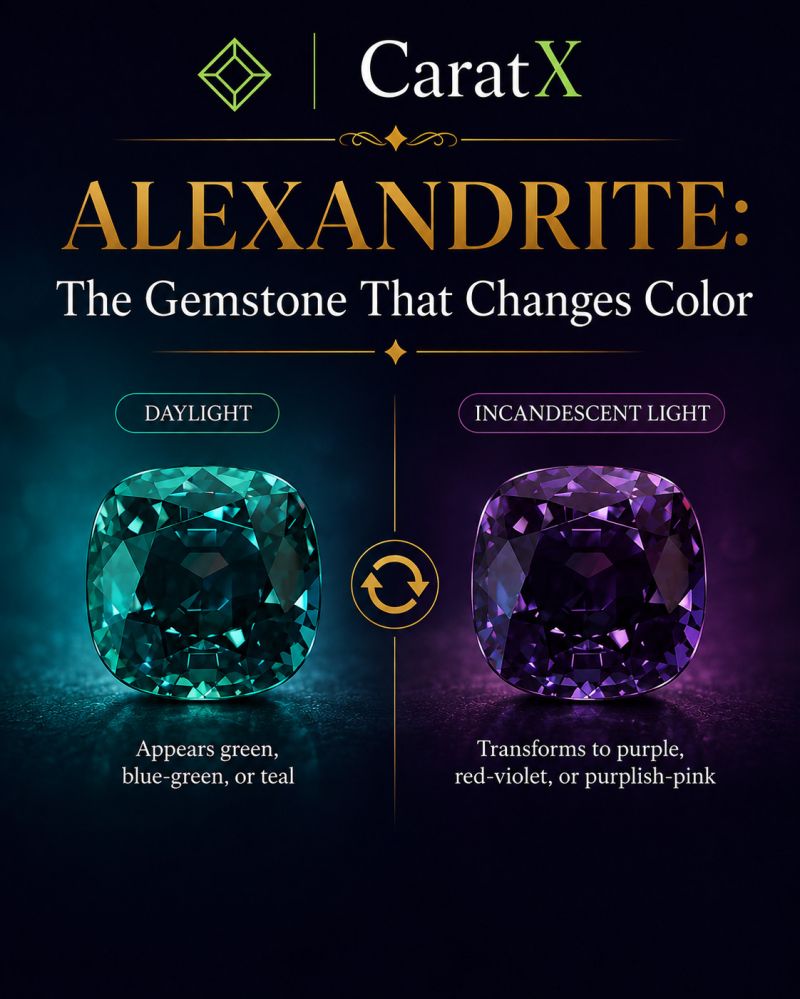
Alexandriteis a rare and fascinating gemstone famous for its extraordinary color‑changing effect. In daylight, it appears green to bluish‑green, while under warm incandescent light, it transforms to red to purplish‑red. This remarkable phenomenon has earned it the poetic nickname “emerald by day, ruby by night”.
First discovered in Russia’s Ural Mountains in the 1830s and named after the future Tsar Alexander II, alexandrite quickly became a symbol of imperial Russia. Its red and green colors perfectly matched the Russian military colours, cementing its status as the country’s national gemstone. Today,alexandriteremains one of the most coveted colouredgemstonesin the world, prized by collectors, investors, and jewellery enthusiasts alike.
AtCaratX, we understand the allure of exceptional gemstones. Whether you’re a collector seeking investment‑grade stones or a jewellery lover looking for the perfect June birthstone piece, ourNatural Gemstones Collectionoffers access to carefully curated alexandrite and other premium gems.
Explore ourAlexandrite Selectionto discover pieces that capture this gem’s magical colour‑changing properties.
The Science Behind the Magic: Why Alexandrite Changes Color
The secret behind alexandrite’s colour change lies in its crystal chemistry. Alexandrite is a variety of the mineral chrysoberyl (beryllium aluminium oxide, BeAl₂O₄). What makes it special is the presence of chromium (Cr³⁺) impurities within its atomic structure.
How Chromium Creates the Colour Change -
In alexandrite, chromium ions substitute for aluminium in the crystal lattice. These chromium ions have a unique optical absorption property: they strongly absorb light in the yellow region of the visible spectrum (around 580 nm). This absorption allows only the red and green wavelengths of light to be transmitted and reflected.
In daylight or fluorescent light (which contains more blue and green wavelengths), the green light dominates, making the stone appear green to bluish‑green.
In incandescent light or candlelight (which contains more red wavelengths), the red light dominates, making the stone appear red to purplish‑red.
The Role of Human Colour Perception -
A 2020 study published inScientific Reports(a Nature Research journal) provided a complete explanation of the alexandrite effect. Researchers demonstrated that the colour change is not merely a physical property of the stone but also involves the human visual system’s colour constancy mechanism.
The ratio of green to red stimuli under different illuminants changes much more dramatically for alexandrite than for normal coloured objects, effectively “overriding” the brain’s automatic colour correction.
Pleochroism vs. Colour Change -
It’s important to distinguish between colour change and pleochroism.Alexandriteis strongly pleochroic, meaning it shows different colours (typically green, purple‑red, and orange) when viewed from different crystallographic directions. However, the famous “emerald by day, ruby by night” transformation isnotpleochroism, it’s a true colour‑change phenomenon caused by the gem’s interaction with different light spectra.
For a deeper dive into gemstone optical phenomena, explore ourComprehensive Guide to Optical Phenomena in Gemstones.
The Discovery of Alexandrite -
The Ural Mountains Discovery -
Alexandritewas first discovered in 1830 (some sources cite 1834) in the emerald mines near the Tokovaya River in the Ural Mountains of Russia. The story goes that Finnish mineralogist Nils Gustaf Nordenskiold was the first to recognise this unusual green gem as something new. It was named in honour of the future Tsar Alexander II, reportedly because it was discovered on his 16th birthday.
Imperial Russia’s Gemstone -
The timing of the discovery was serendipitous. Alexandrite’s red and green colours mirrored the military colours of Imperial Russia, making it an instant national treasure. It became the official gemstone of the Russian Tsardom.
Global Sources Emerge -
The spectacular Ural Mountain deposits didn’t last forever. By the early 20th century, the Russian sources were largely exhausted. Today, important sources include:
Brazil (notably the Hematita mine in Minas Gerais).
Sri Lanka (produces stones with a more brownish‑green daylight colour).
East Africa (Tanzania and Madagascar).
India (minor sources).
Interestingly, the finest colour‑change material remains rare from all these localities, and some experts note that Brazilian stones, while exceptional do not always match the vividness of the original Russian gemstones.
Learn more about gemstone origins and how they affect value in ourComplete Guide to Colored Gemstone Valuation.
Alexandrite as a Birthstone: June’s Most Magical Gem
Alexandriteis one of the traditional June birthstones, alongsidepearland moonstone. It shares this distinction with these two other gems, making June one of the few months with multiple birthstone options.
Symbolism and Meaning -
Alexandrite’s colour‑changing nature has imbued it with rich symbolic meaning:
Transformation and adaptability – its ability to shift between colours represents personal growth and evolution.
Balance and duality – the stone embodies the harmony between opposing forces.
Luck and prosperity – alexandrite has long been associated with good fortune and abundance.
Creativity and confidence – metaphysically, it is believed to enhance intuition and creative thinking.
Anniversary Gemstone -
Beyond its role as a birthstone,alexandriteis also the traditional gemstone for the 55th wedding anniversary. Its durability (8.5 on the Mohs scale) makes it an enduring symbol of a long‑lasting marriage.
For a complete guide to all birthstones, their meanings, and market trends, read ourBirthstones by Month: Meaning, Color, Market Trends & Your Ultimate Buying Guide (2026).
Physical Properties:
Alexandrite is not just beautiful, it’s remarkably durable, making it suitable for everyday wear in jewellery.
Hardness and Toughness -
Mohs Hardness: 8.5 – This places alexandrite among the hardest gemstones, surpassed only by diamond (10), corundum (ruby and sapphire, 9), and topaz (8). It is harder than garnet, which is another gemstone that can exhibit colour change.
Toughness: Excellent – Alexandrite has no cleavage (it doesn’t split along predictable planes) and is highly resilient.
To understand how alexandrite compares to other gemstones in terms of hardness and durability, check out ourMohs Scale Decoded: The Ultimate Guide to Gemstone Hardness and Durability in Fine Jewelry.
Rarity and Value: Why Alexandrite Commands Premium Prices
The Rarity Factor -
Alexandrite is one of the rarest gemstones on Earth. Its formation requires a remarkable geological coincidence: the presence of both beryllium (one of the rarest elements on Earth) and chromium in the same geological environment elements that rarely occur together.
Furthermore, natural alexandrite crystals are typically small; most cut gems weigh less than one carat.Stonesover 2 carats are considered large, and those over 5 carats are exceptionally rare.
Value Factors -
The value of alexandrite is determined by several key factors:
Colour Change Quality – This is the most important factor. The closer the colours are to pure green (daylight) and pure red (incandescent), and the more dramatic and complete the change, the higher the value. Some stones exhibit changes of 80‑100%, while others show more subtle shifts.
Carat Weight – Prices increase dramatically with size. A 1‑carat stone might cost around $2,000 per carat, while larger, finer specimens can command $16,000 per carat or more at retail.
Clarity – High‑quality alexandrite has few inclusions. Rarely, needle‑like inclusions create a desirable cat’s‑eye effect (chatoyancy).
Cut – Due to its rarity, alexandrite is often cut to preserve weight rather than to maximise brilliance.
Origin – Stones from the original Russian Ural Mountains or Brazil’s Hematita mine often command premiums.
Auction Records -
The market for fine alexandrite has reached extraordinary heights. In December 2024, a 16.53‑carat Brazilian alexandrite ring sold at Sotheby’s for $1.92 million, setting a new world record for the gemstone. This underscores the immense value that collectors place on large, high‑quality specimens with strong colour change.
Natural vs. Synthetic Alexandrite:
Lab‑Grown Alexandrite -
True synthetic (lab‑grown) alexandrite has the same chemical composition (BeAl₂O₄ with chromium), crystal structure, and physical properties as natural alexandrite. It exhibits the same colour‑change phenomenon and the same 8.5 Mohs hardness.
Most true synthetic alexandrite is grown using the floating zone method or the pulled method (Czochralski process). The largest producer of jewellery‑quality laboratory‑grown alexandrite is Tairus.
How to Identify Genuine Alexandrite -
When purchasing alexandrite, theGemological Institute of America (GIA)recommends:
If it seems too good to be true, it probably is – genuine alexandrite with strong colour change is expensive.
Work with a trusted jeweller who has expertise in coloured gemstones.
Request an independent laboratory report from a reputable lab like GIA, SSEF, or Gübelin to confirm natural origin and provide details on colour change.
Learn more about gemstone verification in ourComplete Guide to Gemstone Verification.
Caring for Your Alexandrite Jewelry -
Alexandrite is a low‑maintenance gemstone, but proper care will ensure it retains its brilliance for generations.
Cleaning Instructions -
The GIA recommends warm, soapy water as the safest cleaning method for alexandrite. TheAmerican Gem Trade Association (AGTA)suggests using a soft brush with a solution of warm water and gentle dish detergent.
Ultrasonic cleaners are usually safe for untreated alexandrite.
Steam cleaners are also generally safe.
Avoid bleach and harsh chemicals.
Storage Tips -
Storealexandrite jewelleryseparately from other pieces to prevent scratching.
Wrap in a soft cloth or keep in a fabric‑lined jewellery box.
Remove alexandrite jewellery before engaging in activities that could cause impact.
Durability Considerations -
Most natural alexandrites are not treated. However, if the stone has fracture‑filled inclusions, it should only be cleaned with warm, soapy water.
Alexandrite in Jewelry:
Alexandrite’s hardness of 8.5 makes it suitable for all types of jewellery, includingrings,pendants,earrings, andbracelets. Its dramatic colour change makes it a conversation piece in any setting.
Popular Jewelry Pieces -
Alexandrite Rings – Often set in white gold or platinum to complement both the green and red colour phases.
Alexandrite Earrings – Showcase the stone’s colour change in a highly visible way.
Alexandrite Pendants – Allow the gem to catch light from various angles throughout the day.
Alexandrite and Diamond Combinations – Diamonds enhance the brilliance of the alexandrite while complementing both its green and red hues.
Explore ourCaratX Jewelry Collectionfor alexandrite and other fine gemstone pieces. Sellers looking to expand their inventory canregister on CaratXto access 18+ international markets.
Recommended Reads from CaratX -
Expand your gemstone knowledge with these carefully curated articles from the CaratX blog. Each link goes directly to the full article.
The Captivating World of Color-Change Gemstones: Identification, Science & Collector's Guide– A exploration of colour‑change gemstones, including alexandrite, sapphire, and garnet.
Birthstones by Month: Meaning, Color, Market Trends & Your Ultimate Buying Guide (2026)– Complete guide to all birthstones with market insights for buyers and sellers.
The Mohs Scale Decoded: The Ultimate Guide to Gemstone Hardness and Durability in Fine Jewelry– Understand how alexandrite compares to other gemstones in terms of durability.
A Comprehensive Guide to Optical Phenomena in Gemstones– Explore the science behind colour change, chatoyancy, asterism, and other optical effects.
The Complete Guide to Gemstone Verification: How to Check Authenticity, Quality & Value– Learn how to distinguish natural alexandrite from synthetics and imitations.
The Ultimate Guide to Colored Gemstone Valuation: Beyond Carats and Into the Rainbow– Deep dive into the factors that determine the price of coloured gemstones, including alexandrite.
Frequently Asked Questions -
1. Why does alexandrite change colour?
Alexandrite contains trace amounts of chromium (Cr³⁺) that absorb yellow light strongly. This selective absorption allows the stone to reflect green light in daylight (which is blue‑rich) and red light in incandescent light (which is red‑rich).
2. Is alexandrite rare?
Yes, fine natural alexandrite with strong colour change is exceptionally rare. The geological conditions required for its formation beryllium and chromium occurring together are highly unusual. Most cut stones weigh under one carat.
3. How much does alexandrite cost?
Prices range from about $2,000 per carat for smaller stones to $16,000 per carat or more for larger, high‑quality specimens. Auction records have exceeded $100,000 per carat for exceptional stones.
4. What is the Mohs hardness of alexandrite?
Alexandrite has a Mohs hardness of 8.5, making it one of the hardest gemstones. It is suitable for everyday wear in all types of jewellery.
5. Is most alexandrite jewellery real?
Much inexpensive “alexandrite” jewellery is actually synthetic corundum or lab‑grown chrysoberyl rather than natural alexandrite. Genuine natural stones are scarce and costly.
6. What are the birthstones for June?
June has three traditional birthstones: alexandrite, pearl, and moonstone.
7. What is the difference between colour change and pleochroism?
Pleochroism means the stone shows different colours when viewed from different angles. Colour change means the stone shows different colours under different light sources. Alexandrite exhibits both properties.
8. Where is alexandrite found today?
Major sources include Brazil (especially Hematita), Sri Lanka, and East Africa (Tanzania and Madagascar). The original Russian Ural Mountains deposits are largely exhausted.