
Australia is home to more than 90% of the world's preciousopals, making it the undisputed global leader in thesestunning gemstones. From the remote outback towns of Lightning Ridge to the underground dwellings of Coober Pedy, the story of Australian opals is one of ancient geology, human endurance, and breathtaking natural beauty.
Opalsare famous for their mesmerizing "play-of-color", where flashes of red, blue, green, and other colors appear to shift and dance as the stone moves. This optical phenomenon, unique to precious opal, has captivated civilizations for millennia and continues to inspire jewelers, collectors, and gemstone enthusiasts worldwide.
The Ancient Formation of Australian Opals -
A Journey Through Deep Time -
The story of Australian opals begins more than 110 million years ago, during the Cretaceous period when much of central Australia was covered by a shallow inland sea known as the Eromanga Sea. This vast body of water, part of the Great Artesian Basin, created the perfect conditions for opal formation.
As the inland seas retreated and the climate weathered the ancient rocks, silica-rich groundwater filled voids, cracks, and fossil cavities deep within the earth. Over millions of years, as the water slowly evaporated, it left behind deposits of hydrated silica.
The Science Behind the Play-of-Color -
The spectacular play-of-color that makes precious opals so treasured is a product of nanoscale physics. Precious opal is composed of microscopic silica spheres arranged in an orderly, three-dimensional lattice. When white light enters the stone, it diffracts or bends as it passes through these tiny spheres, splitting into the spectral colors we see.
The size of these silica spheres determines which colors are visible:
Smaller spheres (around 100-200 nm) diffract violet and blue light.
Medium spheres produce greens and yellows.
Larger spheres (around 300-350 nm) create oranges and reds.
The regularity and uniformity of the sphere packing is what separates precious opal (with play-of-color) from common opal or "potch" (without play-of-color).
Australia's Opal Heartland -
Almost all of Australia's commercial opal deposits are geographically related to the Great Artesian Basin (GAB). This vast geological formation, spanning parts of Queensland, New South Wales, South Australia, and the Northern Territory, provided the sedimentary environment essential for opalization.
According to research from the University of Technology Sydney, the sedimentary geological environment associated with Cretaceous sediments of the Great Artesian Basin is the source of most precious opals in Australia. The Australian National University confirms that Australia produces over 90% of the world's opal and that it is the country's official NationalGemstone.
The Gemmological Association of Australia notes that the geological conditions producing Australian precious opal are ancient, dating back more than 110 million years. Today, opal stands alongside the national flag and coat of arms as a nationally significant and internationally recognizable Australian symbol.
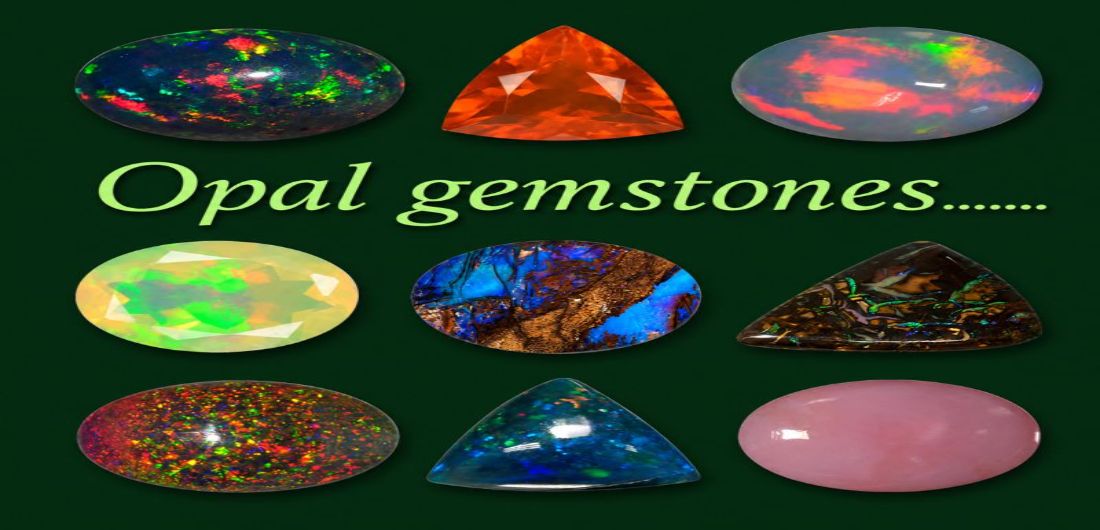
The Major Types of Australian Opals -
Australia produces several distinct varieties of precious opal, each with unique characteristics, origins, and value. The Gemmological Association of Australia classifies opal body tone as black, dark, or light with black opal being the most highly valued.
Black Opal:
Black opal is the rarest and most valuable variety of opal in the world. Its dark body tone ranging from dark grey to jet black provides a stunning contrast that makes the play-of-color appear exceptionally vivid and intense.
Primary Source: Lightning Ridge, New South Wales.
Key Characteristics:
Dark body tone that enhances color brilliance.
Vivid flashes of red, blue, green, and other colors.
Most valuable when displaying strong red "fire".
Prices range from $200 to $25,000+ per carat depending on quality.
Historical Significance: Black opals were first discovered in 1902 at Lightning Ridge. Today, Lightning Ridge is globally celebrated for producing the finest and rarest black opals on Earth.
White Opal: Australia's Classic Light Opal
White opal also known as light opal features a pale, milky to translucent body that sets off delicate play-of-color in pastel pinks, blues, greens, and golds. It is the most commercially abundant variety and serves as an accessible entry point intopreciousopal collecting.
Primary Source: Coober Pedy, South Australia
Key Characteristics:
Light, milky-white to cream body color.
Soft pastel color flashes.
More affordable than black opal.
Ideal for everyday jewelry.
The town of Coober Pedy derives its name from an Aboriginal term often translated as "white man's hole in the ground," reflecting the underground dugout homes residents built to escape the outback heat.
Boulder Opal:
Boulder opal is a truly uniquegemstonethat forms as thin seams and patches of precious opal within ironstone boulders. Because the opal layer is often too thin to stand alone, it is cut together with its natural ironstone host rock.
Primary Source: Queensland (Winton, Quilpie, Yowah, and Koroit fields)
Key Characteristics:
Precious opal naturally bonded to dark ironstone matrix.
The dark backing intensifies the play-of-color.
Each stone is unique in shape and pattern.
More durable than thin solid opals.
Not a doublet, the opal and ironstone are naturally bonded.
According to Geoscience Australia, Queensland boulder opal is found within the Cretaceous Winton Formation and results from the deposition of silica-rich solutions in an iron-rich host rock.
Crystal Opal:
Crystal opal is a transparent to semi-transparent variety that allows light to pass through the stone, creating a luminous, ethereal appearance. It can have a light or dark body tone and is highly prized for its clarity and brilliance.
Primary Sources: Found across various Australian fields, including Lightning Ridge and Coober Pedy
Other Notable Varieties -
Andamooka Matrix Opal: Found in South Australia, this opal occurs within a matrix of ironstone and is often treated to enhance its color.
Opalized Fossils: Australia is famous for opalized shells, bones, and wood, created when silica replaced organic material over millions of years.
Yowah and Koroit "Nut" Opal: Found in Queensland, these are boulder opals where color fills concentric ironstone nodules.
The History of Australian Opal Mining -
Early Discoveries -
Opal appears to have been first discovered in Australia in 1849 near the small town of Angaston in South Australia by the German geologist Johannes Menge. Within a few decades, major deposits were found and exploited in several areas of the country.
Initially, rough opal was sent to Germany to be cut and polished; later it was manufactured locally. Australian opal began to appear in the international market in the 1890s, and over time, the availability of high-quality material made Australia the world's main producer.
The Opal Rush -
While overshadowed by the famous gold rush of the 1850s, the Australian opal industry has a unique and vibrant history. The late 1800s and early 1900s saw mining begin in earnest in the remote outback. Key discoveries included:
White Cliffs, NSW (1890): One of the earliest commercial opal fields
Lightning Ridge, NSW (1901-1903): The world's premier source of black opal
Coober Pedy, SA (1915): Became the world's largest opal mining town
Modern Opal Industry -
Today, Australia currently produces around 95% of the world's precious opal and probably has most of the world's major opal reserves. The opal industry contributes approximately $85 million annually to Australia's GDP and employs thousands in outback communities. Opal tourism brings an estimated $324 million each year to these remote mining communities.
According to the National Opal Miners Association, the opal industry attracts more than 231,000 tourists per year to opal fields across Australia.
Why Australian Opals Are Superior -
Australian opals are widely considered the finest in the world for several reasons:
1. Exceptional Stability -
Australian opals formed slowly in sedimentary conditions over millions of years, making them generally very stable and resistant to crazing (cracking). Unlike some opals from other sources, most Australian opal is non-porous and does not absorb water or turn transparent when wet.
2. Unmatched Variety -
Australia produces the full spectrum of opal types from the coveted black opal of Lightning Ridge to the affordable white opal of Coober Pedy and the unique boulder opal of Queensland.
3. National Gemstone Status -
In 1993, opal was formally recognized as Australia's national gemstone. This official designation reflects the stone's cultural and economic significance to the nation.
4. Rich Color Palette -
Australian opals are renowned for their vibrant and diverse colors. The presence of strong red hues referred to as the opal's "fire" is highly desirable and can give exceptional contrast and life to the gemstone.
Caring for Your Australian Opal -
Australian opals are durable gemstones, but they do require proper care:
Avoid Sudden Temperature Changes: Opal contains water (typically 6-10% by weight) and can crack if exposed to rapid temperature fluctuations.
Protect from Impact: With a hardness of 5.5-6.5 on the Mohs scale, opal is softer than quartz and can scratch or chip.
Avoid Ultrasonic Cleaners: The vibrations can damage opals.
Clean Gently: Use warm, soapy water and a soft cloth.
Store Properly: Keep opals away from extreme heat and dry conditions.
Opal in Jewelry and Investment -
Jewelry Applications -
Australian opals are versatilegemstonesused in all types ofjewelry:
Rings:Black and crystal opals create stunning centerpieces.
Pendants:Boulder opals showcase natural patterns beautifully.
Earrings:White opals offer affordable elegance.
Statement Pieces: Large, high-quality opals are true works of art.
Investment Potential -
Black opal from Lightning Ridge is among the mostvaluable gemstonesin the world. Top stones with broad, multicolor flash are highly valued and can appreciate significantly over time. As the Gemmological Association of Australia notes, no two opals are alike a characteristic that makes each stone uniquely valuable.
Shop Australian Opals at CaratX -
AtCaratX, we connect buyers with a global marketplace of naturalgemstones,diamonds, and fine jewelry. Whether you're looking for a rare black opal, a classic white opal, or a unique boulder opal, our platform offers access to thousands of unique pieces from over 16 countries and 2000+ sellers.
For Buyers -
Shop gemstonesfrom our marketplace at unbeatable prices.
Shop natural diamondsfrom verified sellers.
Explore our collection ofnatural gemstonesincluding Australian opals.
For Sellers -
Register as a sellerto start selling to B2B and B2C buyers worldwide.
Sell jewelry internationallythrough our CaratX seller plan.
Choose your seller planto launch your products on CaratX.
Sell diamondsin 18+ international countries.
CaratXgives you a professional storefront dedicated to diamonds and fine jewelry. Your products won't get lost among electronics or clothing this is a specialized marketplace where serious buyers shop for jewelry.
Recommended Reads from CaratX -
Expand your knowledge of gemstones and the jewelry industry with these insightful articles from the CaratX blog:
The United States: A Treasure Trove of Gemstones, A Complete Guide to Mining, History, and Buying— Discover the rich gemstone heritage of the United States, from Montana sapphires to Arizona turquoise, and learn how over 50 different commercial gemstones are found within U.S. borders.
Online Jewelry Shopping Is Booming: A Guide to Trends, Innovations in 2025— Stay ahead of the curve with insights from the 2025 Plumb Club Industry Report, including how 62% of U.S. consumers now confidently buy jewelry online with an average spend of $1,652.
Why Experienced Gemologists Choose Natural Gemstones Over Synthetics— An evidence-backed analysis of why natural stones remain the top choice for professionals, covering geology, investment value, and the forensic science of gemology.
Sell on CaratX – Choose Your Plan— Find the right selling solution for your jewelry business with flexible pricing options, from the Free plan to Enterprise. CaratX gives you a professional storefront dedicated to diamonds and fine jewelry in a specialized marketplace where serious buyers shop.
Additional Related Content from CaratX -
De Beers Revises Rough Diamond Index— An in-depth analysis of the rough diamond market correction, including how Anglo American revised historical data to reveal an 18% price drop in Q1 2025 and the subsequent 64% sales surge.
Request Seller Account – CaratX— Create a free customer account and start your seller application to join CaratX's global marketplace connecting manufacturers, retailers, and wholesalers with buyers worldwide.
Frequently Asked Questions -
What makes Australian opals so special?
Australian opals are renowned for their exceptional stability, vibrant play-of-color, and wide variety of types. Australia produces over 90% of the world's precious opals, including the highly prized black opal from Lightning Ridge.
What is the difference between black opal and white opal?
Black opal has a dark body tone that makes its play-of-color appear more vivid, making it the rarest and most valuable type. White opal has a light, milky body and is more common and affordable.
Is boulder opal a doublet?
No. Boulder opal is a solid, naturally bonded gem where the opal and ironstone host rock are naturally fused together. Doublets are man-made assemblies with opal glued to a separate backing.
How can I tell if my opal is genuine Australian opal?
Genuine Australian opal typically shows play-of-color that shifts as the stone moves. Most Australian opal is non-porous and does not absorb water or become transparent when wet. For definitive identification, consult a certified gemologist.
What is the value of Australian opals?
Values vary widely based on type, size, color, brightness, and pattern. Black opals can range from $200 to $25,000+ per carat, while white opals are generally more affordable. The Gemmological Association of Australia offers a Certificate in Opal Studies for those seeking expertise in opal valuation.
How should I care for my Australian opal jewelry?
Avoid sudden temperature changes, impacts, and ultrasonic cleaners. Clean gently with warm soapy water and a soft cloth. Store away from extreme heat and dry conditions