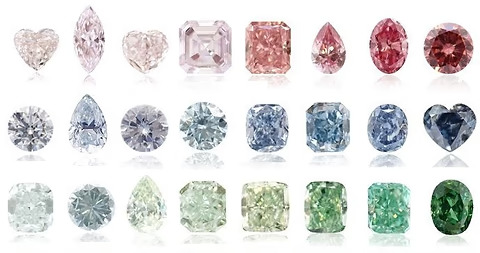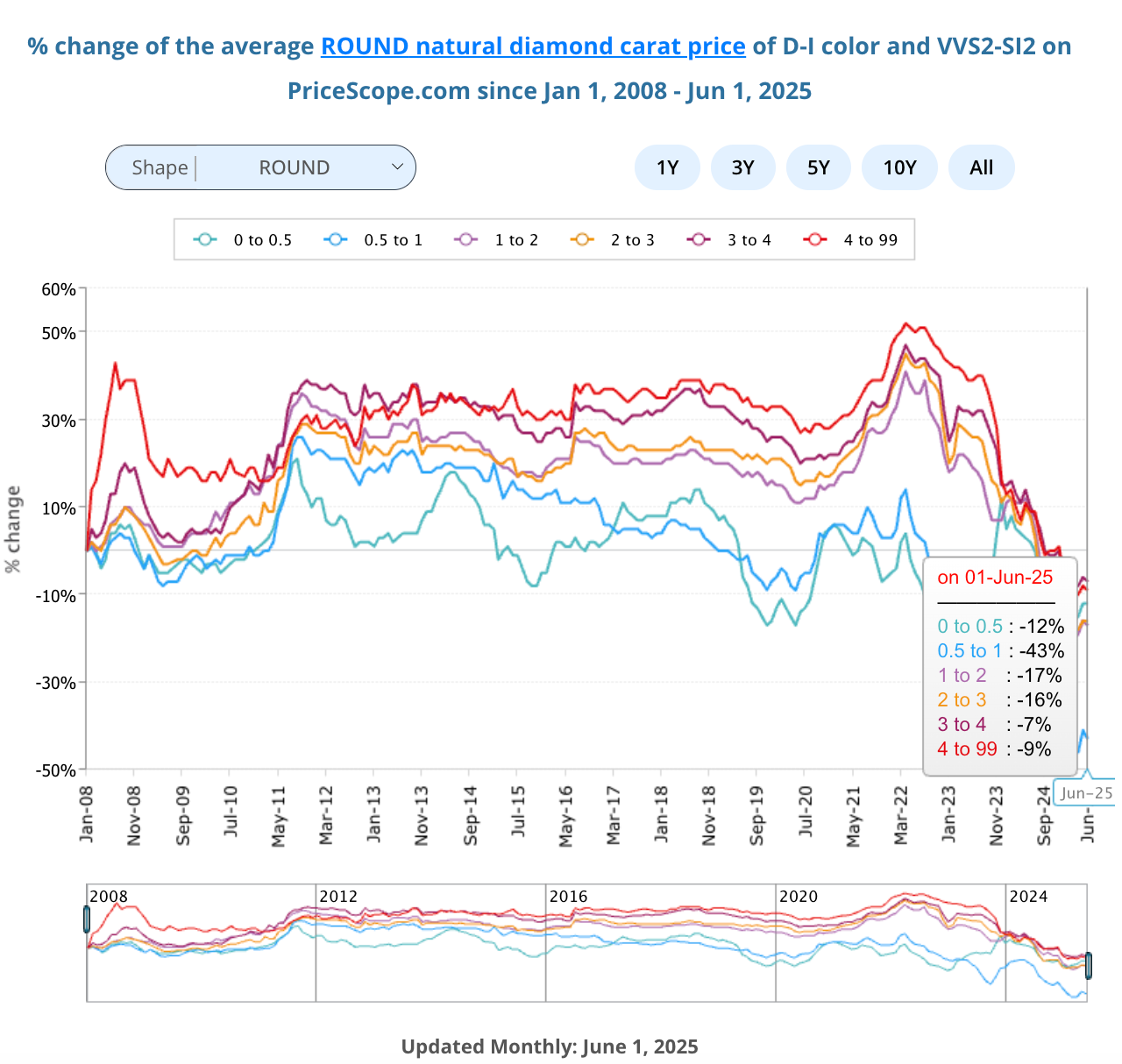

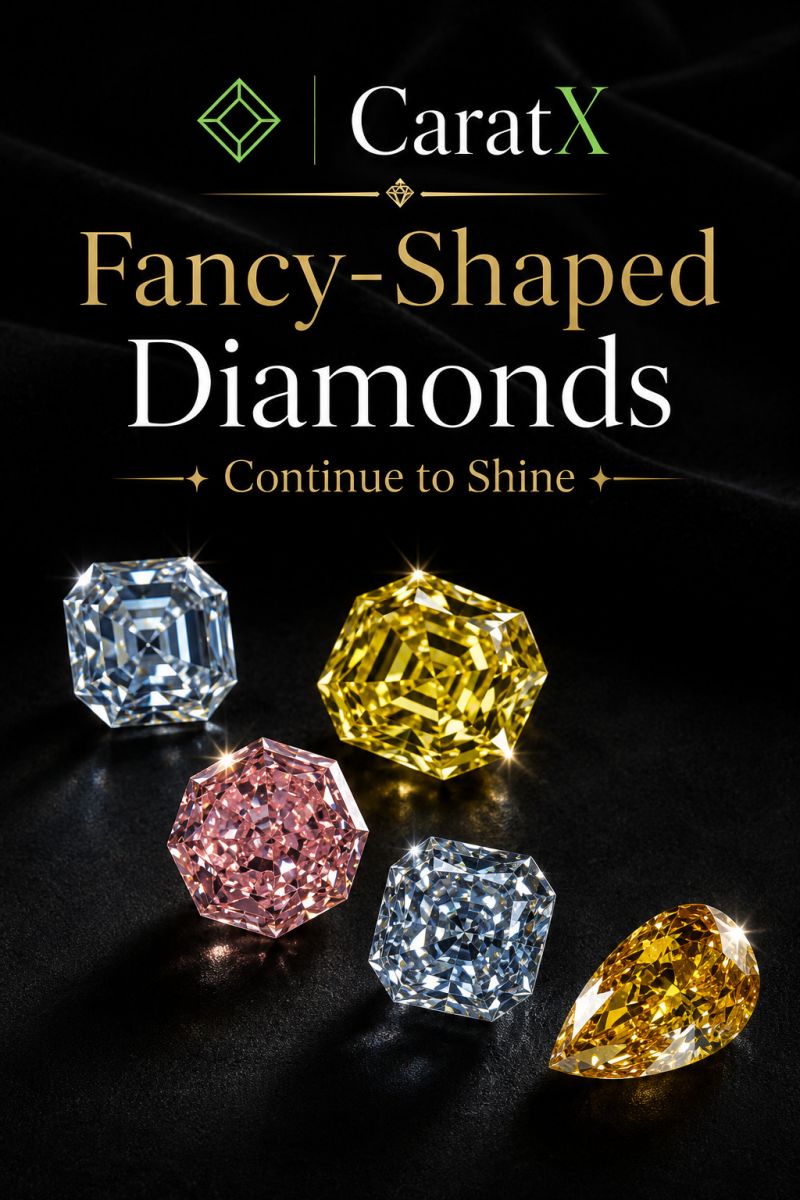
The diamond industry is witnessing one of its most dramatic transformations in decades. Whileround brilliant diamondshave long reigned as the undisputed kings of thegemstoneworld, a powerful new narrative is unfolding one where fancy-shaped diamonds, particularly elongated cuts, are not just competing but outperforming their traditional counterparts.
According to theGemological Institute of America's (GIA) 2025 Global Diamond Report, fancy-shaped diamonds now represent a commanding 52% of luxury purchases.
This analysis explores the forces driving this remarkable shift, examines which shapes are commanding premiums, and provides actionable insights for buyers, sellers, and investors navigating the evolving diamond landscape.
The Fancy Shape Revolution:
For decades, theround brilliant cutwas the undisputed champion of the diamond world, prized for its unparalleled brilliance and fire. However, contemporary buyers armed with more information and a stronger desire for individual expression are driving a decisive move toward unique silhouettes.
The data speaks clearly: for diamonds 2 carats and above, elongated fancy shapes likeOvals,Marquises,andEmeraldsare consistently outperforming rounds. This isn't a fleeting trend but a fundamental restructuring of consumer preferences that shows no signs of reversing.
Several interconnected factors explain this phenomenon:
Visual Perception: Elongated stones create the illusion of greater size on the finger compared to round stones of equal carat weight. The length draws the eye along the finger, enhancing perceived scale and creating a flattering, slimming effect. As noted by industry experts, these elongated diamonds "flatter the hand, creating a graceful and slimming effect on the finger".
Fashion Alignment: Contemporary jewelry design increasingly favors streamlined, elegant silhouettes that complement elongated shapes. This trend is amplified through social media and celebrity endorsements, making fancy shapes the preferred choice for modern engagement rings and statement jewelry.
Value Proposition: Consumers recognize that elongated shapes often retain more of the original rough crystal, potentially offering better value per carat compared to rounds, which lose more weight during cutting.
Scarcity: According to GIA supply analysis, only 3% of rough diamonds yield quality elongated shapes over 2 carats. This inherent scarcity drives value and creates a robust premium market.
Shape-by-Shape Analysis:
Marquise Diamonds:
TheMarquise cutwith its distinctive navette (boat-like) shape currently holds the title of the most expensive fancy shape. This isn't accidental. It results from a perfect storm of limited supply and intense demand.
The cut requires a specific type of rough diamond crystal to yield a well-proportioned stone without excessive weight loss. This inherent rarity, combined with its strong appeal to retailers designing statement pieces and collectors seeking unique assets, has propelled its value.
High-quality Marquisestones are extremely limited, and the shape requires expert cutting to avoid undesirable "bow-tie" effects. Good stones with proper symmetry and length-to-width ratios are rare, and collectors, designers, and retailers are actively searching for fineMarquise diamonds.According to industry sources, Marquise diamonds can currently price in at up to 15% more than their shorter fancy cut counterparts.
Market reports consistently confirm thathigh-quality Marquises, long Radiants, and long Cushions are in notably short supply. This scarcity directly translates to value, making Marquise diamonds a prime target for both collectors and investors.
Shop Marquise Cut Diamonds on CaratX:Browse Marquise Diamonds
Oval Diamonds:
Oval diamondshave sustained remarkable popularity, particularly in the U.S. market. They offer a versatile blend of brilliance and elongation that appeals to a broad range of consumers. According to recent market data, oval cuts are leading the way, making up more than 50% of all mount sales from bridal initiatives.
The most sought-after Oval specimens feature length-to-width ratios between 1.35 and 1.50, with premium prices for stones in the D-I color range and VS-SI clarity. Their rounded edges make them more practical for daily wear than sharper shapes.
In the U.S. market, Ovals with good shape and quality in D-I, VS-SI categories are experiencing solid demand.Ovalsare also trading at 5% to 10% premiums over Pear shapes in the U.S. market.
Best sellers are consistently 1.70 to 3 carat stones in Oval, Emerald, and Marquise shapes for bridal and gifting purposes.
Shop Oval Cut Diamonds on CaratX:Browse Oval Diamonds
Emerald Cut Diamonds:
Emerald cut diamondscontinue their steady demand, particularly in the step-cut category. Their clean lines and distinctive "hall of mirrors" effect attract buyers who appreciate architectural elegance over fiery brilliance.
The transparency ofEmerald cutsdemands higher clarity grades, making top-quality stones particularly scarce. In the UKengagement ringmarket of 2025, the Emerald cut diamond captured 7% of all diamond shapes sold, a notable increase from 6% in 2024.
Emerald cuts are prized for their understated glamour, though their large, open tables demand high clarity grades (VS+) to avoid visible inclusions. Despite this requirement or perhaps because of it, they remain a favorite among discerning buyers seeking sophistication over flash.
Elongated Emeralds in the 2.50 to 2.99 carat range are seeing particular demand, with stable prices reflecting consistent buyer interest.
Shop Emerald Cut Diamonds on CaratX:Browse Emerald Diamonds
Long Cushion and Radiant Cuts:
Long Cushion cutsare experiencing remarkable market success. They are easy to sell and are trading at a 20% to 25% premium over square Cushion versions.
This premium is a direct reflection of their elegant, flattering proportions on the finger and their superior rarity. A well-executed Long Cushion with a length-to-width ratio of approximately 1.15 to 1.35 now consistently achieves this significant premium over a square cushion of equivalent weight and quality.
Long Radiantsare also facing particularly tight supply. Both long Radiants and long Cushions are reported to be in notably short supply, making them even more attractive to buyers.
According to industry reports, "elongated fancy shapes are in high demand" with "Long Cushions selling very quickly, often trading at a 20% to 25% premium compared to square Cushions".
This premium reflects a clear consumer preference for the stretched aesthetic over traditional square proportions.
Shop Cushion Cut Diamonds on CaratX:Browse Cushion Diamonds
Shop Radiant Cut Diamonds on CaratX:Browse Radiant Diamonds
Princess Cut:
ThePrincess cutis making a notable comeback after a long period of lower demand. Recent market reports indicate renewed demand for Princesses after an extended period of weakness.
However, prices remain affordable, and the Princess cut continues to be positioned as a more accessible option for buyers seeking a modern, square silhouette. Market data shows that the Princess cut, once a mainstream favorite, declined from about 12% to 6% of engagement ring sales as Oval and other shapes took attention.
Nevertheless, thePrincess cutremains popular among customers seeking a modern appearance, with its sharp lines and strong brilliance suiting minimalist designs and contemporary engagement rings. Industry observers note that "it is a shape of fierce angles and uncompromised fire and in 2026, it is experiencing a powerful renaissance driven by buyers who want architectural lines without sacrificing brilliance".
Antique-Inspired Cuts:
Antique cuts and styles are increasingly hot in the current market. Buyers are drawn to the romantic, timeless appeal of vintage-inspired diamonds that offer character and distinction.
The elongated cushion cut, with its vintage-inspired rounded corners and pillow-like appearance, has seen increased popularity in recent years. While vintage-inspired, the elongation is a modern trend that has significantly boosted demand for these classical-meets-contemporary shapes.
This revival speaks to a broader consumer desire for uniqueness and individuality qualities that mass-produced, uniform shapes cannot provide.
The Cut Quality Imperative -
A critical theme emerging from the data is the overwhelming importance of cut quality. Very well-cut fancy shapes are difficult to find and commanding premiums.
Conversely, fancies with bad proportions are illiquid. This creates a bifurcated market where exceptional stones command substantial premiums while poorly cut stones struggle to find buyers.
As industry experts emphasize, "the quality of the cut is paramount; a poorly executed marquise can appear unbalanced or contain undesirable bow-tie effects". This principle applies across all fancy shapes: cut quality is non-negotiable for value retention and saleability.
For buyers, this means prioritizing cut quality above all else. For sellers, it means highlighting the superior proportions and craftsmanship of their inventory.
Regional Market Analysis:
The natural diamond market is showing positive signs across several countries, with stronger demand for popular diamond sizes and growing confidence among buyers.
United States: Strong Across Most Categories
The U.S. market is demonstrating strength across most diamond categories.Round natural diamondsbetween 1 and 2.99 carats are selling well, while 5-carat and larger diamonds are moving more slowly.
Retailers are actively preparing for the upcoming holiday shopping season, with mood positive for the season that begins in September. The wholesale market has remained steady through the summer vacation period, with contractors manufacturing for brands remaining busy and prices mostly stable.
Growing interest in low-color goods has been noted, and 1-carat and larger diamonds are seeing renewed demand. Independent jewelers are increasingly returning tonatural diamondsfollowing the drop in synthetic prices, with some consumers showing preference for natural stones as large lab-grown diamonds appear "inauthentic".
India: Surging Confidence and Demand
India's market confidence has improved significantly following the IIJS jewelry exhibition, which ended with positive reviews and upbeat domestic demand. The show saw strong traffic and trading, contributing to overall market optimism.
Demand remains strong, and manufacturers are carefully managing production to balance supply and demand. Very small diamonds (below 0.01 carat) are currently in short supply.
India has overtaken China and Japan to become the world's second-largest diamond jewellery market, capturing 12% of global demand, according to the 2025 Diamond Acquisition Study by De Beers Group. The domestic natural diamond jewellery market is valued at ₹49,700 crore and is projected to reach ₹150,000 crore by 2030.
Generation Z has emerged as the dominant force, with consumers aged 18-28 now accounting for 51% of market value up 19% since 2022. Combined with Millennials, these segments contribute 86% of total market value, signalling sustained, youth-led demand.
A significant structural shift is underway: daily wear now accounts for 52% of purchases, compared with just 27% in 2014. Outside bridal, 64% of natural diamond jewellery is self-purchased, driven by milestone spending and discretionary buying. Even within weddings, 79% of value is attributed to brides buying their own jewellery.
Hong Kong:
Hong Kong buyers are seeking round, oval, and pear-shaped diamonds with high color and clarity, especially for bridal jewelry. Investment buying of round diamonds in the 3 to 10 carat range with D-F color and IF-VVS clarity has been active.
Marquise, Oval, and Emerald cuts are commanding premiums, while goods under 1 carat remain slow and Princess cuts remain unpopular. Eye-clean Pears and rounds between 0.50 and 1.50 carat are popular for bridal purposes.
However, demand for smaller diamonds remains slower, and there has been less purchasing from Chinese buyers.
Belgium:
Trading is quiet in Belgium as the diamond industry is on its annual summer holiday. The market is officially in vacation mode until mid-August, with overall activity significantly slowed.
Israel: Slow Summer, Strategic Moves
Business activity is slow in Israel during the summer break. However, some companies are exploring new trade opportunities through Belgium, looking to benefit from 0% tariffs on imports to the U.S. market.
The Supply Side:
The rough diamond supply side provides important context for understanding fancy shape premiums. Global rough diamond output slipped nearly 8% in 2025, falling to 98.8 million carats, down from 107.9 million carats in 2024.
However, total value held up far better, slipping just 3.15% to $9.23 billion. The result: miners pulled fewer stones out of the ground, but each carat fetched more on average, with the worldwide price per carat climbing to $93.43 in 2025 from $88.35 the year before.
Russia mined 31.5 million carats in 2025, down 15.6% from 2024, while Botswana's output dropped to 15.5 million carats, yet the value of that output rose 45.5% to $1.98 billion. Botswana's average value per carat jumped to $127.66, up from $74.99 in 2024 a rise of over 70%.
India didn't mine a single carat of rough diamond but imported 106.1 million carats worth $11.07 billion in 2025 more than the combined production value of Russia, Botswana, and Angola put together. India now dominates global fancy shape output, giving buyers access to certified diamonds at 20 to 40 percent less than equivalent rounds.
Strategic Implications for Buyers and Sellers -
For Buyers -
Prioritize Cut Quality: Well-cut fancy shapes command premiums and retain value. Poorly cut stones are illiquid and difficult to sell.
Focus on Elongated Shapes: Long Cushions, Ovals, Marquises, and Radiants in the 2-carat-plus range offer the best value appreciation potential.
Consider Clarity Requirements: Emerald cuts demand higher clarity grades (VS+) due to their transparency. Factor this into your budget.
Explore Premium Shapes:Marquise diamondscurrently offer the highest premium potential among fancy shapes.
Shop Natural Diamonds on CaratX:Browse All Diamonds
Shop Gemstones on CaratX:Browse Gemstones
For Sellers -
Highlight Cut Quality: If you hold high-quality, elongated fancy shapes, emphasize the cut quality and proportions.
List Strategically: Premium fancies sell efficiently on platforms like CaratX that connect sellers with international buyers.
Monitor Regional Demand: The U.S. and India are showing the strongest demand; target these markets.
Consider Production Balance: With shortages of sought-after goods, controlling production to balance supply and demand is critical.
Register as a Seller on CaratX:Start Selling
Sell Jewelry Internationally:CaratX Seller Plan
Learn About Our Pricing:Pricing Details
Recommended Reads from CaratX -
Expand your understanding of the diamond market with these insightful resources from CaratX:
An Exhaustive Analysis of Fancy Shapes Surpassing Rounds & Strategic Opportunities for Buyers & Sellers— A comprehensive deep-dive into the fancy shape phenomenon, complete with strategic insights for both buyers and sellers.
The Rise of Elongated Diamonds: Market Trends, Pricing & Sourcing Guide— Explore the forces driving the elongation trend and understand the premium pricing dynamics.
Fancy Shape Diamonds: A Deep Dive into Market Trends, Consumer Preferences, and Strategic Insights— Comprehensive analysis of what's driving demand for specific shapes and how to navigate the evolving landscape.
The Reign of Elongation: Why Long Fancy Shapes are Dominating the 2025 Diamond Market— Detailed analysis of why elongated diamond shapes are significantly outperforming traditional rounds.
Frequently Asked Questions -
Q: Why are fancy-shaped diamonds becoming more popular than round diamonds? A: Fancy-shaped diamonds offer greater visual size perception, unique character, and often better value for money compared to traditional round brilliants. Contemporary buyers increasingly seek individual expression through unique silhouettes.
Q: Which fancy diamond shape is currently the most expensive? A: The Marquise cut currently holds the title of the most expensive fancy shape, driven by limited supply and intense demand.
Q: What premium do Long Cushion diamonds command over square Cushions? A: Long Cushion diamonds are trading at a 20% to 25% premium over square Cushion versions of equivalent weight and quality.
Q: Are Princess cut diamonds making a comeback? A: Yes. Recent market reports indicate renewed demand for Princess cuts after a long period of weakness, though prices remain affordable.
Q: Why is cut quality so important for fancy-shaped diamonds? A: Very well-cut fancy shapes are difficult to find and command premiums, while fancies with bad proportions are illiquid. Poorly executed cuts can appear unbalanced or contain undesirable effects like bow-tie patterns.
Q: Which regions are showing the strongest demand for natural diamonds? A: The United States and India are showing the strongest demand for quality diamonds. India has become the world's second-largest diamond jewellery market, capturing 12% of global demand.
Q: What sizes of fancy-shaped diamonds are performing best? A: Fancy-shaped diamonds in 2 carats and above are consistently outperforming rounds. Best sellers are in the 1.70 to 3 carat range.