
Introduction:
In the diamond trade, price is rarely a single number. It is a negotiation between four variables cut, carat, colour, and clarity and among those, colour and clarity are the two that most visibly separate a commodity stone from a premium asset.
A D-FL diamond and a D-I2 diamond can both weigh exactly 1.00 carat and both be round brilliants, yet the former can list at nearly 20 times the per-carat price of the latter. That is not a rounding error. That is the market speaking.
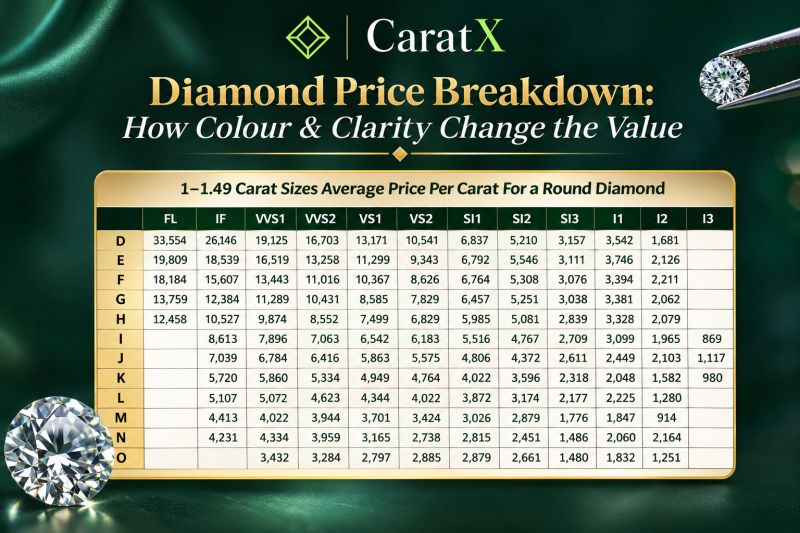
This breakdown uses average price-per-carat figures for 1.00–1.49 ct round diamondsto show exactly how the colour and clarity grades reshape value. It also places those numbers in the broader grading framework used by theGIAand the American Gem Society (AGS), and connects them to the supply-and-demand dynamics that B2B sellers and buyers are navigating in 2026.
If you are sourcing loose diamonds for inventory or evaluating a parcel for resale, understanding this spread is not academic. It is operational.
How Colour and Clarity Are Actually Graded -
Before the price data makes sense, the scales have to make sense.
The GIA Colour Scale: D to Z
The GIA colour scale runs from D (colourless) to Z (light yellow or brown). The evaluation is based on theabsenceof colour, measured against master stones under controlled lighting and precise viewing conditions. Many colour distinctions are invisible to the untrained eye, but they make a very big difference in diamond quality and price.
The GIA colour scale is the global reference point. Even labs that use their own systems such as AGS map their grades back to the GIA verbal descriptors so that the trade can compare stones across reports.
The Clarity Scale: FL to I3
The GIA clarity scale contains eleven grades: Flawless (FL), Internally Flawless (IF), VVS1, VVS2, VS1, VS2, SI1, SI2, I1, I2, and I3. Clarity is evaluated at 10× magnification, and the grade depends on the size, nature, number, location, and relief of inclusions and blemishes.
The American Gem Society adds a numerical layer to the GIA verbal scale a 0–10 deduction-based system where 0 is best but the underlying grades remain aligned: AGS 0 corresponds to FL/IF, AGS 1–2 to VVS, AGS 3–4 to VS, AGS 5–7 to SI, and AGS 7–10 to I1–I3. The Gemmological Association of Great Britain (Gem-A) also trains graders on the same internationally recognised colour and clarity standards, reinforcing how universal these benchmarks have become.
The Price Data: 1.00–1.49 ct Round Diamonds, by Colour and Clarity
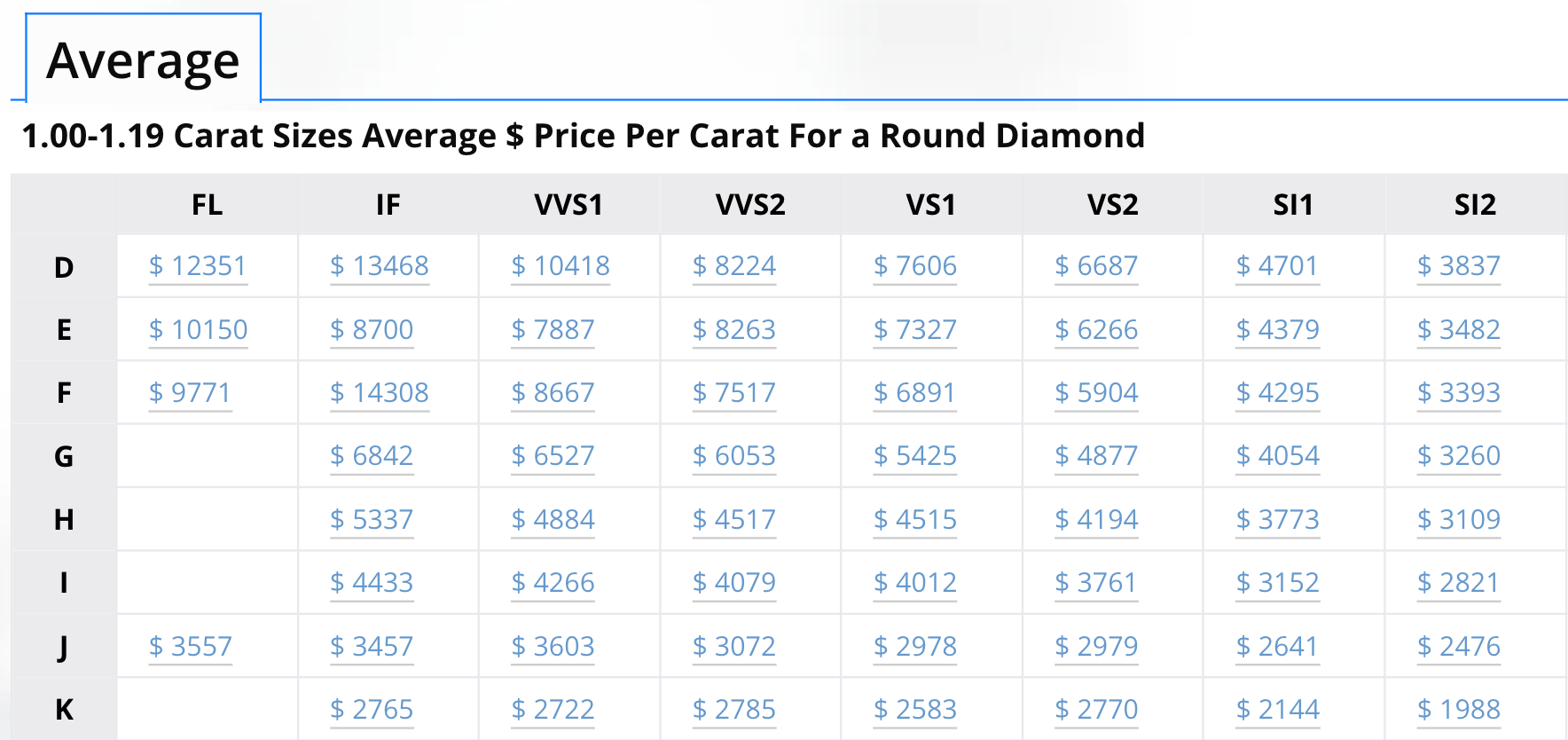
The following figures are average price per carat for 1.00–1.49 carat round diamonds, listed by colour and clarity grade. Treat them as market references, not fixed quotes actual transaction prices move with cut quality, fluorescence, certificate issuer, and parcel context. But as directional benchmarks, they are precise enough to reveal the structure of value.
Colour Clarity Price per Carat (USD)
D FL $33,554
D IF $26,146
D VVS1 $19,125
D VS1 $13,171
D SI1 $6,837
I I3 $869
The highest listed price D colour, FL clarity at $33,554 per carat is roughly 38.6× the lowest listed price I colour, I3 clarity at $869 per carat.
Even within the D colour grade alone, the step from FL to IF removes $7,408 per carat of value, and the step from IF to VVS1 removes another $7,021 per carat. By the time clarity falls to SI1, the D-colour stone is listing at $6,837 per carat still far above the bottom of the market, but a fraction of the flawless benchmark.
These spreads are not linear. They are curved, grade-dependent, and segment-specific, and that curvature is where the trading opportunity and the trading risk lives.
The Colour Premium: Why D Commands More and How Much More
GIA states the relationship plainly: colourless diamonds are scarce, mostdiamondshave tints of yellow or brown, and value and rarity are directly related a colourless diamond is rarer and more valuable than one with a slight yellow colour. The GIA colour scale exists precisely because those subtle differences dramatically affect diamond value, and two diamonds of the same clarity, weight, and cut can differ in value based on colour alone.
The D-colour price ladder in the dataset shows this compounding effect:
D-FL: $33,554/ct
D-IF: $26,146/ct (a 22% drop from FL)
D-VVS1: $19,125/ct (a 27% drop from IF)
D-VS1: $13,171/ct (a 31% drop from VVS1)
D-SI1: $6,837/ct (a 48% drop from VS1)
The lesson for B2B buyers is that the colour premium is not a flat tax. It is steepest at the top of the clarity ladder and flattens as clarity moves into the SI range. A D-SI1 is still a D-colour stone, but the market prices it as a clarity-compromised D and the discount reflects that hierarchy.
The Clarity Ladder: FL, IF, VVS, VS, SI, and I
Clarity moves price in the opposite direction higher clarity, higher price but the rate of change depends on where you sit on the scale. AGS defines the grades in practical terms:
FL/IF: No inclusions or blemishes visible under 10× (IF may have minor surface blemishes).
VVS1/VVS2: Minute inclusions difficult for a skilled grader to see under 10×.
VS1/VS2: Minor inclusions, visible under 10× but still relatively small.
SI1/SI2: Noticeable inclusions, fairly easy to see under 10×; sometimes visible to the unaided eye.
I1/I2/I3: Obvious inclusions at 10×; sometimes visible to the naked eye; at lower clarities, inclusions may affect durability.
The price dataset shows that the FL-to-IF step is one of the most expensive single-grade movements in the entire market. At D colour, moving from FL to IF costs $7,408 per carat a 22% reduction.
Moving from IF to VVS1 costs $7,021 per carat another 27% reduction. These are not marginal adjustments. They are structural re-pricings that reflect how the market weighs absolute rarity versus near-absolute rarity.
At the lower end, the I-grade stones tell the other side of the story. An I colour, I3 clarity diamond at $869 per carat is a commercial-grade stone. It is still a diamond, still graded, still sellable but it sits in a completely different value universe from the D-FL benchmark.
For sellers moving commercial parcels, this segment is volume-driven and highly sensitive to inventory availability and discounting pressure, which is why platforms that connect directly to international buyers such asCaratX’s B2B marketplacematter for margin preservation.
The 20× Gap: D-FL vs. D-I2 and What It Reveals
The dataset notes that a D-FL diamond is listed at almost 20 times the price per carat of a D-I2 diamond. That single ratio is one of the clearest statements of how the market prices rarity at the top and tolerance at the bottom.
Why does the gap exist?
Absolute rarity at FL. Flawless diamonds are the top of the GIA clarity scale and are exceptionally scarce relative to commercial-grade goods.
D colour is the scarcest colour grade. The D-to-Z scale measuresabsenceof colour, and D represents the complete absence of colour within the normal range.
The market prices “perfection” as a separate category. A D-FL is not simply “a better D-SI1.” It is a different product tier, often traded through different channels and held for different buyer profiles.
Clarity discounts accelerate at the bottom. The step from SI1 to I-grade clarity is where durability concerns and eye-visibility begin to enter the valuation, and the discount curve steepens accordingly.
For B2B sellers, the implication is strategic: do not treat the 20× gap as a linear gradient. It is a segmented market. A parcel of D-FL goods and a parcel of D-I2 goods may share a colour prefix, but they have different liquidity profiles, different buyer universes, and different price elasticity.
Market Context: What 2026 Data Says About Premium vs. Commercial Diamonds
The colour and clarity spread does not exist in a vacuum. It sits inside a diamond market that is bifurcating.
On the premium side, D–F colour diamonds with IF–VVS clarity account for 20.9% of all buyer searches yet represent only 14.6% of total available inventory a structural supply gap that supports premium pricing. Industry data shows that search demand forhigh-end natural diamondsin these categories exceeds supply by an estimated 30%–40%.
On the commercial side, the I–M colour, I1–I3 clarity segment represents 27.0% of inventory but only about 29.1% of search demand, and is described as experiencing market stagnation and heavy discounting.
De Beers’ 2026 production cuts and a 23% year-on-year fall in rough-diamond imports into India have tightened supply in some size categories, but the pressure on lower-value natural diamonds fromlab-grownalternatives remains real.
The takeaway is not that clarity and colour “matter more” in 2026. It is that the premium for top colour and clarity is being reinforced by a supply-demand mismatch, while the discount for lower clarity and colour is being reinforced by oversupply and alternative-product competition.
Sellers who understand which side of the bifurcation their inventory sits on can price more intelligently and route goods to the right buyer pools.
What This Means for B2B Buyers and Sellers -
For buyers sourcing inventory
Use the per-carat benchmarks as a negotiating frame, not a fixed quote. The D-FL at $33,554/ct and the I-I3 at $869/ct are anchors; the actual transaction price will depend on cut, fluorescence, certificate, and parcel size.
Target the supply gap. D–F / IF–VVS goods are in structural shortage relative to search demand. If your buyer base is premium,CaratX’s loose diamond inventoryis filterable by colour, clarity, and shape so you can isolate the grades that command the strongest pricing power.
Do not ignore the mid-segment. G–J colour, VS–SI clarity goods make up 58.4% of total supply and remain the volume engine of the wholesale market but they face slower turnover and heavier discounting than premium goods.
For sellers listing on a marketplace -
Certification is a price multiplier. GIA- and AGS-graded stones carry a credibility premium because the grading scales are universally understood. If you are listing on a B2B platform, lead with the certificate.
Colour and clarity are not the only variables. Fluorescence, cut grade, and polish/symmetry can move the realised price within a grade band. A D-FL with strong blue fluorescence may price differently from a D-FL with none, even though both are “D-FL” on paper.
International reach changes the buyer pool - CaratXconnects sellers to buyers in 18+ countries, which matters for premium goods that may be scarce in one market but in demand in another. If you are still selling only domestically, you are pricing against a smaller demand curve.
Frequently Asked Questions -
Q: Is a D-colour diamond always worth more than an E-colour diamond? In the normal colour range, yes D is the highest colour grade on the GIA scale and represents the scarcest level of colourlessness. But thesizeof the premium depends on clarity, cut, and market segment. A D-SI1 may not command the same premium over an E-VS1 that a D-FL commands over an E-FL.
Q: How much does clarity actually change the price per carat? It depends on where you are on the scale. At D colour, the FL-to-IF step in this dataset is a $7,408/ct difference; the IF-to-VVS1 step is $7,021/ct; the VS1-to-SI1 step is $6,334/ct. The discounts are not uniform, and the steepest absolute drops occur at the top of the clarity ladder.
Q: Why is an I-clarity diamond so much cheaper? I-grade clarity includes obvious inclusions at 10× magnification, sometimes visible to the naked eye, and at the lower end may affect durability. The market prices these stones as commercial-grade goods, and the discount reflects both visual difference and the larger supply of lower-clarity inventory.
Q: Are these prices fixed? No. The figures are average price-per-carat references for 1.00–1.49 ct round diamonds. Actual prices vary with cut quality, fluorescence, certificate issuer, parcel size, and the specific buyer-seller relationship. Use them as directional benchmarks, not as binding quotes.
Q: Does the certificate issuer affect the price within the same grade? Yes. A GIA or AGS report carries more market recognition than a less-known lab report, and stones with widely recognised certificates tend to command stronger pricing and faster liquidity. The grading scales are standardised, but the credibility of the certificate is part of the value proposition.
Q: Where can I source or sell diamonds across these grades? CaratX lists natural diamonds, gemstones, and jewellery from sellers in multiple countries, with filters for colour, clarity, shape, and carat weight. Sellers canregister on CaratXto access B2B and B2C buyers internationally.
Recommended Reads from CaratX -
The Art of Buying Loose Diamonds: Your Buyer’s Guide— a step-by-step walkthrough of the 4Cs, certification, and the buying process for loose stones.
Understanding Today’s Diamond Inventory Landscape— a data-driven look at the supply-demand gap between premium and commercial diamond segments.
Market Insight: Small Diamonds Rebound as Supply Tightens— how size-segment dynamics interact with colour and clarity pricing.
Global Diamond Markets Show Growing Confidence After Las Vegas— regional demand trends for D–I colour, VS–SI clarity goods.
How CaratX Is Revolutionizing the Jewelry Supply Chain— why direct marketplace access changes the markup structure on graded diamonds.
Bottom line: Colour and clarity are not abstract grades, they are price multipliers with a documented, data-backed spread. The D-FL benchmark sits at $33,554 per carat; the I-I3 benchmark sits at $869 per carat.
Between those two points is a segmented market where rarity, supply, and certificate credibility determine where any individual stone lands. For B2B professionals, the advantage goes to those who price against the curve not against a single grade.