
Global retail sales of lab-grown diamond jewelry reached an estimated $23.8 billion in 2025, according to diamond industry analyst Edahn Golan, a figure that confirms lab-grown stones have moved from niche alternative to a central pillar of the modern jewelry economy. But behind that headline number lies a far more complicated story: one of collapsing wholesale prices, a dramatic redistribution of profit along the value chain, India’s rise to production dominance, and a consumer shift toward larger, bolderengagement ringsthat shows no sign of reversing.
For sellers, buyers, and industry observers alike, understanding the 2025 lab-grown diamond market is no longer optional. It is the price of admission. This deep-dive breaks down the numbers, the geography, the money flow, and the consumer behavior with practical guidance on where the real opportunities sit in 2026 and beyond.
The $23.8 Billion Milestone:
The $23.8 billion figure represents global retail sales of finishedlab-grown diamond jewelryin 2025. To put that in context, independent market research houses have valued the broader lab-grown diamond market including loose stones and industrial applications anywhere between $22.45 billion and $34.1 billion in 2025, depending on methodology and scope. The variation is less a contradiction than a reflection of how quickly the category is evolving: different analysts are measuring different slices of the same rapidly expanding pie.
What matters for jewelry professionals is the direction of travel. The Dubai Multi-Commodities Centre (DMCC), in itsFuture of Trade: Special Lab-Grown Diamond Editionreport, estimated the market for createddiamond jewelryat $25 billion–$35 billion in 2025 and projected that it could double by 2030. Even under conservative assumptions, lab-grown is no longer a marginal experiment. It is a mature, global consumer category.
The volume data tell the same story from a different angle. Global production of gem-qualitylab-grown diamondsreached an estimated record 69.4 million carats in 2025, according to Golan’s value-chain report roughly 30% below the 98.8 million carats of natural rough mined, but growing at a pace that natural supply cannot match. The stones are being made, polished, set, and sold at a scale that would have seemed implausible a decade ago.
India’s Ascent:
One of the most consequential shifts in the 2025 market was geographic. India overtook China as the world’s largest producer of gem-quality lab-grown diamonds by volume, producing about 8% more carats than its northern neighbor. This is a structural change with long-term implications for pricing, supply security, and trade flows.
The numbers behind India’s rise are staggering. Kira, part of the Kiran family, expanded its production capacity from 2,600 to 4,000 chemical vapor deposition (CVD) reactors, cementing its position as the world’s largest grower of lab-grown diamonds and producing over 250,000 polished carats every month.
Greenlab, another Indian producer, purchased more than 1,100 new growing machines to scale output. And India already handles the cutting and polishing of more than 90% of the world’s diamonds natural and lab-grown alike.
The geographic concentration is not without risk. India’s production boom, combined with China’s earlier capacity expansion, contributed to the wholesale price collapse that defined the 2025 market. But it has also made India the indispensable node in the lab-grown supply chain: if a lab-grown diamond is sold anywhere in the world, the odds are overwhelming that it passed through Surat or Mumbai at some point.
For international buyers sourcing lab-grown inventory, understanding Indian production economics is no longer optional, it is the baseline. CaratX connects buyers directly to verified sellers across this ecosystem, withcertified lab-grown diamondslisted by vetted suppliers.
The Value Chain Reality: Producers Keep 5%, Retailers Capture the Rest
The most important and most uncomfortable number in the 2025 lab-grown diamond story is this: diamond growers received only about 5% of the total market value, while retailers earned the largest share. The producer economics are brutal by any historical standard.
The raw math from Golan’s value-chain analysis makes the disparity concrete. Producing 69.4 million carats of gem-quality lab-grown rough in 2025 cost an estimated $753 million, or $10.85 per carat. That rough was valued at $1.13 billion, or about $16 per carat a modest margin at the production stage.
By contrast, natural rough averaged about $93 per carat at the mine. Cutting and polishing the lab-grown rough cost an estimated $1.23 billion more than the value of the rough itself.
Most of the retail value is added close to the consumer. The lab-grown diamond content offinished jewelrywas valued at $12.4 billion at retail in 2025, nearly three times what retailers paid for those stones, while total retail sales of the jewelry containing them reached $23.78 billion. Retailers like Signet Jewelers captured 73% gross margins on lab-grown diamonds, profiting from the boom while producers faced commodity-like price erosion and capacity overruns.
Independent analyst Paul Zimnisky estimates retailers capture a markup of more than 80% above wholesale, and even that may understate the gap at the high end of the market.
This asymmetry is not a moral failing of retailers; it is the predictable outcome of a supply chain in which production has been commoditized while consumer-facing brand, trust, and distribution have not. But it has profound implications for anyone entering the lab-grown space. Value capture is a retail and brand problem, not a growing problem.
Sellers who list on marketplaces likeCaratXcan access international buyers directly, bypassing some of the traditional layers that compress producer margins. For jewelers and brands looking to sellfinished lab-grown jewelryinternationally,CaratX’s seller planprovides a storefront and cross-border payment infrastructure built for this exact shift.
Consumer Demand: Engagement Rings, Everyday Jewelry, and the “Bigger Stone” Effect
If the supply side of the lab-grown market is defined by oversupply and margin compression, the demand side is defined by something closer to liberation. Consumers particularly in the United States have embraced lab-grown diamonds at a pace that has surprised even bullish forecasters.
In 2025, lab-grown diamonds accounted for 53% of diamond engagement rings sold in the U.S., according to Golan’s analysis, though they represented only 27% of engagement-ring sales value because of their lower price points.
Other industry surveys put the penetration even higher: BriteCo’s 2025 report found that 48% of engagement rings contained lab-grown stones, while Taylor & Hart reported that 70% of couples choosing an engagement ring in 2025 selected a lab-grown diamond, up 14 percentage points from 2024.
The variation across surveys reflects differences in sampling and definition, but the directional consensus is unmistakable: lab-grown has become the default choice for a substantial and likely majority share ofU.S. engagement-ringbuyers.
The affordability dividend is the primary driver. In 2025, the average price of a lab-grown 1-carat diamond was around $1,000 or less, compared with an average of $4,200 for a natural 1-carat stone.
That gap has allowed consumers to buy larger stones for the same budget. The average size of a lab-grown center diamond for an engagement ring increased from 1.31 carats in 2019 to 2.45 carats in 2025, according to BriteCo. Golan’s data shows the average loose lab-grown diamond reaching 2.26 carats, with the average spending on a lab-grown-set engagement ring falling nearly 8% to $2,448 even as the stones got bigger.
This “bigger stone” effect is not limited to bridal. Lab-grown diamonds are increasingly being used in everyday jewelry pendants, studs, tennis bracelets, andfashion-forward pieceswhere consumers prioritize design and visual impact over long-term resale value. CaratX’s marketplace reflects this shift, with a growing catalog oflab-grown diamond jewelryandloose gemstonesspanning a wide range of shapes, colors, and price points.
Why the Price Collapse Matters -
Wholesale lab-grown diamond prices fell sharply in 2025. Stones of 1 carat and above declined 13% year over year in midstream trading, while 3-carat stones dropped 47%. By the end of the year, wholesale prices across sizes had converged around $100 per carat in Surat and Mumbai, though the pace of decline slowed and continued to moderate into 2026. From the 2018 peak, wholesale lab-grown prices have fallen by roughly 96%, according to some measures.
For producers, this is an existential margin problem. For retailers and consumers, it is a different story. Falling wholesale prices mean higher retail margins and more affordable finished jewelry, even as the absolute dollar value of the category grows. The lab-grown diamond market is not shrinking; it is repricing.
Unit sales of lab-grown items at U.S. specialty jewelers rose 25% in 2025, while revenue increased 20% a sign that volume growth is more than offsetting price deflation at the retail level.
The risk for retailers is inventory. Golan’s report flags a potential concern: retailers’ unit purchases of finished lab-grown jewelry increased 33%, versus a 25% rise in unit sales to consumers a disparity that points to inventory buildup during 2025, leaving retailers holding merchandise that can lose value as wholesale prices decline.
Inventory discipline is now a core competency in the lab-grown trade, not a back-office afterthought.
The Global Demand Map: The U.S. Still Dominates, but China and India Are Closing the Gap
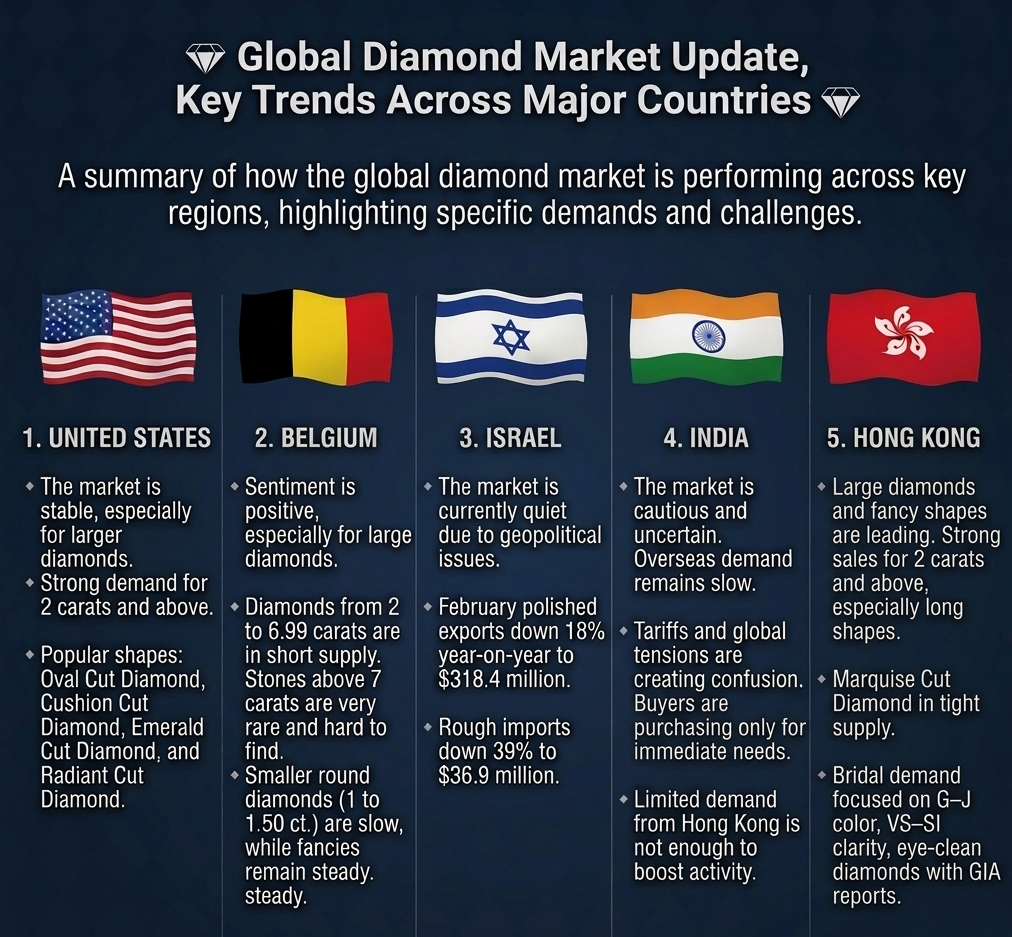
The United States remains the lab-grown diamond market’s indispensable consumer. In 2025, the U.S. accounted for an estimated 73% of global lab-grown diamond demand, according to Golan down from more than 80% several years earlier, but still nearly three-quarters of the world’s consumer spending on the category.
That dominance is both an opportunity and a concentration risk. For international sellers, U.S. buyers are the primary target; for the category as a whole, diversification beyond the U.S. is essential for long-term health.
The diversification is already underway. China represented 8% of global demand in 2025, and India represented 5.5% both figures up meaningfully from prior years. India’s domestic lab-grown jewelry market is still nascent relative to its production capacity, but rising incomes, a young population, and growing acceptance of lab-grown stones in bridal and fashion jewelry suggest significant upside.
China’s market is more complex, shaped by a strong domestic production base and a consumer culture that has historically placed heavy emphasis on natural diamond rarity, but the affordability and design flexibility of lab-grown are gaining traction, particularly among younger urban consumers.
For sellers looking to reach buyers across these regions, CaratX connects sellers to buyers in over 18 countries, providing a single marketplace where U.S., European, Asian, and Middle Eastern buyers can source lab-grown diamonds and jewelry directly. The platform’s cross-border infrastructure reduces the friction that has historically kept smaller producers and brands out of international trade.
What the 2025 Data Means for Sellers, Buyers, and the Industry’s Next Chapter -
The 2025 lab-grown diamond market is not a simple growth story. It is a repricing story, a redistribution story, and a maturation story all at once.
For producers, the message is that volume growth alone will not solve the margin problem. Differentiation through quality, certification, traceability, and direct-to-buyer distribution is the only path to capturing more than the commodity sliver of the value chain. Producers who list directly on marketplaces like CaratX can shorten the distance between their factory floor and the buyer’s counter.
For retailers and brands, the opportunity is in the gap between wholesale cost and consumer willingness to pay.Lab-grown diamondsoffer higher gross margins than natural diamonds at most price points, and consumers have demonstrated that they will pay for design, brand trust, and a compelling story even as the underlying stone becomes cheaper.
The risk is inventory obsolescence: falling wholesale prices mean that yesterday’s stock can become tomorrow’s markdown. Just-in-time sourcing and access to live marketplace pricing are no longer luxuries; they are survival tools.
For buyers, 2025 was the year lab-grown diamonds became undeniably mainstream. The combination of affordability, size, and ethical positioning has made lab-grown the rational choice for a growing share of jewelry purchases, from engagement rings to everyday pieces.
The remaining barrier is not desire but trust: buyers need confidence that the stone they purchase is correctly graded, transparently sourced, and fairly priced. Marketplaces that prioritize certification and seller verification like CaratX are positioned to capture that trust.
For the industry as a whole, the $23.8 billion milestone is a threshold, not a destination. The DMCC projects the category could double by 2030. Whether that growth is profitable for the majority of participants or concentrated in the hands of a few retail winners depends on how the value chain evolves from here. The producers who move closer to the consumer, the retailers who manage inventory intelligently, and the marketplaces that reduce friction and build trust will be the ones who capture the next wave of value.
Frequently Asked Questions -
Is the $23.8 billion figure for lab-grown diamond jewelry sales or the entire lab-grown diamond market? The $23.8 billion figure refers specifically to global retail sales of finished lab-grown diamond jewelry in 2025, as reported by Edahn Golan. The broader lab-grown diamond market including loose stones and industrial applications is estimated at between $22.45 billion and $34.1 billion depending on the research methodology.
Why do diamond growers only receive 5% of the market value? The 5% figure reflects the commoditization of lab-grown diamond production. Wholesale prices have collapsed as production capacity particularly in India and China has expanded faster than retail demand. Most of the value is added at the retail stage through branding, design, certification, and the consumer experience. Retailers capture the largest share because they control access to the end customer.
Is India really the largest producer of gem-quality lab-grown diamonds? Yes. In 2025, India produced about 8% more carats of gem-quality lab-grown diamonds than China, according to Golan’s value-chain report. India also polishes virtually all of the world’s lab-grown diamonds and is home to the world’s largest individual growers, including Kira, which operates 4,000 CVD reactors.
Are lab-grown diamonds actually more sustainable than mined diamonds? The answer is conditional. Lab-grown diamonds can have a significantly lower environmental footprint than mined diamonds, particularly when produced with renewable energy. Pandora reports a carbon footprint of approximately 12.58 kgCO₂e per carat, about 90% lower than mined alternatives, but researchers emphasize that the footprint varies widely depending on the energy source and production methods. Verifiable sustainability claims are essential.
What is the biggest risk for retailers selling lab-grown diamonds in 2026? Inventory risk. Falling wholesale prices mean that stock purchased at one price can lose value quickly. Retailers need access to live pricing, just-in-time sourcing, and flexible inventory management to avoid being caught with merchandise that must be marked down.
How can sellers reach international buyers for lab-grown diamonds and jewelry? Marketplaces like CaratX connect sellers to buyers in over 18 countries, with storefronts, cross-border payment infrastructure, and a buyer base that includes both B2B and B2C channels. Sellers can register atwww.caratx.com/registerto start listing products and accessing international demand.
Recommended Reads from CaratX -
Global Diamond Markets Show Growing Confidence After Las Vegas: The 2026 Recovery Takes Shape— A regional deep-dive into post-Vegas market dynamics, the bifurcation between high-end and mid-tier stones, and what it means for lab-grown and natural inventory strategies.
Lab-Grown Diamonds Reach 42% Market Share in 2025: Industry Shift Explained— A closer look at the penetration data behind the lab-grown surge, with charts and category-level analysis.
Shop Certified Lab-Grown Diamonds on CaratX— Browse IGI- and GIA-certified lab-grown diamonds across shapes, sizes, and colors, with direct seller contact and international shipping options.
Launch Your Products on CaratX— Pricing, plans, and onboarding details for sellers who want to reach B2B and B2C buyers in 18+ countries.