
Why Length-to-Width Ratio Is the Most Overlooked Metric in Diamond Buying
When most buyers walk into a jewelry store or browse an online marketplace, they focus on the 4Cs carat, color, clarity, and cut. But there's a fifth dimension that quietly determines whether a diamond looks elegant or awkward, elongated or stubby, graceful or clumsy: the length-to-width (L/W) ratio.
The L/W ratio is a simple numerical expression of a diamond's outline, its length divided by its width, measured in millimeters. A ratio of 1.50 means the diamond is 50% longer than it is wide. A ratio of 1.00 means it's perfectly square or round.
But here's what makes this metric so powerful: the L/W ratio is the single most important factor in how a diamond's shape "reads" to the human eye. Two diamonds with identical carat weight, color, and clarity can look completely different one elegant and elongated, the other squat and unbalanced solely because of their proportions.
This isn't just marketing talk. TheGemological Institute of America (GIA), the world's foremost authority on diamond grading, has studied shape preferences. A landmark GIA survey found that consumers and trade professionals consistently prefer elongated shapes but the "ideal" ratio varies dramatically by shape, and sometimes even by personal preference and cultural market.
For sellers on platforms likeCaratX, understanding L/W ratio is equally critical. Diamonds with "premium" ratios command higher prices and sell faster. Shapes with awkward proportions sit in inventory longer, regardless of their color or clarity grades.
This guide breaks down every major diamond shape's ratio ranges, explains what each ratio actually looks like, and shows you how to use this knowledge to buy smarter or sell more effectively.
What Exactly Is the Length-to-Width Ratio?
The L/W ratio is calculated by dividing a diamond's length by its width:
Length ÷ Width = Length-to-Width Ratio
For example, a diamond measuring 10.0 mm in length and 7.0 mm in width has an L/W ratio of 1.43. A diamond measuring 6.5 mm by 6.5 mm has a ratio of 1.00.
These measurements appear on every diamond's grading report. GIA reports list fancy shapes as "length × width × depth" in millimeters, whileround brilliantsare listed as "minimum diameter × maximum diameter × depth."
Here's the key insight: the L/W ratio tells you nothing about the diamond's quality in terms of cut, color, or clarity. A poorly cut diamond with a perfect 1.40 ratio is still a poorly cut diamond. But the ratio does tell you something equally important what the diamond will actually look like on a hand, in a setting, and from across the room.
A higher ratio creates a longer, more slender appearance. A lower ratio creates a more square or compact look. Neither is inherently "better" but each creates a distinctly different visual effect, and some ratios are more universally flattering than others.
Shape-by-Shape Deep Dive -
Oval Diamonds:
Theoval diamondhas become the dominant fancy shape in the global market, and for good reason. Its elongated form creates the illusion of greater size an oval of the same carat weight as a round brilliant will appear larger on the finger because its weight is distributed across a longer vertical axis.
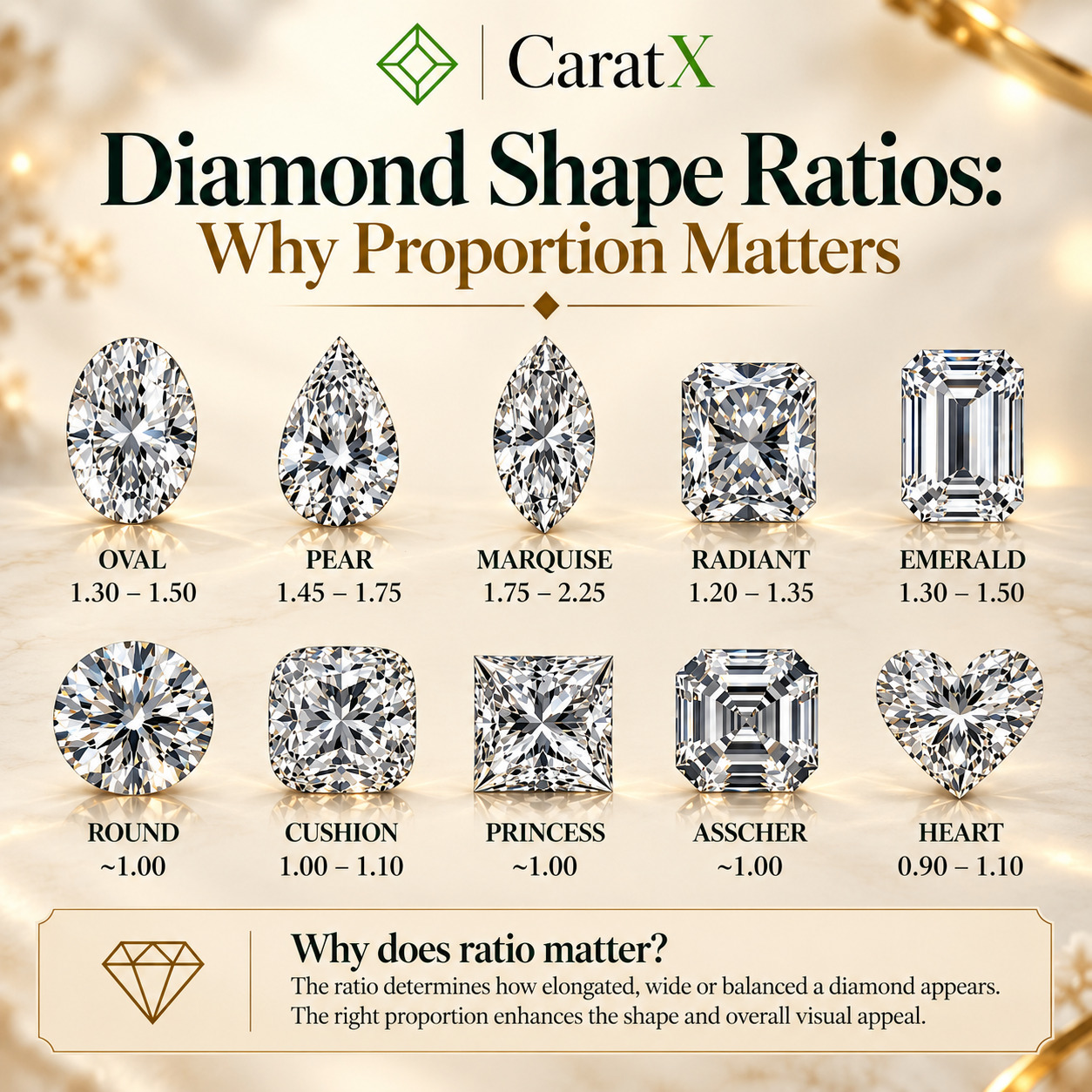
The sweet spot for oval diamonds is 1.35 to 1.50. GIA research reveals that consumers and trade professionals tend to prefer longer ovals, with the most popular ratio being 1.7:1 in an idealized survey setting. However, GIA also notes that such elongated ovals are impractical to cut from most rough diamonds, making them extremely rare. More commonly available ovals fall in the 1.3:1 to 1.4:1 range.
AtCaratX, we observe that the most sought-after ovals in the current market feature L/W ratios between 1.35 and 1.50, with strong preference for D–I color and VS–SI clarity. These ratios create a silhouette that flatters the finger while maintaining the brilliant faceting pattern 57 facets inherited from the round brilliant that gives ovals their exceptional fire.
Ovalsbelow 1.25 tend to look "fat" or roundish, losing the elongating effect that makes them special.Ovalsabove 1.60 can develop a pronounced "bow-tie" effect a dark, bow-shaped shadow across the center because the facets across the width become too stretched.
For buyers seeking premium oval diamonds, explore ourcurated Oval Diamond collection.
Always view an oval diamond in person or through high-resolution video. The L/W ratio tells you the outline, but the "bow-tie effect" and facet symmetry require visual inspection.
Pear Diamonds: The Teardrop with Drama
Thepear-shaped diamondalso called the pendeloque or drop cut is a hybrid of the round brilliant and the marquise. It combines brilliant faceting with a pointed tip that creates a dramatic, elongated silhouette.
The recommended L/W ratio for pears is 1.45 to 1.75. GIA's buying guidance notes that many experts prefer ratios in the 1.50–1.75 range, though personal preference plays a significant role.
The pear's unique geometry means the L/W ratio has an outsized impact on visual balance. At 1.45, the pear looks full and rounded almost like a lopsided oval. At 1.75, it becomes a dramatic, slender teardrop with a long, sweeping line. Both are beautiful, but they appeal to very different aesthetics.
Critical buying consideration for pears: Symmetry. Because the pear has only one axis of symmetry (running from tip to rounded end), any unevenness in the "shoulders" or "wings" becomes immediately visible. GIA graders specifically evaluate whether the two halves mirror each other, and asymmetry in a pear even with a perfect L/W ratio can significantly reduce its appeal.
Pear shapesare currently experiencing a renaissance, particularly in the 2–3 carat range. At CaratX, we've noted that pears trade at a 5–10% discount compared to ovals of comparable quality, making them an exceptional value proposition.
Explore ourPear Diamond Collectionto see how different ratios look in real inventory.
Forpear shapes, the L/W ratio should be paired with careful inspection of the "point." An uneven point, a thick point, or a point with inclusions near the tip are all quality detractors that the L/W ratio alone won't reveal.
Marquise Diamonds: Maximum Elongation, Maximum Impact
The marquise also called the "navette" (French for "little ship") is the most dramatically elongated of all diamond shapes. Its boat-like outline with points at both ends creates the largest perceived size of any shape, often appearing 30–40% larger than a round brilliant of the same carat weight.
The recommended L/W ratio for marquise is 1.75 to 2.25. At the low end (1.75), themarquiselooks refined and balanced, a classic "navette" silhouette. At the high end (2.25), it becomes extremely elongated, creating a dramatic, almost needle-like appearance.
Marquise diamondsare currently the most expensive fancy shape on the market not because they're inherently more beautiful, but because high-quality marquises with symmetrical wings, minimal bow-tie effect, and no "undesirable" inclusions are in critically short supply. The elongated L/W ratio required for a proper marquise means more rough diamond must be sacrificed during cutting, driving up cost.
What makes a great marquise: Symmetry is paramount. The two points should be perfectly aligned, the two "wings" (the curved sides) should mirror each other, and the belly of the stone should be evenly proportioned. A marquise with a beautiful L/W ratio but asymmetrical wings will look "off" from every angle.
Marquise diamondsare particularly sensitive to the bow-tie effect. Because of their extreme elongation, the facets across the width are highly susceptible to creating dark zones. Look for marquises where the bow-tie is minimal and the wings sparkle with even brilliance.
View ourMarquise Diamond Collectionfor examples of well-proportioned stones.
Emerald Cut Diamonds:
Theemerald cutis the quintessential step cut a rectangular shape with trimmed corners and concentric rows of parallel facets that create a "hall of mirrors" effect. Unlike brilliant cuts, which hide imperfections with sparkle, emerald cuts reveal clarity. This makes them the most demanding shape in terms of clarity grading.
The classic emerald cut L/W ratio is 1.30 to 1.50. Around 1.30–1.40, the emerald looks squarer and chunkier. At 1.50, it becomes the classic elongated emerald sleek, sophisticated, and reminiscent of Art Deco elegance.
Emerald cutshave a distinct visual characteristic: their large, open table means that color is more visible than in brilliant cuts. A G-color emerald will show noticeably more warmth than a G-color round brilliant, which is why CaratX recommends targeting F color or higher for emerald cuts to achieve a truly "icy" appearance.
The L/W ratio of an emerald cut should be considered alongside its clarity. Because the step-cut facets act like windows, any inclusion near the center of the stone becomes immediately visible.
Explore ourEmerald Cut Diamond Collectionfor high-clarity options.
Radiant Cut Diamonds:
Theradiant cutis a brilliant-step hybrid, it combines the rectangular outline of an emerald cut with the brilliant faceting pattern of a round cut. The result is a shape that offers both the elegance of a step cut and the sparkle of a brilliant cut.
The recommended L/W ratio for radiant is 1.20 to 1.35. A radiant at 1.00–1.10 is essentially square, while a radiant at 1.50 or above becomes a distinctly rectangular "elongated radiant."
The market for radiants has bifurcated. Square radiants (L/W ratio 1.00–1.10) have stable but unspectacular demand. Elongated radiants (L/W ratio 1.40+) are experiencing a surge in popularity, as buyers recognize that the elongated silhouette offers the visual size benefit of an oval or emerald with the sparkle of a round brilliant.
For square radiants, look for L/W ratios between 1.00 and 1.05 beyond that, the stone will look visibly rectangular rather than square. For elongated radiants, 1.40–1.60 creates the most flattering silhouette.
Browse ourRadiant Diamond Collectionto see both square and elongated options.
Cushion Cut Diamonds:
Thecushion cutoften called the "pillow cut" is one of the oldest diamond shapes, dating back to the 19th century. Its soft, rounded corners and plump appearance create a romantic, vintage feel.
The recommended L/W ratio for cushion is 1.00 to 1.10. A cushion at 1.00–1.05 is essentially square. A cushion at 1.10–1.20 is slightly rectangular. Anything above 1.20 becomes a "long cushion" a distinct subcategory that has gained significant market traction.
Long cushions are currently trading at a 20–25% premium over square cushions because they combine the antique romance of the cushion cut with the elongating effect of a radiant or oval. They're described by market analysts as "easy to sell" a rare combination of trend appeal and classic charm.
Cushion cuts come in two faceting styles "crushed ice" (smaller, more numerous facets creating a shattered-glass sparkle) and "chunky" (larger facets creating bolder, more geometric flashes).
The L/W ratio doesn't tell you which you're getting, so always ask for video or in-person viewing. Explore ourCushion Cut Diamond Collection.
Princess Cut and Asscher: The Square Shapes
Bothprincessand Asscher cuts are designed to be square, with L/W ratios around 1.00. However, slight variations exist:
Princess cut: A square princess cut should have an L/W ratio not exceeding 1.05:1. Rectangular princess cuts can have ratios up to 1.25:1, but these are less common and often less desirable.
Asscher cut: The Asscher is a step-cut square with deeply cut corners. Like the princess, an ideal Asscher is essentially square, with a ratio of approximately 1.00.
For square cuts, even small deviations from 1.00 are noticeable. A princess with a 1.10 ratio will look distinctly rectangular.
If you want a true square, insist on a ratio between 1.00 and 1.05. Browse ourPrincess Diamond Collection.
Heart Shape Diamonds:
Theheart shapeis the only major diamond shape where the L/W ratio is typically less than 1.00 meaning the diamond is wider than it is long. The recommended ratio for heart shapes is 0.90 to 1.10.
GIA guidance suggests that a symmetrical heart-shaped diamond should have a length-to-width ratio of 1:1 to 1:1.2 (expressed as width-to-length in some contexts).
Heart shapesare the most difficult to cut well. Asymmetry in the lobes, an off-center point, or uneven shoulders are common problems. The L/W ratio is just the starting point, visual inspection is essential.
Why Ratio Matters for Sellers on CaratX -
For sellers listing diamonds onCaratX, understanding L/W ratio is not just educational, it's a competitive advantage.
Inventory velocity: Diamonds with "premium" ratios sell faster. Elongated ovals (1.35–1.50), long cushions (1.10–1.20), and well-proportioned marquises (1.75–2.00) are in highest demand across the 18+ international markets CaratX serves.
Pricing power: Two diamonds with identical 4Cs grades can differ by 15–25% in price based solely on their L/W ratio. A 2-carat oval with a 1.45 ratio commands a significant premium over an otherwise identical oval with a 1.20 ratio. Understanding this dynamic allows sellers to price more strategically.
Market positioning: CaratX's marketplace data reveals that fancy shapes are outperforming rounds in the 2-carat and above category, particularly in the US, European, and Middle Eastern markets. Sellers who understand ratio preferences by market can tailor their inventory to regional demand.
To start selling on CaratX and reach B2B and B2C buyers in over 18 countries,register here. For detailed pricing information,check our seller plans.
How to Read L/W Ratio on a Diamond Grading Report -
Both GIA and IGI reports list diamond dimensions in the measurement line. For fancy shapes, the format is:
Length × Width × Depth (in millimeters)
For example: 8.50 × 6.10 × 3.90 mm
To calculate the L/W ratio: 8.50 ÷ 6.10 = 1.39
Most grading reports do not print the L/W ratio as a separate figure — you'll need to calculate it yourself.
For round brilliants, the format is different:
Minimum Diameter × Maximum Diameter × Depth
Round diamonds are always close to 1.00, so the L/W ratio concept is less relevant for them.
Frequently Asked Questions -
Q: Is a higher L/W ratio always better?
No. The "best" ratio depends entirely on the shape and your personal aesthetic. A marquise at 2.00 looks dramatically elongated and elegant. An oval at 2.00 would look bizarrely stretched. Each shape has its own ideal range.
Q: Does L/W ratio affect sparkle?
Indirectly, yes. Extremely elongated or extremely squat proportions can cause light leakage or exaggerated bow-tie effects. However, L/W ratio is just one factor crown angle, pavilion depth, and facet symmetry all play roles in light performance.
Q: Can I tell the L/W ratio from a photo?
You can estimate it visually, but the exact ratio comes from the millimeter measurements on the grading report. A diamond that looks "elongated" in a photo might have a ratio of 1.35, while a seemingly similar stone could be 1.50.
Q: Which ratio is best for maximizing perceived size?
Higher ratios (within each shape's recommended range) create a larger perceived size because the diamond's weight is distributed across a longer vertical axis. Elongated ovals (1.45–1.50), marquises (2.00+), and long radiants (1.50+) all maximize face-up size.
Q: Do different markets prefer different ratios?
Yes. The US market tends to favor more elongated ovals (1.40–1.50), while some Asian markets prefer slightly fuller ovals (1.30–1.40). Middle Eastern markets often favor larger, more elongated marquises. Understanding regional preferences is essential for international sellers.
Q: How does L/W ratio affect price?
Diamonds with "ideal" ratios for their shape typically command premiums of 10–25% over comparable diamonds with off-ratio proportions. The premium is highest for shapes where the ideal range is narrow like oval and marquise.
Recommended Reads from CaratX -
The Diamond Market Shift: Why Long Fancy Shapes Are Outperforming Rounds in 2026
All You Need To Know About Oval Cut Diamond
All You Need to Know About Marquise Cut Diamond
All You Need to Know About Cushion Cut Diamond
Start Buying or Selling on CaratX
Ready to put this knowledge to work? Whether you're a buyer searching for a perfectly proportioned diamond or a seller looking to reach international B2B and B2C buyers, CaratX connects you with over 200 artisan sellers across 16 countries.
Shop natural diamonds: https://caratx.com/search?query=Natural
Shop gemstones: https://caratx.com/search?query=gemstones
Sellers start selling to 18+ countries: www.caratx.com/register
Pricing and seller plans: Launch Your Products on CaratX
Follow CaratX for more insightful and educational content on diamonds, gemstones, and the global jewelry market.