
Emerald cut diamondsoccupy a unique position in the world offine jewelry. Whileround brilliantsdominate the market with their explosive sparkle, the emerald cut offers something altogether different: a quiet, architectural elegance built on clean lines, deep transparency, and a mirror-like optical effect that connoisseurs describe as the "hall of mirrors."
Unlike brilliant cuts, which are engineered to scatter light in every direction and mask inclusions with thousands of tiny reflections, the emerald cut is a step-cut diamond. Its long, rectangular facets run parallel to the girdle, creating broad, dramatic flashes of light rather than the continuous scintillation of a round brilliant.
This design philosophy prioritizes clarity, symmetry, and structure over raw fire. It is a cut that demands precision and rewards those who understand what makes a good one.
This guide will walk you through every critical factor in evaluating an emerald cut diamond: its history, anatomy, proportions, color and clarity requirements, light performance, and market positioning. Whether you are a first-time buyer, a trade professional, or a jewelry designer sourcing stones for your next collection, this is the knowledge you need to select an emerald cut with confidence.
The Historical Roots of the Emerald Cut -
Theemerald cutdid not begin as a diamond cut at all. Its origins lie in the cutting of emerald gemstones, which are softer and more prone to fractures than diamond. Sixteenth-century stone cutters developed a rectangular step-cut style specifically to reduce stress on the emerald crystal during cutting while showcasing its color and clarity. The shape was practical before it was beautiful: the trimmed corners and stepped facets minimized the risk of chipping in a gemstone that was already fragile.
The cut's transition to diamonds occurred gradually, but its cultural breakthrough came in the 1920s and 1930s with the rise of the Art Deco movement. Art Deco celebrated bold geometric forms, symmetry, and linear design, all qualities that the emerald cut embodied perfectly.
Jewelry houses of the era embraced the cut for its clean, architectural lines, and it quickly became associated with vintage glamour and sophistication. Princess Grace Kelly's 10-caratemerald-cut engagement ringin 1956 cemented its status as a symbol of understated luxury.
Today, the emerald cut has experienced a remarkable resurgence. Searches for emerald cut diamonds have grown approximately 95% since 2020, and they now represent roughly 12% of the diamond market. Celebrities and tastemakers from Beyoncé to Amal Clooney have been photographed wearing emerald cut engagement rings, reinforcing its reputation as the choice of those who value quiet confidence over ostentatious sparkle.
What Defines an Emerald Cut Diamond?
An emerald cut diamond is a rectangular or square-shaped gem with trimmed corners and concentric rows of step-cut facets on both the crown (top) and pavilion (bottom). TheGemological Institute of America (GIA)classifies it as a fancy shape, noting that its octagonal outline is one of the traditional fancy shapes alongsidemarquise,pear, and oval diamonds.
The defining feature of the emerald cut is its step-cut facet arrangement. Unlike the triangular or kite-shaped facets of a brilliant cut, step-cut facets run parallel to the girdle, creating a layered, terrace-like appearance. This structure prioritizes clarity and luster over dispersion (fire), making the emerald cut one of the most revealing diamond shapes available. There is simply nowhere for an inclusion or a poorly proportioned facet to hide.
GIA describes the emerald cut as "the most popular of the step-cut diamonds," with its four longer sides having beveled corners and two, three, or four concentric rows of facets parallel to the girdle on both the crown and pavilion. This facet arrangement is what produces the signature "hall of mirrors" effect broad, slow-moving flashes of light that reflect from one step facet to the next like a corridor of mirrors.
The Critical Role of Proportions -
Because the GIA does not assign an overall cut grade to emerald cut diamonds, proportion evaluation falls entirely on the buyer. This is the single biggest challenge and the single biggest opportunity, when shopping for an emerald cut. A poorly proportioned brilliant cut might lose some sparkle, but a poorly proportioned emerald cut will look completely lifeless, resembling a flat piece of glass.
The GIA provides cut grades for round brilliants but deliberately omits them for fancy shapes like emerald cuts. Instead, the grading report only assesses polish and symmetry. While these are important metrics, they do not tell you whether the stone's physical dimensions are balanced enough to produce beautiful light return. You must learn to navigate the proportions yourself.
Length-to-Width Ratio -
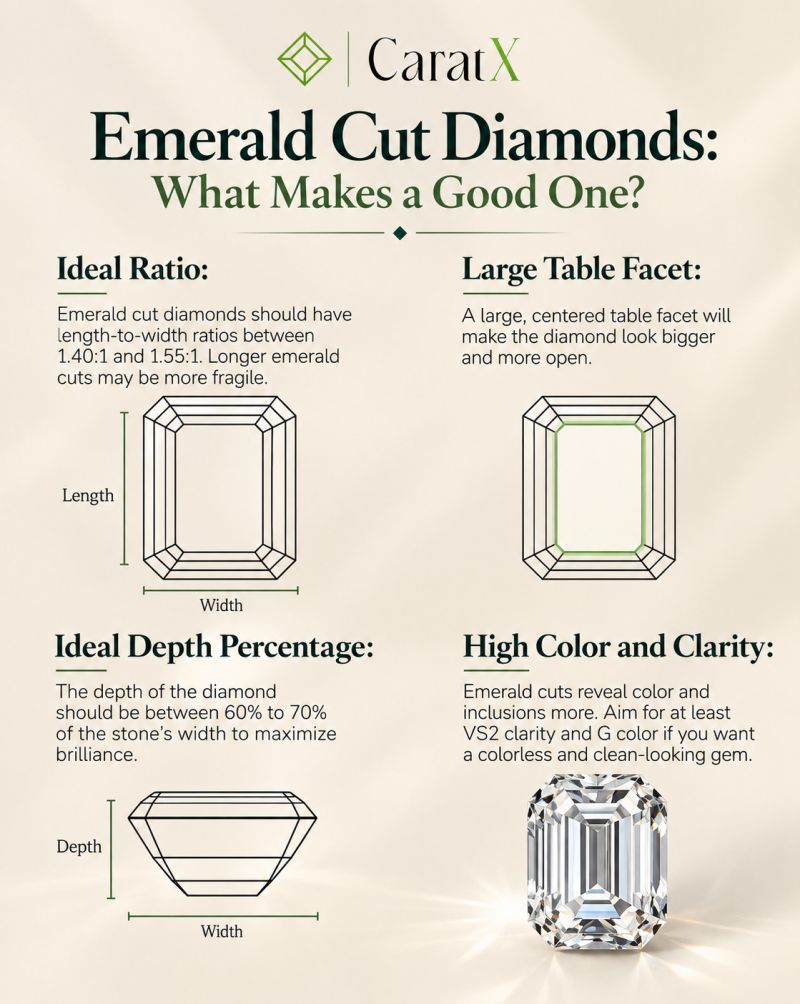
The length-to-width ratio is the proportion that determines the emerald cut's fundamental character, whether it looks squarish, classically rectangular, or dramatically elongated. The ratio is calculated simply by dividing the diamond's length by its width.
The classic emerald cut ratio is 1.40–1.50, which produces the balanced, timeless rectangular silhouette that most buyers associate with the cut. Stones in the 1.30–1.40 range look squarer and more compact, offering a bolder, more modern appearance.
Ratios of 1.50–1.60 create a slender, elegant silhouette that flatters the finger and can make the diamond appear larger for its carat weight. Above 1.60, the stone becomes very elongated and dramatic, but buyers should check that the proportions still look balanced to the eye.
The most popular ratios fall between 1.40 and 1.50, with 1.40 often cited as the "ideal" or most classic proportion. However, there is no single correct ratio, it is ultimately a matter of personal taste and how the stone looks on the hand.
Table Percentage -
The table is the large, flat facet at the top of the diamond. In an emerald cut, the table percentage, the table's width expressed as a percentage of the diamond's average width, plays a crucial role in how open and transparent the stone appears.
An excellent table percentage for an emerald cut falls between 61% and 68%. Tables below 59% or above 70% are generally avoided. A larger table can make the diamond look more open and expansive from the top, but an excessively large table may compromise light return. A slightly smaller table can create more depth and contrast, but too small a table may make the stone look dark or closed off.
Depth Percentage -
Depth percentage measures the diamond's total depth (from table to culet) relative to its average width. This proportion is critical for light performance. An ideal depth percentage for an emerald cut is between 60% and 65%. Stones with depth below 57% or above 68% should be approached with caution.
A diamond that is too shallow may exhibit "windowing", a phenomenon where light passes straight through the diamond instead of reflecting back to the viewer's eye, creating a transparent, glassy area in the center of the stone. A diamond that is too deep may lose light through the pavilion, making the stone appear darker than its color grade would suggest.
For a broader exploration of how table and depth interact across different diamond shapes, see our guideThe Diamond Table: The Architectural Marvel Controlling Brilliance.
Girdle Thickness and Culet -
Two often-overlooked metrics on a GIA report are girdle thickness and culet size. The girdle should be thin to slightly thick, extremely thin girdles are vulnerable to chipping, while very thick girdles add unnecessary weight without contributing to beauty. The culet should be none or very small; a large or extremely large culet will be visible as a dark spot at the bottom of the stone and will detract from the diamond's clarity.
Color: Why Emerald Cuts Demand Higher Grades
Here is a principle that surprises many buyers: the same color grade can look dramatically different in an emerald cut compared to a round brilliant. A G-color round brilliant may appear impeccably icy and colorless, while a G-color emerald cut of the same grade will often display a faint but noticeable warm tint.
This is not a flaw in the grading system. It is a direct consequence of the emerald cut's optical design. Brilliant cuts use their many facets to scatter light in multiple directions, effectively masking body color. Step cuts, by contrast, have fewer, larger facets that allow light to pass through the diamond more directly, revealing the stone's true body color.
GIA notes that emerald cuts are "less scintillating due to the step cut style of faceting," and since "lots of scintillation masks lower color grades, this type of facet pattern looks best on a diamond with higher colors on the GIA D-to-Z color scale".
The practical implication is straightforward: for emerald cuts, aim for a color grade of G or higher. Many experts recommend targeting F color or higher for a truly clear, icy appearance. A G-color emerald cut can work beautifully in certain settings, but a warm tint is more likely to be visible than it would be in a brilliant cut of the same grade. If budget constraints push you toward H or I color, consider a yellow gold or rose gold setting, which can mask warmth more effectively than platinum or white gold.
Clarity:
If color is the emerald cut's subtle challenge, clarity is its most demanding requirement. The long, rectangular facets and large open table that give the emerald cut its distinctive character also make it the most revealing diamond shape for inclusions.
GIA is unequivocal on this point: "They will typically be easier to see in an emerald cut diamond compared to a round brilliant cut diamond. The long, rectangular facets that are characteristic of emerald cut diamonds make inclusions more readily visible than among the many smaller facets of a brilliant cut". The emerald cut has been described as having "a perfectly unobstructed window into the center of the stone," meaning that large internal inclusions in the center of an emerald cut can be visible to the naked eye.
The practical recommendation is to prioritize clarity when shopping for an emerald cut. While a VS2 clarity grade is often acceptable for round brilliants,emerald cuts generally require VS1 or higher to ensure a clean, clear appearance. Some experts recommend a minimum of VS2, but VS1 provides a greater margin of safety. For larger stones (2 carats and above), the case for VS1 or better becomes even stronger, as inclusions become more visible at larger sizes.
It is important to understand that the GIA clarity scale applies to all diamond shapes, but the visual impact of a given clarity grade varies significantly by cut. A VS2 inclusion that is invisible in a round brilliant may be visible in an emerald cut because of the step-cut facet arrangement. This is not a difference in grading standards; it is a difference in how the cut interacts with light.
Light Performance: The Hall of Mirrors and the Windowing Risk
The emerald cut's optical personality is defined by two contrasting phenomena: the "hall of mirrors" effect and the risk of windowing.
The hall of mirrors is the emerald cut's signature visual characteristic. As light enters the diamond and reflects between the parallel step facets, it creates broad, dramatic flashes of light that move slowly and deliberately across the stone. This is not the rapid-fire sparkle of a round brilliant; it is a more contemplative, architectural display of light. Emerald cuts are known more for their clean reflections and elegant lines than for the intense sparkle of a round brilliant.
But this same facet arrangement creates a vulnerability: windowing. Because the emerald cut has a large, open table and relatively shallow pavilion angles in some configurations, light can pass straight through the diamond instead of reflecting back to the viewer's eye. When this happens, the center of the stone can appear transparent or "glassy," revealing whatever is behind it, including the skin of the wearer's finger.
Windowing is not always visible on a grading report. As one industry analysis notes, "it is not possible to predict from the numbers on a GIA report whether an emerald cut will have excessive windowing". This is why visual inspection, either in person or through high-quality video, is essential when evaluating an emerald cut. The American Gem Society (AGS) has developed a light performance grading system for emerald cuts that uses ray tracing to assess how well the diamond returns light, but not all emerald cuts carry an AGS report.
When evaluating an emerald cut for light performance, look for a stone that shows a good balance of light and dark areas under the table. Excessive darkness may indicate light leakage, while excessive transparency may indicate windowing. The goal is a stone that returns light efficiently while still maintaining the emerald cut's characteristic depth and contrast.
Carat Weight and Size:
One of the practical advantages of the emerald cut is its spread. Because the emerald cut carries its weight across a long, broad top rather than in depth, it can look larger than a round brilliant of the same carat weight. A 1-carat emerald cut will typically appear larger face-up than a 1-carat round brilliant, because more of the carat weight is distributed across the visible surface of the stone.
This characteristic makes the emerald cut an attractive option for buyers who want maximum visual impact for their budget. However, it also means that carat weight alone is not a reliable indicator of size. A well-proportioned emerald cut with a favorable length-to-width ratio will maximize the face-up spread, while a poorly proportioned stone may appear smaller than its carat weight suggests.
Emerald Cut Diamonds in the Market: Trends and Value
The emerald cut occupies a distinctive position in the diamond market. It represents roughly 3–5% of the total diamond market, making it significantly rarer than round brilliants but more common than some other fancy shapes. This relative scarcity, combined with its association with vintage glamour and understated luxury, has helped the emerald cut maintain strong demand even as other fancy shapes have fluctuated in popularity.
Recent market intelligence from CaratX indicates that long fancy shapes such as ovals, marquises, and emeralds are significantly outperforming rounds, particularly in the 2-carat and larger categories. The emerald cut, with its clean, sophisticated lines, continues to attract buyers seeking understated elegance. However, finding well-cut specimens is becoming increasingly difficult, as cutters prioritize yield over proportion in response to rising rough diamond costs.
One market dynamic worth noting is the "window" problem. Emerald cuts with shallow pavilions and poor light return are being discounted in the market, while well-proportioned stones with strong light performance command premiums. Unlike rounds, an emerald cut with VS2–SI1 clarity can still be a good value if the inclusions are positioned favorably and do not affect the stone's overall transparency.
Setting and Styling Considerations -
The emerald cut's clean, geometric lines make it remarkably versatile in jewelry design. Its elongated shape can make the finger look longer and more slender, which is one reason it has remained a perennial favorite for engagement rings.
Solitaire settingsare perhaps the most classic choice for emerald cuts, allowing the stone's clean lines and hall-of-mirrors effect to take center stage. A simple four-prong or bezel setting in platinum or white gold creates a sleek, modern look that complements the emerald cut's architectural character.
Three-stone settings are another popular option, with a central emerald cut flanked by smaller trapezoid-shaped or emerald-cut diamonds. This configuration, which was particularly favored during the Art Deco era, creates a sense of symmetry and balance that enhances the emerald cut's geometric appeal.
Halo settingscan add sparkle and perceived size to an emerald cut, but they should be used judiciously. A delicate halo of round brilliants can frame the emerald cut beautifully without overwhelming its clean lines. A heavy or ornate halo, however, may compete with the emerald cut's understated elegance.
Emerald Cut vs. Asscher Cut:
The emerald cut is often confused with the Asscher cut, and for good reason both are step-cut diamonds with trimmed corners. However, there are important differences.
TheAsscher cutis essentially a square version of the emerald cut, with a length-to-width ratio of approximately 1.00–1.05. It was developed in 1902 by the Asscher brothers of Amsterdam and features a distinctive high crown and deep pavilion. The Asscher cut has a more compact, symmetrical appearance than the emerald cut, and its facet arrangement is slightly different.
The emerald cut, by contrast, is typically rectangular, with a length-to-width ratio of 1.30–1.50. Its proportions are more elongated, giving it a different visual character. Both cuts share the step-cut faceting style and the "hall of mirrors" effect, but the emerald cut's elongated shape makes it appear larger face-up and creates a more dramatic, linear silhouette.
From a buying perspective, the same principles apply to both cuts: prioritize clarity and color, pay close attention to proportions, and inspect for windowing. The Asscher cut, however, may require slightly different proportion parameters because of its square shape.
Recommended Reads from CaratX -
1. Anatomy of Emerald Cut Diamond – Clean Lines, Deep Clarity, and Hall-of-Mirrors Elegance
2. Why the Same Diamond Colour Looks Different Across Cuts: A Gemologist's Guide
URL: https://caratx.com/blog/why-the-same-diamond-colour-looks-different-across-cuts-a-gemologists-guide
3. The Geometry of Brilliance: Why Length-to-Width Ratio Dictates Diamond Beauty and Value
4. The Diamond Table: The Architectural Marvel Controlling Light, Fire, and Brilliance
5. The Art of Buying Loose Diamonds: Your Buyer's Guide
URL: https://caratx.com/blog/the-art-of-buying-loose-diamonds-your-buyers-guide
6. Diamond Size Chart Guide: Carat vs. Millimeter Measurements for Every Cut
URL: https://caratx.com/blog/diamond-size-chart-guide-carat-vs-millimeter-measurements-for-every-cut
7. Fancy Shape Diamonds Are Leading the Premium Market
URL: https://caratx.com/blog/fancy-shape-diamonds-are-leading-the-premium-market
8. The Ultimate Guide to Diamond Settings & Ring Profiles: How Design Dictates Brilliance, Durability, and Style
Emerald Cut Diamonds: Frequently Asked Questions
What is the best length-to-width ratio for an emerald cut diamond?
Most buyers prefer a ratio between 1.40 and 1.50 for a classic rectangular look. Ratios of 1.30–1.40 appear squarer and more compact, while 1.50–1.60 creates a more elongated, slender silhouette. There is no single "correct" ratio, it depends on personal preference and how the stone looks on the hand.
What clarity grade should I choose for an emerald cut?
Because emerald cuts reveal inclusions more readily than brilliant cuts, aim for a clarity grade of VS1 or higher. VS2 can work for smaller stones or stones with favorably positioned inclusions, but VS1 provides a greater margin of safety, especially for stones above 1.5 carats.
What color grade is best for an emerald cut?
Aim for G color or higher. F color or better is recommended for a truly icy, colorless appearance. The emerald cut's step facets make body color more visible than in brilliant cuts, so compromising on color is more noticeable.
Why doesn't GIA give a cut grade for emerald cuts?
GIA assigns cut grades only to round brilliant diamonds. For fancy shapes like emerald cuts, the grading report assesses polish and symmetry separately but does not provide an overall cut grade. This is because the variables affecting light performance in fancy shapes are more complex and less standardized than in round brilliants.
What is windowing, and how do I avoid it?
Windowing is a phenomenon where light passes straight through the diamond instead of reflecting back to the viewer, creating a transparent or "glassy" area in the center of the stone. It is more common in emerald cuts because of their large, open tables. To avoid windowing, inspect the stone visually—either in person or through high-quality video—and look for a good balance of light and dark areas under the table.
Are emerald cut diamonds more expensive than round brilliants?
Generally, emerald cut diamonds are less expensive per carat than round brilliants of comparable quality, because they require less rough diamond to produce and are less in demand. However, high-quality emerald cuts with excellent color, clarity, and proportions can command significant premiums.
Can emerald cut diamonds be lab-grown?
Yes. Lab-grown emerald cut diamonds are increasingly available and offer the same optical and physical properties as natural emerald cuts at a lower price point. The same evaluation criteria proportions, color, clarity, and light performance, apply to both natural and lab-grown stones.