
Square diamonds are having a moment. From the sharp, geometric brilliance of aprincess cutto the quiet, hall-of-mirrors elegance of an Asscher, square and square-adjacent diamond cuts offer something theround brilliantsimply cannot: architectural presence. A square diamond sits differently on the finger, catches light differently, and tells a different story about the person wearing it.
But here is the problem. Most buyers walk into a jeweller or scroll through an online marketplace and see "square diamond" as a single category. It is not. Even when diamonds share a square outline, their facet patterns, crown heights, pavilion configurations, and cutting philosophies can make each style look and perform completely differently. Two square diamonds of identical carat weight can face up at different sizes, show colour differently, and produce entirely different types of sparkle.
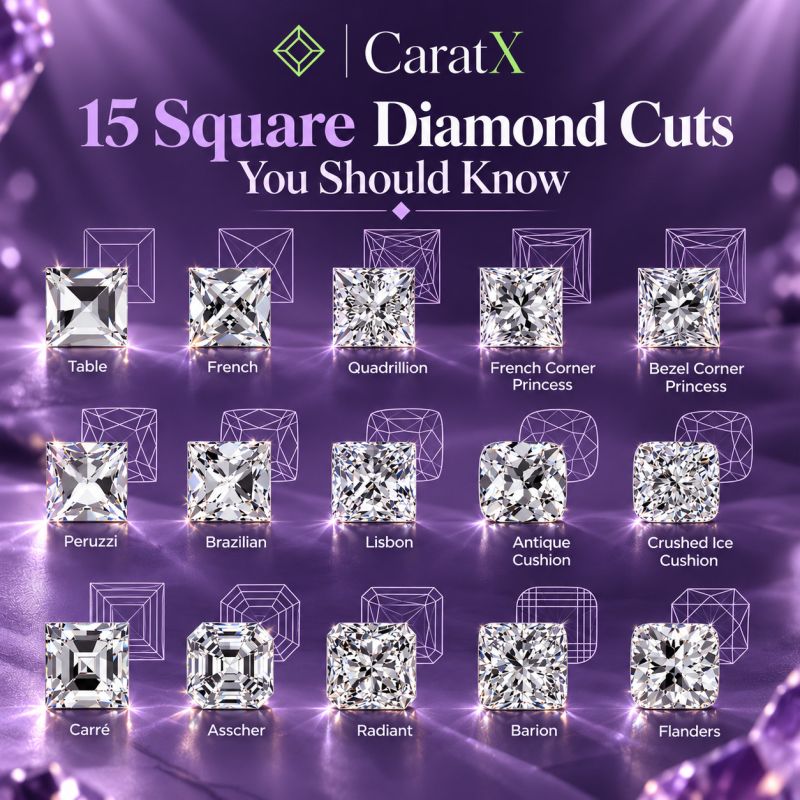
This guide breaks down 15 square diamond cuts across four families Classic, Brilliant, Fancy, and Unique, so you can understand exactly what you are looking at, what to prioritise, and where to buy with confidence.
Whether you are a first-time buyer, a jeweller sourcing inventory, or a seller listing on a B2B marketplace, this is the reference you will come back to.
Why Square Diamond Cuts Matter More Than Ever -
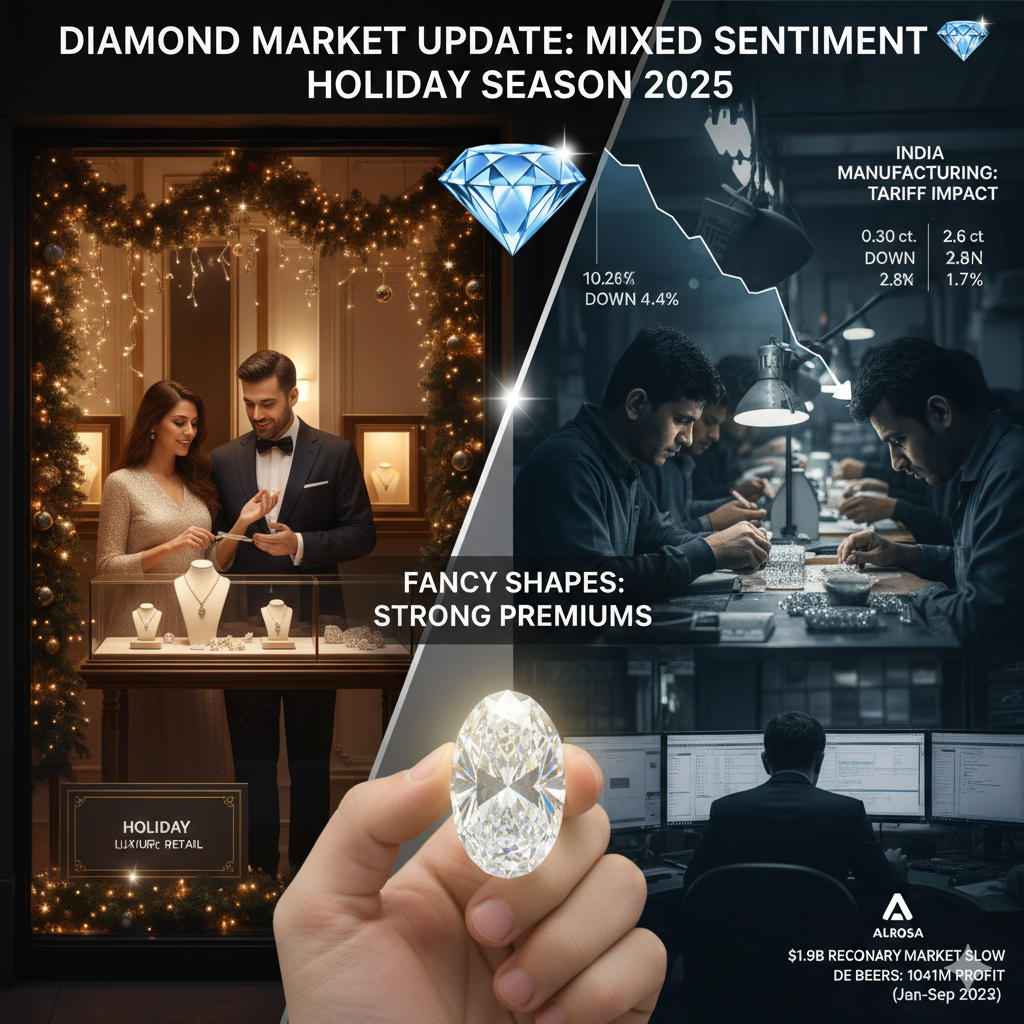
The global diamond market is undergoing a structural shift. Fancy shapes including square cuts like princess,radiant, cushion, andAsscherare outperforming rounds in premium categories, particularly at 2 carats and above.
Elongated shapes get most of the headlines, but square cuts remain the backbone of the fancy-shape market because they offer a combination no other category can match: geometric symmetry, strong face-up size for the carat weight, and a design language that works in both vintage-inspired and contemporary settings.
There is also a practical dimension. Square cuts often retain more rough diamond weight during cutting than rounds, which can translate to better value per carat. Aprincess cut, for example, can retain up to 80% of the rough diamond, while around brillianttypically retains around 40–50%. That efficiency is one reason square cuts have historically been favoured by cutters and buyers alike.
But "square" is not a single cut. It is a family of cutting styles, each with its own history, geometry, and light performance. Understanding the differences is the difference between buying a diamond and buying the right diamond.
Classic Styles: The Step-Cut Heritage
Classic square cuts are defined by step faceting parallel rows of facets that create a "hall of mirrors" effect rather than the scattered sparkle of brilliant cuts. They are elegant, understated, and historically significant. If you want a square diamond that whispers rather than shouts, start here.
1. Table Cut -
The table cut is where diamond cutting begins. Emerging in the 14th century, it was the first widely recognised diamond cut, created by grinding down one point of a diamond octahedron to create a flat "table" on top. The remaining natural crystal faces formed the crown, and the result was a quadrangular usually square stone with roughly 10 facets.
Table-cut diamonds were the standard in Renaissance and Medieval jewellery. They appear in European court inventories from the 15th and 16th centuries, and famous historical stones like the Mirror of Portugal were table cuts. Today, genuine antique table cuts are extremely rare and mostly found in museum collections or high-end antique jewellery auctions.
They are not a practical purchase for most buyers, but understanding the table cut is essential because every subsequent square cut French, carre,Asscher,emeraldevolved from this foundation.
Table cuts have very low brilliance by modern standards. Their value is historical and collectible, not optical. If you are buying antique jewellery, a table-cut diamond should be evaluated as a piece of history, not as a modern light-performance stone.
2. French Cut -
The French cut evolved directly from the table cut and became fashionable in the 17th century, particularly among European royalty. It is a square or rectangular stone with a high crown and a distinctive criss-cross pattern of triangular facets on the crown. The arrangement follows the octahedral form of the rough diamond, creating a cross-like appearance when viewed face-up.
French cuts reached peak popularity during the Art Deco period (roughly 1910–1940), when their geometric precision and low, clean sparkle suited the architectural jewellery designs of the era. They are still produced today, though in limited quantities, and are prized for channel-set eternity bands where their square shape and flat faceting sit flush against one another.
The French cut is the bridge between the table cut and the modern step-cut family. It also demonstrates an important principle: a square diamond does not need brilliant faceting to be beautiful. Sometimes restraint produces the most sophisticated result.
3. Carre Cut -
The carre cut is a true square step cut with sharp 90-degree corners and a large upper facet. It was developed as a solution to a practical problem: how to use the maximum amount of rough diamond while minimising waste. Unlike the Asscher oremerald cut, which have cropped corners, the carre keeps all four corners intact, resulting in a pure square outline.
Carre cuts are closely related to French cuts and are often used together in vintage-style jewellery. They are the preferred cut for channel-set eternity bands because their straight edges and large step facets fit perfectly into a channel, creating a nearly seamless line of stones.
Carre cuts show inclusions more readily than brilliant cuts because their large, open facets provide nowhere to hide. If you are buying a carre, prioritise clarity (VS or above) and colour (G or above) unless you specifically want a warm, vintage look.
4. Asscher Cut -
TheAsscher cutis the most famous of the classic square cuts. Developed in 1902 by Joseph Asscher of the Royal Asscher Diamond Company in Amsterdam, it became the defining diamond cut of the Art Deco movement. The originalAsscher cuthas 58 facets arranged in three step-cut rows on the crown and three on the pavilion, with cropped corners that give the stone a nearly octagonal outline.
The Asscher cut's genius is its "hall of mirrors" effect. Because the facets are large and wide-set, light enters the stone and reflects back in concentric square patterns rather than scattered sparks. This creates a quieter, more architectural brilliance than a round brilliant, an aesthetic that appeals to buyers who want elegance over flash.
In 1999, Edward Asscher (Joseph's grandson) redesigned the cut as the Royal Asscher, adding 16 facets (74 total) to increase brilliance while preserving the original's classic feel. The Royal Asscher cut is internationally patented, meaning only the Royal Asscher Company can produce it within specified angle ranges.
Asscher cuts are most effective in colourless (D–F) or fancy-coloured diamonds. The large step facets amplify colour, so a warm-tinted Asscher will look warmer than a warm-tinted round of the same colour grade. Symmetry is critical, the corners should be cropped to identical size, and the parallel facets should align precisely.
Brilliant Styles:
Brilliant-style square cuts use triangular and kite-shaped facets to maximise light return. They are the opposite of step cuts in personality: bright, fiery, and forgiving of inclusions. If you want a square diamond that sparkles aggressively, this is your family.
5. Radiant Cut -
Theradiant cutwas created in 1977 by Henry Grossbard, making it the first square or rectangular cut to feature a complete brilliant facet pattern on both the crown and pavilion. On GIA grading reports, it is officially described as a "cut-cornered square modified brilliant" or "cut-cornered rectangular modified brilliant".
Aradiant cuttypically has 70 facets, with cropped corners that make it more durable than a princess cut. Its faceting pattern triangular and kite-shaped facets similar to a round brilliant produces intense sparkle while the cropped corners reduce the risk of chipping.
Radiant cutscan be square (length-to-width ratio of 1.00–1.05) or rectangular (up to 1.50), and they are especially effective at disguising inclusions, making them a good choice for buyers who want to prioritise carat weight over clarity.
Radiant vs. Princess: This is the most common comparison in square diamond buying. Radiants have cropped corners and are more durable; princess cuts have sharp corners and can be slightly more affordable.
Radiants tend to have a higher crown and smaller table thanprincess cuts, which affects light performance and face-up appearance. If durability is a priority, choose radiant. If maximum face-up size for the carat weight is the priority, princess may have the edge.
6. Crushed Ice Cushion -
Thecushion cutis one of the oldest diamond shapes, with a history stretching back to the "old mine" cuts of Brazil in the 18th and 19th centuries. The modern cushion cut comes in two main faceting styles: antique (chunky) and brilliant (crushed ice).
The crushed icecushionis the contemporary variant. It features an additional row of facets carved just beneath the girdle, creating a mass of small, kaleidoscopic light reflections that resemble a pile of broken glass or crushed ice. This faceting style produces a more modern, intense sparkle than the antique cushion's larger, chunkier flashes.
Crushed ice cushions are particularly effective in fancy-coloured diamonds because the intricate facet arrangement lengthens the light path through the stone, intensifying colour saturation. They also tend to have lower contrast than antique cushions, which gives them a softer, more uniform appearance face-up.
Crushed ice cushions can sometimes look "busy" or even slightly hazy if the faceting is not well-executed. Look for stones with good contrast between light and dark areas, and avoid cushions where the crushed ice pattern looks muddy or dull.
7. Brazilian Cut -
The Brazilian cut is a historic brilliant-style square cut that emerged from the Brazilian diamond fields before the South African diamond rush of the late 1860s. When Brazilian deposits were superseded by South African mines, the older Brazilian cutting style became known as "old mine" and the cushion cut's small table and distinctive faceting are direct legacies of Brazilian cutting traditions.
The Brazilian cut, sometimes also called the "Lisbon cut" in historic literature, was a double brilliant with 74 facets arranged in two rows of lozenge-shaped facets and three rows of triangular facets. It represented a significant advancement over the table and French cuts, offering greater brilliance and dispersion.
Today, antique Brazilian-cut diamonds are rare and mostly found in period jewellery. They are not a practical modern purchase for most buyers, but they are important historically because they represent the transition from step-cut to brilliant-cut thinking in square diamonds.
Fancy Styles:
Fancy square cuts are the result of 20th-century innovation. They combine unusual facet arrangements, patented geometries, and cutting philosophies that prioritise either light performance, weight retention, or both. These are the cuts for buyers who want something genuinely different.
8. Quadrillion Cut -
The Quadrillion is a patented square brilliant cut developed in the late 1970s by Israel Itzkowitz and Betzalel Ambar after three years of optical research into light reflection. It has 49 facets and sharp corners, and it was an important precursor to the modern princess cut.
What makes the Quadrillion unique is its pavilion configuration. Unlike a round brilliant, where the lower-pavilion facets narrow toward the culet, the Quadrillion's lower-pavilion facets widen toward the culet, creating a star-like effect in the centre of the stone. This brilliant-style faceting minimises light leakage and maximises light return.
The Quadrillion is always cut in ideal proportions to maximise brilliance rather than weight retention. This means a Quadrillion will look slightly smaller than a princess cut of the same carat weight, but it will typically outperform the princess in light return.
Quadrillion diamonds are scarce on the wholesale market. If you are selling them, highlight the patented facet pattern and ideal proportions. If you are buying, expect limited selection and premium pricing relative to comparable princess cuts.
9. Lisbon Cut -
The Lisbon cut is a historic modified old-mine cut with 16 extra facets eight on the crown and eight on the pavilion for a total of 74 facets. It was one of the cuts that featured 58 facets by the end of the 17th century, alongside the Brazilian cut, and it played a role in the dramatic increase in diamond dispersion and brilliance that characterised the early brilliant era.
The Lisbon cut is square or square-adjacent in outline, with a cushion-like shape and brilliant-style faceting. It is rarely produced today, but antique Lisbon-cut diamonds appear occasionally in period jewellery and at auction.
The Lisbon cut sits alongside the Peruzzi cut as one of the ancestors of the modern brilliant. Understanding it helps you understand how diamond cutting evolved from step cuts to the brilliant cuts we know today.
10. Peruzzi Cut -
The Peruzzi cut is named after Vincenzo Peruzzi, a Venetian diamond cutter who, in the 17th century, increased the number of crown facets from 17 to 33. This "triple-cut brilliant" was a revolutionary advancement that significantly increased the fire and brilliance of cut diamonds. It is widely considered the ancestor of the modern round brilliant cut, and the square version attributed to Peruzzi has been studied by gemological historians as a key transitional style.
The Peruzzi cut has a cushion-shaped or square outline with 33 crown facets and 25 pavilion facets. It reflected more light than any previous cut and became the model for the brilliant cuts that followed.
Genuine Peruzzi-cut diamonds are extremely rare and mostly held in museum or private collections. However, the Peruzzi cut is important context for anyone studying diamond history because it demonstrates the moment when cutters began to understand how facet arrangement, rather than just external shape, determines light performance.
11. Barion Cut -
The Barion cut was developed in October 1970 by Basil Watermeyer, a diamond cutter who was attempting to solve a specific problem: how to create a square diamond with the brilliance of a round brilliant while maintaining the step-cut elegance of an emerald cut. The result was a mixed cut, a full emerald-cut crown superimposed on a modified brilliant-cut pavilion.
A typical Barion square cut has 81 facets (not including girdle facets) and four-fold mirror-image symmetry, creating a characteristic cross-shaped pattern at the centre of the stone. The Barion was the forerunner of the princess cut, and together with the Quadrillion, it laid the foundation for the modern square brilliant.
The Barion cut represents a pivotal moment in square diamond design. It proved that you could combine step-cut and brilliant-cut faceting in a single stone, and that a square diamond could sparkle as aggressively as a round without sacrificing its geometric identity.
Unique Styles:
Unique square cuts are the rarest of the rare. They are often patented, produced in limited quantities, or associated with specific cutting houses. They are for buyers who want something no one else has and for sellers who want to differentiate their inventory with genuinely distinctive stones.
12. Antique Cushion -
The antique cushion is the older, chunkier cousin of the crushed ice cushion. It features fewer facets and larger, wider-set facets that produce bold, broad flashes of light rather than the scattered sparkle of a modern brilliant. The antique cushion's high crown and small table legacies of the old mine cut create a deep, romantic glow that is often described as "candlelit."
Antique cushionsare not graded for cut by GIA because their proportions vary widely. This makes buying them more challenging but also more rewarding for buyers who understand what they are looking for. The bestantique cushionshave a well-balanced face-up pattern, good contrast between light and dark facets, and a crown height that produces the characteristic "chunky" sparkle.
When evaluating anantique cushion, tilt the stone under strong light and watch for broad, distinct flashes of light. If the pattern looks like a shattered mirror, it is probably a crushed ice cushion, not an antique one. If it looks like a series of large, geometric blocks of light and dark, it is a true antique cushion.
13. French Corner Princess -
The French corner princess is a variation of the princess cut with a specific crown facet arrangement. In a French corner princess, the star facets point to the stone's corners and typically extend about 50% of the distance from the corner of the table to the corner of the girdle. This creates a broader centre and a different light pattern than the standard princess cut.
The French corner style is one of two basic crown configurations for princess cuts the other being the bezel corner style. French corners are slightly less durable than bezel corners because they have four fewer facets, but they produce a distinctive visual pattern that some buyers prefer.
French corner princess cuts still have sharp corners, so they require protective settings. V-prong or bezel settings are recommended to prevent chipping.
14. Bezel Corner Princess -
The bezel corner princess is the more durable princess cut variation. It features four additional kite-shaped bezel facets on each corner compared to the French corner style, bringing the total facet count to approximately 76 or more. These extra facets create a more angular faceting look and a broader centre.
Bezel corner princess cuts are the standard for most modern princess cut production because the additional corner facets reduce the risk of chipping at the sharp points. If you are buying a princess cut for everyday wear, a bezel corner stone is the safer choice.
On theCaratXmarketplace, princess cut diamonds with bezel corners and excellent symmetry command a premium over French corner stones because they are perceived as more durable and more modern. Sellers should specify the corner style in their listings to capture this premium.
15. Flanders Cut -
The Flanders cut was created in 1983 by a Belgian gemologist and is a full square brilliant cut with cut corners. It combines the external shape of a square with the faceting of a round brilliant, resulting in a stone that retains more weight from the rough than a comparable round.
The Flanders cut has 57 facets (28 on the crown, 28 on the pavilion, plus the table and culet) and is known for its exceptional brilliance and clean, geometric appearance. It is sometimes confused with the Lucida and Lucere cuts, which share the same outline (square with cut corners) but have different facet arrangements.
Flanders cuts are produced in very limited quantities and are not widely available on the retail market. They are most commonly found through specialised dealers or at auction. If you are a seller with Flanders cut inventory, the CaratX marketplace gives you access to international buyers who are specifically searching for rare and branded cuts.
How to Choose the Right Square Diamond Cut -
Choosing a square diamond cut is not about finding the "best" cut. It is about finding the cut that matches your priorities.
If you prioritise brilliance and sparkle: Choose a radiant cut, crushed ice cushion, or Quadrillion. These brilliant-style cuts maximise light return and produce the most aggressive sparkle.
If you prioritise elegance and sophistication: Choose an Asscher cut, French cut, or carré cut. These step cuts produce a quieter, more architectural beauty that works beautifully in vintage-inspired settings.
If you prioritise durability: Choose a radiant cut or a bezel corner princess. The cropped corners of a radiant and the additional corner facets of a bezel corner princess reduce the risk of chipping compared to sharp-cornered cuts like the standard princess or Quadrillion.
If you prioritise rarity: Choose a Flanders cut, Barion cut, or Peruzzi cut. These are produced in limited quantities and are genuinely difficult to find.
If you prioritise value: Choose a princess cut or a crushed ice cushion. These are the most widely produced square cuts and tend to offer the best price-per-carat value. Lab-grown princess cuts with IGI certification, for example, average $300–$600 at one carat, while natural equivalents of premium quality reach $1,800–$2,100.
If you prioritise historical significance: Choose a table cut, French cut, or antique cushion. These cuts carry centuries of diamond-cutting history in their facet patterns.
Square Diamonds on CaratX: Buy, Sell, and Source Internationally
CaratXis the exclusive diamond and gemstone hub connecting buyers and sellers across 18+ international countries. Whether you are a retailer sourcing square-cut diamonds for your inventory, a jeweller looking for a specific Asscher or radiant for a client, or a seller wanting to reach B2B and B2C buyers globally, CaratX provides the platform.
For buyers: Browse thousands of certified loose diamonds, including princess, radiant, cushion, Asscher, and rare fancy cuts, from over 200 artisan sellers. Every CaratX diamond comes with certification, and the platform's AI-powered search makes it easy to filter by shape, cut style, carat weight, colour, and clarity.
For sellers: Register on CaratX to list your square-cut diamond inventory and reach buyers in 18+ international countries.
The platform offers professional storefronts dedicated to diamonds and fine jewellery, so your products reach serious buyers rather than getting lost in a general marketplace. Start your seller registration here:www.caratx.com/register
For jewellery buyers: CaratX also offersfinished jewellery,includingengagement rings,earrings, andnecklacesfeaturing square-cut diamonds.
Shop the CaratX marketplace atwww.caratx.comand explore natural diamonds andlab-grown diamondsat unbeatable prices.
Frequently Asked Questions -
What is the difference between a princess cut and a radiant cut?
The main difference is the corners. Princess cuts have sharp, pointed corners, while radiant cuts have cropped (bevelled) corners. This makes radiant cuts more durable and less prone to chipping. Princess cuts are typically square, while radiant cuts can be square or rectangular. Radiant cuts also tend to have a higher crown and smaller table than princess cuts, which affects light performance.
Is an Asscher cut the same as an emerald cut?
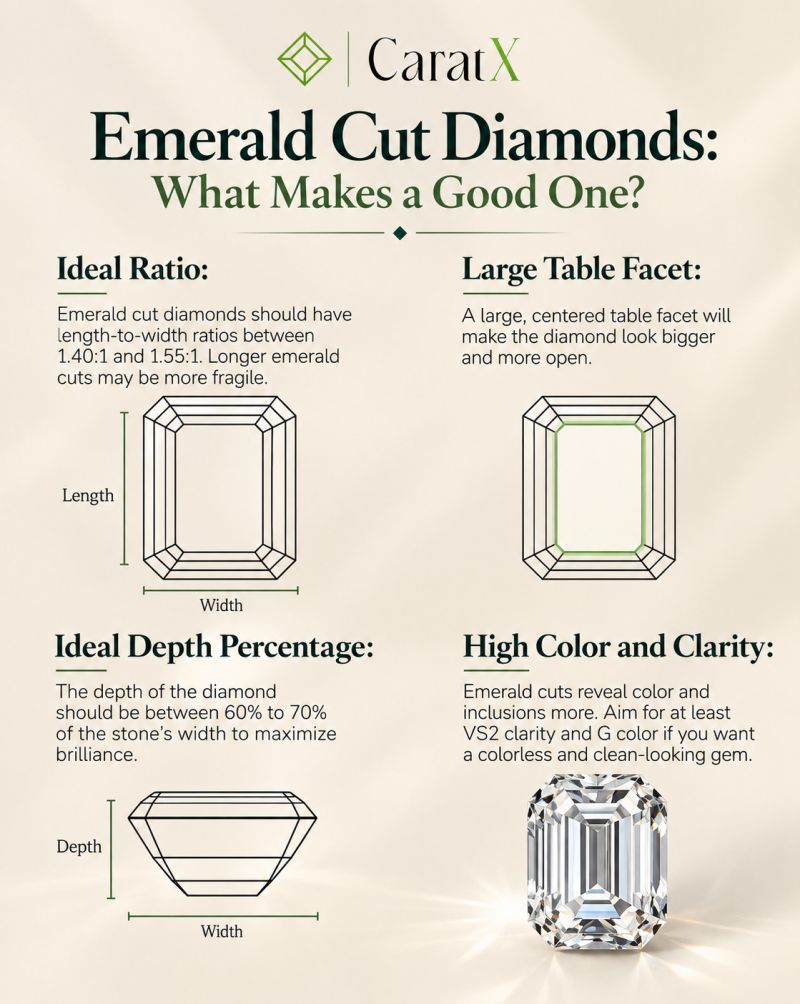
No. Both are step cuts with cropped corners, but the Asscher is square (length-to-width ratio of approximately 1.00–1.04) while the emerald cut is rectangular. The Asscher also has larger step facets, a higher crown, and a smaller table than the emerald cut, which gives it more brilliance and a more compact, symmetrical appearance.
What is a crushed ice cushion?
A crushed ice cushion is a cushion cut diamond with an additional row of facets beneath the girdle that creates a mass of small, kaleidoscopic light reflections hence the name. It is the modern, brilliant-style counterpart to the antique (chunky) cushion, which has fewer, larger facets and produces broader, bolder flashes of light.
Are square diamonds more affordable than round diamonds?
Generally, yes. Square cuts like princess and cushion often cost less per carat than round brilliants of comparable quality because they retain more rough diamond weight during cutting. However, this varies by cut. Radiant cuts, for example, are slightly more expensive than princess cuts but still cheaper than rounds. Rare cuts like Flanders or Quadrillion command premiums.
Do square diamonds show inclusions more than round diamonds?
It depends on the cut. Step cuts (Asscher, carré, French, emerald) show inclusions more readily because their large, open facets provide nowhere to hide. Brilliant cuts (radiant, princess, crushed ice cushion) disguise inclusions effectively because their faceting pattern scatters light and breaks up the visual continuity of the stone. If clarity is a concern, choose a brilliant-style square cut.
What is the best setting for a square diamond?
For sharp-cornered cuts like princess and Quadrillion, V-prong or bezel settings are recommended to protect the corners from chipping. For cropped-corner cuts like radiant and Asscher, standard four-prong settings work well, though bezel settings offer additional protection. Step cuts like Asscher and carré look particularly elegant in channel-set or bezel-set eternity bands.
Can I sell square-cut diamonds internationally on CaratX?
Yes. CaratX connects sellers with buyers in 18+ international countries. Register as a seller atwww.caratx.com/registerto start listing your square-cut diamond inventory. The platform supports B2B and B2C sales, and every listing reaches a dedicated audience of diamond and jewellery buyers.
Recommended Reads from CaratX -
The Anatomy of Asscher Cut Diamonds: A Deep Dive into Geometry, Light, and Value— Explore the history, geometry, and buying considerations for the classic square step cut.
All You Need to Know About Cushion Cut Diamond— The complete guide to the pillow cut, from antique to crushed ice.
The 10 Diamond Shapes: A Complete Guide— Round, oval, cushion, emerald, pear, and more — the essential reference for every buyer.
The Art of Buying Loose Diamonds: Your Buyer's Guide— How to evaluate quality, understand the 4Cs, and make informed decisions when purchasing loose diamonds.
The Ultimate Guide to Diamond Carat Size and Cut— How different shapes concentrate weight and what that means for face-up size.
The Geometry of Brilliance: Why Length-to-Width Ratio Dictates Diamond Beauty and Value— Why proportion is the single most important factor in diamond beauty.
Fancy Shape Diamonds Lead the Premium Market in 2026— Why elongated and square fancy shapes are outperforming rounds in 2026.