
When most people picture a diamond, they envision a brilliant, colourless stone the classic symbol of purity and eternal love. Yet deep within the Earth's mantle, under conditions of extreme heat and pressure that defy imagination, nature occasionally creates something far more extraordinary. These are fancy colour diamonds, and they represent one of the most remarkable phenomena in the natural world.
Fancy colour diamondsarenatural diamondsthat display beautiful, distinct colours instead of the traditional white or colourless appearance. They come in virtually every shade imaginable from delicatepinkand vibrant blue to intense yellow, rare green, and the legendary red that is so scarce it barely exists in recorded history.
Thesestunning gemstonesare not merely geological curiosities; they are nature's rarest masterpieces, formed over billions of years through processes that scientists are still working to fully understand.
The rarity of these gems is almost incomprehensible. According to theGemological Institute of America (GIA), only one out of every 10,000 carats of fashioned diamonds displays a fancy colour. The odds of a diamond displaying an intense, vivid colour drop to just one in 25,000 carats.
Among all diamonds mined globally, less than 0.1% qualify as fancy colour diamonds. To put this in perspective, of the millions of carats of rough diamonds mined each year, only approximately 0.0001% can qualify as fancy colours, and only a handful can achieve the top grades of Intense and Vivid.
This extreme scarcity is what elevates fancy colour diamonds from rare curiosities to some of the most coveted and valuable assets on Earth. As the GIA notes, "Fancy color diamonds are the rarest of the rare. Each is one of a kind".
How Nature Paints Diamonds -
The unique colours of fancy colour diamonds are created by tiny changes in the diamond's crystal structure or the presence of trace elements during their formation deep within the Earth over billions of years. Unlike colourless diamonds, where value is based on the absence of colour, fancy colour diamonds are valued for the presence, intensity, and purity of their hue.
Yellow Diamonds:
Yellow diamonds, sometimes marketed as "canary" diamonds, are the most common fancy colour, making up approximately 60% of the fancy colour diamond market. Their colour comes from the presence of nitrogen atoms within the crystal structure. When nitrogen substitutes for carbon atoms in the diamond lattice, it absorbs blue light, causing the stone to reflect a yellow hue. While yellow is the most common fancy colour, intensely saturated "Fancy Vivid" yellows remain exceptionally rare and highly prized.
Blue Diamonds:
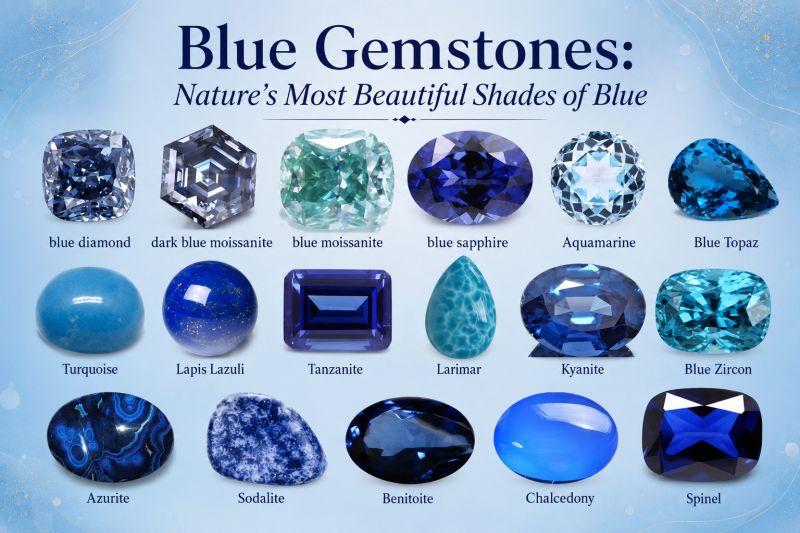
Blue diamondsare among the rarest and most valuable fancy colour diamonds in the world. Their mesmerizing colour is caused by the presence of boron impurities in the crystal structure. Less than one boron atom per million of carbon atoms can give a diamond a blue colour. The more boron present, the deeper the blue hue.
The most famous example is the 45.52-carat Fancy Deep grayish blue Hope Diamond, which resides at the Smithsonian Institution and is arguably the world's most famous gem. Research has shown that the Hope Diamond derives its colour from approximately 360 parts per billion of neutrally charged boron. Blue diamonds generally have a slight hint of gray, making them rarely as highly saturated as blue sapphires.
Pink and Red Diamonds:
Perhaps the most fascinating of all fancy colour diamonds arepinkandred diamonds. Unlike yellow or blue diamonds, which get their colour from chemical impurities, pink and red diamonds derive their hue from a phenomenon called plastic deformation a structural distortion of the crystal lattice caused by immense pressure during the diamond's journey to the Earth's surface.
The GIA confirms through advanced spectroscopy that the colour in approximately 99.5% of natural pink diamonds is not caused by chemical impurities but rather by this crystal lattice distortion.
These coloured deformation lamellae are caused by shear stress and natural plastic deformation.
Red diamonds represent the absolute pinnacle of rarity. Researchers estimate that less than one in 25 million diamonds is a Fancy red. Fewer than thirty true red natural diamonds are known to exist in the entire world. The largest red diamond in existence is only 5.11 carats the Moussaieff Red. In 2025, the Smithsonian Institution acquired one of the world's largest Fancy red diamonds, a 2.33-carat stone that ranks among the largest diamonds ever bestowed with the coveted "Fancy red" colour grade by the GIA.
Green Diamonds:
Green diamondsare among the rarest of the "Big Four" colours. Their colour is created when natural radiation displaces carbon atoms from their normal positions in the crystal structure. This can happen naturally when diamond deposits lie near radioactive rocks over millions of years.
According to GIA research, "Among fancy-color diamonds, natural-color green stones with saturated hues are some of the rarest and most sought after". The colour in most green diamonds is typically light in tone and low in saturation, often appearing muted with a grayish or brownish cast. In manygreen diamonds, the colour is confined to the surface, which is why cutters try to leave as much of the natural rough around the girdle as possible.
Brown Diamonds:
Brown is the most common fancy diamond colour. While historically considered good only for industrial use,brown diamondsunderwent a remarkable transformation in the 1980s when the Argyle mine in Australia began marketing them under trade names like "Champagne" and "Cognac". This marketing campaign successfully created consumer demand, and today brown diamonds are found in many medium-priced jewellery designs. Consumers generally prefer brown diamonds in medium to dark tones with a warm, golden to reddish appearance.
Black and White Fancy Diamonds -
Black diamonds and fancy white diamonds are also classified as fancy colour diamonds.Black diamondsget their colour from numerous graphite inclusions that make the stone opaque. The 67.50-carat Black Orloff diamond, named after Russian Princess Nadia Vyegin-Orloff, is the most well-known example. Fancy white diamonds have a milky white colour and are not routinely submitted to GIA for grading fewer than 2,000 have been submitted since 2008.
The Fancy Colour Grading System:
Fancy colour diamonds are graded differently from colourless diamonds. While colourless diamonds are graded on the absence of colour using the D-to-Z scale, fancy colour diamonds are evaluated on the presence and intensity of colour.
The GIA Colored Diamond Grading System, developed and used worldwide, evaluates fancy colour diamonds on three distinct dimensions:
Hue: The dominant colour of the diamond (e.g., pink, blue, yellow).
Tone: The relative lightness or darkness of the colour.
Saturation: The depth or strength of the colour.
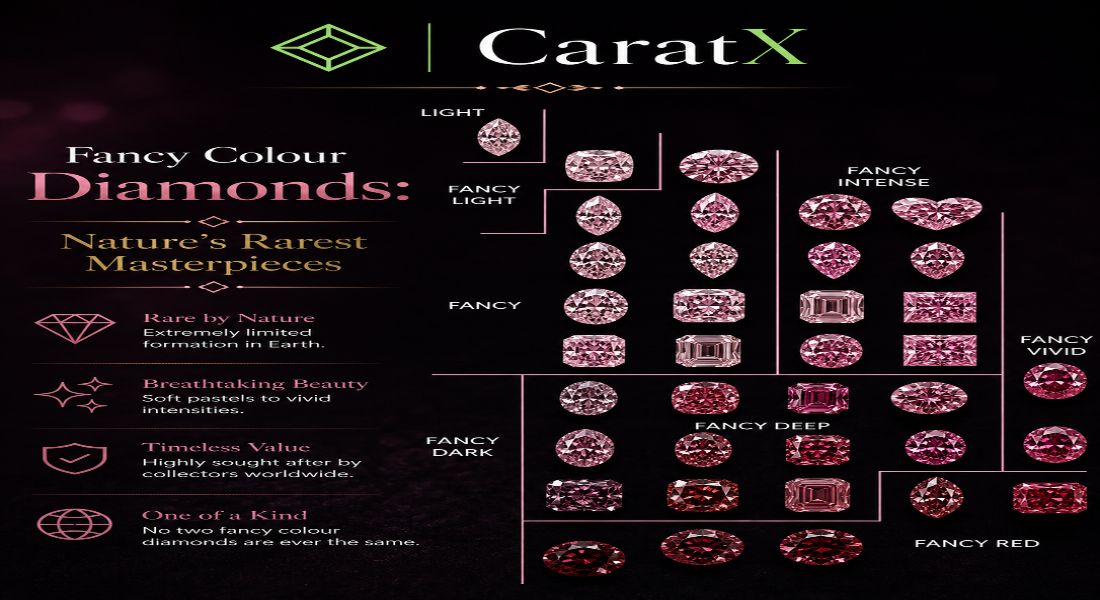
The GIA system uses a set of colour grades, ranging from Faint, Very Light, and Light through Fancy Light, Fancy, Fancy Intense, Fancy Vivid, Fancy Deep, and Fancy Dark. For investors and serious collectors, three grades matter most:
Fancy Light diamonds display a soft and delicate colour appearance, making them the most accessible intensity grade and often the most affordable entry point into fancy colour diamond ownership.
Fancy Intense diamonds exhibit a deeper, more noticeable colour with strong saturation and visual impact. Their vibrant appearance makes them significantly rarer than lower intensity grades, commanding a substantial premium.
Fancy Vivid diamonds represent the pinnacle of colour intensity, showcasing exceptionally rich, pure, and highly saturated colour. As the rarest of all fancy-colour grades, they account for only a small fraction of fancy-colour diamonds discovered worldwide. Their exceptional rarity and beauty often drive prices to 100% or more per carat above comparable Fancy Intense diamonds.
In most cases, the stronger and more vivid the colour, the more valuable the diamond. Even very slight colour differences can have a significant impact on value. As the GIA explains, "The rarer the color, the more valuable the diamond".
The World's Most Famous Sources -
Fancy colour diamonds are found in various locations around the world, including South Africa, Australia, Canada, Russia, and Botswana. However, two sources stand out as legendary in the history of fancy colour diamonds.
The Argyle Mine:
For nearly four decades, one name dominated the world of pink and red diamonds: Argyle. Located in the remote East Kimberley region of Western Australia, the Argyle diamond mine was unlike any other diamond deposit on Earth.
Discovered in 1979, Argyle began production in 1985 and quickly became one of the world's largest diamond mines by volume. Over its 37-year operational lifetime, Argyle produced more than 865 million carats of rough diamonds. At its peak in 1994, the mine produced an astonishing 42 million carats in a single year.
Before its closure in November 2020, Argyle produced approximately 90% of the world'snatural pink diamonds. While the vast majority of Argyle's output was lower-value champagne and cognac diamonds, the mine's true fame rested on its production of pink and red diamonds. In fact, some estimates place this figure as high as 95%.
The closure of the Argyle mine marked a pivotal moment in Australian and global mining history. In October 2021, nearly one year after the end of operations, Rio Tinto sold its final production of pink and blue diamonds through the 37th Argyle Pink Diamond Tender, delivering record-breaking prices.
The Cullinan Mine: Source of Blue Diamonds
Located in South Africa, the Cullinan Mine (formerly the Premier Mine) is the primary source of the world's rarest blue diamonds. The mine has produced some of the most famous blue diamonds in history, including the Cullinan Blue and stones that have graced the British Crown Jewels.
Why Colour Trumps Carat -
Fancy colour diamonds have become one of the most actively discussed and aggressively sought asset classes in the world of tangible luxury. Their investment appeal stems from a combination of geological uniqueness, irreplaceable supply constraints, and a maturing global market where collectors and ultra-high-net-worth individuals increasingly prioritise colour over carat weight.
The numbers tell a compelling story. In April 2017, the Pink Star a 59.60-carat Fancy Vivid pink diamond sold for $71.2 million, becoming the most expensive gem ever auctioned. The Winston Pink Legacy, an 18.96-carat Fancy Vivid pink diamond, sold for more than $50 million, establishing a per-carat record of $2.6 million.
Blue diamonds have also achieved extraordinary prices. A 9.75-carat Fancy Vivid blue diamond sold for $32,645,000 at Sotheby's New York, setting a new auction record total price for any blue diamond. A 5.3-carat Fancy Deep blue diamond sold for $1.8 million per carat at Bonhams in London.
The Fancy Color Research Foundation (FCRF) has reported that fancy colour diamond prices have increased by 5.7% annually over the past 20 years. This consistent appreciation, combined with finite supply, has made fancy colour diamonds an increasingly attractive alternative investment for sophisticated portfolios.
Why Fancy Colour Diamonds Are Unique -
Every fancy colour diamond is unique, with no two stones having exactly the same colour, intensity, or natural pattern. This individuality is part of their enduring appeal. Unlike colourless diamonds, which are valued for their uniformity and lack of colour, fancy colour diamonds are celebrated for their distinctiveness and character.
In the world of colourless diamonds, "Flawless" clarity is the holy grail. However, in the realm of fancy colour diamonds, the rules are different. Because the colour is the primary value driver, even diamonds with lower clarity grades are prized by connoisseurs if their colour is attractive. Fancy shapes like radiant cuts are commonly used to maximise the intensity of the colour.
The geological conditions required to yield fancy colour diamonds are so rare that they make these gems "scarce and highly prized". As the GIA explains, "This rarity means that these diamonds command a higher market price".
Conclusion:
Fancy colour diamonds represent nature's ultimate artistic achievement, a convergence of geology, chemistry, and physics that occurs over billions of years and under conditions that are nearly impossible to replicate. From the delicate pink of a stone born from plastic deformation to the deep blue created by a single boron atom per million carbon atoms, each fancy colour diamond tells a story of the Earth's extraordinary forces.
Their rarity is almost beyond comprehension. Only one in 10,000 diamonds displays a fancy colour.Red diamondsare so rare that fewer than thirty are known to exist. The Argyle mine, which produced 90% of the world's pink diamonds, is now closed forever. These are not merely gemstones; they are irreplaceable pieces of natural history.
Recommended Reads from CaratX -
Why Fancy Color Diamonds Are Capturing Attention in 2026: The Complete Investor & Collector's Guide
The Guide to Fancy Colored Diamonds: Nature's Most Rare and Vibrant Gems
Red Diamonds: The World's Rarest and Most Valuable Fancy Color Diamonds
The World of Pink Diamonds: Why Pink Diamonds Are So Rare and Valuable
Pink Diamonds: Understanding the GIA Color Scale Behind Their Value
Frequently Asked Questions -
What makes a diamond a "fancy colour" diamond?
A diamond is classified as a fancy colour diamond when it falls outside the GIA D-to-Z colour scale used for colourless stones. This includes yellow and brown diamonds that exhibit colour beyond the Z range, as well as diamonds that exhibit any other colour such as pink, blue, green, or red.
What is the rarest fancy colour diamond?
Red diamonds are the rarest of all fancy colour diamonds. Researchers estimate that less than one in 25 million diamonds is a Fancy red. Fewer than thirty true red natural diamonds are known to exist in the entire world.
How are fancy colour diamonds graded?
Fancy colour diamonds are graded on three dimensions: hue (the dominant colour), tone (lightness or darkness), and saturation (intensity or strength of the hue). The GIA uses a nine-tier scale ranging from Faint, Very Light, and Light through Fancy Light, Fancy, Fancy Intense, Fancy Vivid, Fancy Deep, and Fancy Dark.
Why did the Argyle mine closing impact pink diamond prices?
The Argyle mine in Western Australia produced approximately 90% of the world's natural pink diamonds before its closure in 2020. With the closure of this primary source, the supply of new pink diamonds has dramatically decreased, driving up prices for existing stones.
Are fancy colour diamonds a good investment?
Fancy colour diamonds have demonstrated consistent appreciation over time, with the Fancy Color Research Foundation reporting average annual price increases of 5.7% over the past 20 years. Their finite supply, increasing demand, and status as tangible luxury assets make them an attractive alternative investment.
What causes the colour in pink diamonds?
Unlike yellow or blue diamonds, which get their colour from chemical impurities, pink diamonds derive their colour from plastic deformation a structural distortion of the crystal lattice caused by immense pressure during the diamond's formation. The GIA confirms that the colour in approximately 99.5% of natural pink diamonds comes from this crystal lattice distortion.
Can fancy colour diamonds be treated or synthetic?
Yes. There are a number of processes used to alter the colour of diamonds, and synthetic fancy colour diamonds exist. This is why independent certification from a reputable laboratory like the GIA is essential to confirm that a fancy colour diamond is natural and untreated.
Follow CaratXfor such insightful and educational content.
Start selling diamonds in 18+ International countries –www.caratx.com/register
Sellers register on CaratX marketplace here to start selling to B2B and B2C buyers –www.caratx.com/register
Shop gemstones from our CaratX marketplace at unbeatable price –https://caratx.com/search?query=gemstones
Shop natural diamonds from here –https://caratx.com/search?query=Natural
More details about our Pricing –https://caratx.com/sell-on-caratx