
Moonstone has captivated humanity for millennia with its ethereal, moon-like glow. This soft, billowy light known as adularescence seems to float beneath the gem's surface, shifting and moving as the stone is turned. Few gemstones possess such an unmistakable, almost supernatural beauty.
As the June birthstone alongsidepearlandalexandrite, moonstone holds a special place in both the jewelry world and human culture.
In this guide, we'll explore everything you need to know about moonstone: from its geological formation and the science behind its magical glow, to the different color varieties, value factors, and proper care techniques. Whether you're a collector, a jewelry enthusiast, or simply someone drawn to this enchanting gemstone, this guide will illuminate the world of moonstone like never before.
What Is Moonstone? The Geology Behind the Glow
Moonstone is a variety of the feldspar-group mineral orthoclase. Feldspars are the most widespread minerals in the Earth's crust, making up more than 60% of the Earth's rocky crust. You can pick up a rock almost anywhere in the world and likely find that it contains a mineral from the feldspar group.
What makes moonstone special is its unique internal structure. During formation, orthoclase and albite two different feldspar minerals separate into stacked, alternating layers. These microscopic layers are similar in size to the wavelength of light (approximately 0.5 microns). When light falls between these thin, flat layers, it scatters in many directions, producing the phenomenon called adularescence.
The minerals in the feldspar family make up more than half of the Earth's rocky crust. Occasionally, these common minerals form crystals that shimmer like the light of the moon. The gems cut from these iridescent crystals are called moonstone, sunstone, and labradorite. Moonstones are the most highly-prized of the feldspar gems.
To be called a moonstone, a mineral's actual identity is not as important as the beauty of its adularescence. Other feldspar minerals can also show adularescence, including labradorite and sanidine. Interestingly, what is commonly sold as "rainbow moonstone" is actually a variety of labradorite rather than orthoclase.
Adularescence:
Adularescence is the defining characteristic of moonstone. It is the light that appears to billow across a gemstone, giving its surface a glowing appearance. Perhaps the most captivating aspect of adularescence is its appearance of motion the misty light seems to roll across the gem's surface as you change the viewing angle.
According to theGemological Institute of America (GIA), moonstone's unearthly glow is caused by light scattering between microscopic layers of feldspar. The stacked layers of orthoclase and albite diffract light, creating moonstone's adularescence.
The term "adularescence" itself comes from Adularia, an early name for moonstone derived from the Adula Group of mountains in the European Alps, where this gem-quality feldspar was historically found. Another historical synonym for moonstone is "selenite," from the Greek wordselenemeaning "moon".
The quality of adularescence varies significantly between stones:
Blue sheen is produced when the albite crystals are very fine.
White sheen occurs when the albite plates are thicker.
The finest moonstone is a gem of glassy purity with a mobile, electric blue shimmer.
Beyond adularescence, some moonstones also display chatoyancy (the cat's-eye effect) or even a four-spoked star effect.
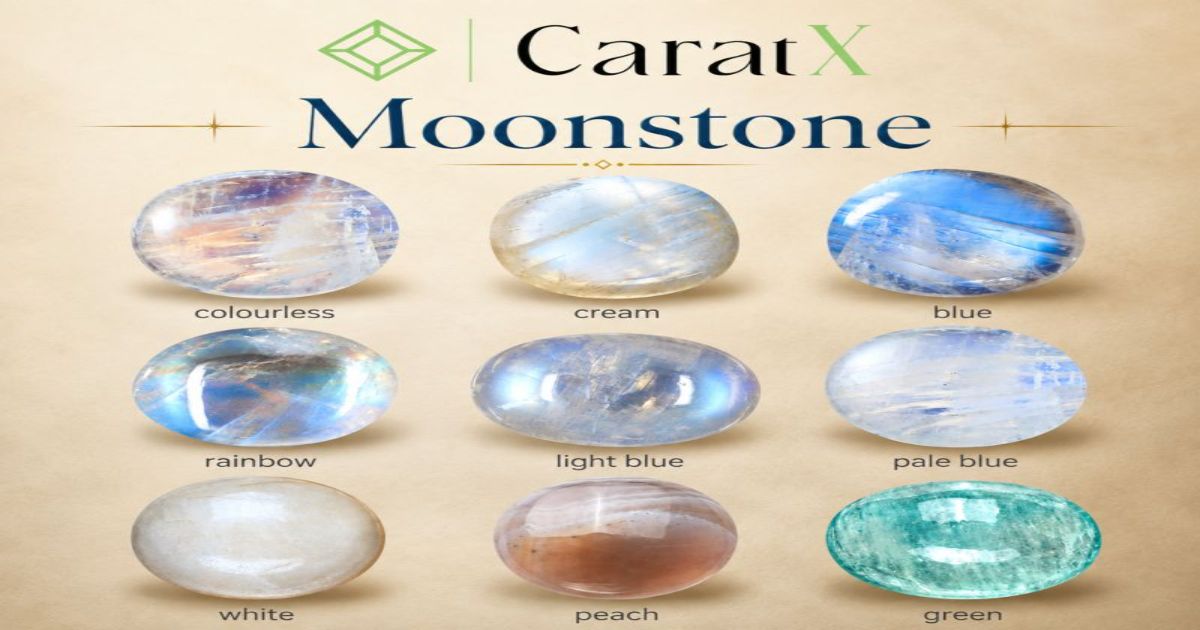
The Spectrum of Moonstone Colors -
Moonstone comes in a surprising array of colors, each with its own unique charm and value.
White Moonstone -
The most common variety, white moonstone features a soft white body color with a characteristic blue sheen. It is often translucent to semi-transparent and displays the classic adularescence that moonstone is famous for.
Blue Moonstone -
The most valuable variety, blue moonstone is famous for its bright blue glow on a nearly transparent background. The finestblue moonstonescome from Sri Lanka, the classical country of origin. A blue sheen is produced when the albite crystals within the stone are very fine. Flawless, clear, or translucent gems exhibiting a rich blue sheen are the most valuable.
Rainbow Moonstone -
Rainbow moonstone displays flashes of blue and rainbow colors, making it a favorite among jewelry lovers. Despite its name, rainbow moonstone is technically a variety of labradorite rather than orthoclase feldspar. It has a multicolored adularescence over a light bodycolor.
Peach Moonstone -
Featuring warm peach to orange shades with a gentle shimmer, peach moonstone offers a softer, more romantic alternative to the classic blue varieties. Specimens from India often feature these warmer tones.
Gray Moonstone -
A unique variety with a silver-gray body color and soft glow, gray moonstone provides a more subtle and sophisticated look.
Green Moonstone -
A rare variety with light green tones and a subtle shimmering effect. In recent years, green, brown, and orange specimens have appeared on the market, mainly originating from India.
Moonstone Hardness and Durability:
Moonstone falls between 6 and 6.5 on the Mohs hardness scale. While this makes it suitable forjewelry, it is less durable than gems like sapphire, diamond, or amethyst. Moonstone is vulnerable to:
Scratching from harder materials.
Chipping or cleaving if accidentally hit against a hard surface.
Cleavage – moonstone has two cleavage directions, which can affect durability.
Because of these factors, manufacturers usually set moonstone intopendants, earrings, and pins rather thanrings. However, with proper care and attention, many people wear moonstone rings for years without any issues. Wearing moonstone rings during sports or at the gym is not recommended.
Cleaning and Care -
Warm soapy water is the only recommended substance for cleaning moonstones. Ultrasonic and steam cleaners are never recommended as they can damage the stone. High heat or sudden temperature changes can cause breaks in moonstone.
Moonstone as a June Birthstone -
Moonstone is one of the three birthstones for June, along withpearland alexandrite. This June birthstone has been associated with both the Roman and Greek lunar deities. Hindu mythology claims that it is made of solidified moonbeams. Moonstone is often associated with love, passion, and fertility; it is believed to bring great luck.
History, Mythology, and Cultural Significance -
Moonstone is surrounded by a good deal of mystique and magic. In many cultures, it is regarded as a holy, magical gemstone:
In India, moonstones are regarded as "dream stones" that bring the wearer beautiful visions at night.
In Arabic countries, women often wear moonstones sewn out of sight into their garments, as the moonstone is a symbol of fertility.
The moonstone symbolizes our being in its entirety. With its soft shimmer, it strengthens our emotional and subconscious aspects.
It is considered a "lovers' stone," evoking tender feelings and safeguarding the true joys of love.
Wearing a moonstone is said to strengthen intuition and the capacity to understand.
Historical figures, including royalty, have prized these gems for centuries. The Roman naturalist Pliny the Elder wrote that moonstone's shimmery appearance shifted with the phases of the moon.
Quality Factors: What Makes a Moonstone Valuable
According to GIA, several characteristics determine moonstone's value:
Color -
The finest moonstone is a gem of glassy purity with a mobile, electric blue shimmer. The most valuable moonstones are those with a rich blue sheen on a transparent or semi-transparent background.
Clarity -
Characteristic inclusions include tiny tension cracks called "centipedes". These are natural and can help identify genuine moonstone.
Cut -
As it displays moonstone's phenomena to best advantage, the cabochon is the common cut. The cutter must align the axes of the crystal precisely to bring about the desired light effect. Moonstone is always cut either en cabochon or with a plane surface never with facets.
Carat Weight -
Moonstone comes in a wide range of sizes and carat weights. Large, high-quality specimens are rare and command premium prices.
Rarity -
Moonstone is rare in top qualities, making this ethereal gem derived from one of the Earth's most common minerals highly sought after.
Moonstone vs. Other Feldspar Gems -
Moonstone belongs to the feldspar family, which includes several other gemstones:
Sunstone – exhibits a reddish to golden schiller caused by hematite or copper inclusions.
Labradorite – displays a strong iridescence known as labradorescence, often in multiple colors.
Peristerite – the least-known iridescent feldspar, often misidentified as moonstone.
"Rainbow moonstone" is technically a variety of labradorite, not true moonstone.
Moonstone Treatments and Synthetics -
Like manygemstones, moonstone can undergo treatments to enhance its appearance. There are a number of processes used to alter the color, apparent clarity, or improve the durability of gems. Some moonstones have been found to fluoresce moderate to strong bluish white to long-wave UV, with the fluorescence visible in fissures.
Some gemstones have synthetic counterparts with essentially the same chemical, physical, and optical properties, grown in a laboratory. Moonstone can also be imitated by adularescent synthetic spinel, milky chalcedony, or glass.
Frequently Asked Questions -
Is moonstone a real gemstone?
Yes, moonstone is a natural gemstone belonging to the feldspar group of minerals. It is composed primarily of orthoclase and albite.
What causes moonstone's glow?
The glow, called adularescence, is caused by light scattering between microscopic alternating layers of orthoclase and albite within the stone.
Is moonstone expensive?
Moonstone prices vary widely. The finest blue moonstones with strong adularescence and high clarity can be quite valuable, while lower-quality specimens are more affordable. Rare in top qualities, this gem is derived from one of the Earth's most common minerals.
Can moonstone get wet?
Yes, moonstone can be cleaned with warm soapy water. However, ultrasonic and steam cleaners should never be used.
Is moonstone good for everyday wear?
Moonstone has a hardness of 6-6.5 on the Mohs scale and can be worn daily with proper care. However, it is vulnerable to scratching and chipping, so it's best suited for pendants, earrings, and brooches rather than everyday rings.
What are the June birthstones?
The three June birthstones are pearl, alexandrite, and moonstone.
What is the difference between moonstone and rainbow moonstone?
True moonstone is a variety of orthoclase feldspar. Rainbow moonstone, despite its name, is actually a variety of labradorite feldspar that displays multicolored adularescence.
Recommended Reads from CaratX -
Moonstone Around the World: A Detailed Guide to Origins, Quality, and Value– A companion piece to this guide, exploring the world's most important moonstone sources and how origin affects quality.
The Mohs Scale Decoded: The Ultimate Guide to Gemstone Hardness and Durability in Fine Jewelry– A deep dive into the Mohs scale, explaining why moonstone's 6–6.5 hardness matters for everyday wear and how to care for your jewelry.
A Comprehensive Guide to Optical Phenomena in Gemstones– An exploration of asterism, chatoyancy, color change, and adularescence—the very phenomenon that gives moonstone its magical glow.
The Timeless Allure of White Gemstones: A Complete Guide to Modern Jewelry's Purest Treasures– Featuring moonstone alongside diamond, moissanite, zircon, and white spinel, this guide explores the versatility of white gems.
Beyond the Hue: A Connoisseur's Dive into Why Colour is Everything in Gemstones, But Not the Only Thing– Learn how color, tone, and saturation affect gemstone value, including colored stones like moonstone.
The Complete Guide to Gemstone Verification: How to Check Authenticity, Quality, and Value– A practical guide to distinguishing natural gemstones from synthetics and imitations, essential for any moonstone buyer.
Start Your Moonstone Journey with CaratX -
Whether you're looking to purchase natural moonstones, sell yourgemstonesinternationally, or explore the world of B2B and B2C diamond and jewelry trading,CaratXprovides a trusted marketplace for buyers and sellers worldwide.
Shop natural gemstones including moonstone at unbeatable prices –https://caratx.com/search?query=gemstones
Shop natural diamonds –https://caratx.com/search?query=Natural
Sellers register to start selling to 18+ international countries –www.caratx.com/register
Sell jewelry internationally to buyers through our CaratX seller plan –www.caratx.com/register
More details about our pricing –https://caratx.com/sell-on-caratx
Follow CaratXfor more insightful and educational content on gemstones, diamonds, and the jewelry industry.