
The global diamond market is showing definitive signs of recovery in 2026 after a challenging downturn that spanned 2023 and 2024. Industry data reveals improving demand across major markets, tightening rough diamond supply, and the first meaningful price increases in over a year.
This analysis examines the current state of the global diamond trade, regional market dynamics, and the factors shaping the industry's trajectory through the remainder of 2026 and beyond.
Market Overview:
The global diamond market has been on a steady recovery path throughout 2025 and into 2026. According to industry research, the diamond market size was valued at approximately $102.06 billion in 2025 and is projected to grow to $106.76 billion in 2026, reaching $153.1 billion by 2034 at a compound annual growth rate of 4.6%. Thepolished diamondsegment continues to dominate, accounting for approximately 68% of total revenue.
The recovery follows a period of significant price correction. After a strong 2022 driven by post-pandemic luxury spending, the industry faced a downturn through 2023 and 2024.
However, 2025 ushered in a revival with improving demand trends and more positive market sentiment. By mid-2026, the recovery had broadened significantly, with the Trade Diamond Index for1-carat diamondsrising 0.5% in August the first increase in 15 months.
Supply Dynamics:
One of the most significant factors supporting the current market recovery is the sharp contraction innatural diamondsupply. Global rough diamond production fell to an estimated 98.8 million carats in 2025, down from 107.9 million carats in 2024 a drop of 8.4%. According to Kimberley Process data, worldwide rough diamond production declined 3% year-on-year by value to $9.23 billion.
The supply picture is even more striking when viewed over a longer timeframe. Natural diamond production is forecast to moderately rebound to around 105 million carats in 2026 down from over 150 million carats as recently as nine years ago.
Industry analyst Paul Zimnisky estimates that global output could fall to around 90 million carats in 2026 from more than 150 million carats before the pandemic. He expectsnatural diamondproduction to remain in the 90-120 million carat range for the foreseeable future.
Major Producers Cutting Output -
De Beers, one of the world's largest diamond producers, has implemented aggressive supply control measures. The company's parent Anglo American cut 2026 production guidance to 21-26 million carats, down from a previous 26-29 million carats. This follows a similar reduction in 2025 guidance from 30-33 million carats to 20-23 million carats. De Beers is currently producing at as much as 35% under capacity.
Russia's ALROSA, the world's largest producer by volume, is also producing below capacity at an estimated 15%. Together, De Beers and ALROSA account for about half of global production by volume.
The supply constraints reflect both strategic production cuts and the reality of aging mines. As industry analyst Paul Zimnisky noted, "The thing with diamond mining is it takes a lot of money and a lot of time to put a new mine into production, so we do have a secular trend of decreasing diamond supply".
Regional Market Analysis -
United States: Steady Demand and Post-Summer Revival
The United States remains the world's largest diamond market, accounting for approximately 55% of global sales. US demand has remained steady throughout 2026, with trading activity picking up after the traditional summer slowdown.
Consumer spending on natural diamonds in the US has shown remarkable resilience. De Beers' 2026 US Diamond Acquisition Study found that average spending on natural diamond jewellery increased to $4,063 per piece in 2025, up from $3,242 in 2023 a rise of 25%. The study, which surveyed 18,500 consumers, also revealed that Gen Z is spending almost double what Baby Boomers spend when buying natural diamonds, at $4,080 per piece versus approximately $2,000.
Natural diamond sales at US independent jewellers grew 4% in Q4 2025 and 9% in Q1 2026. Sales of K-to-Z colour natural diamonds climbed 15% and 19% during the same periods.
US Market Insight: Natural diamonds remain the most desired luxury jewellery product, with US women spending an average of $4,063 on a natural diamond in 2025.
For those looking to capitalize on the US market recovery, CaratX offers acomprehensive marketplace platformfor selling natural diamonds andjewelleryto international buyers.
Belgium (Antwerp): Large Stones in Short Supply
The Antwerp diamond market, a critical global trading hub, is showing signs of recovery after a challenging period. According to the Antwerp World Diamond Centre (AWDC), the total trade value of diamonds passing through Antwerp in 2025 amounted to $19.07 billion. While this represents a 22.4% decline year-on-year, the market is showing clear signs of stabilization.
Business activity is slowly returning as traders come back from the summer break, with demand positive and sentiment optimistic.Large stones are in particularly short supply, especially 3-4 carats and above, with even sharper shortages in 7-carat+ stones.
Fancy shapes and 10-carat-plus diamonds are seeing strong demand, while round 5-carat stones remain slower.
The AWDC noted that Antwerp maintained a 34% share of global rough diamond imports and exports ($6.5 billion) during 2025 and a 65.6% share of all polished diamond imports and exports ($12.5 billion).
For sellers looking to access the European market through Antwerp and other international channels,registering on CaratXprovides access to buyers across 18+ countries.
India: Leading the Price Recovery
India has emerged as a critical growth market in the global diamond industry. The country's share of global diamond demand has grown substantially over the last two decades from just 2% to nearly 11% today, making it the second-largest consumer of natural diamonds globally.
Indian demand is broadening beyond tier-1 cities, with tier-2 and tier-3 locations showing strong buying patterns across southern, northern, and western parts of the country.
In the polished diamond segment, 0.30-carat round diamonds in D-G colour and VVS-SI clarity are leading the price recovery, with demand from major retailers continuing following inventory drops. Round 0.50-carat goods are close behind. Melee supply is tight.
India Market Note: Pearandoval shapesare the strongest fancy shapes in the Indian market, with buyers focused on the right combination of shape, make, size and price.
Indian manufacturers and retailers report that prices have stabilized, encouraging consumers to return to diamond jewellery purchases. The combination of lower production, leaner inventories and improving consumer sentiment could support a gradual recovery in the natural diamond market over the coming quarters.
Indian sellers canregister on CaratXto access international buyers and expand their global reach.
Hong Kong:
The Hong Kong market remains somewhat subdued as buyers await the Jewellery & Gem WORLD Hong Kong show (September 14-20, 2026). Trading is slow ahead of the event, with fine jewellery performing well but loose stones remaining weak.
Large rounds and long fancy shapes of 2 carats and larger are the best sellers. High-end buying focuses on D-G colours, while regular Chinese retailers seek G-H stones. IF-VVS investment-grade diamonds are in demand.
However, commercial goods under 1 carat in lower colours and clarities are losing ground to synthetics. Mainland China remains quiet overall ahead of the Shenzhen International Jewelry Fair (September 9-12) and the Hong Kong show.
Demand recovery in China remains critical for a broader rebound in the global diamond market. Chinese diamond consumption has fallen sharply over the past few years due to weakness in the country's property market and softer consumer sentiment.
Buyers and sellers canshop natural diamondsthrough CaratX's global marketplace and connect with international customers.
Israel:
The Israeli diamond market remains quiet as the summer break ends. Some buyers are returning with orders for 1-carat and larger diamonds, though overall trading remains limited. The market is showing cautious optimism as activity gradually picks up.
The Lab-Grown Diamond Challenge -
The diamond industry continues to face significant competition fromlab-grown diamonds(LGDs), particularly in the smaller-size segment. The global lab-grown diamond market reached $29.5 billion in 2025 and is projected to more than triple by 2035.
Lab-grown diamondshave made substantial inroads in certain segments. According to The Knot's survey of more than 10,000 US couples, lab-grown centre stones accounted for 61% of all engagement ring purchases in 2025 a 239% jump since 2020. Natural diamonds' share of jewellery sales slipped from approximately 50% to 41%.
The price differential between natural andlab-grown diamondshas widened dramatically. The discount in LGD prices relative to natural diamonds has increased from 15% in FY2016 to 90% in FY2025 due to oversupply and rapid technological advancements. A genericlab-grown diamondcan be bought for as little as one-twentieth the price of an equivalent natural diamond.
However, the lab-grown diamond market is showing signs of strain. World Diamond Council President Feriel Zerouki has stated that lab-grown diamonds are losing their appeal due to oversupply and plummeting prices, with consumer preferences starting to shift back to natural stones. Lab-grown diamond exports from India showed a decline of 10.61% in gross exports in FY2025-26.
Natural vs. Lab-Grown: Natural 1-carat diamondsaveraged around $4,200 in 2025, down from roughly $6,000 in 2021, while the average price of a lab-grown diamond was $2,786 in 2025.
Industry analyst Paul Zimnisky believes natural diamonds will continue to retain a significant share of the jewellery market, especially among consumers looking for rarity and authenticity. Premium natural diamonds are expected to outperform, while mid-sized stones may remain under pressure unless industry marketing improves.
Fancy Shapes: A Growing Premium Segment
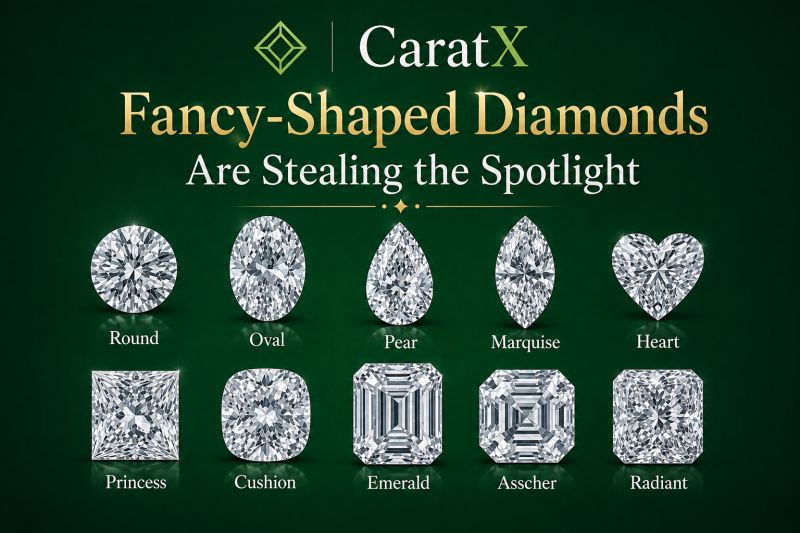
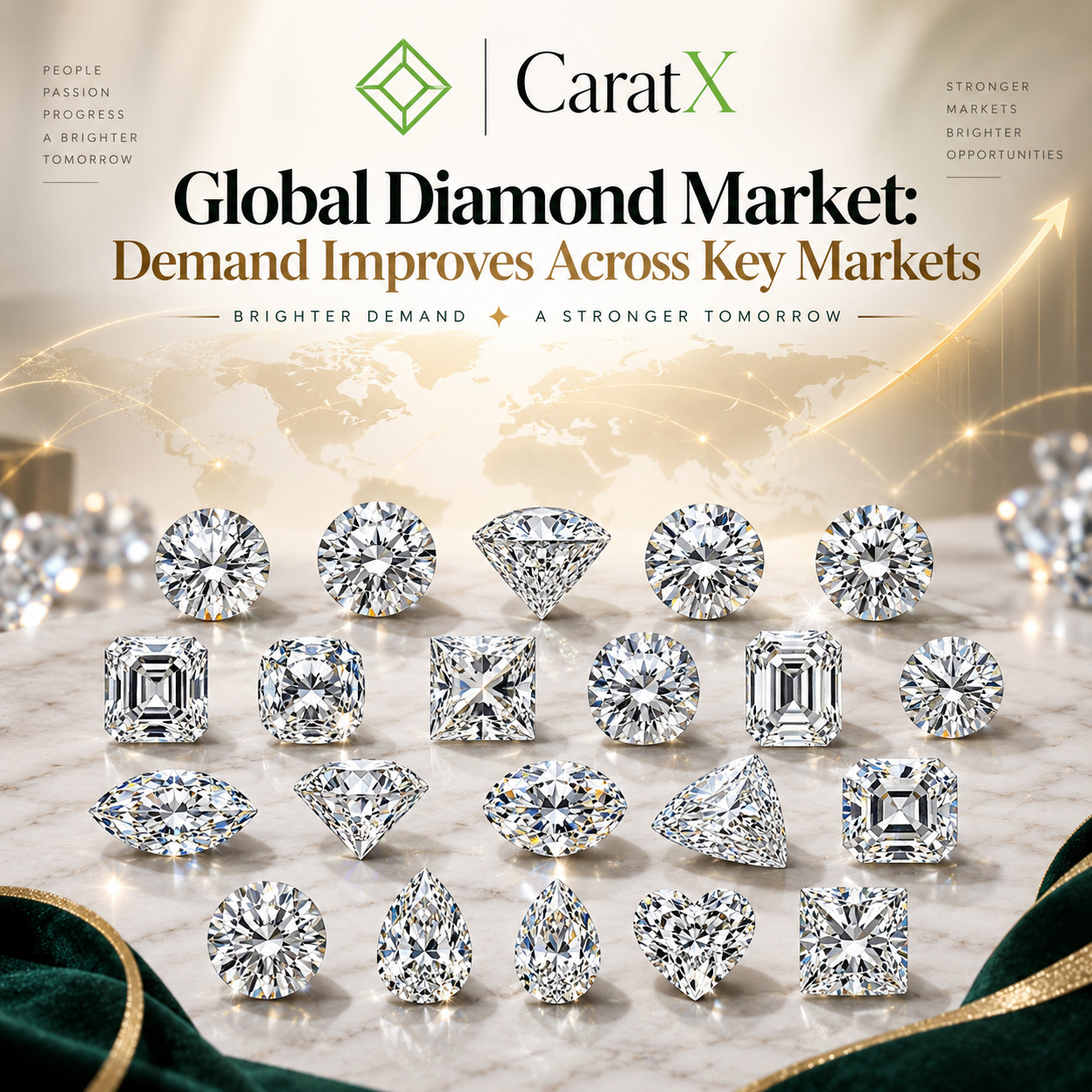
Fancy shape diamonds are experiencing particularly strong demand across multiple markets, with well-cut stones commanding significant premiums.
Long fancy shapes such as ovals, marquises and emeralds are moving well in 2-carat and larger sizes.
High-quality marquises, long radiants and long cushions are in short supply.
Marquiseis the most expensive fancy shape.
Long cushionsare easy to sell and trade at a 20% to 25% premium over square ones.
The US market shows solid demand for elongated ovals of good shape and quality in D-I, VS-SI categories.
Very well-cut fancy shapes are difficult to find and command premiums.
Reports also indicate demand for princess cuts after a long period of weakness, though prices remain low. Antique cuts and styles are also trending.
Sellers looking to capitalize on the fancy shape premium canlist their diamonds on CaratXto reach international buyers seeking these high-demand shapes.
Price Outlook and Future Projections -
The price outlook for natural diamonds is increasingly positive, supported by tightening supply and improving demand.
Short-Term Indicators -
The Rapaport Trade Diamond Index provides the most current price indicators:
1-carat RAPI: +0.5% in August 2026 first rise in 15 months.
0.30-carat RAPI: +2% in August, continuing a strong rebound.
0.50-carat RAPI: +2.5% in August.
Small diamond recovery accelerated in June, with 0.30-carat RAPI rising 4.2%.
Certified stones in India are seeing increased premiums over non-certified goods.
Medium-Term Projections -
Industry experts project continued price recovery through 2026 and beyond:
The diamond market is expected to grow from $1.39 billion in 2025 to $1.45 billion in 2026 at a CAGR of 4.7%
By 2030, the market is projected to reach $1.84 billion at a CAGR of 6.1%
Alrosa forecasts that global diamond prices across all categories will rise at least 50% over the next 2-3 years to approximately $180 per carat.
Some analysts warn that if current supply dynamics continue, shortages could emerge in 2027 and 2028.
Factors Supporting Price Recovery -
Declining Supply: Natural diamond production at multi-decade lows
Strategic Production Cuts: Major producers operating significantly below capacity
Reduced Inventories: Manufacturer and wholesaler inventories have fallen significantly over the past two years
Stabilizing Prices: Wholesale and retail prices have largely stabilized after years of decline
Festive and Wedding Season Demand: Improving consumer sentiment ahead of key buying seasons.
Expand your diamond industry knowledge with these resources:
Start Selling to Diamonds in 18+ International Countries– Register on CaratX marketplace to begin selling to B2B and B2C buyers worldwide.
Sell Jewelry Internationally– Access international buyers through our CaratX seller plan.
Shop Gemstones at Unbeatable Prices– Explore our extensive collection of gemstones on the CaratX marketplace.
Shop Natural Diamonds– Browse our curated selection of natural diamonds.
CaratX Pricing Details– Learn more about our competitive pricing structure.
Sellers Register Now– Start selling to 18+ international buyers today.
Recommended Reads from CaratX -
Deepen your understanding of the global diamond market with these hand‑picked articles from our blog:
Market Recovery & Regional Dynamics -
Global Diamond Markets Show Growing Confidence After Las Vegas: The 2026 Recovery Takes ShapeA detailed post‑show analysis of the Las Vegas JCK event, with fresh data on US buyer sentiment, inventory restocking, and the early signs of a broad‑based market turnaround.
Global Diamond Market Update: A Deep Dive into Regional Dynamics, Trends, and Future OutlookComprehensive breakdown of how each major hub US, Belgium, India, Hong Kong, and Israel is performing, complete with price forecasts and supply‑side indicators.
India's Diamond Export: A 20‑Year Low, Global Shifts, and the Lab‑Grown Diamond SurgeExamines why Indian polished exports hit a two‑decade low, the shifting competitive landscape, and how domestic consumption is becoming a new growth engine directly relevant to the Indian demand trends covered in this article.
Natural vs. Lab‑Grown & Premium Segments -
2026 Natural Diamond Market Report: Premium Demand Surges as Millennials and Gen Z Redefine Luxury GiftingExclusive data on how younger generations are driving spending on natural diamonds, with specific insights on larger stones and premium fancy shapes mirroring the supply tightness we discussed for 3–4 ct+ goods.
The Fancy Shape Revolution: A Deep Dive into the Global Diamond Market's Dramatic ShiftA thorough exploration of why ovals, marquises, cushions, and radiants are outperforming rounds, with pricing premiums and consumer preference data that align perfectly with our section on fancy shapes.
The Definitive 2025 Guide: Moissanite vs Diamonds – Science & Market RevolutionWhile focused on moissanite, this guide also contrasts natural diamonds with lab‑grown alternatives, giving you a broader view of the competitive pressures mentioned in our lab‑grown segment.
Pricing, Valuation & Supply Chain -
De Beers Revises Rough Diamond Index: What the 18% Price Drop Really Means for the MarketAn in‑depth look at De Beers’ strategic production cuts and how they are reshaping rough prices directly tied to the supply constraints we highlighted (multi‑decade low output).
The Ultimate Guide to Rough Diamond Pricing and Valuation: Beyond the RoughA foundational piece for understanding how rough diamonds are valued, which underpins every price recovery discussion in our main article.
The Diamond Market Right Now: What's Trending & What is HotA snapshot of the hottest categories (sizes, colours, clarities, shapes) from early 2025 many of which remain exactly the same drivers in 2026 (e.g., 0.30–0.50 ct rounds in India, large fancy shapes).
Trade Policy & Global Shifts -
How U.S. Reshaping Diamond Global Trade – A Deep Dive into Challenges, Strategies, and OpportunitiesAnalysis of US tariff policies, reshoring trends, and their impact on international diamond flows essential context for the US market section of our article.
GIA Expands International Lab Services Amid U.S. Tariffs: A Strategic Shift in Diamond GradingHow grading institutions are adapting to trade barriers, affecting certified stone premiums a point we touched upon in the price outlook.
Educational Series for Buyers & Sellers -
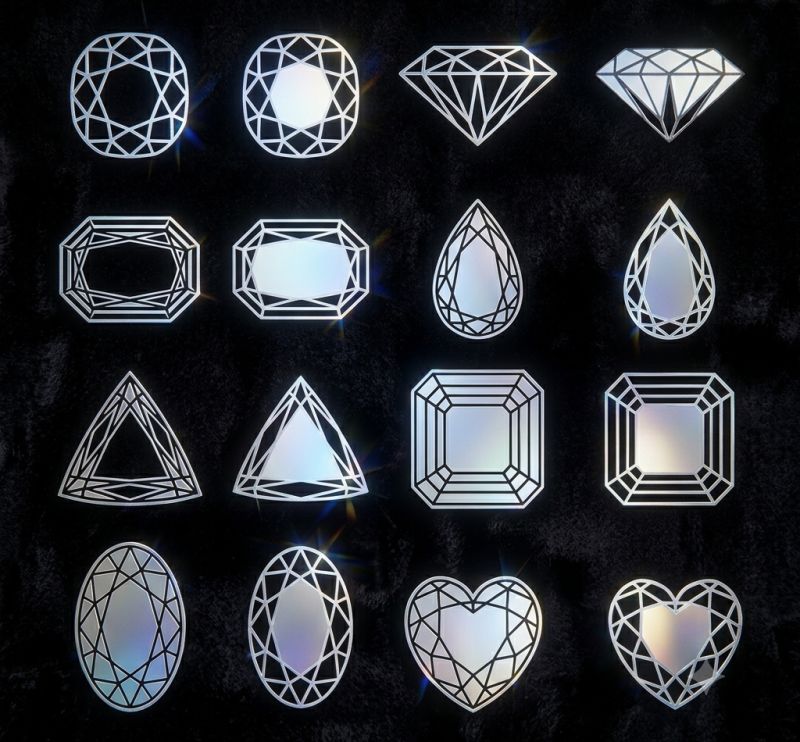
Facets of a Diamond: The Star Facet – Understanding the Essential Brilliance EnhancerA deep dive into diamond cutting anatomy valuable for anyone selling or buying fancy shapes, where make and proportions are critical.
Understanding Diamond Color – A Comprehensive GuideEssential reading for interpreting the D‑G and G‑H colour ranges mentioned in our India and Hong Kong sections.
The Ultimate Guide to Diamond InclusionsClarifies VVS‑SI clarity grades, helping you understand why those categories are leading the recovery in India.
Top 10 Rarest Diamonds in the WorldA fascinating look at extreme rarity contextualises why 7‑ct+ and 10‑ct+ stones are in such short supply.
Blog Home & Categories -
For even more articles, visit theCaratX Blog Homeor browse our curated categories:
Our Favourite Articles– Editor’s picks.
News and Media– Industry updates and analysis.
FAQs -
Q1: Are diamond prices recovering in 2026?
A: Yes, diamond prices are showing clear signs of recovery in 2026. The Rapaport Trade Diamond Index for 1-carat diamonds rose 0.5% in August 2026 the first increase in 15 months. Smaller diamonds (0.30 and 0.50 carat) have seen even stronger gains, with increases of 2% and 2.5% respectively.
Q2: What is driving the diamond market recovery?
A: The recovery is driven by multiple factors including: sharp declines in natural diamond production (down to multi-decade lows), strategic production cuts by major miners like De Beers and ALROSA, reduced inventories across the supply chain, stabilizing wholesale and retail prices, and improving consumer sentiment ahead of festive and wedding seasons.
Q3: Which diamond sizes are in highest demand?
A: Large diamonds (3-4 carats and above) are in particularly short supply, with even sharper shortages in 7-carat+ stones. Fancy shapes and 10-carat-plus diamonds are seeing strong demand. In India, 0.30-carat and 0.50-carat rounds are leading the price recovery.
Q4: Are lab-grown diamonds affecting natural diamond prices?
A: Lab-grown diamonds continue to compete in the smaller-size segment, with lab-grown stones accounting for 61% of US engagement ring purchases in 2025. However, the lab-grown market is showing signs of oversupply and price crashes, with some industry leaders suggesting the "bubble has burst". Premium natural diamonds are expected to remain resilient due to their increasing scarcity.
Q5: Which fancy shapes are performing best?
A: Long fancy shapes such as ovals, marquises and emeralds are moving well in 2-carat and larger sizes. Marquise is the most expensive fancy shape, while long cushions trade at a 20-25% premium over square ones. Well-cut fancy shapes are difficult to find and command significant premiums.
Q6: How can I sell diamonds internationally?
A: CaratX provides a global marketplace for selling natural diamonds and jewellery to buyers across 18+ countries. Sellers canregister on the CaratX platformto access B2B and B2C buyers internationally. The platform supports both diamond and jewellery sales with comprehensive seller plans.
Q7: What is the outlook for the diamond market?
A: The diamond market is projected to grow from $102.06 billion in 2025 to $106.76 billion in 2026, reaching $153.1 billion by 2034 at a CAGR of 4.6%. Industry experts expect prices to continue recovering, with Alrosa forecasting a minimum 50% price increase over the next 2-3 years.