
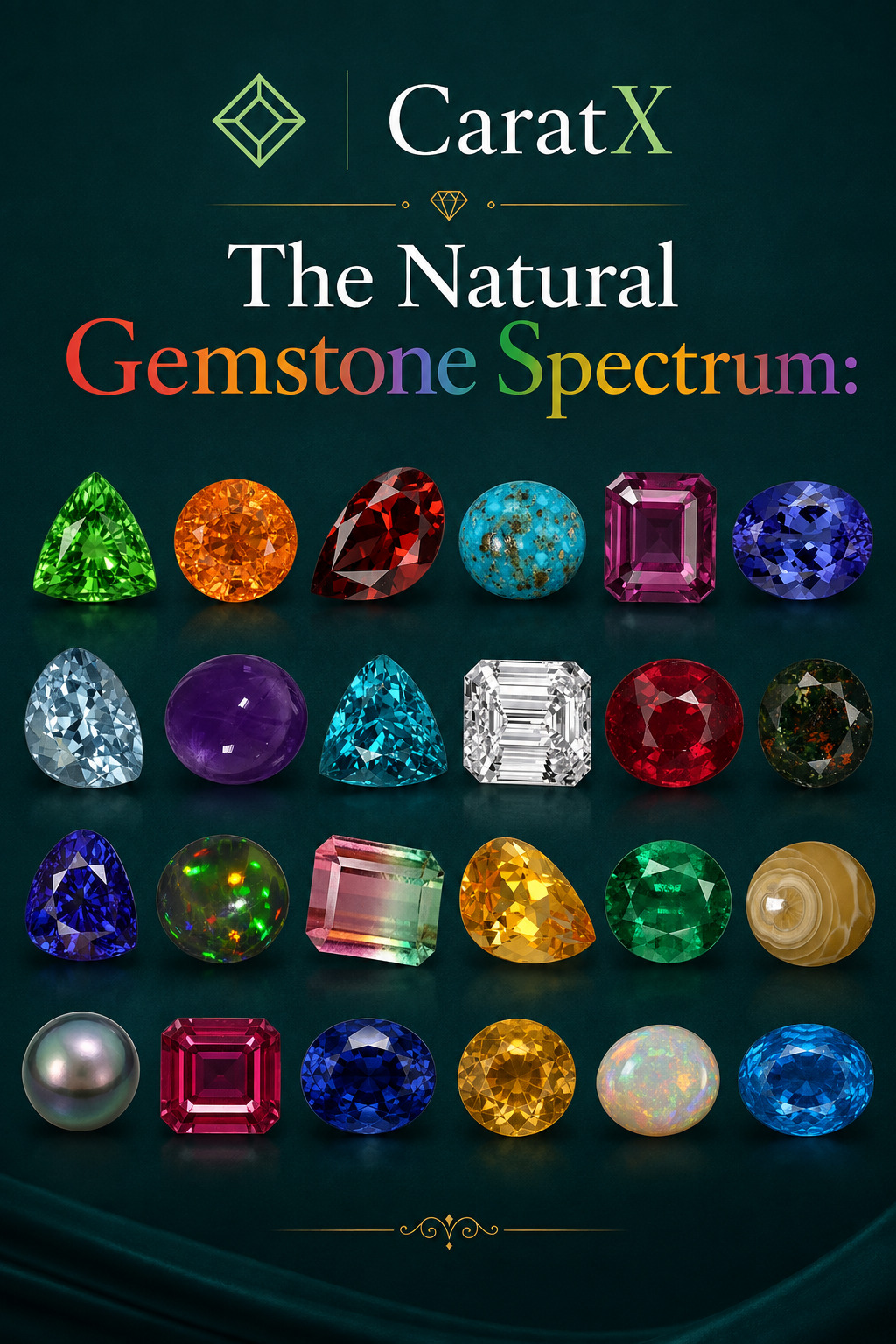
Natural gemstonesrepresent one of nature's most extraordinary artistic expressions. From the fiery red ofrubyto the serene blue ofsapphire, from the lush green ofemeraldto the sunny yellow ofcitrine, the gemstone world offers a breathtaking palette that has captivated humanity for millennia.
Each stone's unique appearance is not merely a matter of chance, it is the direct result of its chemical composition and the remarkable geological processes that shape it deep within the Earth.
The Science Behind Gemstone Colors -
Understanding why gemstones display their characteristic colors requires a journey into the atomic structure of minerals. The color of a gemstone is inextricably linked to its chemical composition.
Some minerals possess inherent color because the chromophore the element responsible for color is one of the basic chemical components of their makeup. These are termed idiochromatic (self-colored) minerals. Turquoise, for example, derives its distinctive blue from copper, a primary component of its structure.
However, most precious gemstones fall into the category of allochromatic minerals, they are naturally colorless when pure, and their colors arise from trace element impurities or other point defects in the crystal lattice. Pure corundum (Al₂O₃), for instance, is completely transparent. It is only when trace elements like chromium, iron, titanium, or vanadium are incorporated during growth that it transforms into ruby or sapphire.
The Chromophores: Color-Causing Elements
The primary chromophores responsible for gemstone colors include:
Chromium (Cr³⁺) : Creates red in ruby and spinel, pink in corundum, and green in emerald.
Iron (Fe²⁺, Fe³⁺) : Produces blue and green in many gems, yellow in citrine and heliodor.
Titanium (Ti⁴⁺) : Often pairs with iron to create blue sapphire.
Vanadium (V³⁺) : Colors tanzanite and contributes to emerald's green.
Manganese (Mn³⁺) : Creates pink and red in tourmaline and morganite.
Research from theGemological Institute of America (GIA)has identified six major chromophores in natural corundum: Cr³⁺, h•-Cr³⁺, Fe³⁺, h•-Fe³⁺, Fe²⁺-Ti⁴⁺, and V³⁺. The interaction between these elements and their concentrations determines the final color and its saturation.
The Color Spectrum of Natural Gemstones -
Red Gemstones -
Rubystands as the undisputed king of red gemstones. Thered varietyof the mineral corundum owes its vibrant color to trace amounts of chromium in its crystal structure. This element also gives manyrubiesa striking fluorescence, glowing bright crimson under ultraviolet light. The most coveted rubies possess a vivid, slightly purplish-red known as "pigeon's blood," particularly associated with Burmese origin stones.
Spineloffers a range of red hues from orange-red to intense "stoplight" red. Intense reds and pinks inspinelare caused by traces of chromium the same element that colors ruby and emerald. The higher the chromium content, the stronger the red hue. Historically, many famous "rubies" in crown jewels were actually red spinels, including the Black Prince's Ruby.
Garnet, particularly the pyrope and almandine varieties, displays rich red colors.Garnetsconstitute a chemically complex group of minerals, and their colors result from absorption by various elements including Cr³⁺, V³⁺, Fe³⁺, Fe²⁺, and Mn²⁺.
Blue Gemstones -
Sapphire, the other variety of corundum, displays a magnificent range of blue colors. The blue color arises from the Fe²⁺-Ti⁴⁺ intervalence charge transfer pair, which strongly absorbs yellow and red light, creating the perception of blue. The most prizedsapphiresdisplay a rich, velvety blue with medium to dark tones and vivid saturation. Silicon also plays a crucial role detailed analyses of Montana's Yogo Gulch sapphires show that without silicon, these stones would not be blue.
Tanzaniteis the blue to violet variety of the mineral zoisite, found in only one place on Earth near Mount Kilimanjaro in Tanzania. Its color is primarily due to vanadium (V³⁺) substituting for aluminum in the crystal structure. Untreatedtanzaniteis typically brown; it is routinely heat-treated to modify its color to a predominantly blue to bluish-purple. The most prized color is a pure blue similar to fine sapphire or an intense violet-blue.
Aquamarine,the blue to blue-green variety of beryl, gets its color from abundant Fe ions. The name derives from the Latinaqua marina, meaning "seawater," a fitting description for its tranquil ocean-like hues.
Green Gemstones -
Emeraldis the rich green to bluish-green variety of beryl, colored by trace impurities of chromium and/or vanadium. Chromium and vanadium create intense green color, while iron gives the stone a bluish tint. The varying presence of these three elements givesemeraldits range of color.
What distinguishesemeraldfrom less expensive green beryl is the depth and saturation of its coloremeraldsmust display sufficiently dark and saturated green to earn the name. Emeralds are famously included, often described as having ajardin(French for "garden").
Peridotis the gem variety of the mineral olivine, an iron and magnesium silicate. Its yellowish-green color is caused by iron content (Fe²⁺) within the structure. The most desired and valuable color is saturated green without any tinge of yellow or brown.
Tourmalinedisplays one of the widest color ranges of any gem. The color originates from metal ions (Fe, Mn, Cr, V, Ti, Cu) in its structure. Blue color is usually caused by Fe²⁺ or Cu²⁺, green comes from Fe²⁺-Ti⁴⁺ intervalence charge transfer or from Cr³⁺ or V³⁺, and pink and red colors are from Mn³⁺.Tourmaline'scolors have many different causes traces of iron and possibly titanium induce green and blue, while manganese produces reds and pinks.
Yellow Gemstones -
Yellow Sapphirerepresents the yellow variety of corundum, colored by trace elements including iron. Yellow sapphires range from pale lemon to rich golden hues.
Citrineis the transparent, pale yellow to brownish orange variety of quartz. A trace of iron in citrine's structure is responsible for its yellow-to-orange color.Natural citrineis relatively rare.
Heliodor is the yellow to golden variety of beryl, colored by Fe ions. The name comes from the Greekhelios(sun) anddoron(gift) the "gift of the sun."
Purple Gemstones -
Amethystis the purple variety of quartz. Its color comes from color centers created when trace amounts of iron are irradiated by natural radiation in the rocks. This gamma irradiation modifies the valence values of impurity elements in the amethyst crystals. The violet-coloredamethystcrystals have the most stable and least reversible coloration.
Sugilite is a rare purple to pinkish-purple mineral, valued for its intense, vibrant color.
Purple Sapphire represents the purple variety of corundum, colored by combinations of chromium, iron, and titanium.
Orange Gemstones -
Fire Opal displays vibrant orange to red-orange colors, caused by the presence of iron oxide impurities. Unlike other opals, fire opals are often transparent to translucent.
Spessartine Garnet is the orange to reddish-orange variety of garnet, rich in manganese (Mn²⁺). The orange-red coloration is due to elevated concentrations of manganese.
Orange Sapphire represents the orange variety of corundum, colored by a combination of iron and chromium.
White and Colorless Gemstones -
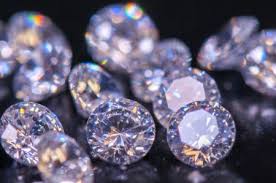
Diamond, when chemically pure, is colorless. The presence of nitrogen causes diamonds to appear yellow, while boron atoms are responsible for natural blue diamonds. Pure colorless diamonds are prized for their exceptional brilliance.
White Sapphire is the colorless variety of corundum. It makes up roughly 10% of sapphire sales, primarily for bridal jewelry. At 9 on the Mohs scale, it is extremely resistant to scratches and daily wear.
Zirconoccurs in a range of colors including colorless, which is often used as a diamond simulant.
Grey Gemstones -
Labradorite displays a unique grey body color with spectacular iridescent play-of-color (labradorescence).
Grey Spinel and Grey Diamonds represent more subtle, sophisticated color choices gaining popularity in modern jewelry design.
Multi-Colored Gemstones -
Some of nature's most extraordinary creations display more than one color within a single stone.
Watermelon Tourmalineis perhaps the most famous example, featuring a green exterior and pink interior. This remarkable color zoning occurs during crystal growth when the chemical environment changes, altering the trace elements being incorporated.
Ametrine combines amethyst and citrine in a single quartz crystal. The bicoloration results from quartz precipitation at specific geochemical conditions, temperatures, and growth rates. The amethyst color comes from iron color centers created by natural irradiation, while the citrine color comes from iron particles (Fe₂O₃).
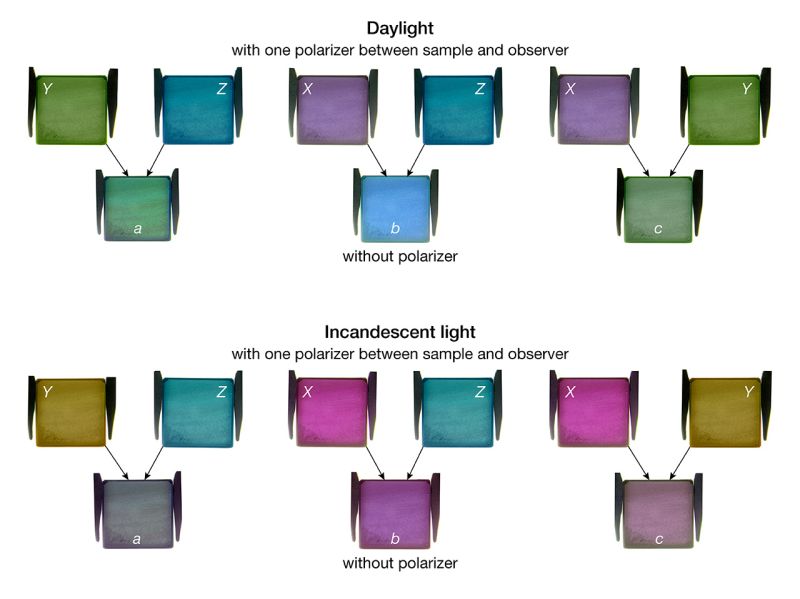
Alexandritedisplays the remarkable phenomenon of color change appearing green in daylight and red under incandescent light due to the presence of chromium.
The Role of Heat Treatment and Enhancement -
It's important to note that many gemstones undergo treatments to enhance their color. Tanzanite, for example, is routinely heat-treated to modify its color from brown to blue. Approximately 95% of commercial rubies are heat-treated. While these treatments are widely accepted in the industry, natural, untreated stones command premium prices.
Some treatments can be detected by trained gemologists. For instance, Flame Fusion rubies synthetic corundum grown in laboratories since 1902 leave characteristic curved striae and gas bubbles that distinguish them from natural stones.
Market Trends and Value -
The colored gemstone market has experienced significant growth in recent years. Dealers report that untreated sapphires and rubies are now 2-3 times pricier than pre-COVID levels due to their rarity.Sapphires, particularly untreated and high-quality specimens, are benefiting from a supply shortage and a growing collector preference for colored gemstones.
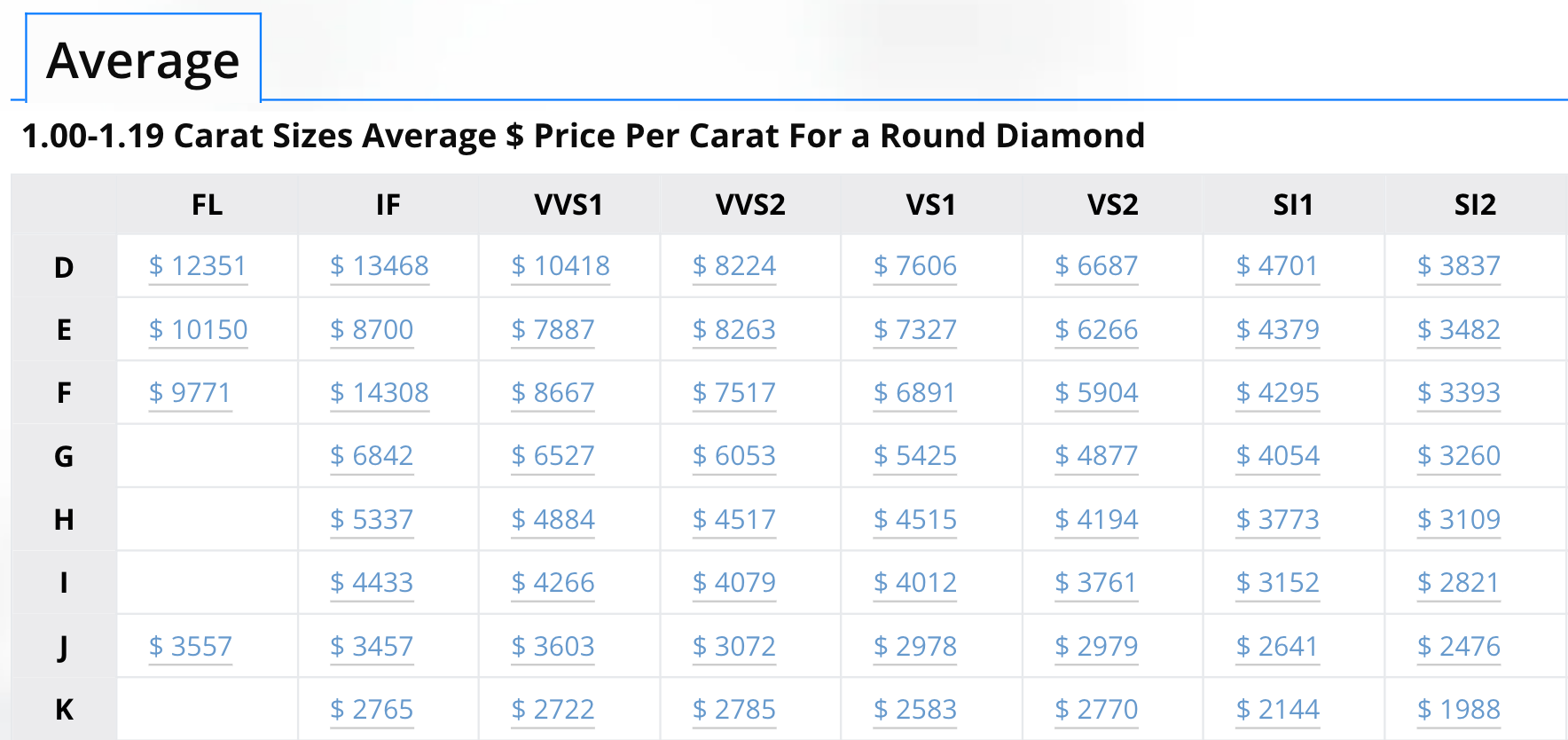
Colombian emeraldsremain the gold standard, but increasing scarcity is pushing buyers toward Zambian and Ethiopian alternatives. High-quality Kashmir and Ceylon sapphires are now rarer than most large D-color diamonds.
The value of colored gemstones is heavily dependent on hue, saturation, and tone. While color is paramount, factors such as clarity, cut, and carat weight also significantly influence value.
Understanding Gemstone Treatments -
The gemstone industry employs various treatments to enhance the color, clarity, or durability of gems. These treatments range from simple heating to more complex processes:
Heat Treatment: The most common treatment, used to improve color and clarity in rubies, sapphires, and many other gems.
Irradiation: Used to create or enhance colors in diamonds, tourmalines, and other gems.
Fissure Healing: Advanced treatment primarily applied to rubies and sapphires.
Some gemstones have synthetic counterparts with essentially the same chemical, physical, and optical properties, grown in laboratories. Imitations also exist any gem can be imitated by manmade materials or natural materials chosen to impersonate a particular gem.
Recommended Reads from CaratX -
How Fake Rubies Are Grown in a Lab (and How to Spot Them!) –Read More
Why Are Some Gemstones Green? The Complete Scientific Guide –Read More
White Gemstones: Properties, Value, and Buying Guide –Read More
Beyond the Hue: A Connoisseur's Dive into Why Colour is Everything in Gemstones –Read More
Not All Blues Are the Same: A Deep Dive into Sapphire, Spinel, Diamond & Tanzanite –Read More
Follow CaratXfor such insightful and educational content.
Start selling to diamonds in 18+ International countries –www.caratx.com/register
Sellers register on CaratX marketplace here to start selling to B2B and B2C buyers –www.caratx.com/register
Shop gemstones from our CaratX marketplace at unbeatable price –https://caratx.com/search?query=gemstones
Shop natural diamonds from here –https://caratx.com/search?query=Natural
More details about our Pricing –https://caratx.com/sell-on-caratx
Frequently Asked Questions -
Q: What determines the color of a gemstone? A: Gemstone color is determined by its chemical composition and the trace elements (chromophores) present in its crystal structure. Elements like chromium, iron, titanium, vanadium, and manganese absorb specific wavelengths of light, creating the colors we perceive.
Q: Why are some gemstones more valuable than others? A: Gemstone value is determined by rarity, color quality (hue, saturation, and tone), clarity, cut quality, carat weight, and whether the stone is natural or treated. Untreated natural stones with exceptional color are typically the most valuable.
Q: What is the difference between natural and synthetic gemstones? A: Natural gemstones form through geological processes over millions of years. Synthetic gemstones have the same chemical, physical, and optical properties but are grown in laboratories. While visually similar, synthetic stones are typically less valuable.
Q: Can gemstones change color? A: Yes! Some gemstones display pleochroism (different colors from different angles) or color change (different colors under different lighting). Alexandrite is famous for its color-change phenomenon.
Q: Are all treated gemstones less valuable? A: Not necessarily. Many treatments, such as heat treatment, are widely accepted in the industry. However, untreated natural stones generally command premium prices due to their rarity.