
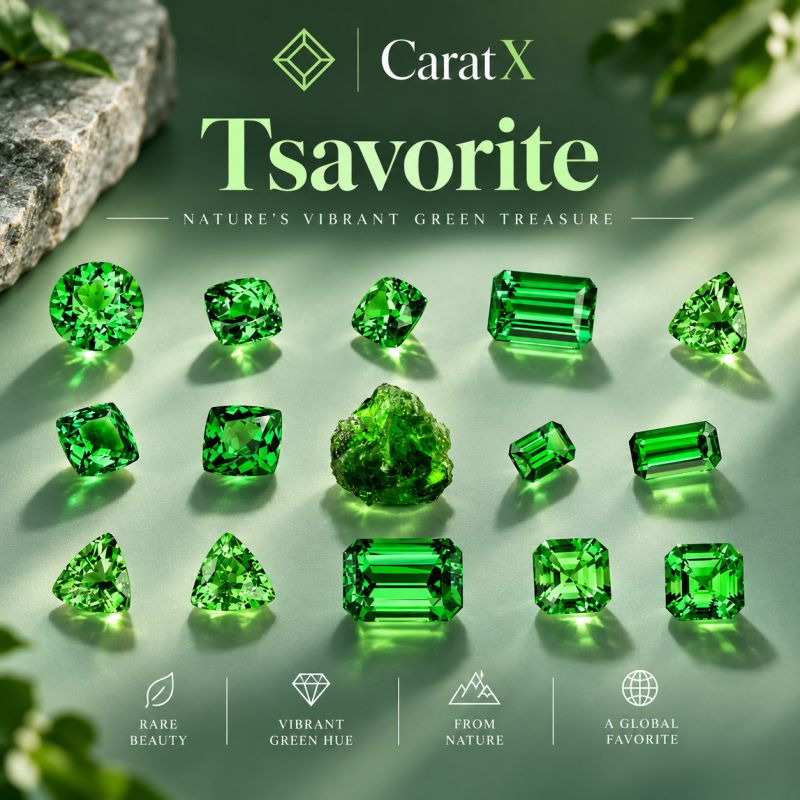
In the world of fine gemstones, few discoveries have captured the imagination of collectors and jewelry enthusiasts quite like tsavorite. This brilliant green variety of grossulargarnet, with its vivid color and exceptional brilliance, has emerged as one of the most coveted gemstones of the modern era.
First discovered in the late 1960s, tsavorite has quickly established itself as a worthy alternative to emerald offering superior durability, unparalleled natural beauty, and a rarity that makes it truly special.
What Is Tsavorite? Understanding This Remarkable Gemstone
Tsavorite (sometimes called tsavolite) is a variety of the garnet group species grossular, a calcium-aluminium silicate with the chemical formula Ca₃Al₂Si₃O₁₂. What sets tsavorite apart from other garnets is its captivating green color, which ranges from light green to vivid, deep green sometimes even displaying a subtle bluish-green overtone that enhances its visual appeal.
The gemstone derives its name from Kenya's Tsavo National Park, where it was first commercially mined. In 1973, Henry B. Platt, then President of Tiffany & Co., along with the discoverer Campbell Bridges, named this green garnet variety "tsavorite" in honor of the park. Tiffany & Co. launched a marketing campaign in 1974 that brought broader recognition to the stone.
The Discovery Story -
The history of tsavorite is as fascinating as the gemstone itself. In 1967, British gem prospector and geologist Campbell R. Bridges discovered a deposit of green grossular in the mountains of the Simanjiro District in northeast Tanzania. The specimens he found were of very intense color and high transparency.
However, the Tanzanian government did not provide export permits, prompting Bridges to prospect in Kenya, where he was successful in 1971 and granted a mining permit.
Physical and Gemological Properties -
Tsavorite possesses a remarkable combination of properties that make it highly desirable forfine jewelry. Understanding these characteristics is essential for anyone considering this gemstone for their collection.
Hardness and Durability -
Tsavorite ranks 7.0 to 7.5 on the Mohs scale of mineral hardness. Whileemeraldtechnically ranks slightly higher at 7.5 to 8, tsavorite is actually the tougher of the two gemstones in practice.
This is because tsavorite lacks cleavage a structural weakness that makesemeraldsmore susceptible to chipping and breakage. As the International Gem Society notes, tsavorite's lack of cleavage makes it tougher thanemerald, though fine large stones over a few carats are rare and command high prices.
Optical Properties -
One of tsavorite's most distinguishing features is its exceptional brilliance. The gemstone has a refractive index of approximately 1.74, considerably higher than emerald's 1.57. Its dispersion of 0.028 is double that of emerald's 0.014. This means that when properly cut, tsavorite radiates an electric energy and sparkle that emeralds simply cannot match.
As a member of thegarnetfamily, tsavorite is singly refractive (isotropic), meaning it exhibits no double refraction or pleochroism. This is a key identifying characteristic that distinguishes it from emerald, which is doubly refractive and pleochroic.
Color and Clarity -
The green color of tsavorite is produced by trace amounts of vanadium and chromium. The most valuable tsavorites display a pure green or rich forest green, sometimes with a desirable blue overtone. Yellowish overtones are generally considered less desirable.
Unlikeemerald, which typically contains numerous inclusions (often described as "jardin," French for garden), tsavorite is typically eye-clean with very few inclusions. This clarity, combined with its natural untreated state, makes tsavorite exceptionally attractive to collectors who value purity and authenticity.
Sources and Mining -
Primary Deposits -
Tsavorite is primarily found in East Africa, specifically in Kenya and Tanzania. The gemstone is exclusively hosted in the Neoproterozoic Metamorphic Mozambique Belt (NMMB), a geological formation often referred to as the "Gemstone Belt of East Africa". This belt also producesruby,sapphire,emerald, spessartine,tourmaline,spinel,tanzanite, andalexandrite.
The most significant sources are located in south-eastern Tanzania (Ruangwa and Tunduru), north-eastern Tanzania (Lelatema fold belt), and south-eastern Kenya from Mgama Ridge to Ngomet. Additional deposits have been found in Madagascar and, more recently, in Pakistan's Swat Valley.
Geological Age -
Recent scientific research has provided remarkable insights into the age of tsavorite deposits. A 2024 study published in the journalCrystalsconducted in situ laser U-Pb geochronological analysis on gem-quality tsavorite samples. U-Pb dating of tsavorite sourced from the Lemshuku mine in Tanzania and the Tsavorite mine in Kenya yielded ages of 643.9 ± 3.2 million years and 617.4 ± 4.8 million years, respectively.
These findings indicate that tsavorite crystallized during the most significant metamorphic period documented in the Mozambique Belt, known as the East African Orogen, which occurred between 640 and 600 million years ago.
The high closure temperature of the U-Pb system within garnets means these ages represent actual crystallization events rather than cooling or metamorphic overprinting.
Rarity -
Tsavorite is exceptionally rare at least a thousand times rarer thanemerald, especially in sizes over 3 carats. Large, clean tsavorites are particularly scarce, with per-carat prices rising sharply with size. Clean tsavorites over one carat are considered rare, and stones above two to three carats are scarce and highly valuable.
Tsavorite vs. Emerald:
One of the most common questions about tsavorite is how it compares to emerald. Here's a comprehensive analysis:
Color
Both gemstones display beautiful green colors, but tsavorite often exhibits a purer, more electric green without the bluish fade sometimes seen inemeralds. Fine tsavorite rivals emerald in color while often offering superior clarity.
Durability -
Whileemeraldscores 7.5–8 on the Mohs scale compared to tsavorite's 7–7.5, tsavorite is actually the tougher stone in practice.Emerald'stypical inclusions (the "jardin") create structural weaknesses that can cause the stone to crack if struck. Tsavorite, being typically cleaner and lacking cleavage, handles daily wear with less worry.
Clarity -
Emerald almost always contains inclusions and is typically oiled to improve its appearance. More than 95% of emeralds receive oil treatment. Tsavorite, in contrast, is usually eye-clean and completely untreated.
Brilliance -
Tsavorite has a significantly higher refractive index (1.74 vs. 1.57) and double the dispersion of emerald (0.028 vs. 0.014). This means tsavorite sparkles far more brilliantly than emerald.
Treatment -
Perhaps the most significant difference is that tsavorite is almost always completely untreated. It is not heated, oiled, fracture-filled, or irradiated to enhance color or clarity. Emerald, conversely, is almost universally treated.
Rarity -
Tsavorite is at least a thousand times rarer than emerald, particularly in sizes exceeding 3 carats.
Price -
Despite its superior properties and greater rarity, tsavorite currently sells for a fraction of the price of an equivalent-quality emerald. This presents a remarkable opportunity for savvy buyers.
Market Value and Investment Potential -
Current Market Trends -
The global tsavorite garnet market was valued at approximately $0.3 billion in 2025 and is projected to expand to $0.5 billion by 2034. This growth reflects increasing awareness of tsavorite's exceptional qualities and its recognition as a valuable alternative to emerald.
Tsavorite remains consistently popular, though fine-quality stones above 1 carat are extremely scarce. The price drivers for tsavorite are primarily color saturation, with vivid, deep green stones commanding premium prices.
Investment Potential -
Tsavorite offers outstanding investment potential for several reasons:
Finite Supply: Mining zones in East Africa are limited, and yields are diminishing.
Growing Demand: International demand for high-quality, untreated gemstones continues to rise.
Rarity Premium: A vivid, flawless tsavorite over 4-5 carats is harder to acquire than an equivalent emerald and is increasingly scarce each year.
Untreated Status: In an era where consumers increasingly value natural, untreated gemstones, tsavorite's completely natural state is a significant advantage.
Price Appreciation: Tsavorite's market value has climbed alongside elite stones such as blue sapphires and rare colored diamonds.
Care and Maintenance -
Proper care ensures your tsavorite jewelry remains beautiful for generations. TheGemological Institute of America (GIA)provides specific guidance for garnet care.
Recommended Cleaning Methods -
Warm soapy water is always safe for cleaning tsavorite.
Gently scrub with a soft toothbrush and a solution of mild dish soap and warm water.
Rinse thoroughly and pat dry with a soft, lint-free cloth.
Cleaning Methods to Avoid -
Ultrasonic cleaners are usually safe only if the stone has no pre-existing fractures or inclusions.
Steam cleaning is not recommended for tsavorite.
Avoid sudden temperature changes, which can cause fracturing.
Storage -
Store tsavorite jewelry separately from other pieces to prevent scratching. While tsavorite is durable, it can still be scratched by harder materials likediamond,sapphire, orruby.
Tsavorite in Jewelry -
Engagement Rings -
Tsavorite has gained popularity as anengagement ringstone due to its beauty, durability, and unique character. Its Mohs hardness of 7-7.5 makes it feasible for everyday wear, though care should still be taken. The gemstone's brilliant green color provides a distinctive alternative to traditional diamond engagement rings.
At the 2024 AGTA Spectrum & Cutting Edge Awards, Omi Privé's "Evergreen" tsavorite and diamond ring claimed first place in the Engagement Ring category, demonstrating the growing appreciation for tsavorite infine jewelry.
Fine Jewelry -
Tsavorite is exclusively a gemstone, faceted for fine jewelry and set inrings,pendants,earrings, andbracelets. Its toughness makes it particularly well-suited to everyday wear, outperforming emerald in this regard.
Frequently Asked Questions -
Is tsavorite a real garnet?
Yes. Tsavorite is the green, vanadium- and chromium-colored variety of grossular garnet, a member of the garnet group.
How does tsavorite compare to emerald?
Tsavorite often matches emerald's color while being more brilliant, cleaner, tougher (no cleavage), and usually untreated, though fine large stones are rarer.
Why is tsavorite expensive?
It comes from only a few small East African deposits, and large clean crystals are very rare, so prices rise steeply with size and color quality.
Is tsavorite treated?
Tsavorite is almost always completely untreated, unlike emerald, which is typically oiled.
How hard is tsavorite on the Mohs scale?
Tsavorite ranks 7.0 to 7.5 on the Mohs scale.
Where is tsavorite found?
Commercial sources include Tanzania, Kenya, and Madagascar, with small deposits also occurring in Pakistan and Queen Maud Land, Antarctica.
Can tsavorite be used in engagement rings?
Yes. Tsavorite's hardness of 7-7.5 makes it feasible for engagement rings, though care should be taken.
Is there such a thing as synthetic tsavorite?
Tsavorite has not been successfully synthesized. However, green glass and green yttrium aluminium garnet (YAG) have been used as simulants.
Recommended Reads from CaratX -
Looking to explore more about gemstones, diamonds, and fine jewelry? Check out these resources from CaratX:
Shop Natural Diamonds – Explore our collection of certified natural diamonds athttps://caratx.com/search?query=Natural
Shop Gemstones – Browse our marketplace for gemstones at unbeatable prices athttps://caratx.com/search?query=gemstones
Sell Your Jewelry Internationally – Register as a seller on CaratX and start selling to buyers in 18+ international countries atwww.caratx.com/register
Sell Diamonds Globally – Start selling diamonds to B2B and B2C buyers worldwide through our marketplace atwww.caratx.com/register
CaratX Seller Plan – Launch your jewelry products internationally with our seller plan athttps://buy.stripe.com/28EaEYgmM0ZBbCu5EWcV207
Pricing Information – Learn more about our pricing structure athttps://caratx.com/sell-on-caratx
Follow CaratXfor more insightful and educational content about gemstones, diamonds, and the jewelry industry.
Recommended Reads from CaratX -
Looking to explore more about gemstones, diamonds, and the jewelry industry? Check out these carefully curated articles from the CaratX Blog:
1. Why Are Some Gemstones Green? The Complete Scientific Guide
Link: https://caratx.com/blog/why-are-some-gemstones-green-the-complete-scientific-guide
2. The Rise of Colored Gemstones: A New Era of Luxury Jewelry
Link: https://caratx.com/blog-post/the-rise-of-colored-gemstones-a-new-era-of-luxury-jewelry
3. The 31-Hue Wheel: The Ultimate Guide to Gemstone Colour Grading
Link: https://caratx.com/blog/the-31hue-wheel-the-ultimate-guide-to-gemstone-colour-grading
4. Peridot: The Green Gemstone with a Story Beneath Its Color
Link: https://caratx.com/blog/peridot-the-green-gemstone-with-a-story-beneath-its-color