
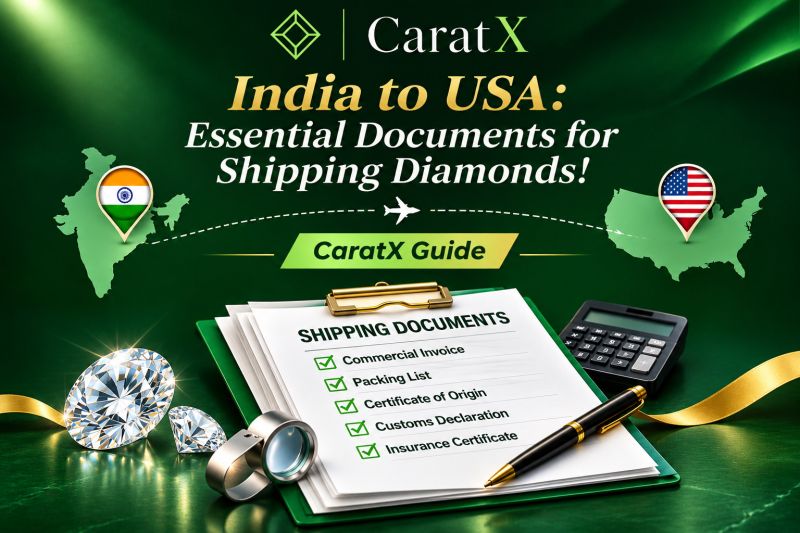
Shippingdiamondsfrom India to the United States is a high-value, high-stakes operation. India is the world’s largest cutting and polishing hub, and the U.S. is its single largest market for cut and polished diamonds. But between the cutting wheel in Surat and the jewelry counter in New York lies a paper trail that can make or break a shipment. A missing certificate, a misclassified HS code, or an overlooked customs bond can stall a parcel for weeks, trigger penalties, or even lead to seizure.
This guide breaks down every document you need, why it matters, and how to prepare it correctly, so your diamonds clear customs without drama. It is written for exporters, importers, and marketplace sellers who want to get the paperwork right the first time.
The Core Export Documents from India -
Every commercial export from India begins with a set of foundational documents. For diamonds, precision matters more than in almost any other commodity because customs authorities on both sides are trained to scrutinize high-value, low-volume shipments.
1. Import Export Code (IEC) -
The Import Export Code is issued by the Directorate General of Foreign Trade under India’s Ministry of Commerce and Industry. No commercial export can clear Indian customs without a valid IEC. It is the first document any Indian exporter must obtain, and it must be active and linked to the exporter’s business PAN.
For diamond exporters, the IEC is typically paired with registration with the Gem & Jewellery Export Promotion Council, which brings us to the next point.
2. RCMC from GJEPC -
The Registration Cum Membership Certificate from the Gem & Jewellery Export Promotion Council is a category-specific registration that Indian gem and jewelry exporters are expected to hold. The GJEPC is the apex trade body for India’s gem and jewelry sector and works closely with customs authorities to streamline clearance procedures for diamonds, gemstones, and jewelry.
While the IEC is the legal gateway, the RCMC signals to customs and to buyers that the exporter is a recognized participant in the gem and jewelry trade. It also gives access to export promotion schemes and trade facilitation measures that can reduce the cost of shipping.
If you are listing diamonds on a marketplace like CaratX, buyers increasingly ask for proof of trade-body registration. Sellers who register onCaratX’s seller platformcan showcase their credentials and reach buyers in 18+ countries.
3. Commercial Invoice -
The commercial invoice is the single most important document in the shipment. For diamonds, it must show:
The full description of the goods (e.g., “natural cut and polished diamonds, round brilliant, VS1 clarity, G color”)
Quantity (in carats and in pieces)
Declared value per carat and total value
Seller and buyer details, including addresses and tax identifiers
Country of origin
HS code
Terms of sale (Incoterms)
A vague or understated invoice is one of the most common triggers for customs inspection. U.S. Customs and Border Protection uses the invoice to assess duties and to verify that the shipment complies with import regulations. If the declared value is inconsistent with market benchmarks, CBP may reject the entry or demand additional documentation.
4. Packing List -
The packing list describes the physical shipment: how many parcels, the weight of each parcel, the dimensions, and the packaging materials used. For diamond shipments, the packing list should also indicate that the goods are packed in tamper-resistant containers, especially if the shipment includes rough diamonds.
A mismatch between the packing list and the actual shipment is a red flag. Customs officers use the packing list to reconcile the physical count with the invoice, and discrepancies can lead to delays or penalties.
5. Shipping Bill -
The shipping bill is the primary export document filed with Indian Customs. It is generated electronically through ICEGATE, the Indian customs electronic data interchange system. The shipping bill captures:
Exporter details
Buyer details
Description and value of goods
HS code
Destination country
Export scheme codes, if applicable
For diamond exports, the shipping bill must accurately reflect the nature of the goods whether they are rough, cut and polished, or lab-grown because different categories attract different regulatory treatments. Errors at this stage can hold up the “Let Export Order,” which is the customs clearance that allows the shipment to move.
6. Airway Bill -
Most diamond shipments travel by air because of value density and security requirements. The airway bill is issued by the courier or freight forwarder and serves as:
Proof of shipment
A tracking document
A contract of carriage
The airway bill number is often required by customs and by the buyer’s bank for payment reconciliation. For high-value diamond shipments, specialized secure couriers such as Malca-Amit, Brinks, or Ferrari Group are commonly used, and their airway bills are designed to meet the documentation expectations of customs authorities and insurers.
7. Certificate of Origin -
A certificate of origin may be required to claim preferential duty treatment under a trade agreement. At present, there is no free trade agreement between India and the United States that eliminates duties on diamonds, but a certificate of origin is still useful for verifying the Indian origin of the goods and for compliance with U.S. import reporting requirements.
If the diamonds are re-exported from India after being imported from another country, the certificate of origin becomes even more important because customs authorities will want to trace the movement of the stones.
U.S. Import Requirements -
Once the shipment leaves India, the U.S. import process takes over. The American importer—or the importer of record is legally responsible for ensuring that the shipment complies with U.S. law.
Formal Entry and the $2,500 Threshold -
U.S. Customs and Border Protection requires a formal entry for commercial imports of diamonds, jewelry, pearls, and precious or semi-precious stones valued at $2,500 or more. This threshold is critical. Below $2,500, an informal entry may be used in some cases; above $2,500, formal entry is mandatory.
Formal entry involves:
Filing CBP Form 3461 (Entry/Immediate Delivery)
Filing CBP Form 7501 (Entry Summary)
Posting a customs bond
Providing the commercial invoice, packing list, and other supporting documents
The formal entry process is more paperwork-intensive and more heavily scrutinized than informal entry. For diamond shipments, which routinely exceed $2,500 in value, formal entry is the default.
Customs Bond (CBP Form 301) -
A customs bond is a financial guarantee that ensures duties, taxes, and fees will be paid to CBP. For formal entries, a bond is required. The bond can be obtained through a surety company, and the minimum bond amount is typically $50,000 or 10% of the duties, taxes, and fees paid in the previous 12 months, whichever is greater.
Importers who use a customs broker can often operate under the broker’s bond, but the importer remains ultimately liable. For diamond importers, the bond is not just a formality, it is the mechanism that allows the shipment to be released before all duties are fully settled.
Importer of Record -
The importer of record is the entity legally responsible for the import. This can be the U.S. buyer, a U.S.-based subsidiary of the Indian exporter, or a customs broker acting on behalf of the importer. The importer of record must have a valid customs bond and must maintain records of the import for at least five years.
For Indian exporters selling directly to U.S. buyers through a marketplace, clarifying who will act as the importer of record is essential. If the buyer is not set up as an importer, the shipment may need to be routed through a U.S.-based intermediary or a customs broker who can act as the importer of record.
Customs Broker -
A licensed customs broker is not legally required, but for diamond imports, it is almost always practical. A broker prepares and files the entry documents, calculates duties, arranges the bond, and communicates with CBP on the importer’s behalf.
CBP maintains a list of licensed customs brokers by port, and for high-value diamond shipments, choosing a broker with experience in Chapter 71 of the Harmonized Tariff Schedule is strongly recommended.
The Kimberley Process Certificate -
The Kimberley Process Certification Scheme is an international certification system designed to prevent conflict diamonds from entering the legitimate trade. It was established in 2003 and is implemented in the United States through the Clean Diamond Trade Act and the Rough Diamonds Control Regulations.
When Is the KP Certificate Required?
The KP Certificate is required for rough diamonds that is, diamonds that are unworked or simply sawn, cleaved, or bruted, classified under HS subheadings 7102.10, 7102.21, and 7102.31. It is not required for cut and polished diamonds, which fall under different HS subheadings.
This distinction is critical. Many first-time exporters assume that every diamond shipment needs a Kimberley Process Certificate. In reality, the certificate applies to the rough diamond trade, where the risk of conflict diamonds is concentrated.
What the KP Certificate Does -
The KP Certificate accompanies a shipment of rough diamonds and certifies that the stones are conflict-free. For imports into the United States:
Rough diamonds may only be imported from Kimberley Process participants.
The shipment must be accompanied by an original KP Certificate.
Rough diamond imports, regardless of value, require a formal entry.
The KP Certificate number must be transmitted on CBP Form 7501.
The shipment must be sealed in a tamper-resistant container.
Importers must also notify the foreign exporting authority of the shipment’s receipt within 15 calendar days of arrival and retain a copy of the KP Certificate for at least five years.
Recordkeeping and Penalties -
Failure to comply with KP requirements can result in seizure of the shipment, penalties, and loss of import privileges. CBP and the U.S. Department of State actively enforce the KP regime, and importers are expected to maintain records that demonstrate compliance.
For cut and polished diamonds, the KP Certificate is not required, but buyers increasingly ask for conflict-free sourcing documentation as part of due diligence. The World Diamond Council’s System of Warranties provides a complementary framework for polished diamond transactions, and many U.S. buyers now expect sellers to provide warranties that the stones are conflict-free.
For a deeper dive into customs clearance strategies for jewelry and diamonds, read CaratX’sGuide to Jewelry Export Customs Clearance.
The Section 301 Tariff Overlay -
Since July 2026, the United States has imposed a 10% Section 301 tariff on a wide range of Indian-origin goods, including natural diamonds, lab-grown diamonds, colored gemstones, and jewelry. This tariff is in addition to the MFN duty rate.
For cut and polished natural diamonds that previously entered duty-free under MFN, the effective duty is now 10%. For diamond jewelry, the MFN rate of 5.5%–6% is combined with the 10% Section 301 tariff, bringing the effective duty to approximately 15.5%–16%.
Crucially, diamonds of European Union origin including Belgian polished diamonds are exempt from the Section 301 tariff, while Indian-origin diamonds are not. This creates a competitive disadvantage for Indian exporters and makes accurate origin documentation essential. If a shipment is incorrectly described as Indian-origin when it is not, or vice versa, the importer may face penalties for misrepresentation.
Why Classification Errors Are Costly -
A diamond classified under the wrong HS code can face:
The wrong duty rate
A requirement for documents that are not actually needed (or the absence of documents that are needed)
Delays while CBP requests a binding ruling
Penalties for negligence or fraud
The U.S. International Trade Commission’s HTS database and the World Customs Organization’s trade tools are the authoritative references for classification. For complex cases such as mixed shipments of loose diamonds and jewelry, or diamonds set in finished pieces a customs broker or trade compliance specialist should be consulted before the shipment is dispatched.
Step-by-Step Shipping Process -
Here is the sequence for a compliant diamond shipment from India to the U.S.:
Confirm the goods and classification. Determine whether the diamonds are rough, cut and polished, lab-grown, or set in jewelry. Assign the correct HS code and verify the duty rate.
Prepare the Indian export documents. Obtain the IEC, RCMC, commercial invoice, packing list, and shipping bill. If the shipment includes rough diamonds, obtain the Kimberley Process Certificate.
Book a secure courier. Use a specialized high-value courier and confirm that the airway bill and security arrangements meet the buyer’s and insurer’s requirements.
File the shipping bill on ICEGATE. Submit the export declaration and obtain the Let Export Order from Indian Customs.
Arrange the U.S. import entry. The importer of record or customs broker files CBP Form 3461 and CBP Form 7501, posts the customs bond, and pays the estimated duties.
Transmit the KP Certificate number (if applicable). For rough diamonds, the KP Certificate number must appear on CBP Form 7501, and the original certificate must accompany the shipment.
Clear customs and arrange delivery. Once CBP releases the shipment, the courier delivers it to the buyer or the buyer’s designated location.
Retain records. Keep copies of all documents invoice, packing list, shipping bill, airway bill, entry summary, bond, and KP Certificate for at least five years.
Common Mistakes and How to Avoid Them -
Mistake 1: Assuming every diamond shipment needs a KP Certificate. The KP Certificate is required for rough diamonds, not cut and polished diamonds. Misunderstanding this can lead to unnecessary delays and costs.
Mistake 2: Under-declaring value. CBP compares declared values against market benchmarks. A significantly undervalued diamond shipment is likely to be flagged for inspection, and the importer may face penalties.
Mistake 3: Using the wrong HS code. A polished diamond classified as rough, or a lab-grown diamond classified as natural, can trigger compliance issues and duty errors. Verify the code against the HTSUS and, if in doubt, request a binding ruling from CBP.
Mistake 4: Forgetting the customs bond. Formal entries require a bond. Without one, the shipment cannot be released. Importers should arrange the bond before the shipment arrives.
Mistake 5: Ignoring the Section 301 tariff. The 10% Section 301 tariff on Indian-origin diamonds is a real cost that must be factored into pricing. Importers who assume diamonds are duty-free may face an unexpected duty bill.
Mistake 6: Shipping without tamper-resistant packaging for rough diamonds. CBP requires rough diamond shipments to be sealed in tamper-resistant containers. Standard express packaging is not sufficient.
Guide to Jewelry Export Customs Clearance: Strategies, Pitfalls & How to Dominate Global Trade— A deep dive into HS codes, valuation, and documentation for jewelry exporters.
Sell on CaratX: Choose Your Plan— Compare seller plans and start listing diamonds, gemstones, and jewelry for buyers in 18+ countries.
Request a Seller Account— Register as a CaratX seller and access a global B2B and B2C marketplace.
Shop Loose Diamonds on CaratX— Browse certified natural and lab-grown diamonds from verified sellers.
Shop Gemstones on CaratX— Explore colored gemstones sourced from around the world.
Shop Jewelry on CaratX— Discover finished jewelry pieces from artisan sellers.
Recommended Reads from CaratXGuide to Jewelry Export Customs Clearance: Strategies, Pitfalls & How to Dominate Global Trade — The essential playbook for exporters. It covers the exact documentation checklist, HS code mastery (including the 0% duty on loose diamonds vs. 5.5% on jewelry), CBP valuation scrutiny, and red flags that guarantee inspection.
Read it here: https://caratx.com/blog/guide-to-jewelry-export-customs-clearance-strategies-pitfalls-how-to-dominate-global-trade
Lab-Grown Diamond Exports in 2025: What You MUST Include When Shipping Lab-Grown Diamonds — If your shipment contains lab-grown stones, the documentation and regulatory landscape is different. This post details the specific requirements to avoid clearance failures.
Read it here: https://caratx.com/blog/lab-grown-diamond-exports-in-2025-what-you-must-include-when-shipping-lab-grown-diamonds
India’s Diamond Dominance & How New US Tariffs Are Shaping the Global Market — Understand the commercial stakes. This analysis explains how tariff changes directly impact the volume and value of Indian diamond shipments to the U.S.
Read it here: https://caratx.com/blog/indias-diamond-dominance-how-new-us-tariffs-are-shaping-the-global-market
Start Selling on CaratX: Choose Your Plan — Ready to put this guide into practice? Compare seller plans (including the Free Loose Diamonds tier and the $795/year Jewelry Seller plan) and open your storefront to buyers in 18+ countries.
View plans: https://caratx.com/sell-on-caratx
Browse Inventory on CaratX — Explore certified natural and lab-grown diamonds, colored gemstones, and finished jewelry from verified sellers on the marketplace.
Shop Diamonds: https://caratx.com/search-results/Diamonds
Shop Gemstones: https://caratx.com/search-results/gemstones
Shop Jewelry: https://caratx.com/search-results/Jewelry
Frequently Asked Questions -
Q: Do cut and polished diamonds from India need a Kimberley Process Certificate to enter the U.S.? No. The KP Certificate is required for rough diamonds. Cut and polished diamonds are not subject to the KP certification requirement at the border, although buyers may request conflict-free warranties.
Q: What is the minimum value at which formal entry is required for diamond imports? Formal entry is required for commercial imports of diamonds, jewelry, pearls, and precious stones valued at $2,500 or more.
Q: Can I use my customs broker’s bond for my diamond shipments? Yes, in many cases a customs broker can allow the importer to use the broker’s bond, but the importer remains legally liable for duties and compliance. The broker’s bond must cover the value and risk of the shipment.
Q: What is the current duty on Indian-origin cut and polished diamonds entering the U.S.? Under the MFN rate, the duty is free. However, the 10% Section 301 tariff applies to Indian-origin diamonds, bringing the effective duty to 10%.
Q: How long must I keep import records? Importers of rough diamonds must retain the KP Certificate for at least five years from the date of importation. General customs records should also be retained for five years.
Q: Can I ship diamonds to the U.S. without an IEC? No. A valid Import Export Code is required for commercial exports from India. Without an IEC, Indian customs will not clear the shipment.