
The Headline That Hides a Bigger Story
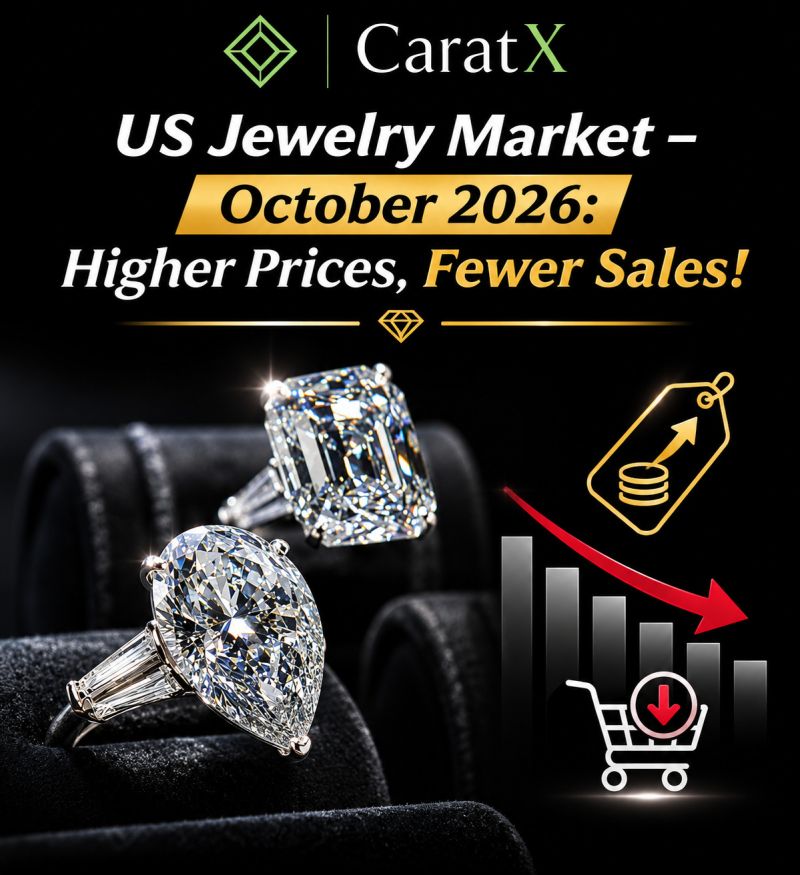
The US jewelry market entered the final quarter of 2026 with a paradox that is reshaping the entire industry: sales value is growing, but the number of pieces sold is shrinking. In October, total jewelry sales value rose 3% year-over-year, even as unit sales fell 7%. Average selling prices climbed 10%. This is not a temporary blip. It is the visible surface of a structural shift what industry analysts are calling the “fewer units, higher tickets” market .
For anyone who buys, sells, or invests in jewelry, understanding this divergence is no longer optional. The gold category is thriving on higher metal prices, whilenatural diamond jewelryis under pressure from lab-grown alternatives, shifting consumer priorities, and macroeconomic headwinds. This deep dive breaks down the October data, connects it to broader trends documented by the World Gold Council, the Natural Diamond Council, and leading retail analysts, and maps out what comes next.
October 2026 in Numbers: The Core Divergence
According to retail sales data from Edge Retail Academy, October marked a slowdown after September’s stronger gains, with gross sales holding flat overall. But the underlying mechanics are more revealing than the headline.
Metric October 2026 Performance
Total Jewelry Sales Value +3%
Total Units Sold –7%
Average Selling Price (ASP) +10%
Gold Jewelry Sales Value +8%
Gold Jewelry Units –8%
Diamond Jewelry Sales Value –2%
Diamond Jewelry Units –14%
Diamond Jewelry ASP +14%
Source: Edge Retail Academy October 2026 retail sales data
The pattern is unmistakable: consumers are buying less, but paying more per item. This is not purely a demand problem. It is a price-driven volume compression, and it is playing out differently across categories.
Gold Jewelry:
Gold jewelry sales value grew 8% in October a strong result by any measure even as the number of gold pieces sold dropped 8%. The explanation lies almost entirely in the metal itself.
Gold prices in October 2026 traded above $4,000 per ounce, with Comex gold settling at $4,084.80 on October 14 and spot prices hovering around $4,017 by late October. The World Gold Council reported that global gold jewelry consumption fell 17% year-over-year to 313 tonnes in Q3 2026, the weakest third quarter in its data series while thevalueof demand edged higher .
This is the gold paradox in its purest form: higher prices suppress tonnage but inflate dollar value. Consumers are adapting by choosing lighter-weight, lower-carat, and smaller pieces . The market is not collapsing; it is repricing. For sellers, this means that a smaller volume of gold jewelry can generate the same or greater revenue provided the price point and design align with what consumers are still willing to buy.
For buyers seeking certified gold jewelry with verified diamond content, CaratX’s curatedgold and diamond jewelry collectionoffers a transparent alternative to traditional retail markup.
Diamond Jewelry:
Diamond jewelrytold a different story in October. Sales value declined 2%, units plummeted 14%, and average prices rose 14%. Unlike gold, where the price increase is driven by a globally traded commodity, diamond jewelry’s price gains are not fully offsetting the collapse in unit demand. The reasons are layered.
The Lab-Grown Disruption Is No Longer Peripheral -
The CIBJO Congress heard in September 2026 that more than half of US engagement rings sold by volume now feature laboratory-grown diamonds .Lab-grown diamond jewelrydemand climbed approximately 26% year-over-year in September, even as natural diamond jewelry sales slipped.
The Natural Diamond Council has acknowledged the shift, with CEO Amber Pepper noting that “the more synthetic there is, the more people crave the real” a bet that natural diamonds’ value proposition will ultimately rest on rarity, provenance, and emotional significance . But in the short term, lab-grown stones are pulling price-sensitive buyers away from natural diamond jewelry at entry and mid-tier price points.
Consumer Confidence Is Under Pressure -
The Conference Board’s US Consumer Confidence Index fell 6.7 points in September, following declines in the prior two months. Jewelry is a discretionary purchase, and when confidence weakens, consumers delay or downsize.
The Gem & Jewellery Export Promotion Council (GJEPC) reported that US specialty jewelers posted a 5.7% year-over-year revenue increase in September, but the growth was driven by higher spending per item, not by more transactions .
Diamonds Are Not Losing Their Meaning -
Research from the Natural Diamond Council and Tenoris shows that consumers whodobuy diamond jewelry are spending more intentionally. Averageengagement jewelryspend reached $7,364 in 2026, a 9% year-over-year increase. The market is splitting into two tracks: everyday, accessible diamond jewelry (where lab-grown is dominant) and investment-grade, heirloomdiamond jewelry(where natural stones retain their narrative power) .
For buyers who want to explore verified natural diamonds with transparent grading, CaratX’scertified natural diamond marketplaceconnects directly with suppliers across 16+ countries.
The Consumer Psychology Behind “Fewer Pieces, Higher Tickets”
Why are consumers buying fewer jewelry pieces even as prices rise? The answer is not simply affordability, it is a change in how jewelry is valued.
Jewelry as Investment and Self-Expression -
McKinsey & Co.’sState of Fashion 2026report, cited by MJSA, found that jewelry continues to outperform the broader fashion category because consumers are seeking “long-lasting investments, self-expression, and self-gifting”. Jewelry is no longer bought solely for occasions. It is bought as a store of value, an emotional marker, and a form of personal expression. That shift favors fewer, more meaningful purchases over frequent, lower-value transactions.
The Dual-Mindset Consumer -
The market is not divided between “rich” and “budget” buyers. The same consumer may operate in two modes: buying accessible, lab-grown or lightweight gold pieces for everyday wear, while saving for a single high-value natural diamond or high-karat gold piece as an investment. This dual mindset explains why unit sales can fall while average prices rise: consumers are concentrating their spending on fewer, better pieces.
The New Price Threshold for “Meaningful” Jewelry -
Industry executives quoted by the GJEPC report that the starting price for a meaningful designerfine jewelrypiece has risen to $5,000 or more, up from $2,500–$3,000 just two years ago. The $1,500–$5,000 band traditionally the volume engine of accessible luxury is tightening . For retailers, this means the middle market is being squeezed, and success depends on either capturing the high end or offering exceptional value at accessible price points.
Strategic Implications for Sellers and Buyers -
For Jewelry Sellers and Brands -
- Price-Point Discipline Matters More Than Ever. The market is rewarding premium merchandise above $2,500 and punishing lower-priced volume. Sellers should audit their assortments to ensure they have compelling offerings at both the accessible everyday tier and the investment tier.
- Gold and Lab-Grown Diamonds Are Growth Engines. Gold jewelry value is being supported by metal prices, while lab-grown diamond jewelry is expanding access to the category. Sellers who ignore these dynamics risk losing share to competitors who embrace them.
- Transparency and Certification Build Trust. With consumers becoming more intentional, independent grading and provenance documentation are no longer nice-to-haves. The Gemological Institute of America (GIA) provides free retailer education tools and the 4Cs framework that consumers increasingly expect. Sellers on CaratX can leverage the platform’sdiamond guide and education resourcesto build customer confidence.
- International Reach Is a Hedge Against Domestic Softness. The US market is growing in value but contracting in volume. Sellers who can access international B2B and B2C buyers through a specialized marketplace can diversify away from single-market risk. CaratX’sseller registrationopens access to buyers in 18+ countries.
For Jewelry Buyers and Investors -
- Understand What You Are Buying. In a market where diamond jewelry prices are rising even as unit demand falls, certification and grading are your protection. Always insist on a GIA report or equivalent independent grading for natural diamonds .
- Gold Jewelry Is a Metal Play With Design on Top. If you are buying gold jewelry, you are partly buying the metal. Understand the karat, weight, and prevailing gold price before you buy. Lighter-weight and lower-carat pieces are becoming more common as prices rise .
- Lab-Grown Diamonds Offer Access But Different Economics. Lab-grown diamonds are real diamonds, but their resale value and price trajectory differ from natural stones. The CIBJO notes that lab-grown prices have fallen in recent years, putting pressure on natural diamond prices . Buy lab-grown for beauty and accessibility, not as an investment.
- Buy From Transparent Marketplaces. Whether you are buyingloose diamondsfor a custom piece orgemstone jewelry, a marketplace that provides verified listings and seller accountability reduces your risk.
The Road Ahead: What to Watch in Late 2026 and 2027
The World Gold Council expects jewelry demand to remain the weakest component of gold demand through the rest of 2026, with elevated prices continuing to constrain volumes. The Natural Diamond Council anticipates that Gen Z will remain the fastest-growing consumer segment for natural diamonds, driven by self-purchasing and a preference for meaningful, authentic pieces. The tension between these two forces price-driven volume compression in gold and generational value shifts in diamonds will define the holiday season and beyond.
For sellers, the imperative is clear: meet the consumer where they are, with the right price points, the right materials, and the transparency they demand. For buyers, the opportunity is equally clear: a market that rewards careful, informed purchasing over impulse.
Frequently Asked Questions (FAQs) -
Q: Why did jewelry sales value rise while unit sales fell in October 2026? A: Higher average selling prices driven by record gold prices and a shift toward premium merchandise more than offset the decline in the number of pieces sold. Consumers are buying fewer but more expensive items .
Q: Is gold jewelry still a good purchase when prices are so high? A: Gold jewelry retains value as both adornment and a metal asset. However, buyers should understand that they are paying for the metal content plus design and craftsmanship. Lighter-weight and lower-carat pieces are becoming more common as a response to higher prices .
Q: Why is diamond jewelry demand falling? A: The decline is driven by a combination of softer consumer confidence, the growing popularity of lab-grown diamonds, and a shift toward more intentional purchasing. Natural diamond jewelry is increasingly positioned as an investment and heirloom purchase rather than an everyday buy .
Q: Are lab-grown diamonds “real” diamonds? A: Yes. Lab-grown diamonds have the same physical, chemical, and optical properties as natural diamonds. The difference is origin. The CIBJO and GIA both provide terminology and grading standards for lab-grown stones .
Q: How can I verify the quality of a diamond before buying? A: Insist on an independent grading report from a recognized laboratory such as GIA. The GIA 4Cs (Cut, Color, Clarity, Carat Weight) remain the global standard for diamond quality assessment .
Q: What is CaratX and how does it help buyers and sellers? A: CaratX is a specialized B2B and B2C marketplace for diamonds, gemstones, jewelry, and pearls, connecting buyers and sellers across 16+ countries. Sellers can register to access international buyers, and buyers can shop verified listings with transparent product information.
The Art of Buying Loose Diamonds: Your Buyer’s Guide— A practical walkthrough of the 4Cs, certification, and what to look for when purchasing loose stones.
Beyond the Sparkle: Unveiling the Secret of Diamonds with Deep UV Light— How advanced gemological tools distinguish natural from lab-grown diamonds and verify origin.
Shop Natural Diamonds on CaratX— Browse verified natural diamond listings from suppliers across the globe.
Shop Lab-Grown Diamonds on CaratX— Explore certified lab-grown diamond options for accessible fine jewelry.
Start Selling on CaratX— Compare seller plans and learn how to reach international B2B and B2C buyers.
Register as a Seller— Create your seller account and begin listing your jewelry, diamonds, and gemstones.
Recommended Reads from CaratX -
GIA to Introduce Cut Grading for Fancy-Shaped Diamonds in 2027— Forward-looking piece on the regulatory change that will reshape how fancy-shape cut quality is assessed.
Marquise Shape Diamonds: History, Cut, and Why They're Trending in 2026— The definitive marquise guide: French royal history, the spread factor, bow-tie management, and ideal length-to-width ratios.
Pear-Shaped Fancy-Color Diamonds: The Complete Guide to Nature's Rarest Teardrops— Anatomy, rarity, color grading, bow-tie effect, and buying considerations for fancy-color pears.
Diamond Shape Ratios: Why Proportion Matters More Than You Think— The single most important internal resource for understanding length-to-width ratios across oval, pear, marquise, emerald, and cushion cuts.
The Anatomy of an Old Mine Cut Diamond: A Collector's Guide to Antique Brilliance— Covers the cushion-like outline, high crown, large culet, and why antique cuts are resurging.
The Guide to the Anatomy of an Oval Diamond: Cut, Clarity, and Carat Insights— Facet-level anatomy, measurements, and optical science behind the oval's brilliance.