
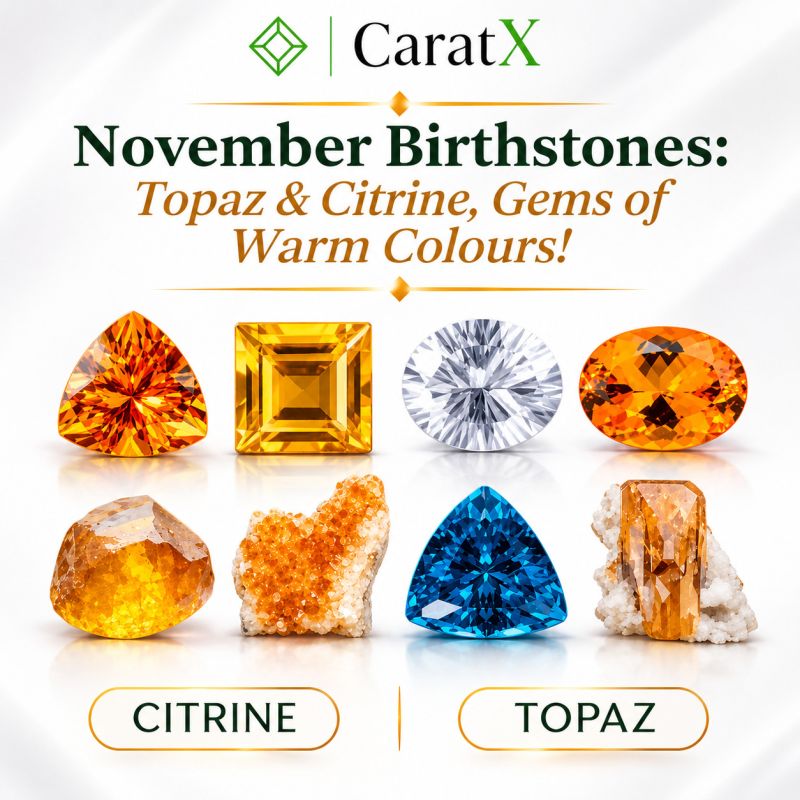
Most months get one birthstone. November gets two, and both are built around the same emotional temperature: warmth.Citrinecarries the lemony gold of late autumn sunlight, while topaz can range from icy blue to a fiery reddish orange that the trade treats as one of the most storied colors in the gem world.
They are often grouped together in birthstone charts, sometimes confused in older jewelry descriptions, and occasionally sold under names that blur the line between them. Butcitrineandtopazare different minerals with different hardness, different care requirements, and very different rarity curves.
This guide goes deep into both November birthstones: their gemology, their history, where they come from, what to look for when buying, how to care for them, and why the rare imperial topaz from Brazil deserves its own chapter in any serious colored-stone conversation.
Citrine: The Accessible Warmth of Quartz
Citrineis the transparent, pale yellow to brownish orange variety of quartz. Its color comes from trace iron in the crystal structure, and its mineral identity is simple: SiO₂, the same chemistry as amethyst, rock crystal, and smoky quartz. On the Mohs hardness scale, citrine sits at 7, which makes it durable enough for everyday jewelry, though it is not indestructible.
One of the most important things to understand aboutcitrineis that natural citrine is rare. Mostcitrineon the market today is the result of heat treatment: amethyst is heated to convert its purple into golden yellow to orange-brown tones. This treatment is stable and widely accepted in the trade, but it is worth knowing becausenatural, unheated citrine commands a different conversation among collectors and gemologists.
Citrine’s history is long and occasionally muddled. Before modern gemology, its tawny color caused it to be confused with topaz, and it was sometimes called “topaz quartz” a name the industry has since ruled out because topaz is an entirely different mineral species.
Ancient cultures used quartz varieties for talismans and ornaments; Roman jewelry includes citrine, and the stone was especially popular in colorful Scottish jewelry during the Victorian era. In folklore, citrine was believed to soothe tempers and calm the wearer, and it has been called the “merchant’s stone” or “money stone” in some traditions.
From a buying perspective,citrineis one of the most accessible colored gemstones. Fine citrine remains affordable even in large sizes, and price per carat does not rise dramatically as stones get bigger.
The most valued colors are saturated yellow to reddish orange, free of brownish tints, and eye-visible inclusions are uncommon in quality citrine. Major sources include Brazil, Bolivia, Spain, Madagascar, Mexico, and Uruguay; the Anahi mine in Bolivia is particularly important for natural, unheated citrine and for ametrine, the bi-color amethyst-citrine material.
For buyers browsing the CaratX marketplace,citrinelistings range from single stones to calibrated sizes suitable for jewelry production. You can explorenatural citrine on CaratXand compare options across cut, clarity, and carat weight.
Topaz:
Topazis an aluminosilicate mineral containing fluorine and hydroxyl, with the formula Al₂SiO₄(F,OH)₂. It rates 8 on the Mohs hardness scale, putting it a full step above quartz and making it one of the harder transparent gems used in jewelry.
But hardness is only part of the story:topazhas perfect basal cleavage, which means it can split if struck at the wrong angle. Its toughness is rated poor, and that single fact changes how topaz should be set, worn, and cleaned.
Topazoccurs in an exceptionally wide color range: colorless, blue, yellow, orange, pink, violet, brown, and, very rarely, red. Colorless topaz is plentiful and is routinely treated to produce blue topaz through irradiation and heating. “Mystic topaz” is created by coating colorless topaz with a thin metallic film, a treatment that requires careful disclosure and gentle cleaning.
None of these treatments change the fact thattopazis a genuinely brilliant gem with strong luster, but they do mean that buyers should ask about treatment history, especially at lower price points.
The name “topaz” itself is debated. Some trace it to the Sanskrittapas, meaning “fire”; others connect it to the Greektopazos. The lore is equally layered. Ancient Greeks believed topaz gave strength. From the 1300s to the 1600s, Europeans thought it could thwart magic spells and dispel anger. In India, topaz worn above the heart has long been associated with long life, beauty, and intelligence.
Imperial Topaz:
When the trade says “imperial topaz,” it means the reddish orange to orangy red variety of topaz, the color that gives November its warmest, most exclusive birthstone option. Imperial topaz is genuinely rare.
For over 200 years, the only known source was a small mining district near Ouro Preto in Minas Gerais, Brazil, and most gem-quality specimens still come from that region. The town of Ouro Preto is a UNESCO World Heritage site, and its topaz deposits have been worked for more than two centuries.
The name “imperial” has competing origin stories. One version ties it to the Russian royal family’s insistence on keeping the finest colors of topaz, mined in the Ural Mountains, exclusively for their use.
Another version, popular in Brazil, dates the name to an 1881 visit by Brazilian Emperor Pedro II to Ouro Preto and the gift of a reddish topaz. Either way, imperial topaz sits at the top of the topaz hierarchy, and fine stones are priced accordingly. The most valued topaz colors are orangy red to red, while blue topaz is widely available and far more affordable.
For buyers who want the warmth of November in its rarest form, imperial topaz is the benchmark. For those who want topaz’s hardness and brilliance at a more accessible price, blue, white, and yellow topaz offer compelling options.
CaratX’s guide toblue topazexplains how colorless topaz is transformed into the iconic blue material, and the marketplace’s broadercolored gemstone collectionis where loose topaz and citrine listings sit alongside other calibrated stones.
Citrine vs. Topaz: A Practical Comparison
The two November birthstones are often spoken of in the same breath, but they behave differently injewelryand in the market. Here is the comparison that matters most when you are choosing between them.
The practical takeaway is simple: if you want a warm-toned stone for a ring that will be worn hard, citrine is the more forgiving choice. If you want maximum brilliance and hardness in a pendant or apair of earrings, topaz delivers more fire and takes a higher polish. If you want rarity and the specific reddish-orange hue that collectors chase, imperial topaz is in a different category entirely.
For a wider view of how these stones fit into the yellow and orange gem spectrum, CaratX’s guide toyellow gemstonescompares citrine, golden topaz, yellow sapphire, sphene, heliodor, and yellow diamond across color, durability, fire, rarity, value, and jewelry use. Theorange gemstones guideplaces imperial topaz alongside orange diamonds, Padparadscha sapphire, fire opal, and other warm-toned materials.
Buying November Birthstones: What to Look For
Citrine buying checklist -
Color: Look for saturated yellow to reddish orange without brownish or muddy tints. Pale or overly brownish stones are common at lower price points.
Clarity: Eye-visible inclusions are uncommon; stones should be clean to the eye. Inclusions that are visible reduce value.
Cut: Citrineis available in calibrated sizes and custom cuts, including carvings. Well-proportioned cuts maximize brightness.
Treatment disclosure: Most citrine is heat-treated amethyst. Natural, unheated citrine exists but is rarer and should be disclosed as such.
Size: Citrine’s price per carat does not climb steeply with size, so larger stones can be surprisingly affordable.
Topaz buying checklist -
Color: For imperial topaz, the target is reddish orange to orangy red; for blue topaz, look for a bright, even hue without excessive windowing or extinction.
Clarity: Jewelry-grade topaz is typically eye-clean. Visible inclusions or fractures are a durability concern because of cleavage.
Cut and orientation: Cutters orient topaz to reduce cleavage risk. Avoid badly proportioned stones with thin edges or sharp points that are more vulnerable to chipping.
Treatment disclosure: Blue topaz is routinely irradiated and heated; mystic topaz is coated. Coated stones require gentle cleaning and careful disclosure.
Setting: For rings, choose protective settings with bezels or low-profile prongs. Pendants and earrings are safer for topaz than high-impact ring wear.
On CaratX, sellers can list loose stones with detailed specifications, and buyers can compare grading information before purchase.
Sellers who want to reach international B2B and B2C buyers canregister on the CaratX marketplaceand list gemstones, jewelry, and diamonds across supported markets. The platform’spricing and listing detailsexplain how to launch products and manage listings.
Care and Cleaning -
Citrineand topaz are often cleaned the same way in casual jewelry care, but their toughness ratings are not the same.
Citrine, at Mohs 7 with good toughness, is usually durable enough for normal wear. Warm soapy water is safe, and ultrasonic cleaning is generally acceptable. Steam cleaning is riskier because high heat can cause thermal shock in some stones, so it is best avoided.
Topazrequires more caution. Because of its basal cleavage, it is not tough, and a hard blow or sharp temperature change can cause internal breaks or surface damage. Do not use steam or ultrasonic cleaners on topaz. Warm soapy water and a soft brush are the safest approach. High heat and sudden temperature changes should be avoided, and prolonged sunlight exposure can fade some yellow-to-brown topaz over time.
For a broader framework on gemstone hardness and why it matters in jewelry selection, CaratX’s guide to theMohs scale and gemstone hardnessexplains how the scale works and why the steps between minerals are not evenly spaced.
The platform’sgemstone verification guidealso covers how buyers can evaluate treatments, inclusions, and disclosure when purchasing online.
Recommended Reads from CaratX -
Birthstones by Month: A Complete Guide to Colors, Meanings & History— the full twelve-month birthstone framework, including November’s dual stones.
Blue Topaz: From Clear Crystal to Iconic Gem— how colorless topaz becomes the blue material that dominates the topaz market.
The Ultimate Compendium on Birthstones: History, Gemology, and the Definitive Buying Guide for 2026
Fancy Sapphires: The Colorful Side of the Sapphire World
URL: https://caratx.com/blog/fancy-sapphires-the-colorful-side-of-the-sapphire-world
Gemstone Identification: How to Recognize Rough Diamonds & Rubies (A Complete Guide)
The Enduring Power of Birthstones: Why Personal Gemstones Dominate Modern Jewelry
For sellers, CaratX provides international reach across 18+ countries.Register as a sellerto list gemstones, jewelry, and diamonds for B2B and B2C buyers, and review thepricing and launch detailsbefore going live.
For buyers, theCaratX marketplaceis where loose citrine, topaz, and a full range of colored gemstones can be compared with transparent specifications and seller information.
Frequently Asked Questions -
Are citrine and topaz the same stone? No. Citrine is a variety of quartz (SiO₂), while topaz is a separate mineral with a different chemical formula and a different crystal structure. Historically, citrine was sometimes called “topaz quartz,” but the gem trade has eliminated that name because it is misleading.
Which November birthstone is harder? Topaz is harder at 8 on the Mohs scale, compared with citrine at 7. However, topaz has poor toughness because of its cleavage, so hardness does not mean it is tougher in everyday wear.
Is imperial topaz always from Brazil? For more than 200 years, the only known source of imperial topaz was the Ouro Preto district in Minas Gerais, Brazil, and most gem-quality imperial topaz still comes from that region. Topaz is found in many other countries, but the specific reddish-orange imperial color is strongly associated with Brazil.
Can I wear citrine or topaz every day? Citrine is generally durable enough for daily wear in rings, bracelets, and pendants. Topaz is better suited to pendants, earrings, and protective settings; if you wear topaz in a ring, choose a low-profile or bezel setting and avoid harsh impacts.
Is most citrine natural? No. Natural citrine is rare, and most citrine on the market is heat-treated amethyst. The treatment is stable and accepted, but it should be disclosed by the seller.
What is the difference between blue topaz and imperial topaz? They are the same mineral species but different color varieties. Blue topaz is typically produced by irradiating and heating colorless topaz, and it is widely available and affordable. Imperial topaz is the rare reddish-orange to orangy-red variety, and fine specimens command significant premiums.