
Introduction: Nature's Most Colorful Gem
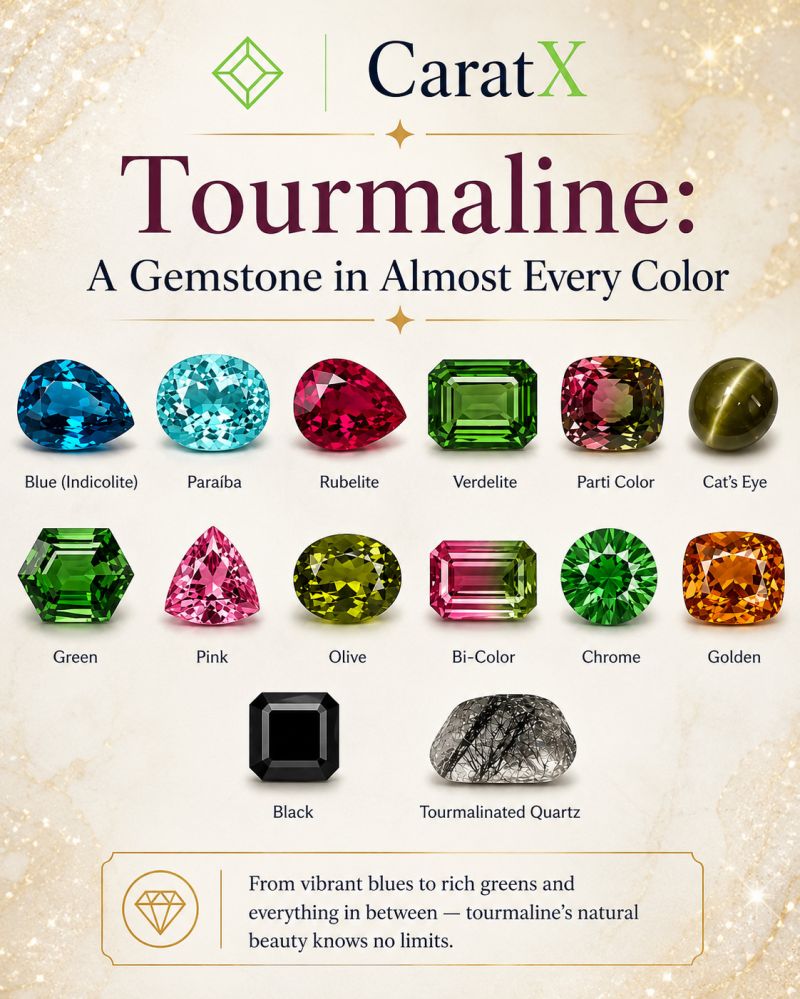
In the vast and vibrant kingdom ofgemstones, few can claim the sheer diversity, fascinating history, and geological complexity oftourmaline. Often dubbed the "Rainbow Gemstone," tourmaline is not merely a single mineral but an entire family of related borosilicate minerals that occur in every hue imaginable. From the fiery reds that rival the finest ruby to the oceanic blues that challenge sapphire, and even bi-colored or tri-colored crystals that look like a master artist's creation,tourmalineis a testament to nature's boundless creativity.
The name "Tourmaline" is derived from the Sinhalese word "Thoramalli," meaning "mixed gems" or "stones with mixed colors". This term was used by gem merchants in Sri Lanka (Ceylon), a historical gem-trading hub, to describe the bewildering variety of colored stones they encountered. For centuries, these gems were consistently confused with others, green tourmaline was passed asemerald, and pink tourmaline was cherished as ruby.
Today,tourmalinestands proudly as October's birthstone (alongside opal) and the gem of the eighth wedding anniversary. Its remarkable color range, durability, and unique optical properties have made it a favorite among collectors, jewelers, and gem enthusiasts worldwide.
The Science Behind the Sparkle:
To truly appreciate tourmaline, one must first understand its unique geological makeup. Unlike simpler gemstones, tourmaline is a complex group of cyclosilicate minerals.
This complexity is the key to its astounding color range.
Crystal Structure and Habit -
Tourmaline crystallizes in the trigonal system, forming long, prismatic crystals that are often striated vertically. According to theGemological Institute of America (GIA), no other common mineral has three-sided prisms like tourmaline.
A distinctive feature is its hemimorphic character meaning the two ends of the crystal are differently terminated. This structural asymmetry is directly linked to one of its most unique properties.
Piezoelectricity and Pyroelectricity -
When tourmaline crystals are subjected to pressure (piezoelectricity) or heat (pyroelectricity), they develop an electrical charge.
This causes them to attract or repel nearby dust particles, a phenomenon first documented by Dutch traders in the 1700s, who used heated tourmaline to draw ash from their meerschaum pipes, giving it the name "Aschentrekker" (ash puller). This fascinating property remains a key topic of study in mineralogy, as detailed by the Geological Society of America.
Formation Environments -
Tourmalineforms primarily in igneous rocks like granite pegmatites and in metamorphic rocks through the action of hydrothermal fluids. The American Museum of Natural History explains thattourmalinescommonly form in pegmatites because pegmatitic magma can concentrate boron, an essential component of tourmaline.
Tourmaline is a characteristic mineral in granitic pegmatites and an accessory mineral in granite, granodiorite, and related felsic rocks. It is also a common mineral in schist, gneiss, quartzite, and phyllite.
These fluids carry a rich soup of elements, and depending on the local geochemistry, different varieties of tourmaline can crystallize sometimes even within the same crystal, leading to stunning multi-color zones.
The Chemistry of Color: Why Tourmaline Comes in Every Hue
Tourmaline's extraordinary color range is a direct result of its complex chemical composition. The California Institute of Technology (Caltech) provides detailed insight into this phenomenon: the color of tourmaline originates from the metal ions (Fe, Mn, Cr, V, Ti, Cu) in its structure.
TheGIAconfirms that traces of iron and possibly titanium induce green and blue colors, while manganese produces reds andpinks. Some pink and yellow tourmalines might owe their hues to color centers caused by radiation, which can benaturalor laboratory-induced.
The great diversity of color in tourmalines is due to the variability in which these mixtures occur.
The Complete Spectrum: Tourmaline Varieties
Green Tourmaline -
Green tourmalineranges from fresh green to deep forest-green shades. The GIA notes that "Chrome tourmaline" is an intense green variety, though it's colored mostly by vanadium, the same element that colors many Brazilian and African emeralds.
Historically,green tourmalinewas often mistaken for emerald. In 1554, Francisco Spinoza's expedition discovered the first recorded green tourmaline crystal, calling it "Brazilian emerald".
Pink Tourmaline -
Pink tourmalineranges from soft pink to bright, vivid pink. The color is attributed to Mn³⁺ ions. Pink to red tourmaline often has more visible inclusions than green to blue varieties.
Blue Tourmaline (Indicolite) -
Blue tourmaline, known in the trade as Indicolite, displays attractive blue to blue-green colors. The blue color is usually caused by Fe²⁺.
Red Tourmaline (Rubellite) -
Rubellite is the name for pink, red, purplish red, orangy red, or brownish red tourmaline. The International Gem Society (IGS) describes rubellites as tourmalines with reasonably saturated dark pink to red colors and medium to dark tones.
Rubellites have a hardness of 7 to 7.5 on the Mohs scale and no cleavage, making them excellent stones for any type of jewelry. Their name is derived from the Latin word for red or reddish.
Purple Tourmaline -
Purple tourmalinedisplays beautiful violet and purple tones, created by specific combinations of trace elements within the crystal structure.
Orange Tourmaline -
Orangetourmalineis rare and valued for its warm orange shades.These colorsoften result from Mn²⁺-Ti⁴⁺ intervalence charge transfer.
Black Tourmaline (Schorl) -
Black tourmaline, known scientifically as schorl, is usually opaque and very common, often seen in crystals and jewelry. According to Caltech, black tourmalines are dark because of their high concentrations of iron, manganese, and titanium.
Black tourmaline is heavily featured in bold and artistic jewelry pieces, often cut in cabochon or raw, unpolished forms. In metaphysical traditions, it is revered for its purported ability to ward off negative energy.
Watermelon Tourmaline:
Watermelon tourmaline is one of the most beloved and recognizable varieties. It shows pink in the center and green around the outside, creating a natural watermelon-like pattern. Crystals of this material are typically cut in slices to display this special arrangement.
Formation of Watermelon Tourmaline -
Watermelon tourmaline forms in granitic pegmatites, where boron-rich fluids crystallize slowly in pockets. Tourmaline is highly sensitive to the changing chemistry of these fluids, so as conditions evolved during growth, the crystal recorded different colors in successive layers.
According to Rock & Gem Magazine, the color zoning occurs because of a changing chemical environment during formation. Initially, the crystal grows with a high concentration of manganese, which gives the inner core its pink-to-red color. As the crystal continues to grow, the chemistry of the surrounding fluid changes, introducing elements that create the green outer layer.
The striking green-to-pink coloration of watermelon tourmaline demonstrates that two visibly contrasting environments are associated with growth in their host hydrothermal environment.
Paraiba Tourmaline:
Paraíba tourmaline is famous for its vivid blue, green, and bluish-green colors and exceptional rarity. Discovered in 1989 by Heitor Dimas Barbosa in the Brazilian state of Paraíba, it is one of the world's rarest and most expensive gemstones.
What Makes Paraíba Tourmaline So Special?
The material displays an unprecedented vivid neon-blue, electric greenish-blue, or violet-blue hue. This unique color is caused by the presence of copper (Cu) and manganese (Mn) as trace elements. Paraíba tourmalines typically contain high levels of copper (0.65% - 1.77% wt of CuO) and manganese (0.35% to 2.46% wt of MnO).
Rarity and Value -
The Brazilian Paraiba deposits were exceptionally small and produced only a tiny amount of this extraordinary material, making it one of the rarest and most expensive gems in the world. The original Brazilian deposits were tiny, and later finds in Nigeria and Mozambique broadened supply, but the finest Brazilian stones still command the highest premiums.
According to GIA research, the quantities available at the February 1990 Tucson gem show amounted to at least 10,000 carats of rough and finished stones. While cut stones over 20 carats have been faceted, tourmaline occurs mostly as crystal fragments that weigh less than a gram.
The name "Paraíba" is now protected, and only tourmalines from the Brazilian locality can legally bear this name. Stones from other sources are referred to as "Paraíba-type" tourmalines.
Tourmaline Quality Factors:
Color -
Tourmaline's rainbow colors have a wide range of color intensity and tone. The 31-Hue Wheel is a precision tool adopted by leading gemologists to pinpoint a stone's color with scientific accuracy. This system divides the visible spectrum into 31 distinct hue positions, capturing subtle transitions that are critical in high-value gemstones.
The most valuable tourmalines typically exhibit pure, spectral hues with medium to medium-dark tones and strong saturation.
Clarity -
Pink to red tourmaline often has more visible inclusions than green to blue varieties. However, inclusions can sometimes enhance a stone's beauty as in the case of cat's-eye tourmalines, where tiny tube-like inclusions create a chatoyant effect.
Cut -
Tourmaline crystals are often long, leading cutters to cut slender finished stones. The cut of a gem can make or break its color, especially given that many tourmalines are strongly pleochroic, meaning they show different colors when viewed from different angles.
Carat Weight -
Tourmalinescome in all shapes and sizes. The value change for size varies with the variety. For Paraíba tourmalines, larger stones command astronomical prices due to their extreme rarity.
Tourmaline in Jewelry and Beyond -
Durability -
With a hardness of 7 to 7.5 on the Mohs scale, tourmaline is durable enough for everyday jewelry wear. It has no cleavage, making it resistant to breaking along specific planes.
Treatments -
There are a number of processes used to alter the color, apparent clarity, or improve the durability of gems. Common treatments for tourmaline include heat treatment and irradiation. The GIA provides comprehensive information on gem treatments, synthetics, and imitations.
Synthetics and Imitations -
Some gemstones have synthetic counterparts that have essentially the same chemical, physical, and optical properties but are grown in a laboratory. Any gem can be imitated sometimes by manmade materials or by natural materials chosen to impersonate a particular gem.
Tourmaline as a Birthstone -
Tourmalineis a birthstone for October, along with opal. It is also the gem of the eighth anniversary.
According to the American Gem Trade Association, the modern, commercially adopted list of birthstones was largely standardized in 1912 by the National Association of Jewelers (now Jewelers of America) and later updated to include stones like tanzanite.
For those born in October, tourmaline offers the unique advantage of choosing from almost any color imaginable, making it a deeply personal and meaningful birthstone choice.
Recommended Reads from CaratX -
Expand your gemstone knowledge with these insightful articles from CaratX:
Tourmaline: The Ultimate Guide to Earth's Rainbow Gemstone– A comprehensive deep dive into the world of tourmaline.
The 31‑Hue Wheel: The Ultimate Guide to Gemstone Colour Grading– Learn how professionals grade gemstone color with scientific precision.
The Ultimate Guide to Colored Gemstone Valuation– Understand what makes colored gemstones valuable.
A Comprehensive Guide to the Power, Beauty, and Mystique of Black Gemstones– Explore the allure of black tourmaline and other dark gems.
A Comprehensive Guide to Optical Phenomena in Gemstones– Discover the science behind chatoyancy, asterism, and more.
Birthstones by Month: Meaning, Color, Market Trends & Your Ultimate Buying Guide– Everything you need to know about birthstones.
The Ultimate Guide to Light Blue Gemstones: Elegance, Rarity, and Meaning– Discover blue tourmaline (Indicolite) alongside other light blue gems, with insights into their properties, historical significance, and current market trends.
Frequently Asked Questions -
1. What is the rarest color of tourmaline?
Paraíba tourmaline with its vivid neon blue-green color is the rarest and most valuable variety. Only about 1 in 10,000 tourmalines exhibits this electric blue hue.
2. Is tourmaline expensive?
Tourmaline prices vary widely. Common colors like black tourmaline are quite affordable, while Paraíba tourmaline can cost tens of thousands of dollars per carat. Rubellite and fine green tourmalines also command premium prices.
3. Can tourmaline change color?
Some tourmalines exhibit pleochroism showing different colors when viewed from different angles. However, true color-change tourmaline (like alexandrite) is extremely rare.
4. How can I tell if my tourmaline is real?
Look for:
Hardness: Tourmaline scratches glass (Mohs 7-7.5)
Pleochroism: Many tourmalines show different colors at different angles
Double refraction: You may see doubled facet edges
Inclusions: Natural tourmalines often have characteristic inclusions
For definitive identification, consult a gemological laboratory like GIA.
5. What is the difference between rubellite and pink tourmaline?
Rubellite is a specific variety of pink-to-red tourmaline with saturated color and medium to dark tones. Some in the trade argue that the term "rubellite" shouldn't apply to lighter pink tourmalines.
6. Is tourmaline suitable for everyday wear?
Yes! With a hardness of 7-7.5 and no cleavage, tourmaline is durable enough for everyday jewelry. However, it should be stored away from harder gems like diamonds to prevent scratching.
7. Where is tourmaline mined?
Major sources include Brazil, Afghanistan, Pakistan, Nigeria, Mozambique, Madagascar, Sri Lanka, and the United States (especially California and Maine).
8. What is the significance of tourmaline as a birthstone?
Tourmaline is the October birthstone, symbolizing protection, grounding, and creative expression. It is also the gem for the eighth wedding anniversary.
Shop Tourmaline at CaratX -
Ready to add the rainbow to your collection?CaratXoffers a curated selection ofnatural gemstones, including tourmaline in all its stunning varieties:
Shop Gemstones at CaratX– Discover our marketplace for natural gemstones at unbeatable prices.
Shop Natural Diamonds– Explore our collection of natural diamonds.
Sellers Register on CaratX– Start selling to B2B and B2C buyers in 18+ international countries.
Learn About CaratX Pricing– More details about our seller plans and pricing.