
Introduction:
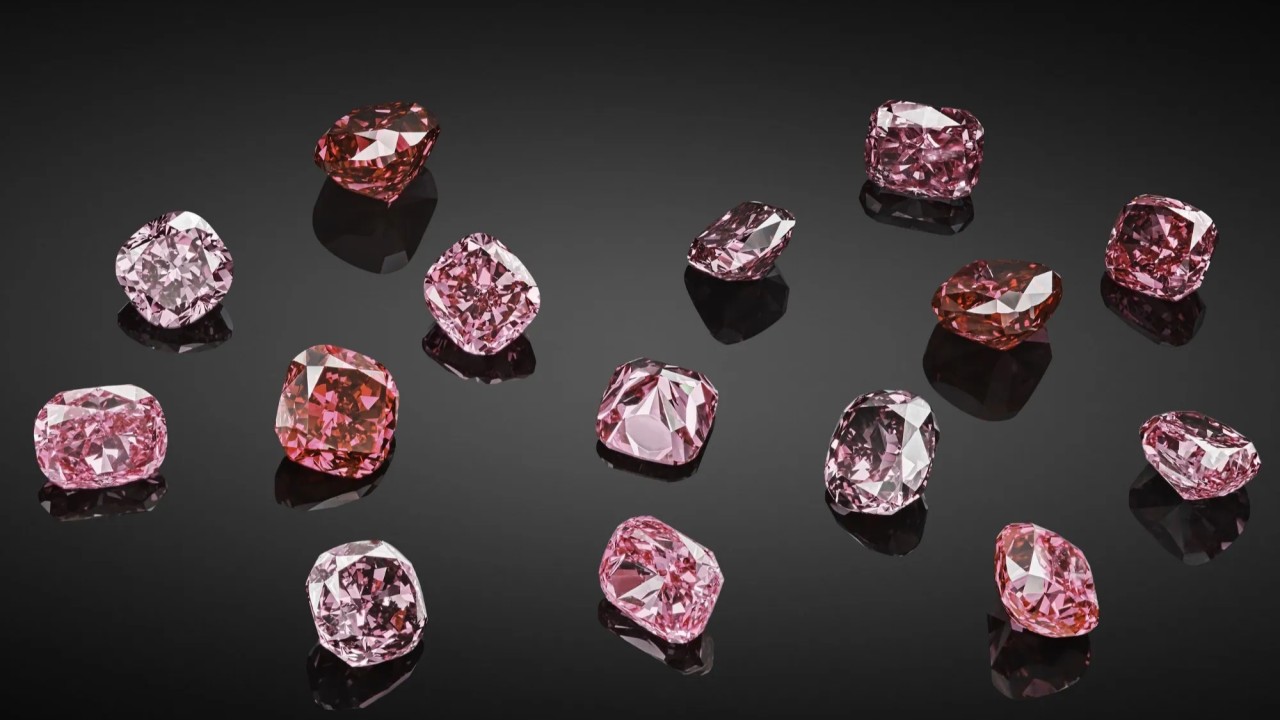
Pink diamondsare among the most extraordinary natural wonders on Earth. They are a geological paradox: flawless in the eyes of collectors yet born from extreme atomic stress deep within the planet's mantle.
Unlikeblue diamonds, whose color comes from boron, or yellow diamonds, where nitrogen plays the starring role, the color in approximately 99.5% of naturalpink diamondsis not caused by chemical impurities at all. It is caused by distortion, a physical warping of the diamond's crystal lattice, a "mistake" in nature's blueprint that produces some of the most valuable gemstones in existence.
This guide explores every facet of pink diamonds: the science behind their color, the GIA grading scale that determines their value, the historic mines that produced them, the legendary stones that have shattered auction records, and the market dynamics that make them one of the most compelling alternative asset classes in the world today.
Part One: The Science of Pink — Why Are Pink Diamonds Pink?
The vast majority of diamonds derive their color from trace elements nitrogen for yellow, boron for blue, and so on.Pink diamondsare different. Their color arises from plastic deformation: a process in which the diamond's crystal structure is literally bent and warped under immense geological forces, creating defects that absorb specific wavelengths of light and produce the pink hue.
This deformation occurs deep within the Earth's mantle, where diamonds are subjected to temperatures between 900°C and 1,400°C and pressures that would crush virtually any other material.
The precise timing and geological conditions that cause the shear stresses necessary for this deformation are still under scientific debate, but researchers at theGemological Institute of America (GIA)and institutions worldwide have identified two distinct geological settings for pink diamond formation: Group 1 formed in Proterozoic cratons (0.5–2.5 billion years ago), while Group 2 formed in Archean cratons (2.5–4 billion years ago).
The Argyle Connection -
The most famous source of pink diamonds was the Argyle mine in the remote East Kimberley region of Western Australia. Research published in 2023 revealed that Argyle'spink diamondsformed approximately 1.3 billion years ago, during the breakup of the supercontinent Nuna. The collision of tectonic plates subjected the diamonds to the forces necessary to create their distinctive color.
The Argyle mine's closure in November 2020 permanently changed the global supply equation for pink diamonds. Before its closure, Argyle was responsible for a staggering 90% of the world's pink diamond supply.
Yet even at the height of its production, less than 0.1% of Argyle's total rough diamond output which exceeded 865 million carats over its 37-year life, was pink. This extraordinary rarity is the foundation of the pink diamond's value proposition.
Part Two: The GIA Pink Diamond Color Grading Scale
Understanding the Nine-Step Scale -
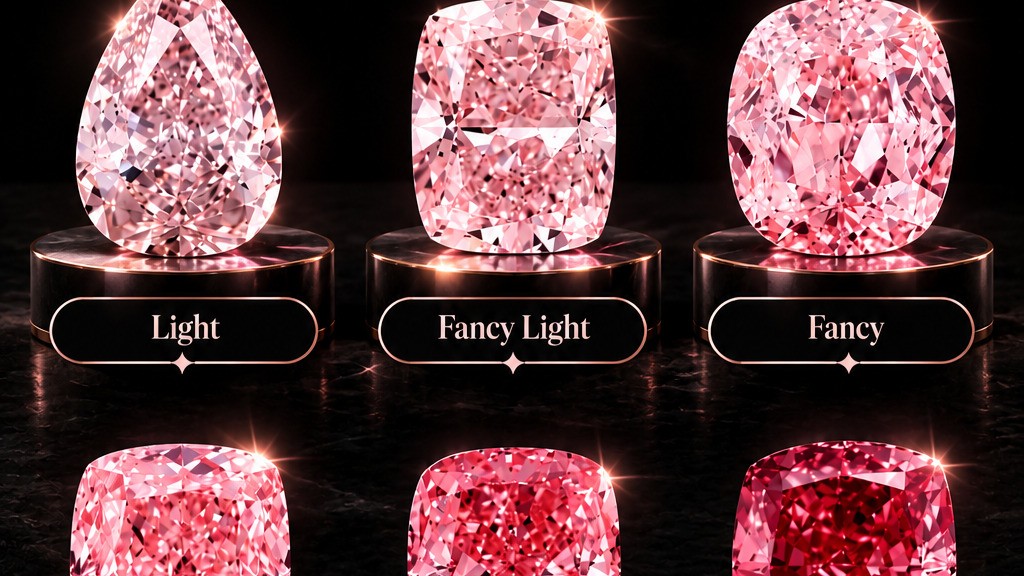
The Gemological Institute of America (GIA) grades colored diamonds on a nine-step scale that measures color strength, from the faintest hints of color to the most intensely saturated stones. For pink diamonds specifically, the grades from lowest to highest are:
Faint — A very soft, barely perceptible pink shade. Stones in this category are the most accessible entry point into pink diamond ownership but still command a significant premium over colorless diamonds of comparable quality.
Very Light — A subtle pink that is noticeable but remains delicate and understated.
Light — A gentle, more discernible pink. Stones with darker tones can receive Light, Fancy Light, Fancy, Fancy Intense, and Fancy Vivid grades, though the exact classification depends on the combined effect of tone and saturation.
Fancy Light — A gentle but clearly noticeable pink. This grade represents the beginning of the "Fancy" range, where the color becomes a defining characteristic of the stone rather than a subtle tint.
Fancy — A clear and attractive pink. This is the most commonly encountered grade in the market for investment-grade pink diamonds.
Fancy Intense — A stronger, richer pink that commands significant premium. Fancy Intense and Fancy Vivid generally command higher prices than other grades. A 2022 GIA study found that only 2% of pink Type IIa diamonds were graded as Fancy Vivid Pink, the classification reserved for specimens with the greatest degree of saturation.
Fancy Vivid — Bright, lively, and highly saturated. This is the pinnacle of pink diamond color. The CTF Pink Star, the most expensive diamond ever sold at auction, is a Fancy Vivid Pink.
Fancy Deep — A deeper, darker pink shade. While Fancy Deep stones may not have the brightness of Fancy Vivid, their rich, saturated color is highly prized.
Fancy Dark — The darkest pink grade, characterized by a deep, brooding tone.
Beyond the Grade: Hue and Saturation
It is essential to understand that the GIA grade is only part of the story. Pink diamonds can exhibit secondary hues purplish pink, brownish pink, orangy pink, and pinkish purple are among the most common. According to GIA research, approximately 28% of pink diamonds are purplish pink to pinkish purple, while 17% are brownish pink to pinkish brown. A purplish pink diamond may command a different price than a pure pink of the same grade, depending on market preferences.
Saturation is the other critical variable. Two diamonds can both be graded Fancy Intense Pink, yet one may have significantly richer color than the other. This is why experienced buyers always examine the actual stone or a high-quality video, not just the report.
Part Three: The Legendary Pink Diamonds
The CTF Pink Star — $71.2 Million
The CTF Pink Star remains the most expensive diamond ever sold at auction. This 59.60-carat oval-shaped, Fancy Vivid Pink, Internally Flawless diamond achieved US$71.2 million at Sotheby's Hong Kong in 2017. Its size, color, and clarity combine to create a stone of almost incomprehensible rarity.
The Williamson Pink Star — $57.7 Million
Sold in 2022 for US$57.7 million, this 11.15-carat cushion-cut Fancy Vivid Pink diamond holds the record for the highest price per carat for any pink diamond, at nearly $5.2 million per carat. The Williamson Pink Star was cut from a rough stone mined at the Williamson mine in Tanzania, a historic source of exceptional pink diamonds.
The Graff Pink — $46 Million
Weighing 23.88 carats with a Fancy Intense Pink grade and Internally Flawless clarity, the Graff Pink sold for $46 million in 2010. Originally weighing 24.78 carats and graded "Potentially Flawless," it was acquired by Laurence Graff and subsequently re-cut to its current form.
The Winston Pink Legacy — $50 Million
The 18.96-carat Winston Pink Legacy, graded Fancy Vivid Pink, sold for over $50 million in 2018, achieving a price of $2.6 million per carat an all-time high for a pink diamond at the time. It was acquired by Harry Winston and renamed in honor of the legendary jeweler.
The Eternal Pink — $34.8 Million
A 10.57-carat Fancy Vivid Purplish Pink diamond, the Eternal Pink sold for $34.8 million at Sotheby's in 2023. Its cushion cut and exceptional saturation make it one of the finest pink diamonds ever to appear at auction.
The Spirit of the Rose — $26.6 Million
This 14.83-carat Fancy Vivid Purple-Pink diamond sold for $26.6 million at Sotheby's Geneva in 2020. It was cut from a 27.85-carat rough stone mined in Russia, demonstrating that exceptional pink diamonds are not limited to Australian or African sources.
Part Four: The Argyle Mine — The End of an Era
A Finite Historical Inventory -
The Argyle mine, located in Western Australia's remote East Kimberley region, was the world's only consistent source of pink diamonds for decades. Mining ceased in November 2020 after 37 years of production.
The closure of Argyle permanently changed the supply equation for pink diamonds. Unlike white diamonds, where new production continues from mines around the world, there is no comparable source capable of replacing Argyle's extraordinary output of pink diamonds. This has transformed existing Argyle pink diamonds into a finite historical inventory.
The Argyle Pink Diamonds Tender -
For decades, the annual Argyle Pink Diamonds Tender was the most exclusive diamond event in the world. A select group of international dealers, jewelers, and collectors were invited to bid on the finest pink, red, and blue diamonds from the mine's production.
The 2020 Tender, the final one included 62 diamonds, including a 62.77-carat fancy deep pink diamond and a 3.14-carat fancy red diamond.
For collectors and investors, this signals that the most desirable Argyle pink diamonds are now firmly in the hands of a single custodian, further tightening supply.
Part Five: Market Dynamics and Investment Potential
The Fancy Color Diamond Index -
The Fancy Color Research Foundation (FCRF) publishes the Fancy Color Diamond Index (FCDI), the most authoritative measure of fancy color diamond prices. According to the Q4 2025 report, thePink diamond categoryrecorded a small decline of 0.2% in Q4 2025, with a 12-month decline of 0.7%.
However, the headline figure masks significant strength in specific categories. The 2-carat Fancy Intense Pink rose by 1.3%, and the 1-carat Fancy Vivid Pink was up 0.8%.
Over a longer horizon, pink diamonds have delivered exceptional returns. According to the FCRF, fancy pinks have appreciated by approximately 116% over the past decade, outpacing all other fancy color categories. A separate analysis found that prices for rare colored stones have climbed 205% since 2005, with pink diamonds alone up by nearly 400%.
Why Pink Diamonds Outperform -
Several structural factors underpin the investment case for pink diamonds:
Supply is permanently constrained. With Argyle closed and no comparable new source on the horizon, the supply of new pink diamonds is effectively capped. Existing stones are all there will ever be.
Demand is global and growing. Ultra-wealthy buyers in India, China, the Middle East, and the West are increasingly viewing pink diamonds as both a store of value and a statement of discerning taste. Demand in India has spiked by 20–25% over the past year alone.
They are portable, private, and concentrated stores of wealth. Unlike real estate or art, a pink diamond can be transported discreetly and holds extraordinary value in a very small package.
They offer diversification. Pink diamonds have historically shown low correlation with traditional asset classes, making them an attractive addition to a diversified portfolio.
The Price Spectrum -
Pink diamond prices vary dramatically based on carat weight, color grade, and clarity. As a general guide:
Faint to Light Pink: Accessible entry points, often under $50,000 per carat.
Fancy Light to Fancy Pink: $50,000 to $150,000 per carat for stones of 1–2 carats.
Fancy Intense Pink: $150,000 to $500,000+ per carat.
Fancy Vivid Pink: $500,000 to $2 million+ per carat, with exceptional stones exceeding $5 million per carat.
These are broad ranges; actual prices depend on the specific characteristics of each stone and prevailing market conditions.
Part Six: How to Buy a Pink Diamond
Step 1: Understand the GIA Report
Every investment-grade pink diamond should come with a GIA Colored Diamond Grading Report. This report will state the color grade (e.g., Fancy Intense Pink), the clarity grade, the carat weight, and whether the color is natural or treated.
The GIA also offers a Colored Diamond Origin Report, which additionally identifies the geographic origin of the diamond a critical piece of information for Argyle stones.
Step 2: Examine the Stone
Never buy a pink diamond based solely on a report. The GIA grade is a range, not a precise point. Within any grade, there is variation in saturation and tone. Insist on seeing high-resolution video or, ideally, the stone itself. Pay attention to the evenness of color distribution, some pink diamonds have color concentrated in parallel bands, which can affect their appearance.
Step 3: Prioritize Saturation Over Size
A smaller, more saturated pink diamond will generally outperform a larger, paler stone in both beauty and investment performance. A 1-carat Fancy Vivid Pink is rarer and more desirable than a 3-carat Fancy Light Pink, and it will typically command a higher price per carat.
Step 4: Consider the Cut
Colored diamonds are usually cut to maximize the intensity of their color rather than to maximize light return. The best cut is one that gives the most attractive face-up color. Cushion cuts, oval cuts, and radiant cuts are particularly popular for pink diamonds because they tend to concentrate color.
Step 5: Buy from a Reputable Source
The pink diamond market has its share of pitfalls, including treated stones and undisclosed synthetics. Work with established dealers, auction houses, or marketplaces like CaratX that provide full transparency and access to verified inventory.
Part Seven: Pink Diamonds vs. Other Fancy Colors
Pink vs. Blue -
Blue diamondsowe their color to boron and are also extraordinarily rare, but the market forblue diamondsis smaller and more concentrated. Pink diamonds enjoy broader global appeal, particularly in Asian markets where pink carries cultural significance.
Pink vs. Yellow -
Yellow diamondsare far more abundant than pink diamonds. While exceptional yellow diamonds can command high prices, the supply-demand dynamics are fundamentally different. Pink diamonds are approximately 1,000 times rarer than yellow diamonds of comparable quality.
Pink vs. Red -
Red diamondsare the rarest of all, with only a handful of stones over 1 carat ever graded. The 2.33-carat DeYoung Red Diamond in the Smithsonian's National Gem Collection is one of the most famous examples. Red diamonds are effectively unobtainable for most collectors, while pink diamonds though still extraordinarily rare offer a more accessible entry point into the world of ultra-rare colored diamonds.
Frequently Asked Questions -
Are pink diamonds a good investment?
Pink diamonds have historically delivered strong returns, with prices up nearly 400% since 2005. However, they are not liquid assets in the way that stocks or bonds are. They are best suited to investors with a long time horizon who can afford to hold the stone for years.
What is the rarest pink diamond color?
Fancy Vivid Pink is the rarest and most valuable pink diamond grade. Only a tiny fraction of pink diamonds submitted to GIA receive this grade. Fancy Deep Pink and Fancy Dark Pink are also exceptionally rare.
Can pink diamonds be lab-grown?
Yes, lab-grown pink diamonds exist and are significantly less expensive than natural stones. However, they do not have the same investment characteristics or rarity as natural pink diamonds. For collectors and investors, natural is the only option.
How do I verify the authenticity of a pink diamond?
Always insist on a GIA Colored Diamond Grading Report. The report will confirm whether the color is natural or treated. You can verify the report's authenticity through GIA's online report check service.
What is the difference between Fancy Intense and Fancy Vivid Pink?
Fancy Vivid Pink represents the highest level of color saturation, while Fancy Intense is one step below. Both are exceptional grades, but Fancy Vivid stones command a significant premium.
Are Argyle pink diamonds more valuable than other pink diamonds?
Argyle pink diamonds carry a premium due to their provenance, the mine's legendary status, and the fact that the supply is now fixed. Stones with documented Argyle origin are particularly desirable.
What size pink diamond should I buy?
For investment purposes, 1 carat and above is generally recommended. Smaller stones can still be beautiful and collectible, but they may be less liquid in the resale market.
How should I store a pink diamond?
Pink diamonds should be stored separately from other diamonds to prevent scratches, ideally in a soft pouch or a dedicated compartment in a jewelry box. Avoid exposing them to sudden temperature changes, which can cause thermal shock.
Recommended Reads from CaratX -
Pink Diamonds: Understanding the GIA Color Scale Behind Their ValueA deep dive into the GIA grading system that determines pink diamond value. Covers the geological origins of pink diamonds, the science of plastic deformation, the nine-step GIA color scale from Faint to Fancy Deep, the market impact of the Argyle mine closure, and the compelling investment performance of pink diamonds.
Understanding Pink Diamond Color Grades: Why Color Changes EverythingExplores how color grade affects price and desirability. This guide walks through the complete GIA fancy color grading system, including hue, tone, and saturation, and provides detailed analysis of each investment-grade category from Fancy Light to Fancy Vivid.
Decoding PP, P, and PR: A Detailed Analysis of Pink Diamond SuffixesLearn what purplish pink, pink, and pink rose really mean. This in-depth guide explains the three most important pink diamond suffixes PP (Purplish Pink), P (Pink), and PR (Pink Rose) within the Argyle color classification system.
Pink & Blue Diamonds in 2026: Market Selectivity, Value Preservation & Investment OutlookThe latest market intelligence on fancy color diamonds. This comprehensive analysis covers Q1 2026 FCRF data showing that the 1-carat Fancy Intense Pink category saw prices increase by approximately 1.9%, while larger Fancy Vivid Pink categories experienced corrections of 1.5–2.2%.
The Guide to Colored Diamonds: Rarity, Value, and Investment Potential of Every HueAn encyclopedic guide to colored diamonds covering rarity, value, and investment potential.
Why Fancy Color Diamonds Are Capturing Attention in 2026: The Complete Investor & Collector's GuideThe complete investor and collector's guide to fancy color diamonds. Includes detailed market analysis of why fancy color diamonds are capturing unprecedented attention in 2026.
Diamond Carat Size Guide: Charts, Real-Life Examples & Buying TipsEverything you need to know about carat weight and visual size.
Start Your Pink Diamond Journey with CaratX -
CaratXis the premier international marketplace for diamonds, gemstones, and jewelry. Whether you are a seller looking to reach buyers in 18+ countries or a buyer seeking the finest natural diamonds, CaratX provides the platform, transparency, and global reach you need.
Sellers: Register on the CaratX marketplace to start selling to B2B and B2C buyers worldwide.www.caratx.com/register
Buyers: Shop natural diamonds at unbeatable prices.https://caratx.com/search?query=Natural
Learn More: Explore our pricing and seller plans -https://caratx.com/sell-on-caratx