
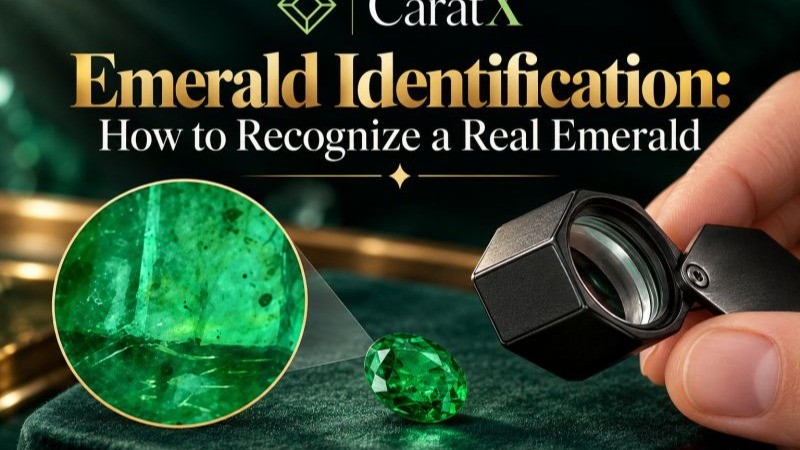
Emeraldis one of the most coveted gemstones on earth, and also one of the most imitated, treated, and misrepresented. Its vivid green fire has inspired collectors for millennia, yet the same geological turbulence that gives emerald its character the fractures, inclusions, and growth marks also creates the conditions for a complex global market in treatments and synthetics.
For buyers, sellers, and jewellers, knowing how to recognize a real emerald is not a hobbyist’s curiosity. It is a commercial necessity.
This guide walks through the gemmological, optical, and laboratory-based methods used to separate natural emerald from synthetic, simulant, and treated material. It draws on primary research from theGemological Institute of America (GIA), the International Gem Society (IGS), and peer-reviewed mineralogical literature, and it connects each identification principle to the practical realities of buying and selling on theCaratX marketplace.
Why Emerald Identification Matters More Than Ever -
The coloured gemstone market has shifted decisively toward value over volume. At independent jewellers in the United States, coloured-stone jewellery sales rose by more than 4% in 2025, while average purchase value climbed nearly 12%.
Unit sales, by contrast, fell roughly 8%. Buyers are choosing fewer pieces but demanding better stones stronger colour, better clarity, and verifiable character. That selectivity has pushed authentication to the centre of the transaction.
At the same time, supply is contracting. FineColombian emeraldsand Burmeserubieshave become harder to source, and dealers at the 2026 Tucson show described the major challenge as sourcing, not demand.
When supply tightens, substitution and treatment disclosure become live risks. A stone that looks like a bargain emerald may be a flux-grown synthetic, a resin-filled low-grade natural, or a green simulant entirely.
The good news is that emerald is one of the most studied gemstones in the world. Its identification rests on a well-established set of visual, physical, and spectroscopic criteria, criteria that any serious buyer can learn to apply, and that every seller on a trustworthy marketplace should be prepared to document.
The Mineralogy of Emerald: Beryl, Beryllium, and the Hexagonal Habit
Emerald is not a mineral species in its own right. It is the green gem variety of beryl, a beryllium aluminium silicate with the chemical formula Be₃Al₂Si₆O₁₈. What makes beryl emerald rather thanaquamarineor morganite is the presence of trace chromium and, in some deposits, vanadium, which substitute into the crystal lattice and produce the characteristic green absorption .
Beryl crystallizes in the hexagonal system. Rough emerald crystals typically form as long, six-sided prisms, often with flat or weakly pyramidal terminations, and many are left in matrix because emerald is frequently included and fragile. The crystals belong to the dihexagonal-dipyramidal class, the highest symmetry class of the hexagonal system, and longitudinal striations on prism faces are a common surface feature.
This crystal habit matters for identification in two ways. First, rough material with a well-defined hexagonal prism and striated prism faces is strongly suggestive of beryl-family origin, though it does not by itself prove emerald rather than green beryl or a synthetic.
Second, the hexagonal growth pattern controls where inclusions are trapped. In trapiche emeralds, inclusions are concentrated at the boundaries between growth sectors, producing a fixed six-rayed pattern when the stone is cut perpendicular to the sixfold axis.
A stone that shows a convincing hexagonal growth framework, consistent with beryl, is already ahead of most simulants.
Colour:
Natural emeralds usually show green to bluish-green shades, and the most desirable stones range from bluish green to pure green with vivid saturation. The colour comes from selective absorption: chromium and vanadium create transmission windows in the red and blue-violet, while absorption in the yellow-to-green region sharpens the green hue.
Colour is a useful first filter, but it is also where many buyers make their first mistake. Synthetic emeralds can be grown in colours that matchfine natural stones, and green glass or green cubic zirconia can be manufactured in almost any shade.
A stone that is “too perfect” in colour uniformly saturated, without the subtle pleochroism that natural beryl often shows warrants closer inspection.
Natural emerald typically shows dichroism (two directions of colour) because of its uniaxial optical character, and this can sometimes be observed with a dichroscope or by rotating the stone in polarized light. Colour alone never confirms authenticity; it only narrows the field.
Crystal Shape and Surface Features -
For rough or uncut material, crystal shape is one of the most direct lines of evidence. Natural emerald forms hexagonal prisms, and the prism faces often carry fine longitudinal striations. Terminations may be flat basal pinacoids, or they may show first- and second-order hexagonal bipyramids, depending on growth conditions.
These features are not easily replicated in synthetic material, which is usually grown as a boule or plate and then faceted, rather than allowed to develop a full crystal habit.
That said, crystal shape is not decisive on its own. A rough green beryl crystal from a non-emerald locality may have the same hexagonal habit without the chromium or vanadium that defines emerald.
Conversely, a natural emerald that has been heavily worn or alluvial may show little of its original crystal form. Crystal shape is therefore best used in combination with colour, inclusions, and physical properties.
Inclusions and the “Jardin”:
Nearly all natural emeralds contain inclusions trapped gas, liquid, and mineral crystals that record the turbulent chemical environment in which the stone grew. The French term jardin (“garden”) is used because these inclusions can resemble moss, foliage, or branching plant structures inside the green gem.
For gemmologists, the jardin is not a defect to be apologised for. It is a fingerprint of natural origin.
The GIA’s inclusion research has documented a wide range of natural emerald inclusion types, including multiphase fluid inclusions, jagged three-phase inclusions typical of Colombian material, blocky two-phase inclusions in Brazilian and Zambian stones, and solid mineral inclusions such as magnetite, phlogopite, albite, carbonates, and pyrite.
These inclusions are not random: their composition and arrangement reflect the host-rock chemistry and the geological conditions of formation, which is why inclusion studies are also used for origin determination.
Synthetic emeralds, by contrast, tend to show different inclusion suites. Flux-grown synthetics may contain oriented needle-like inclusions or phenakite crystals and roiled growth zoning, while hydrothermal synthetics can show nail-head spicules wedge-shaped two-phase inclusions capped by tiny crystals.
A synthetic stone may also be relatively free of the chaotic, multi-directional jardin thatnatural emeraldalmost always displays. The presence of a natural-looking jardin is therefore one of the strongest visual arguments for natural origin, though it is not a substitute for laboratory confirmation.
Hardness, Toughness, and the Limits of Physical Testing -
Emerald ranks 7.5 to 8 on the Mohs hardness scale, making it resistant to scratching by most everyday materials. This hardness is often cited as a quick identification clue: a stone that can be scratched by quartz (hardness 7) or by a steel file is unlikely to be emerald.
But hardness testing has serious limitations in practice. It is a destructive test if done carelessly, and it cannot distinguish emerald from other beryl varieties, from synthetic emerald, or from hard simulants such as green sapphire or zircon.
Emerald’s toughness is more revealing. Despite its hardness, emerald has fair to good toughness at best, because natural stones are riddled with fissures and inclusions that can propagate under stress.
This is why emeralds require more careful setting and wearing than ruby or sapphire. A stone that is claimed to be emerald but shows unusual toughness or that has been so heavily filled that its fractures no longer behave like fractures, should be examined for treatment.
Physical properties such as refractive index and specific gravity provide firmer ground.Emeraldtypically has a refractive index of approximately 1.577 to 1.583 and a specific gravity of about 2.72, though values vary slightly by locality and trace-element content.
Synthetic emeralds can fall outside or at the edges of these ranges: flux-grown material may have a lower specific gravity (around 2.66 in some early synthetics), and hydrothermal material may show subtle differences in refractive index and birefringence.
A gemmologist’s refractometer and hydrostatic balance remain basic but powerful tools for separating emerald from many simulants.
Treatments and Enhancements:
The vast majority of emeralds on the market have undergone clarity enhancement. GIA laboratory estimates cited in gemmological literature suggest that about 90% of the emeralds seen by identification laboratories most of them high-quality stones have been clarity enhanced in some fashion.
The treatment works by introducing a substance with a refractive index close to beryl’s into surface-reaching fissures, reducing the visibility of cracks and improving apparent clarity and colour .
The filler can be “presumed natural” (cedarwood oil, other oils, waxes) or artificial (epoxy prepolymers, UV-setting adhesives, other polymers). Since December 2024, GIA has offered optional filler identification on its emerald reports, classifying fillers as Type A (oil, wax, or natural resin) or Type B (artificial resin), and indicating when the filler cannot be identified.
This is a meaningful advance for buyers, because filler type can affect durability, value, and the long-term behaviour of the stone.
Detecting and identifying fillers requires laboratory instrumentation. Raman and infrared spectroscopy can separate fillers into spectral groups and distinguish most artificial resins from cedarwood oil, though not every filler is spectroscopically unique.
Under the microscope, fillers may show flash effects blue, violet, orange, or yellowish flashes when transmitted light hits filled fractures and flattened gas bubbles or resin residues in fissures. A stone that shows evidence of filling is still a real emerald, but it is a treated emerald, and its value and disclosure status are different from an untreated stone.
Synthetic Emeralds:
Laboratory-grown emeralds are chemically and optically close enough to natural emerald that the unaided eye cannot reliably separate them. There are two main synthesis routes. Flux growth dissolves the necessary ingredients in a molten flux and grows emerald crystals at high temperature; hydrothermal growth crystallises emerald from aqueous solutions under high pressure and temperature, in an autoclave .
Flux-grown synthetics often contain oriented needle-like inclusions, phenakite crystals, and roiled growth zoning that can sometimes be mistaken for natural features if examined casually.
Hydrothermal synthetics may show nail-head spicules, distinctive two-phase inclusions that are rare in natural emerald . Some flux-grown material can appear remarkably clean, and in the absence of flux “fingerprints” it could easily be mistaken for natural by an untrained observer .
The decisive separation usually comes from spectroscopy. Infrared and UV-visible spectroscopy can distinguish natural from synthetic emerald, and in some cases can also provide clues to geographic origin.
FTIR is particularly useful for detecting water-related features that differ between natural and laboratory-grown material, and for identifying the specific chemistry of fillers. A laboratory report is not a luxury in this market. It is the only reliable way to know whether a stone is natural, synthetic, or treated.
Laboratory Reports and Certification: What to Look For and What to Verify
A credible emerald transaction begins with a credible report. The GIA Identification and Origin Report describes whether the stone is natural or laboratory-grown, identifies the species and variety, discloses detectable treatments, and when determinable offers an opinion on geographic origin.
For emeralds, the report also includes a clarity enhancement table describing the extent of treatment. A QR code on the report links to GIA Report Check, which verifies the data against the laboratory’s database and provides more detailed treatment information .
Other respected laboratories include the International Gemological Institute (IGI), which certifies coloured stones and discloses treatments, and the American Gem Trade Association (AGTA) Gemological Testing Center, which offers emerald origin and filler identification services . For high-value emeralds, laboratories such as SSEF and Gübelin are also widely cited in the trade for coloured-stone certification.
The key point is not which logo appears on the report, but whether the report is verifiable, specific about treatments, and issued by a laboratory with a public database and a reputation to protect.
Buyers should treat any emerald without a report as an unverified stone, regardless of how convincing the seller’s description may be.
OnCaratX, sellers can list gemstones and jewellery for B2B and B2C buyers across more than 16 countries, and the marketplace’s reach makes documentation a commercial advantage, not just a compliance obligation .
A Practical Identification Checklist for Buyers and Sellers -
The following sequence reflects how a gemmologist actually approaches an emerald, from least invasive to most definitive.
Step 1: Observe colour and pleochroism. Natural emerald is green to bluish green, often with subtle dichroism. Uniform, flat colour with no directional variation is a warning sign, not a virtue.
Step 2: Examine the crystal habit if the stone is rough. Look for a hexagonal prism, striated prism faces, and flat or pyramidal terminations . A well-formed hexagonal crystal is consistent with beryl, though not conclusive proof of emerald.
Step 3: Study the inclusions under magnification. A natural-looking jardin multiphase fluid inclusions, jagged three-phase fingerprints, mineral crystals, and chaotic fracture networks supports natural origin.
Oriented needles, nail-head spicules, or suspiciously clean interiors point toward synthesis.
Step 4: Check physical properties. Refractive index around 1.577–1.583 and specific gravity around 2.72 are consistent with emerald, but not unique to it. A gemmologist can use these values to exclude many simulants.
Step 5: Look for evidence of filling. Flash effects, flattened bubbles in fractures, and resin residues indicate clarity enhancement . Filler identification by Raman or FTIR spectroscopy, as offered in GIA’s updated reports, provides the most precise answer.
Step 6: Obtain a verifiable laboratory report. For any stone of significant value, the report should state natural vs. synthetic, describe treatments and their extent, and be checkable through the laboratory’s online verification system .
Sourcing and Selling with Confidence on CaratX -
Identification is only half of the emerald story. The other half is provenance, disclosure, and access to a market that values both.
CaratXconnects the diamond, gemstone, jewellery, and pearl industry across more than 16 countries and over 200 artisan sellers, bringing loose gemstones, finished jewellery, and certified stones into a single B2B and B2C marketplace.
For buyers, that means access to natural emeralds and coloured gemstones from sellers who can be held to documentation standards. For sellers, it means reaching international buyers who are actively looking for verified material.
Sellers can register on the CaratX marketplace to list products for B2B and B2C buyers across 18+ international countries.
Registration is available atwww.caratx.com/register, and sellers who want to understand the commercial landscape can read CaratX’s analysis of the coloured gemstone market in 2026, which covers rising demand, shrinking supply, and the new rules of a rarer market.
Buyers can browse natural emeralds, coloured gemstones, and fine jewellery directly on the marketplace, and can source from sellers who understand that disclosure is not a threat to value, it is the foundation of it.
Recommended Reads from CaratX -
Replace the previous bullet list with the following. Each link has been opened and confirmed to resolve to the actual article or product page, not a generic homepage.
Why Are Some Gemstones Green? The Complete Scientific Guide -
Correct URL: https://caratx.com/blog/why-are-some-gemstones-green-the-complete-scientific-guide
Coloured Gemstones in 2026: Rising Demand, Shrinking Supply, and the New Rules of a Rarer Market -
Why Gem Prices Are Climbing and What Retailers Should Expect in 2025 -
URL: https://caratx.com/blog/why-gem-prices-are-climbing-and-what-retailers-should-expect-in-2025
GIA's 2026 Gemstone Report Overhaul: Elevating Transparency and Value in the Colored Stone Market -
The Ultimate Guide to Colored Gemstone Valuation: Beyond Carats and Into the Rainbow -
Gemstone Zoning: Nature's Hidden Color Pattern -
URL: https://caratx.com/blog/gemstone-zoning-nature-s-hidden-color-pattern
The Ultimate Compendium on Birthstones: History, Gemology, and the Definitive Buying Guide for 2026 -
FAQs -
Can a jeweller’s loupe tell me whether an emerald is real?
A loupe can reveal useful clues, jardin inclusions, surface-reaching fractures, and some filling residues but it cannot reliably distinguish natural from synthetic emerald. Flux-grown synthetics can contain inclusions that resemble natural features, and hydrothermal synthetics can be nearly clean.
A loupe is a screening tool, not a certification tool. A laboratory report is required for certainty.
Are inclusions a sign that an emerald is fake?
No. Inclusions are expected in natural emerald and are one of the strongest indicators of natural origin. The term jardin exists precisely because these internal features are characteristic of the stone. A completely flawless emerald is more likely to be synthetic or glass than a natural untreated emerald.
Is oiled emerald still a real emerald?
Yes. Oiling and resin filling are clarity enhancements applied to real emerald. The stone is still emerald, but it is treated emerald, and the treatment should be disclosed. GIA’s filler identification service distinguishes Type A fillers (oil, wax, natural resin) from Type B (artificial resin), which is important for durability and value.
An untreated emerald commands a premium, but a disclosed treated emerald is not a fake.
Can emerald be identified by its hardness alone?
Hardness can help exclude soft simulants such as glass or plastic, but it cannot distinguish emerald from other beryl varieties, synthetic emerald, or hard simulants. Emerald’s Mohs hardness of 7.5–8 is useful context, not a standalone test.
Identification requires a combination of visual, physical, and spectroscopic evidence.
Why do some emerald reports mention filler type?
Because filler type affects durability and value. Artificial resins can be more stable than oils in some conditions, but the trade and consumers increasingly want to know what is inside the stone. GIA reintroduced filler identification on emerald reports in December 2024, and the service now classifies fillers as Type A or Type B or states that the filler cannot be identified.
A report that specifies filler type is more informative than one that only says “clarity enhanced.”