
The Americanfine jewelrymarket is undergoing one of the most consequential structural shifts in a generation. Consumers are buying fewer pieces, yet they are spending significantly more per purchase. In April 2026, average spending per jewelry item jumped 21% year-over-year, the highest increase ever recorded.
This paradox fewer units, higher spend is the hallmark of what industry analysts call a “K-shaped market,” and it is fundamentally reshaping how jewelry is bought, sold, and positioned across the United States.
The term “K-shaped” entered popular parlance in 2020 to describe the uneven post-COVID recovery, and it has since become ubiquitous in discussions of consumer behavior.
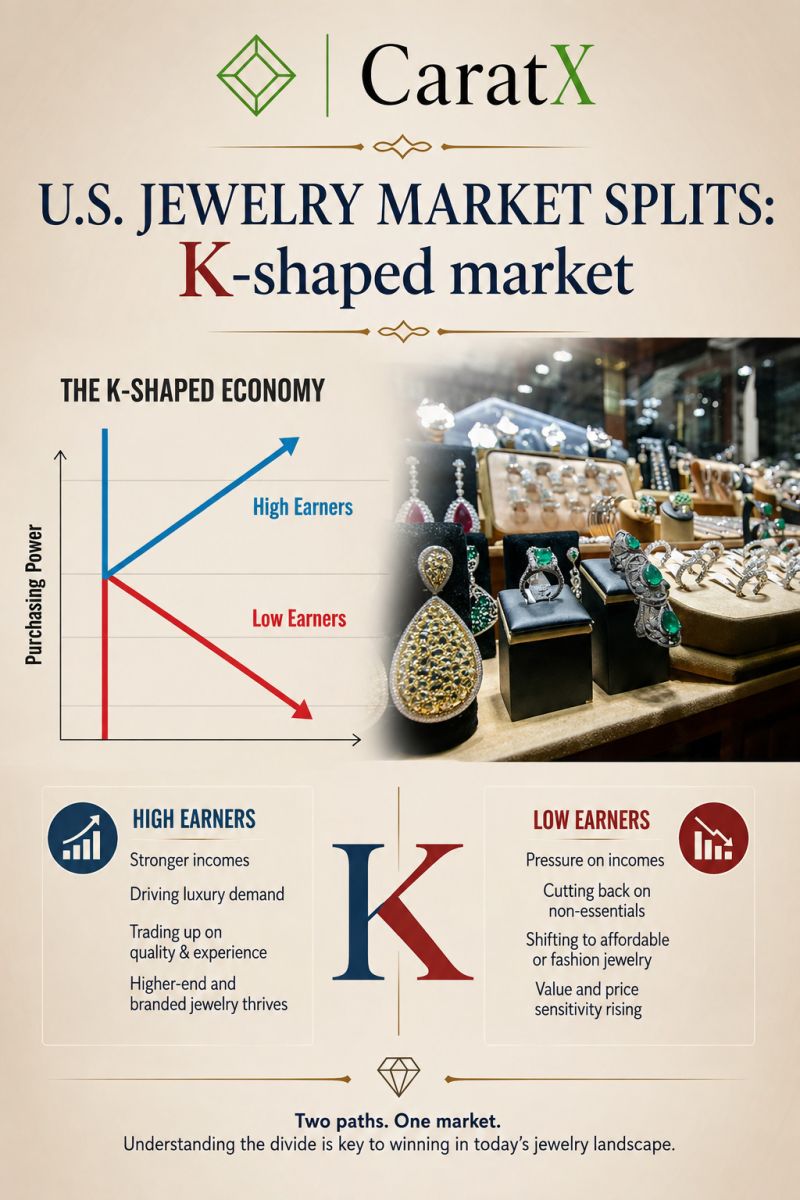
In economic terms, a K-shaped market describes a bifurcation where one segment of consumers typically higher-income households continues to spend and even increase their expenditure, while another segment typically lower and middle-income households pulls back. In the jewelry industry, this split is stark: demand remains strong at both the highest and lowest ends of the market, but the middle is hollowing out.
This article explores the dynamics of the K-shaped jewelry market, the distinct consumer groups driving this divide, how retailers are adapting, and what the future holds for industry players. We will also examine how platforms likeCaratXare helping jewelry businesses navigate this new landscape by connecting sellers to buyers across 18+ international markets.
What Is the K-Shaped Economy?
The K-shaped economy describes a scenario where economic recovery and growth follow divergent paths for different segments of the population. The “K” shape represents two trajectories: the upper branch affluent consumers who continue to thrive and spend and the lower branch those who face financial strain and pull back.
According to Moody’s Analytics, the top 10 percent of U.S. households were responsible for nearly half of all spending. Meanwhile, lower-income families have been struggling due to a host of factors: tariffs, unemployment, inflation, and job market risks. This wealth disparity has created what analysts describe as “two distinct realities” in the American consumer landscape.
Financial markets have hit record highs, and the wealthiest Americans have been on “an escalator” going up. But for many middle- and lower-income households, the economic picture is far less rosy.
This divide has profound implications for thejewelryindustry, which has historically relied on a broad middle market of consumers making occasional aspirational purchases.
The Two Faces of the K-Shaped Jewelry Market -
Industry economist has documented how American jewelry buyers are splitting into two distinct groups:
1. Value-Focused Buyers -
Price threshold: Below $1,500
This segment of consumers is spending less overall and buying fewer pieces, particularlyjewelrypriced below $1,500. Over the past year, these consumers did spend slightly more per item, but not enough to offset the decline in unit sales. As a result, revenue from this segment has generally declined.
The one notable exception islab-grown diamond jewelry. Demand for this category continues to grow, although much of the volume is concentrated in relatively simple items such asstud earrings, rather than higher-value pieces.Lab-grown diamondsnow account for more than 45% of all U.S.engagement ringpurchases, evolving from a niche product into a mainstream choice. According to BriteCo’s 2025 research, lab-grown diamonds have captured approximately 48% of engagement ring center stones.
According to The Knot, six out of 10 brides in 2025 chose lab-grown diamonds for the center stones of theirengagement rings. Some retailers report even higher penetration Rêve Diamonds found that lab-grown diamonds represented 52% of their 2025 engagement ring sales, marking the first timelab-grown diamondsovertook natural diamonds.
Lab-grown diamonds appeal to value-focused buyers because they offer the look and feel of diamonds at significantly lower prices. As lab-grown diamond prices continue to decline falling 15-30% between 2024 and 2026 they become increasingly accessible to budget-conscious consumers.
Lower-priced jewelry categories overall have suffered. Revenue in this segment fell 17%, while unit sales dropped 20%.
2. Luxury Buyers -
Price threshold: Above $1,500
This group of consumers is moving in the opposite direction. Shoppers buyingjewelrypriced above $1,500 are spending significantly more overall. Their average spending per item has remained relatively stable, but the increase in total spending is driven by more units being bought, rather than higher prices alone.
This group continues to spend heavily on:
Natural diamond bridal jewelry
High-end natural diamond pieces
According to De Beers’ 2025 Diamond Acquisition Study, spending onnatural diamondshas risen more than 25%, reaching an average of $4,063 per piece in 2025, up from $3,242 in 2023. The average total carat weight also increased from 1.65 carats to 1.86 carats. The average price for anatural diamond engagement ringin the U.S. rose 9% to $7,346.
De Beers found that bridal purchases now account for only 25% of U.S. natural diamond demand. This suggests that self-purchases and gifting beyond the bridal category are increasingly driving natural diamond sales, a trend that luxury retailers are capitalizing on.
Premium jewelrycategories have outperformed significantly: high-value natural diamond pieces, branded bridal, tennis bracelets, diamond necklaces, and luxury earrings saw sales increase 14% year-over-year.
Premiumization:
The K-shaped market is driving a broader trend of premiumization in the jewelry industry. Consumers across both segments are becoming more intentional about their purchases, focusing on quality, craftsmanship, and longevity rather than accumulating jewelry indiscriminately.
According to Tenoris, jewelry sales in the first half of 2026 increased 8.6%, while the average purchase price jumped 19%. These figures indicate that consumer demand has strengthened as the year has progressed, but the growth is driven by higher prices and more expensive items, not by volume.
For specialty jewelry retailers, the impact is already visible in the numbers. Overall revenue for specialty jewelers increased 7% year-over-year, driven almost entirely by rising average ticket size. The average purchase price offinished jewelrysurged 25%. Moreover, average consumer spending per jewelry item has increased every single month since September 2024, and for the past nine consecutive months those increases have remained in double digits.
This premiumization trend is not limited to jewelry. As Modern Retail observed, “spending is rising at the top, holding steady on the value end, and hollowing out in the middle”. This dynamic is forcing luxury brands to pick a side either lean into the value proposition or double down on luxury and exclusivity.
The Shrinking Middle Market -
Perhaps the most significant implication of the K-shaped market is the hollowing out of the middle. The $5,000 to $10,000 retail sweet spot that once anchored the fine jewelry market now feels less prominent.
This dynamic was evident at the 2026 Couture show, where retailers described a market in which the middle is no longer the safest place to be. That leaves a lot of the traditional apparel retailers in the middle really fighting amongst themselves for the consumer’s attention”.
For jewelry businesses, this means that competing mainly on price or focusing on luxury and uniqueness may become more important than ever. The middle ground offering neither the lowest prices nor the highest exclusivity is becoming increasingly difficult to sustain.
How Retailers Are Adapting -
Retailers across the United States are responding to the K-shaped market in two distinct ways:
Strategy 1: Focusing on Affordable, High-Volume Jewelry and Lab-Grown Diamonds
Retailers serving the lower branch of the K are leaning into:
Lab-grown diamond jewelryas a value proposition.
Competitive pricing to attract budget-conscious consumers.
Higher-volume business models that rely on selling more units at lower margins.
Stores that want to serve the lower-price segment likely will need to go heavy on lab-grown diamonds, offer competitive pricing, and build their business model around being a higher-volume retailer.
The lab-grown diamond market continues to expand rapidly. By units,lab-grown diamondsreached 61% of U.S. engagement ring purchases. This growth trajectory shows no signs of slowing, and retailers who can effectively market lab-grown diamonds to value-focused consumers are well-positioned to capture this growing segment.
Strategy 2: Concentrating on Luxury Products, Natural Diamonds, Craftsmanship, and Personalized Service
Retailers targeting the upper branch of the K are focusing on:
Natural diamondsand high-end gemstones.
Superior craftsmanship and unique designs.
Personalized service and exclusive experiences.
Strong storytelling around materials and heritage.
Retailers targeting higher-end consumers face a different set of decisions. Their stores must communicate luxury: fewer pieces on display, more space around each item, and stronger storytelling around craftsmanship and materials.
The high-end consumer remains motivated by originality and exceptional design rather than price alone. Despite sharp rises in gold and precious metal costs, most retailers reported little resistance among affluent consumers.
The Role of B2B Marketplaces in a K-Shaped World -
As the jewelry market becomes more bifurcated, the need for efficient, global distribution channels has never been greater. This is where next-generation B2B and B2C marketplaces likeCaratXare transforming how the industry operates.
CaratXis a global diamond, gemstone, and jewelry marketplace that connects sellers to buyers in over 18 countries. The platform offers direct access to lucrative consumer bases, bypassing traditional, costly distribution layers.
For jewelry businesses navigating the K-shaped market, platforms likeCaratXprovide several critical advantages:
Global Reach -
CaratXgives sellers access to millions of buyers worldwide through its established marketplace. The platform handles international shipping, payments, and currency conversion, removing the barriers to cross-border trade.
B2B and B2C Capabilities -
TheCaratX marketplaceserves both B2B wholesale buyers and B2C retail buyers. This dual-channel approach allows sellers to diversify their customer base and reduce reliance on any single market segment, a crucial strategy in a K-shaped environment where different consumer segments behave so differently.
Cost Efficiency -
By providing a professional storefront and handling the complexities of international e-commerce,CaratXreduces the costs to sell online for the diamond,gemstone, jewelry, andpearlindustry. This efficiency is particularly valuable for smaller retailers and manufacturers who may lack the resources to build their own global e-commerce infrastructure.
Access to Premium Categories -
For sellers ofnatural diamonds,lab-grown diamonds, andfinished jewelry, CaratX provides a platform to reach both value-focused and luxury buyers. The platform’sloose diamondsandgemstonescategories cater to the growing demand for high-quality stones, whether natural or lab-grown.
Sellers can register on CaratX to start selling to B2B and B2C buyers in 18+ international countries atwww.caratx.com/register. With transparent pricing and a global buyer base, CaratX is the essential gateway for diamond and jewelry businesses looking to thrive in the K-shaped market.
Industry Outlook and Future Trends -
What the Experts Are Saying -
McKinsey & Company forecasts that jewelry will be among the most resilient luxury categories, with projected growth of 4% to 6% over the next two years. The consultancy notes that lab-grown diamonds are expected to account for half of all diamond jewelry unit sales by 2030.
However, McKinsey’s research also reveals that “one-third of fine jewelry purchases could be influenced by ESG factors by 2025” making ethically-minded choices and demonstrating transparency throughout the supply chain vital. This trend toward ethical consumption is likely to benefit both natural diamonds (with proper provenance) and lab-grown diamonds (with lower environmental impact).
According to the Global Diamond Industry Report from GJEPC, global rough diamond production fell to 98.8 million carats in 2025, down from 107.9 million carats in 2024, a drop of 8.4%. This supply constraint may put upward pressure on natural diamond prices, further reinforcing the premiumization trend.
The Lab-Grown vs. Natural Diamond Dynamic -
The relationship between lab-grown and natural diamonds continues to evolve. While lab-grown diamonds have captured significant market share by unit volume particularly in engagement rings natural diamonds continue to command strong revenue share in higher-end and branded segments.
Analysts suggest that lab-grown diamonds may become so inexpensive that they effectively become fashion accessories and no longer compete directly with natural diamonds. If this scenario plays out, the K-shaped market could become even more pronounced: lab-grown diamonds dominating the value segment, and natural diamonds anchoring the luxury segment.
The Rise of Self-Purchases and Gen Z -
De Beers’ research found that Gen Z is now the second-largest diamond consumer group, with Gen Zers spending almost double what previous generations spent on diamonds. The study also revealed that self-purchases are increasingly driving diamond demand, with bridal purchases accounting for only 25% of U.S. natural diamond demand.
This shift toward self-purchases and younger consumers has significant implications for the jewelry industry. Gen Z consumers tend to be more value-conscious, more ethically-minded, and more digitally-native than previous generations. They are also more open to lab-grown diamonds, which may accelerate the bifurcation of the market.
The $1 Trillion Holiday Season and Beyond -
The U.S. economy reached a historic $1 trillion holiday spending milestone in 2025, though much of this growth was nominal, driven by inflation and tariff-related price increases rather than transaction volume. This holiday season highlighted the K-shaped dynamic: success concentrated in absolute luxury or extreme value categories, with the middle struggling.
Looking ahead to 2026 and beyond, the K-shaped market shows no signs of reversing. Wealth inequality continues to widen, and consumer behavior is likely to remain bifurcated. Retailers and manufacturers that can clearly position themselves on one side of the K either as value providers or luxury purveyors are best positioned for success.
Recommendations for Jewelry Businesses -
Based on the analysis above, here are key recommendations for jewelry businesses navigating the K-shaped market:
1. Choose Your Position Clearly -
Decide whether you are serving the value segment (lab-grown diamonds, competitive pricing, high volume) or the luxury segment (natural diamonds, craftsmanship, exclusivity). The middle ground is increasingly unsustainable.
2. Embrace Digital and Global Platforms -
Platforms likeCaratXoffer access to global buyers and efficient distribution channels.Register as a sellerto reach B2B and B2C buyers in 18+ countries.
3. Monitor Consumer Trends Closely -
Stay informed about shifts in consumer preferences, particularly among Gen Z and self-purchasers. The De Beers Diamond Acquisition Study and Tenoris reports are valuable resources for understanding market dynamics.
4. Diversify Your Channel Strategy -
Consider selling through multiple channels both direct-to-consumer and through B2B platforms likeCaratX. Diversification reduces risk in a volatile market.
Conclusion -
The U.S. jewelry market is experiencing a profound structural shift. The K-shaped economy is not a temporary phenomenon but a fundamental reconfiguration of consumer behavior that will shape the industry for years to come.
On one side of the K, value-focused consumers are embracing lab-grown diamonds and seeking affordable options. On the other side, luxury buyers continue to invest in natural diamonds, exceptional craftsmanship, and exclusive experiences. The middle market is shrinking, and businesses must choose which side of the K they will serve.
For jewelry businesses looking to thrive in this new landscape, platforms likeCaratXoffer a powerful solution. By connecting sellers to buyers across 18+ international markets, CaratX enables businesses to reach both value-focused and luxury consumers efficiently and cost-effectively.
Start selling to diamonds and jewelry in 18+ international countries by registering on the CaratX marketplace atwww.caratx.com/register. Whether you are a B2B wholesaler or a B2C retailer, CaratX provides the tools and reach you need to succeed in the K-shaped market.
Shop gemstones from the CaratX marketplace at unbeatable prices atwww.caratx.com.
Shop natural diamonds fromhttps://caratx.com/search?query=Natural
Sellers can register to start selling to 18+ buyers now atwww.caratx.com/register.
More details about pricing are available athttps://caratx.com/sell-on-caratx
The K-shaped market presents both challenges and opportunities. Businesses that understand the dynamics, choose their position wisely, and leverage the right platforms will be well-positioned to capture growth in this new era of jewelry retail.
Recommended Reads from CaratX -
The US Jewelry Market Is Undergoing One of the Most Consequential Structural Shifts in a Generation– A deep dive into premiumization, consumer behavior shifts, and what they mean for the industry.
Lab-Grown Diamonds 2025: Fast Growth, Bigger Stones– An in-depth analysis of the lab-grown diamond market, including key penetration figures and future projections.
The Ultimate Guide to HSN Codes for Jewelry Sellers– A comprehensive guide for international jewelry exports and navigating global trade
The US Jewelry Market Is Undergoing One of the Most Consequential Structural Shifts in a Generation– A deep dive into premiumization, consumer behavior shifts, and what they mean for the industry
The Ultimate Guide to the IEC Code: The Non-Negotiable Key for Jewelry Exporters Internationally– Essential information for jewelry businesses looking to expand internationally
De Beers Revises Rough Diamond Index: What It Means for the Market– Analysis of De Beers’ rough diamond pricing and its implications
Additional Related Content from CaratX Blog -
To further enrich your understanding of the K-shaped market and related industry trends, here are additional recommended reads from the CaratX blog:
How Premiumization Is Reshaping the US Diamond Market– Valentine’s Day 2026 delivered a remarkable 14% year-over-year surge in jewelry spending, while overall February sales climbed 10.7%
The Big Shift in Lab-Grown Diamonds: 2025 (Feb–April Analysis)– Between February and April 2025, shifts in inventory and pricing within China’s LGD sector unveiled critical insights for retailers, investors, and consumers
Global Diamond Markets Show Mixed Trends Ahead of JCK Las Vegas– The Hong Kong diamond market is projected to grow at a CAGR of 4.8% through 2032, while the global lab-grown diamond market is projected to reach $40.8 billion by 2030
Antwerp Signals Recovery: Polished Prices Rise While Rough Still Under Pressure– Major miners, including De Beers, have drastically slashed their 2026 production plans to balance an oversaturated market
Frequently Asked Questions (FAQs)
Q1: What is a K-shaped market in the jewelry industry?
A K-shaped market describes a bifurcation where one segment of consumers (typically higher-income) continues to spend and increase their expenditure, while another segment (typically lower- and middle-income) pulls back. In the jewelry industry, this means demand remains strong at both the high and low ends, but the middle market is shrinking.
Q2: How are lab-grown diamonds affecting the K-shaped market?
Lab-grown diamonds are the primary driver of growth in the value segment of the K-shaped market. They now account for more than 45% of U.S. engagement ring purchases and appeal to value-focused consumers because they offer the look of diamonds at lower prices. Meanwhile, natural diamonds continue to dominate the luxury segment.
Q3: What price points define the K-shaped jewelry market?
According to industry analyst Edahn Golan, the divide occurs around the $1,500 price point. Consumers buying jewelry below $1,500 are spending less overall, while consumers buying above $1,500 are spending significantly more.
Q4: How are retailers adapting to the K-shaped market?
Retailers are adapting in two main ways: (1) focusing on affordable, high-volume jewelry and lab-grown diamonds with competitive pricing, or (2) concentrating on luxury products, natural diamonds, craftsmanship, and personalized service.
Q5: What is the outlook for the jewelry industry in a K-shaped economy?
McKinsey forecasts jewelry will grow 4% to 6% over the next two years. However, growth will be concentrated at the high and low ends of the market. The middle market will continue to shrink, and businesses must choose which segment to serve.
Q6: How can jewelry businesses succeed in the K-shaped market?
Businesses should: (1) choose a clear market position (value or luxury), (2) embrace digital and global platforms likeCaratX, (3) invest in storytelling and branding, (4) monitor consumer trends closely, and (5) diversify their channel strategy.
Q7: What is the difference between natural and lab-grown diamonds?
Natural diamonds are formed over billions of years beneath the Earth’s crust and are mined from the earth. Lab-grown diamonds are created in laboratories using advanced technological processes that replicate the natural diamond-growing environment. Both are chemically and physically identical, but lab-grown diamonds are typically more affordable.
Q8: Where can I sell jewelry internationally?
Platforms likeCaratXenable jewelry sellers to reach buyers in 18+ international countries. Sellers can register atwww.caratx.com/registerto start selling to B2B and B2C buyers globally.