
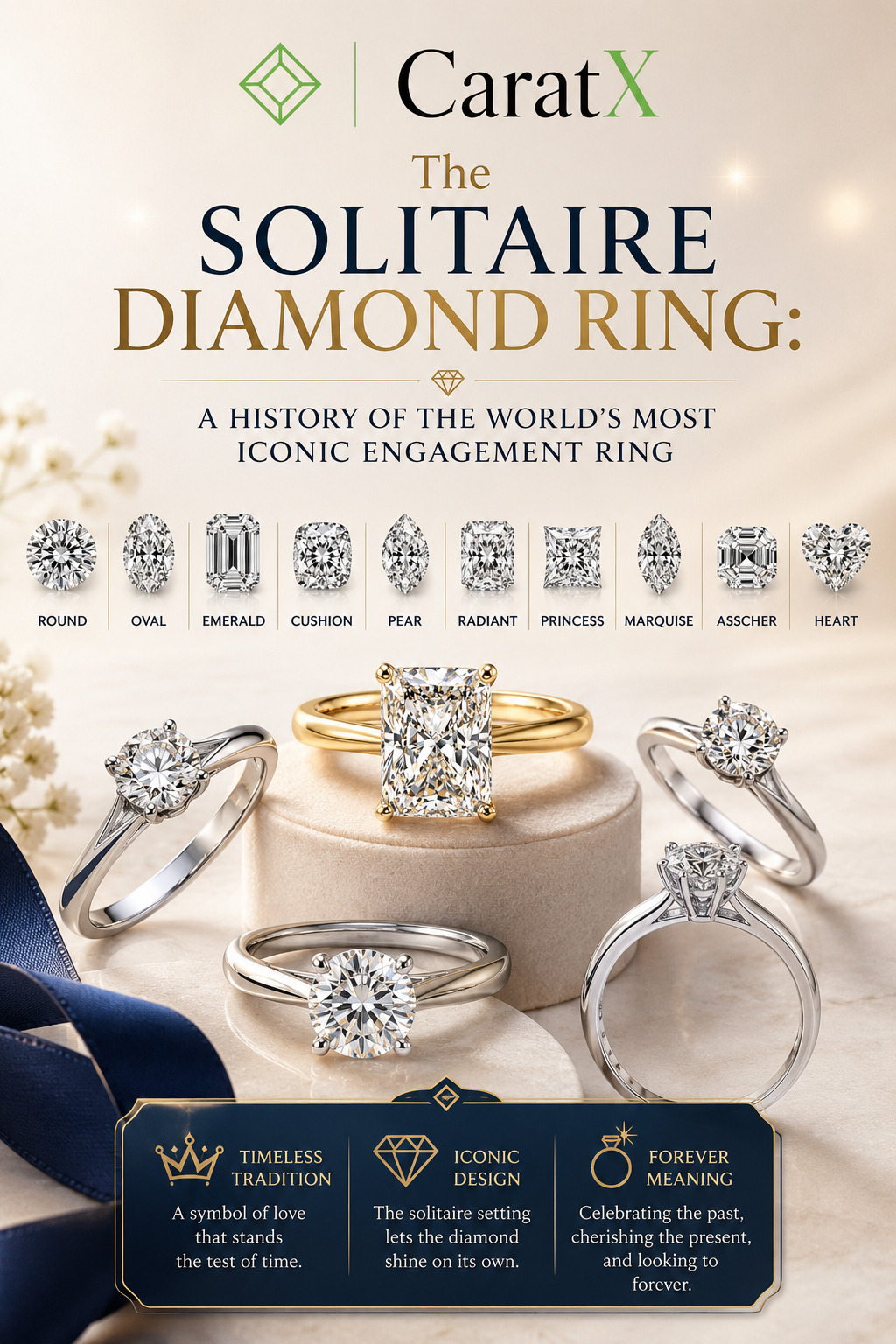
Few pieces ofjewelrycarry the cultural weight and romantic symbolism of thesolitaire diamond ring. With its single, breathtaking diamond mounted on an unadorned band, the solitaire represents the purest expression of love and commitment. But how did this minimalist design become the world's most popular engagement ring style?
This guide traces the solitaire's remarkable journey from ancient Roman gold bands to the revolutionary Tiffany Setting of 1886, and through to its enduring status as the ultimate symbol of eternal love.
What is a Solitaire Ring?
Asolitaire ringis defined by its simplicity: a single diamond or gemstone set on a plain metal band, with no side stones or additional detailing. The name derives from the French termsolitaire, meaning "loner" or "alone". This minimalist design allows the center stone to take center stage, showcasing its cut, color, clarity, and brilliance without distraction.
The solitaire is the most classic of all engagement ring styles. According to theGemological Institute of America (GIA), a diamond solitaire refers to any piece of jewelry with a single diamond, and they "have come to mark some of the most significant occasions in one's life, like sweet-sixteen, anniversaries, and the most notable, an engagement proposal".
Ancient Origins: The Roman Beginning
The story of the solitaire begins not in a 19th-century jewelry salon, but in Ancient Rome. As historians atBerganzanote, the diamond solitaire can trace its origins back to Ancient Roman times, when gold bands were occasionally set with a single uncut diamond crystal. These crystals were acquired directly from Indian traders and were highly prized by the Romans.
The Roman naturalist Pliny the Elder, in hisNaturalis Historia, described the diamond as "the substance that possesses the greatest value, not only among the precious stones, but of all human possessions". The word "diamond" itself derives from the Ancient Greekadamas, meaning "everlasting" or "unbeatable" a property that would later become central to the diamond's link with eternal love.
In ancient Rome, rings symbolized life and eternity and were used as public pledges of marriage between couples. The single uncut diamond crystal set in a goldbandrepresented the earliest precursor to what we now recognize as asolitaire engagement ring.
The First Diamond Engagement Ring: 1477
While diamonds had been set in rings for centuries, the tradition of using a diamond specifically for an engagement ring has a clear historical starting point. According to the GIA, the earliest written record of the use of a diamond in an engagement ring was in 1477.
That year, Archduke Maximilian of Austria (who would later become Holy Roman Emperor) gifted a diamond engagement ring to Mary of Burgundy. A Dr. Moroltinger advised Maximilian to have a ring set with a diamond for his betrothal. This act set a trend among European nobility and is widely considered the birth of the diamond engagement ring tradition.
As theCape Town Diamond Museumexplains, "the idea of giving a gem-studded ring originates with Archduke Maximilian of Austria, who in 1477 proposed to Mary of Burgundy with a diamond ring". TheNational Geographicsimilarly notes that this jewel "was part of history's first recorded diamond engagement ring".
Early cutting techniques at this time were primitive. According toGIA, early cutting techniques caused gems to look dull and even black. To compensate for these lackluster stones, goldsmiths designed elaborate settings composed of romantic motifs such as rosettes and fleur-de-lis, symbolizing the bride's purity. The diamond itself was often set low against the band in closed-back settings.
The Evolution of Diamond Cutting -
The history of thesolitaireis inextricably linked to the evolution of diamond cutting techniques. As cutting technology advanced, diamonds could display greater brilliance, making the solitaire design increasingly appealing.
Point Cut (12th Century) -
The earliest form of faceted diamond is known as thepoint cut, formed by cleaving the crystal in half and polishing it to achieve a four-sided pyramidal shape. This technique's intention was to maintain the essence of the rough diamond without alterations; the diamond would weigh nearly the same as the rough diamond, as very little material was removed.
One such point-cut diamond ring from the 12th century, currently on loan to the Metropolitan Museum of Art, is one of the oldest surviving specimens of what we now call a solitaire ring.
Table Cut (14th-16th Centuries) -
Thetable cutemerged in the 14th to 16th centuries, featuring a flat top with facets on the sides, resembling a table. This cut evolved from the point cut by removing points on either side of the stone to expose a flat crown and culet.
One famous table-cut diamond, the Mirror of Portugal, played a significant role in the political and romantic intrigues of European royalty, passing through the hands of three kings.
Rose Cut (16th Century) -
Therose cutoriginated in the 1500s and was commonly used through the Georgian and Victorian eras. Like other antique diamond cuts, rose cuts were cut by hand and meant to dazzle under candlelight.
Old Mine Cut and Old European Cut -
As technology advanced, diamonds could be faceted in a variety of ways, predominantly as rose cuts and old cuts. These cuts, with their larger facets and softer shapes, were the diamonds typically set in Georgian and Victorian solitaires.
The Round Brilliant Cut -
Theround brilliant cut, the shape most commonly associated with modern solitaires has been around since the 1700s but has been modified over the years. This cut, optimized to bring out maximum fiery sparkle, became the perfect complement to the revolutionary setting that would emerge in 1886.
The Tiffany Revolution: 1886
Thesolitaire ringas we know it today was introduced by Charles Lewis Tiffany in 1886. This moment marked a turning point not just in jewelry design, but in the very definition of theengagement ring.
The Problem with 19th-Century Settings -
Before 1886, engagement rings were heavily embellished with ornate details and gemstones set low against the band. AsGemological Institute of America (GIA), explains: "All diamonds were set in a bezel so only the crown (top) was visible". Imagine a turtleneck sweater for gemstones, the diamond was cloaked in metallurgy, its brilliance hidden from view.
Charles Lewis Tiffany's Vision -
Fueled by a desire to reinvent the most celebratory of pieces, Mr. Tiffany created a design that showcased the diamond rather than the setting. According to Tiffany & Co., the Tiffany® Setting is "the first ring design in history to lift the diamond off the band".
The Six-Prong Setting -
The revolutionary design featured around brilliant-cut diamondheld in place by six platinum prongs of equal weight, height, and angle. The prongs were designed with V-shaped scoops so that the diamond would get maximum visibility.
The setting virtually disappeared lifting the diamond into the light for maximum brilliance. The openness on the underside of the gemstone allowed light to penetrate from below as well, increasing the diamond's brilliance and making it appear larger. This innovative setting was given the name claw setting or prong setting.
The Result -
The result was a design so revolutionary and coveted that at the time, Tiffany & Co. had to publicly release statements warning about counterfeits. The Tiffany® Setting "defines what we know to be an engagement ring today".
According to Forbes, "the term 'Tiffany setting' has reached Kleenex status, it's now used colloquially throughout the jewelry industry to describe any multi-pronged solitaire setting, Tiffany or no". It has been called "the most brilliant ring ever" and remains "the most sought-after engagement ring style to date".
The GIA notes that "the simple elegance of the classic Tiffany mounting, introduced in 1886 by Charles L. Tiffany, offered an ideal complement to the beauty of the diamond. With the diamond set high in an open, six-prong mounting, the design permitted greater amounts of light to enter the gem, allowing it to exhibit maximum brilliance".
The 20th Century: De Beers and Mass Popularity
While the Tiffany Setting established the solitaire's design, the 20th century solidified its cultural dominance.
The Discovery of African Diamond Mines -
The discovery of rich diamond deposits in South Africa in the late 19th century made diamonds more readily available. Widespread wealth, initiated by the 19th century's Industrial Revolution and the rich supply of newly discovered African diamond mines, made diamonds available to a greater public.
"A Diamond is Forever"
The solitaire's popularity exploded in the mid-20th century, thanks to some clever marketing. In 1947, the De Beers company launched its famous "A Diamond is Forever" campaign. This slogan, created by advertising agency N.W. Ayer, became one of the most recognizable slogans in the history of American advertising.
The solitaire design was perfect for this message timeless, elegant, and focused entirely on the diamond's beauty.
The Solitaire Becomes the Standard -
By the mid-20th century, the diamond solitaire had become the quintessential engagement ring. As the University of Florida notes in academic research, "the act of giving/receiving a diamond engagement ring as a token of romantic commitment has become nearly universal and obligatory in contemporary American culture".
Modern Solitaire: Cuts, Metals, and Trends
While the classic round brilliant solitaire remains the most popular choice, the solitaire has evolved significantly over the decades.
Diamond Cuts -
Round Brilliant:Still the most popular shape, accounting for approximately 45% of UK orders in 2025.
Princess Cut:Invented in the 1960s, offering a modern, geometric alternative.
Oval:Growing in popularity, representing about 20% of UK orders in 2025.
Emerald, Pear, and Cushion: Offering more options to express personal style.
Metals -
While yellow gold was the traditional choice for decades, white gold and platinum gained popularity for their sleek, modern look. In recent years, rose gold has seen a resurgence.
According to 2025 data, yellow gold dominates as the top metal (41%), followed by platinum (31%).
Contemporary Trends -
Today's solitaire engagement rings blend tradition and innovation. Minimalist designs have become increasingly popular. According to WWD, "solitaires with subtle, thoughtful details are leading think thin bands that let the center stone stand out, or clean bezel settings".
The east-west placement, where an elongated diamond like an oval oremeraldis set horizontally rather than vertically has emerged as a modern trend.Lab-grown diamondshave also gained significant traction, with some reports showing a 239% increase since 2020.
Enduring Popularity -
The solitaire remains the world's most popular engagement ring style. According to The Knot, 38% of consumers choose solitaire stone settings. Austen & Blake reports that "solitaire engagement rings have spent another year at the top of our list of bestsellers". In the UK,round-brilliant solitairesaccount for 45% of orders, and 53% of celebrities received solitaire engagement rings in 2023.
Why Choose a Solitaire Ring?
The solitaire offers several distinct advantages:
1. Timeless Elegance -
The solitaire is "timeless, elegant and never goes out of fashion". Its simplicity ensures it will remain stylish for generations.
2. Focus on the Diamond -
The solitaire "allows the diamond to take centre stage". Every aspect of the diamond's quality cut, color, clarity, and carat is fully visible.
3. Versatility -
A solitaire "pairs easily with any wedding band". The clean design allows for countless customization options.
4. Maximum Diamond Visibility -
A solitaire prong setting exposes approximately 90% of the stone's surface to light significantly more than bezel or other settings.
5. Investment Value -
Because the solitaire focuses on the quality of the center stone, it often represents a sound investment in a high-quality diamond.
The Symbolism of the Solitaire -
The solitaire diamond ring carries profound symbolic meaning that has evolved over centuries.
Eternal Love -
The single diamond in the center of the ring symbolizes love, commitment, and fidelity between a couple. Its durability diamonds are the hardest natural material on Earth represents the unbreakable nature of true love.
Unity -
The solitaire represents unity, as it's often chosen to signify a commitment to a shared future. As Prins and Prins Diamonds explains, "a single diamond set on a band represents unity, strength, and eternal devotion".
Purity -
The diamond at the center of a solitaire ring is often interpreted as a symbol of purity representing the purity of feelings and intentions in a relationship.
Singularity -
The single stone "means that there is only one that you pledge your everlasting love to and that you have found your one-true..."
A New Chapter -
As Natural Diamonds notes, the solitaire "symbolises the beginning of a very special chapter in life".
How to Choose the Perfect Solitaire Ring -
1. Understand the 4Cs
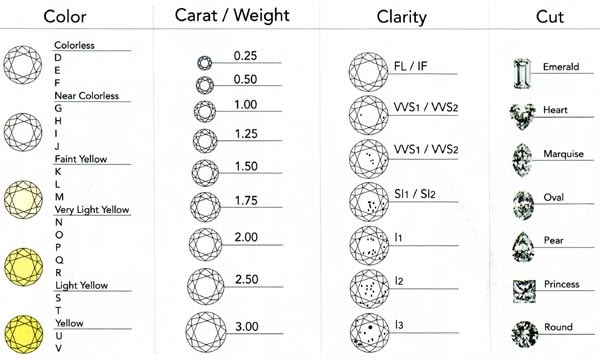
The 4Cs of diamond quality Cut, Color, Clarity, and Carat Weight were developed by theGemological Institute of America (GIA)as the global standard for assessing diamond quality.
Cut: The most important factor determines a diamond's brilliance and fire.
Color: Graded on a D-to-Z scale, with D being completely colorless.
Clarity: Measures the absence of internal inclusions and external blemishes.
Carat: The diamond's weight, 1 carat equals 0.20 grams.
2. Choose the Setting -
The classic solitaire typically features a prong setting, most commonly four or six prongs. Four prongs offer more visibility of the diamond, while six prongs provide extra security.
Alternative settings include:
Bezel setting: The diamond is surrounded by a metal rim for maximum protection.
Tension setting: The diamond appears to float between two ends of the band.
3. Select the Metal
Platinum: Durable, hypoallergenic, naturally white (95% pure).
18K Gold: Available in yellow, white, and rose (75% gold).
14K Gold: More affordable, durable (58.3% gold).
4. Consider Your Budget -
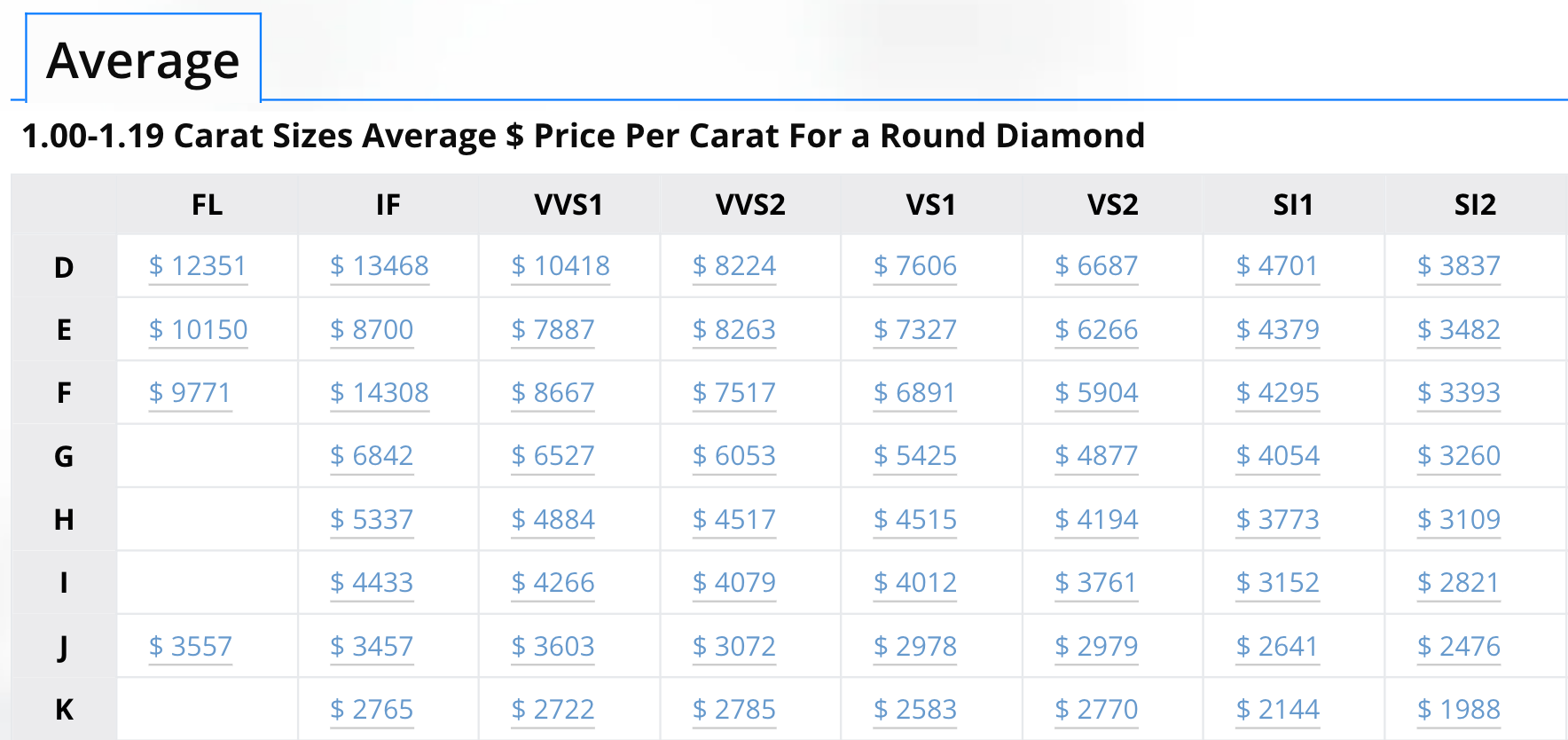
Engagement ring prices vary widely. According to industry data, the average engagement ring costs approximately $5,493. The 1-carat Tiffany Setting starts at approximately $11,000.
Frequently Asked Questions -
What is a solitaire ring?
A solitaire ring features a single diamond set on a plain metal band with no side stones or extra detailing. The name comes from the French wordsolitaire, meaning "alone".
Who invented the solitaire engagement ring?
Charles Lewis Tiffany introduced the modern solitaire engagement ring in 1886 with the six-prong Tiffany® Setting. However, single-stone diamond rings existed in various forms dating back to Ancient Rome.
What is the most popular diamond shape for a solitaire?
The round brilliant cut is the most popular shape for solitaire engagement rings, accounting for approximately 45% of UK orders in 2025.
What is the difference between a solitaire and a halo ring?
A solitaire features a single diamond with no surrounding stones. A halo ring surrounds the center diamond with a circle of smaller diamonds, making the center stone appear larger and adding extra brilliance.
What does a solitaire ring symbolize?
A solitaire symbolizes eternal love, unity, purity, and commitment. The single diamond represents the singular nature of the couple's love and devotion.
How many prongs should a solitaire have?
Most solitaires feature either four or six prongs. Four prongs offer more visibility of the diamond, while six prongs provide extra security and stability.
Can a solitaire ring be resized?
Yes, most solitaire rings can be resized because the band is typically plain metal without stones along the sides. However, the ability to resize depends on the specific design and metal type.
Are solitaire rings still popular?
Yes. According to recent data, 38% of consumers choose solitaire stone settings. Solitaire engagement rings remain at the top of bestseller lists.
Recommended Reads from CaratX
Expand your diamond knowledge with these insightful articles from the CaratX blog:
Diamonds: Why Are They Forever?– Explore the science and history behind why diamonds have become the ultimate symbol of eternal love
Diamond Type Classification: Guide to Geology, Rarity and Smart Buying– Discover how diamond types reveal a stone's origin, rarity, and value
The Ultimate Guide to Diamond Settings & Ring Profiles– Learn how different settings affect brilliance, durability, and style
The Ultimate Guide to Choosing the Right Metal for Your Diamond Ring– Understand how metal choice impacts aesthetics, durability, and value
The Ultimate Guide to the Anatomy of a Ring– Every part of a ring explained, from prongs to galleries
The Ultimate Guide to Diamond Color: How to Choose a Brighter, More Valuable Stone– Master the diamond color scale and make informed purchases
Rings: More Than Just a Pretty Circle– The history and symbolism of rings through the ages
The World's Top 10 Most Popular Gemstones– A complete guide to gemstone history and beauty
Start Your Solitaire Journey with CaratX -
Ready to find your perfect solitaire diamond ring?CaratXconnects buyers with certified natural diamonds, lab-grown diamonds, gemstones, and exquisite jewelry from sellers across 18+ countries.
Shop Natural Diamonds:https://caratx.com/search?query=Natural
Shop Lab-Grown Diamonds:https://caratx.com/search?query=Lab-grown
Shop Gemstones:https://caratx.com/search?query=Gemstones
Sell on CaratX:https://www.caratx.com/register
Learn About Pricing:https://caratx.com/sell-on-caratx