
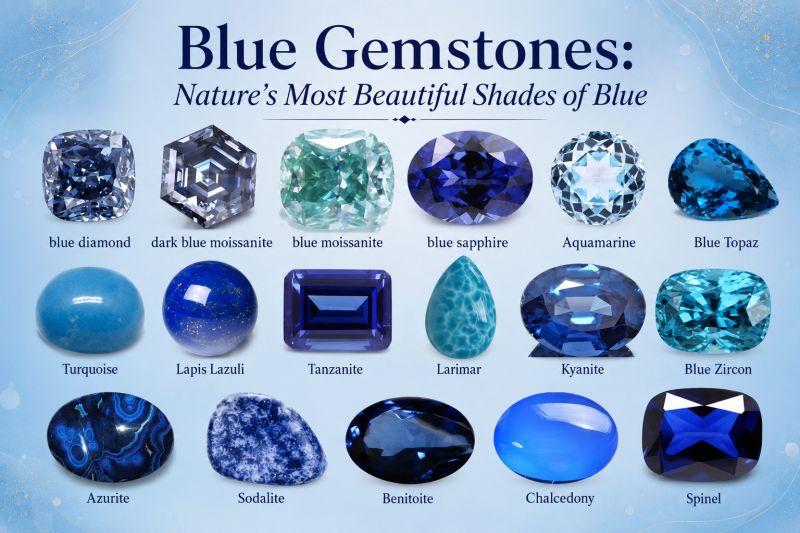
Blueis the most beloved color in the world, and it is no surprise that bluegemstoneshave captivated humanity for millennia. From the deep, velvety blue ofsapphireto the tranquil ocean hues ofaquamarine, blue gemstones represent nature's artistry at its finest. This guide explores the most stunningblue gemstones, their geological origins, unique properties, and what makes each one special.
Understanding Blue Gemstones:
Before diving into individual gemstones, it helps to understand what creates the mesmerizing blue color in these natural treasures. The blue color in gemstones typically arises from trace elements primarily iron and titanium that substitute into the crystal lattice during formation. In some cases, vanadium or cobalt produces the blue hue. The specific combination of these elements, along with the gemstone's crystal structure, determines the exact shade from pale sky blue to deep navy and violet-blue.
The Mohs hardness scale, developed by Friedrich Mohs in 1812, measures a mineral's resistance to scratching. This scale is crucial for understanding how durable a gemstone is for everyday wear. Gemstones rated 7 or higher on the Mohs scale are generally suitable forringsanddaily-wear jewelry, while softer stones require more protective settings.
The Most Beautiful Blue Gemstones -
1. Blue Sapphire –
Blue sapphireis arguably the most famous and valuable blue gemstone in the world. A variety of the mineral corundum (aluminum oxide),sapphireowes its blue color to trace amounts of iron and titanium. Red corundum is called ruby; all other colors are termed "fancy sapphires".
Key Properties:
Mohs Hardness: 9 (second only to diamond).
Birthstone: September.
Sources: Sri Lanka, Madagascar, Myanmar (Burma), Australia, Thailand, and Montana, USA.
Blue sapphire'sexceptional hardness makes it ideal for everyday jewelry, includingengagement ringsand wedding bands. The most prized sapphires display a rich, velvety blue with medium to dark tones and vivid saturation. Kashmir sapphires, now largely exhausted, are legendary for their cornflower-blue color and command extraordinary prices.
Shop natural sapphires and other fine gemstones at CaratX and explore our curated collection.
2. Aquamarine –
The nameaquamarinecomes from the Latinaqua marina, meaning "seawater". This light blue to blue-green variety of beryl captures the serene beauty of the ocean. Its color comes from trace amounts of iron within the crystal structure.
Key Properties:
Mohs Hardness: 7.5–8
Birthstone: March
Sources: Brazil, Pakistan, Afghanistan, Madagascar, Namibia
Aquamarineforms primarily in granitic pegmatites, where beryllium-rich fluids slowly crystallize into large hexagonal crystals. Historically, sailors carried aquamarine as a talisman for protection at sea. Most commercialaquamarineis gently heat-treated to remove green or yellow tints, producing a pure blue color.
3. Blue Topaz –
Blue topazis one of the most popular and affordableblue gemstonesavailable today. While natural blue topaz is rare, most commercial blue topaz is produced by treating colorless topaz with irradiation and heating.
Key Properties:
Mohs Hardness: 8
Colors: Sky blue, Swiss blue, and London blue
The affordability and bright color of blue topaz make it an excellent choice for fashion jewelry,earrings, and pendants. Its hardness of 8 on the Mohs scale ensures good durability for everyday wear.
4. Tanzanite –
Discovered in 1967 and named by Tiffany & Co.,tanzaniteis one of the rarest gemstones on Earth. Found exclusively in a small area near Mount Kilimanjaro in Tanzania,tanzaniteis often cited as being 1,000 times rarer than diamonds.
Key Properties:
Mohs Hardness: 6.5–7
Colors: Blue to violet with purple flashes
Source: Merelani Hills, Tanzania (the only source in the world)
Tanzanite formed approximately 585 million years ago during metamorphism associated with the East African continental collision. Its most distinctive feature is strong trichroism, displaying blue, violet, and burgundy hues from different viewing angles. Nearly all tanzanite is heat-treated to remove brownish tones and enhance the blue-violet color.
Discover rare and collectible gemstones at CaratX, your trusted marketplace for fine jewelry and natural diamonds.
5. Lapis Lazuli –
Lapis lazuli is one of the oldest gemstones known to humanity, with a history stretching back more than 6,500 years. This deep blue metamorphic rock gets its color primarily from the mineral lazurite, often accompanied by golden pyrite inclusions that create a starry night effect.
Key Properties:
Mohs Hardness: 5–6
Sources: Afghanistan (the world's oldest commercial gemstone sources)
Lapis lazuli has been treasured by ancient civilizations including Mesopotamia, Egypt, China, Greece, and Rome. The lapis mines in Badakhshan, Afghanistan, have been producing since at least 700 BC and are still active today. Tutankhamun's funerary mask was adorned with lapis lazuli, and Cleopatra used powdered lapis as eyeshadow.
6. Turquoise –
Turquoise is one of the oldest gemstones used by humans, prized for its distinctive blue-green color. Its unique hue comes from copper and iron within its chemical structure. Turquoise has been used in jewelry and art for thousands of years, from ancient Egypt to Native American craftsmanship.
Key Properties:
Mohs Hardness: 5–6
Sources: Iran, United States (Arizona, New Mexico), China, Egypt
Turquoise is a porous gemstone that can be enhanced or stabilized to improve durability. Its unique color and cultural significance make it a perennial favorite in both traditional and modern jewelry designs.
7. Blue Spinel –
Blue spinelis a natural gemstone known for its bright color and excellent brilliance. Whilespinelhas often been mistaken for sapphire throughout history, it is a distinct mineral species (magnesium aluminum oxide).
Key Properties:
Mohs Hardness: 7.5–8
Color: Caused primarily by cobalt (Co²⁺) with some iron contribution
Cobalt-blue spinel is one of the most valuable varieties. Unlike many colored gems, bluespinelis typically untreated, making its natural color especially prized. Fine blue spinels are increasingly popular among collectors and connoisseurs.
8. Blue Zircon –
Blue zirconis famous for its exceptional sparkle and fire, rivaling diamond in brilliance. Its high refractive index and strong double refraction create a distinctive shimmering effect.
Key Properties:
Mohs Hardness: 6–7.5
Colors: Vivid blue (typically heat-treated from brown zircon)
Birthstone: December
Bluezirconfrom Cambodia's Ratanakiri Province now marketed as Cambolite is renowned for its rich blue colors, ranging from Silky Blue to Regal Blue. While durable enough for jewelry, blue zircon requires careful handling as it can chip easily.
The Science Behind Blue Gemstone Formation -
Blue gemstonesform through various geological processes, each creating unique crystal structures and properties:
Sapphireforms in aluminum-rich, silica-poor environments under high temperature and pressure, primarily in metamorphic rocks like marble and gneiss, and igneous rocks like syenite and basalt.
Aquamarinecrystallizes in granitic pegmatites where beryllium-rich fluids fill open pockets and allow large hexagonal crystals to grow slowly.
Tanzaniteformed approximately 585 million years ago during regional metamorphism related to the Pan-African orogenic event.
Blue zirconis created through volcanic activity, with the Cambodian deposits formed some 700,000 years ago.
Choosing the Right Blue Gemstone -
When selecting a blue gemstone, consider the following factors:
1. Durability: For everyday rings, choose gems with a hardness of 7.5 or higher sapphire (9), spinel (7.5–8), aquamarine (7.5–8), or topaz (8).
2. Color: Blue gemstones range from pale sky blue (aquamarine, sky-blue topaz) to deep navy (sapphire, London blue topaz) to violet-blue (tanzanite).
3. Rarity: Tanzanite, fine cobalt-blue spinel, and untreated sapphires are among the rarest and most valuable.
4. Budget: Blue topaz and heat-treated aquamarine offer beautiful color at affordable prices. Sapphire, tanzanite, and fine spinel command premium prices.
5. Treatment: Many blue gemstones are heat-treated or enhanced to improve color. Always ask about treatments when purchasing.
Caring for Blue Gemstones -
Sapphire and spinelcan be cleaned with warm soapy water and a soft brush.
Aquamarine and topaz should be protected from harsh chemicals and extreme temperature changes.
Tanzanite requires careful handling due to its cleavage and sensitivity to sudden temperature changes.
Lapis lazuli and turquoise are porous and should be kept away from chemicals, perfumes, and prolonged water exposure.
Blue zircon should be protected from direct sunlight, as prolonged exposure can cause color fading.
Recommended Reads from CaratX -
Shop Natural Diamonds– Explore our curated collection of GIA-certified natural diamonds
Shop Gemstones– Discover fine gemstones at unbeatable prices
Sell Jewelry Internationally– Start selling to B2B and B2C buyers in 18+ countries
CaratX Seller Plan– Launch your products on our global marketplace
Pricing Information– Learn more about our seller plans and pricing
About CaratX -
CaratXis a leading global marketplace for fine jewelry, natural diamonds, and gemstones. We connect sellers with buyers across 18+ international countries.
Shop gemstones at unbeatable prices:https://www.caratx.com/search?query=gemstones
Sell jewelry internationally to B2B and B2C buyers:www.caratx.com/register
Learn more about our pricing and seller plans:https://www.caratx.com/sell-on-caratx
Follow CaratXfor more insightful and educational content about the world of fine jewelry, diamonds, and gemstones.
Recommended Reads from CaratX -
Explore these in-depth blog posts from our official blog each one carefully curated to complement your journey into the world of blue gemstones, colored stones, and fine jewelry:
Blue Gemstones & Color Stone Guides -
Not All Blues Are the Same: A Deep Dive into Sapphire, Spinel, Diamond & Tanzanite– Explore the geological origins, color science, and historical significance of the world's most captivating blue gemstones, from sapphires and spinels to tanzanite and blue diamonds.
The 31‑Hue Wheel: The Ultimate Guide to Gemstone Colour Grading– Master the art of color grading. Learn how to precisely describe a sapphire's "purplish blue" or a tanzanite's "violetish blue" using the industry-standard 31-hue wheel.
The Ultimate Guide to Colored Gemstone Valuation: Beyond Carats and Into the Rainbow– Discover what truly drives the value of colored gemstones – from hue, tone, and saturation to rarity and origin – moving far beyond simple carat weight.
The Mohs Scale Decoded: The Ultimate Guide to Gemstone Hardness and Durability in Fine Jewelry– A complete breakdown of the Mohs hardness scale. Understand why blue sapphire (hardness 9) is ideal for engagement rings, while tanzanite (6.5–7) requires more protective settings.
Deep Dives into Specific Blue Stones -
Market Deep Dive 2025: The Unstoppable Rise of Blue and Green Sapphires in Q4 Global Markets– An exclusive data-driven analysis showing how blue and green sapphires dominated Q4 colored gemstone sales, accounting for 67% of the market on the CaratX platform.
Blue Topaz: From Clear Crystal to Iconic Gem– Trace the fascinating journey of blue topaz – from a naturally colorless crystal to the brilliant sky-blue and Swiss-blue gems beloved by jewelry lovers worldwide.
Zircon Quality Factors– An in-depth look at what makes blue zircon one of the brightest natural gems, covering color grading, clarity, cut, and the heat-treatment process that unlocks its signature blue.
Zircon vs. Cubic Zirconia: The Ultimate Guide to Jewelry's Most Confused Gems– Clear up the confusion once and for all. Learn the critical differences between natural zircon (a precious gemstone) and synthetic cubic zirconia (a diamond simulant).
Birthstones & Jewelry Trends -
The Ultimate Compendium on Birthstones: History, Gemology, and the Definitive Buying Guide for 2026– Your complete reference for every birthstone, including March's aquamarine, September's blue sapphire, and December's trio of tanzanite, blue zircon, and turquoise.
More Curated Articles -
Our Favorite Articles– A handpicked collection of CaratX's most popular blog posts, covering diamond markets, rare red diamonds, India's diamond export landscape, and more.
News and Media– Stay updated with the latest industry insights, market surveys, and expert commentary from the CaratX editorial team.
For the complete library of educational content, visit theCaratX Official Blog.
Start Your Journey with CaratX Today -
Shop Natural Diamonds & Gemstones –https://www.caratx.com/search?query=Natural
Sell Jewelry in 18+ International Markets –Register as a Seller
Explore Seller Plans & Pricing –Launch Your Products on CaratX
Frequently Asked Questions -
What is the hardest blue gemstone?
Blue sapphire ranks 9 on the Mohs hardness scale, making it the hardest blue gemstone after diamond. This exceptional durability makes it ideal for everyday jewelry, including engagement rings.
What is the rarest blue gemstone?
Tanzanite is considered one of the rarest gemstones in the world, found exclusively in a small four-kilometer area near Mount Kilimanjaro in Tanzania. It is often cited as being 1,000 times rarer than diamonds.
Are blue sapphires always blue?
No. While blue is the most famous color, sapphires occur in a rainbow of colors including pink, yellow, green, orange, and purple. Any corundum that is not red (ruby) is called a sapphire.
What gives blue gemstones their color?
The blue color typically comes from trace elements such as iron, titanium, vanadium, or cobalt that substitute into the crystal lattice during formation.
Is tanzanite durable enough for an engagement ring?
With a hardness of 6.5–7 on the Mohs scale and distinct cleavage, tanzanite is best suited for protected settings, earrings, or pendants rather than everyday rings.
What is the difference between blue zircon and cubic zirconia?
Blue zircon is a natural gemstone (zirconium silicate) with high brilliance and fire. Cubic zirconia is a synthetic material (zirconium dioxide) created in laboratories as a diamond simulant.