
Greengemstoneshave captivated humanity for millennia from the emeralds of Cleopatra to therare green diamondscoveted by modern collectors. But what exactly gives these precious stones their mesmerizing green hues? The answer lies deep within their crystal structures, where trace elements interact with light in fascinating ways.
The Science Behind Green Gemstone Coloration -
At its most fundamental level, the green color ingemstonesis a product of light absorption. When white light enters agemstone, certain wavelengths are absorbed by trace elements within the crystal lattice, while others are transmitted or reflected back to our eyes. The wavelengths that are not absorbed determine the color we perceive.
The primary mechanism responsible for most gemstone colors is crystal field theory. Transition metal ions such as chromium (Cr), iron (Fe), and vanadium (V) have partially filled d-orbitals. When these ions are incorporated into a gemstone's crystal structure, their electrons can absorb specific wavelengths of visible light, causing transitions between energy levels. The specific wavelengths absorbed depend on:
The identity of the element.
Its valence state.
The coordination environment (octahedral, tetrahedral, etc.).
The nature of the surrounding ligands.
The Three Primary Coloring Agents -
Chromium (Cr³⁺) – The Emerald Maker
Chromium is perhaps the most famous coloring agent in the gemstone world. When trivalent chromium (Cr³⁺) substitutes for aluminum in a crystal structure, it creates some of the most intense and prized green colors known to gemology.
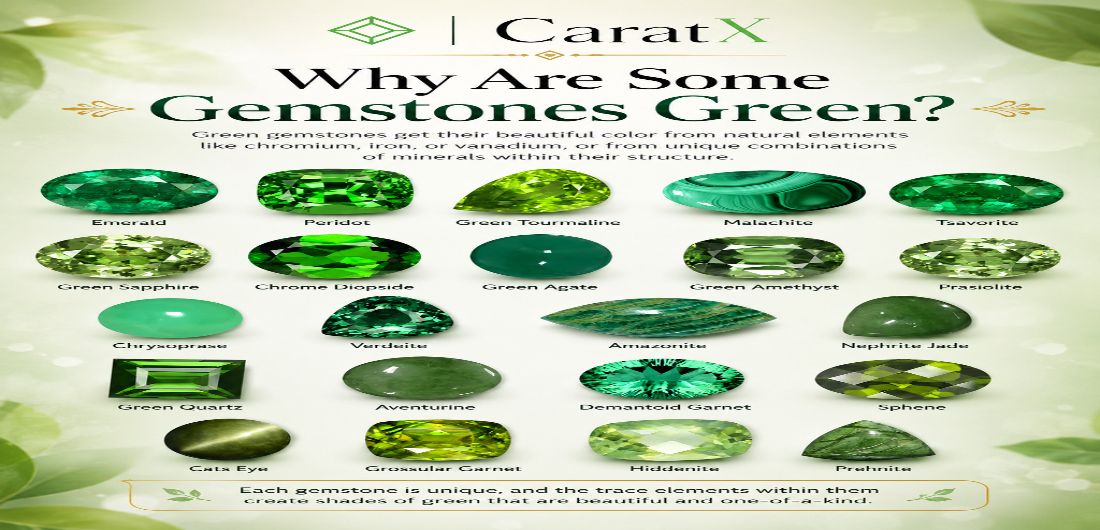
Emeraldis the quintessential example. Chemically pure beryl (Be₃Al₂Si₆O₁₈) is completely colorless. However, when trace amounts of chromium or vanadium replace aluminum ions in the beryl crystal lattice, the stone transforms into the rich green we recognize asemerald. The Cr³⁺ ions absorb light in the red and blue-violet regions of the visible spectrum, allowing green light to pass through.
According to GIA research, the higher the chromium or vanadium content, the more intense the green color. Iron content adds a bluish component when iron is relatively high,emeraldappears bluer green; when iron is low, the green is purer.
Demantoid garnet the green variety of andradite also owes its vibrantgreencolor primarily to chromium. These rare garnets display a brilliance and fire that rivals diamond, with their green coloration caused by Cr³⁺ substitution.
Green jadeite similarly derives its coveted "emerald green" color from chromium. Quantitative analysis confirms that chromium is responsible for the green coloration in jadeite, while manganese produces lavender hues.
Iron (Fe²⁺ and Fe³⁺) –
Iron is the most abundant chromophore in nature and produces a wider range ofgreenshades from yellowish-green to olive-green to dark bottle-green.
Peridotis one of the few gemstones whose green color comes directly from iron as an essential component of its chemical structure, not merely as a trace impurity.Peridotis the gem variety of the mineral olivine ((Mg,Fe)₂SiO₄). The divalent iron ion (Fe²⁺) replaces magnesium in the crystal structure, and its concentration directly correlates with color intensity. Iron contents above 15% produce a very dark or muddy color.
Green tourmaline typically gets its color from iron, though chromium or vanadium can produce more vivid stones. When chromium or vanadium replaces iron as the coloring agent, the result is "chrome tourmaline" a distinct and more valuable subtype.
Green sapphirespresent a more complex case. Their color results from a mixture of blue and yellow chromophores. Iron (Fe³⁺) creates yellow coloration, while the combination of Fe²⁺-Ti⁴+ charge transfer produces blue. Green sapphires contain both mechanisms operating simultaneously.
Vanadium (V³⁺) –
Vanadium can produce beautiful green colors, often with subtle bluish or yellowish undertones depending on the specific crystal environment.
Inemeralds, vanadium can serve as the primary chromophore alongside chromium. Someemeraldsparticularly those from Malipo, China have vanadium as the predominant coloring agent, producing a typically yellowish-green color.
Tsavorite garnet, the emerald-green variety of grossular garnet, owes its vivid green color to vanadium (and sometimes chromium). First discovered in Tanzania in the 1960s, tsavorite's unique color was initially attributed to chromium and later to vanadium as well. Vanadium's presence in grossular garnet produces the intense green that has made tsavorite one of the most sought-after green gemstones.
Green euclase also derives its color from chromium and vanadium impurities, with Cr³⁺ producing strong absorption bands that create the green hue.
The Spectrum of Green Gemstones -
Emerald:
Emeraldis the green to bluish-green variety of beryl, colored by chromium and/or vanadium. What distinguishes emerald from less expensive green beryl is the depth and saturation of its color, emeralds must display sufficiently dark and saturated green to earn the name.
Thefinest emeraldscome from Colombia, where they formed from hot evaporitic brines at approximately 330°C that reacted with organic matter in shales. Colombian emeralds are prized for their pure, vibrant green with a slight bluish undertone. Other significant sources include Zambia, Brazil, Pakistan, Madagascar, and Myanmar (as noted in the original prompt).
Emeralds are famously included their internal fractures and inclusions are often described as "jardin" (French for garden). These inclusions are so characteristic that a completely clean emerald is exceptionally rare.
Peridot:
Peridotforms deep within the Earth's mantle and is brought to the surface through volcanic activity. It typically forms at temperatures between 910°C and 980°C at pressures corresponding to depths of around 60 kilometers.
The gem often occurs in volcanic rocks called basalts, which are rich in iron and magnesium. Unlike many other gems, olivine is highly susceptible to chemical weathering and does not survive long at the surface in wet climates, which is why significant peridot sources are limited to arid or semi-arid regions.
Major sources include Zabargad Island in Egypt (an ancient source mentioned by Pliny), Myanmar, Arizona, Vietnam, Pakistan, China, Ethiopia, and Tanzania.
Green Diamond:
Green diamondsoccupy a unique position among colored gemstones. Unlike most other green gems, their color does not come from transition metal ions but from radiation damage.
Natural green diamondsreceive their color from exposure to radioactive minerals and fluids containing uranium, thorium, and potassium-40 isotopes. These elements emit alpha particles that displace carbon atoms in the diamond's crystal lattice, creating GR1 centers (General Radiation 1) that absorb red and yellow light, allowing only green light to pass through.
Remarkably, the green color in natural diamonds is often confined to a "skin" only a few micrometers thick, the result of surface-level radiation exposure. Less than 0.1% of all diamonds submitted for grading fall into the "Fancy Color" category, and green is the scarcest among the primary hues.
Natural green diamonds often display green or brown surface spots called "radiation stains," which cannot be duplicated in a laboratory.
Tsavorite and Demantoid: The Garnet Greens
Both tsavorite and demantoid are green varieties of garnet, but they belong to different species:
Tsavorite is the green vanadium-chromium variety of grossular garnet.
Demantoid is the green chromium-bearing variety of andradite garnet.
Demantoid is particularly notable for its high dispersion (fire) that can exceed that of diamond, and its characteristic "horsetail" inclusions of chrysotile asbestos.
How Green Gemstones Form -
The formation of green gemstones requires specific geological conditions that bring together the right elements, temperatures, and pressures over millions of years.
Emerald formation typically occurs through one of two primary mechanisms:
Hydrothermal processes: Hot, mineral-rich fluids circulate through fractures in rocks, depositing beryl crystals with chromium and vanadium impurities.
Metasomatic processes: Regional metamorphism and deformation along shear zones facilitate the interaction between beryllium-bearing pegmatites and chromium-rich country rocks.
Peridotforms in the upper mantle and is brought to the surface through volcanic eruptions, often as xenoliths (foreign rock fragments) in basaltic lavas.
Green diamondsform under extreme pressure and temperature in the Earth's mantle, then acquire their green color through subsequent exposure to radiation from surrounding radioactive minerals.
Global Sources of Green Gemstones -
As mentioned in the original prompt, green gemstones are found in numerous countries worldwide:
Colombia: World's premier source of fine emeralds, particularly from the Muzo, Chivor, and Coscuez mines.
Zambia: Major emerald producer, known for stones with a slightly bluish-green tone.
Brazil: Significant source of emeralds, tourmalines, and other green gems.
Pakistan: Source of fine emeralds from the Swat Valley and peridot from Kohistan.
Madagascar: Produces emeralds, sapphires, and other colored stones.
Myanmar (Burma) : Source of peridot, jadeite, and other gemstones.
Tanzania and Kenya: Primary sources of tsavorite garnet.
Russia: Historical source of demantoid garnet from the Ural Mountains.
United States (Arizona) : Major peridot source from the San Carlos Apache Reservation.
The Role of Crystal Structure -
The specific arrangement of atoms in a crystal lattice profoundly affects how color is produced. The same element can produce different colors in different minerals depending on:
Coordination number: Whether the ion is in octahedral or tetrahedral coordination.
Bond lengths: The distance between the ion and its surrounding atoms.
Crystal field splitting: The energy difference between d-orbital energy levels.
For example, Cr³⁺ produces the red of ruby in corundum (Al₂O₃) but the green of emerald in beryl (Be₃Al₂Si₆O₁₈), the different crystal structures create different energy level splits, resulting in different absorption spectra.
Color Centers and Special Cases -
While most green gemstones owe their color to transition metal ions, some use different mechanisms:
Green diamondsuse color centers structural defects in the crystal lattice created by radiation damage. The GR1 center (a neutral vacancy) absorbs red and yellow light, producing green color.
Green quartz (sometimes called "prasiolite" or "green amethyst") can form through natural radiation exposure or through heat treatment of amethyst. Exposure to temperatures between 140°C and 380°C can artificially alter purple amethyst to green or yellow.
Color Grading and Value -
The value of green gemstones depends significantly on their color characteristics:
Hue: The basic color (green, yellowish-green, bluish-green, etc.)
Tone: The lightness or darkness of the color.
Saturation: The intensity or purity of the color.
Foremeralds, the most valuable stones display a pure, vibrant green with medium to medium-dark tone and high saturation. Colombian emeralds are particularly prized for their pure green with a slight bluish undertone.
Forgreen diamonds, the GIA color scale ranges from Faint Green to Fancy Vivid Green, with Fancy Vivid being the most intensely colored and valuable.
Recommended Reads from CaratX -
The Guide to the Green Diamond Color Scale: Rarity, Valuation, and Market Trends– Explore the fascinating world of natural green diamonds, from their radiation-induced color to their position in the fancy color diamond market.
Beyond the Hue: Why Colour is Everything in Gemstones, But Not the Only Thing– Learn why color drives gemstone value and how other factors like clarity, cut, and carat weight interact with color.
The Ultimate Guide to Colored Gemstone Valuation– A guide to understanding how colored gemstones including emeralds, sapphires, and tourmalines are valued in the global market.
The Mohs Scale Decoded: The Ultimate Guide to Gemstone Hardness and Durability– Understand why emeralds, despite their relative hardness, require special care due to their inclusion characteristics.
Frequently Asked Questions -
Q: What makes emerald green?
A: Emerald gets its green color from trace amounts of chromium and/or vanadium that substitute for aluminum in the beryl crystal structure. The higher the chromium or vanadium content, the more intense the green color. Iron content adds a bluish component.
Q: Why is peridot always green?
A: Peridot's green color comes from iron (Fe²⁺) that is an essential part of its chemical structure as the mineral olivine ((Mg,Fe)₂SiO₄). The iron concentration directly affects the color intensity higher iron produces darker green, while lower iron produces lighter yellowish-green.
Q: Can the same element produce different colors in different gemstones?
A: Yes. Chromium produces green in emerald and red in ruby. This happens because the same ion experiences different crystal field environments in different mineral structures, altering which wavelengths of light are absorbed.
Q: Are green diamonds naturally green?
A: Yes, natural green diamonds get their color from millions of years of exposure to radiation from surrounding radioactive minerals. However, green color can also be produced artificially through laboratory irradiation, so proper gemological testing is essential to distinguish natural from treated stones.
Q: What is the rarest green gemstone?
A: Green diamonds are among the rarest less than 0.1% of all diamonds are fancy color, and green is the scarcest among the primary hues. Among other green gems, demantoid garnet and tsavorite are also relatively rare and highly prized.
Q: Where are the best emeralds found?
A: Colombia is widely considered the source of the finest emeralds, particularly from the Muzo, Chivor, and Coscuez mines. Zambian emeralds are also highly regarded for their slightly bluish-green tone.
Q: Why do some green gemstones have yellowish or bluish tints?
A: Yellowish tints typically come from iron content, while bluish tints can result from higher iron content or from the specific crystal field environment of the chromophore. Vanadium can also produce yellowish-green tones in some stones.
Explore Green Gemstones at CaratX -
Shop Natural Diamonds– Browse our selection of natural diamonds, including rare fancy color green diamonds.
Shop Gemstones– Explore our marketplace foremeralds,sapphires, tourmalines, and other colored gemstones at competitive prices.
Sell on CaratX– Register as a seller to list your diamonds, gemstones, and jewelry for B2B and B2C buyers across 18+ international countries.
Learn About Our Pricing– Detailed information about CaratX seller plans and pricing structures.
This article was prepared by CaratX connecting global sellers and buyers of diamonds, gemstones, and jewelry across 18+ international markets. Visit CaratX.com to explore our marketplace or register to start selling today.