
Introduction:
For over two thousand years, the island nation of Sri Lanka known historically as Ceylon has been the source of some of the world's most breathtaking sapphires. The Ceylon sapphire is not merely a gemstone; it is a geological wonder formed over hundreds of millions of years, a cultural treasure woven into the fabric of South Asian history, and today, one of the most commercially significantcolored gemstonesin the global luxury market.
Unlike the legendary but largely exhausted Kashmir sapphire deposits, Sri Lanka continues to producesapphiresof exceptional quality, making Ceylon sapphire the most accessible entry point into fine colored stones without sacrificing quality or prestige.
Whether you are a jewelry brand sourcing inventory, anengagement ringshopper, or a collector building a portfolio, understanding the science, market dynamics, and sourcing considerations for Ceylon sapphire is essential.
This guide will walk you through everything you need to know about Ceylon sapphire from its geological origins in the Ratnapura highlands to its treatment and certification standards, market trends, and practical buying advice.
We will also connect you directly to where you canshop natural sapphires and fine gemstones on CaratX.
What Exactly Is a Ceylon Sapphire?
A Ceylon sapphire is simply a sapphire, a variety of the mineral corundum (aluminium oxide, Al₂O₃) that originates from Sri Lanka. The term "Ceylon" is the colonial-era name for Sri Lanka and remains the traditional trade designation for sapphires from this origin, even though the country was officially renamed in 1972.
According to theGemological Institute of America (GIA), the name "sapphire" applies to any corundum that is notrubyred. Depending on trace element content, sapphires can be blue, yellow, green, orange, pink, purple, or even display a six-rayed star when cut as a cabochon. That historically the finest sapphire gems came from Burma, Sri Lanka, and the Kashmir region of India, with blue remaining the most popular and valuable color.
Ceylon vs. Other Sapphire Origins -
The distinction between Ceylon sapphire andsapphiresfrom other origins is not merely geographical, it is also a matter of color character. As Sotheby's notes, Burmese and Ceylon sapphires are often associated with brighter, more luminous appearances, while Kashmir sapphires are legendary for their velvety cornflower-blue color.
Ceylon sapphires favour a brighter, more luminous medium blue, are frequently untreated or only lightly heated, and their clarity holds up well even in larger sizes, often outperforming Burmese material past five carats.
This color and clarity advantage, combined with active and largely traceable mining operations, makes Ceylon the most commercially attractive origin for fine blue sapphires today.
The Geological Origins of Ceylon Sapphire -
The Ratnapura Mines: "City of Gems"
The heart of Ceylon sapphire production lies in the Ratnapura region, approximately 100 kilometers southeast of Colombo. Ratnapura is Singhalese for "gem town," and Sri Lanka has been known for its gem deposits for more than 2,000 years. The name reflects the area's historical and ongoing significance: Ratnapura contains the most gem deposits and derived its name from the gem industry itself.
It is likely that Sinbad's "Valley of Gems" in theTales of the Arabian Nightsis a reference to the Ratnapura area. In 1292, Marco Polo wrote: "The Island of Ceylon is, for its size, the finest island in the world, and from its streams come rubies, sapphires, topaz, amethyst and garnet".
How Ceylon Sapphires Formed -
The sapphires of Ratnapura are found in ancient river sediments old river beds that are now covered with layers of mud and sand in an area largely given over to paddy fields. The hard gem minerals sapphires,rubies,spinels, andgarnetswere long ago weathered and eroded from the nearby highlands.
Because of their exceptional hardness, they survived as large pebbles and crystals, eroded out of the rocks where they first formed and transported down rivers that acted like a natural panning system.
This alluvial (river-borne) formation process is similar to how gold and diamonds are concentrated in river sands elsewhere on the globe. On their journey along the river, the softer rocks from the highlands were worn down into mud and fine sand, but the harder minerals survived better, retaining their size and often their shape.
If chromium is added instead, the result is ruby and Sri Lanka is also famous for its rubies. The presence of tiny whisker-like crystals of rutile (a titanium-dioxide mineral) trapped within the sapphire crystal as it grew is what creates the six-pointed star effect seen in star sapphires like the famous "Star of Adam".
Color Varieties:
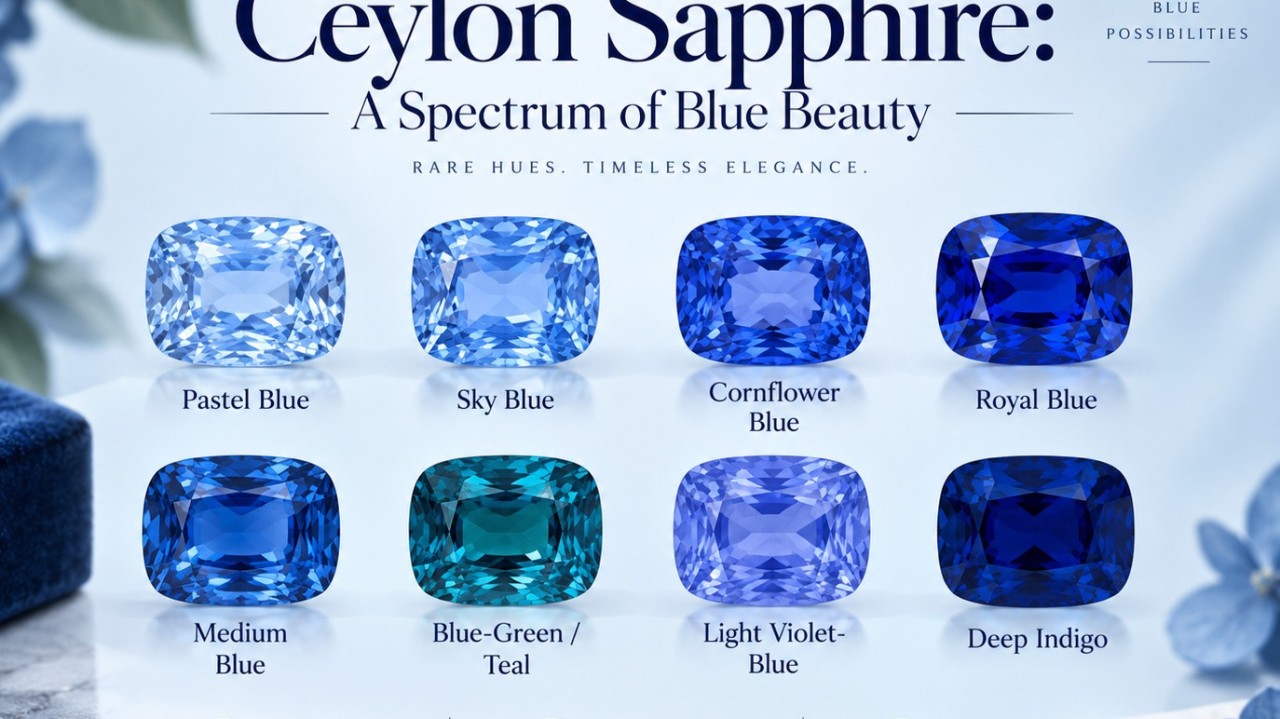
While Ceylon sapphire is most famous for its blue hues, Sri Lanka produces sapphires in a remarkable spectrum of colors. This diversity is one of the origin's greatest strengths.
Blue Ceylon Sapphire -
The classic Ceylon blue sapphire typically displays a bright to medium blue color, often described as cornflower blue or myosotis blue with a hint of purple. The most prized stones exhibit a rich, velvety blue with medium to dark tones and vivid saturation. Ceylon blue sapphires are admired for their bright color and good transparency, with clarity that holds up well even in larger sizes.
Fancy Sapphire Colors from Sri Lanka -
CaratX's guide to fancy sapphires explains that "fancy" is the term for any corundum gemstone that is not red (ruby) or blue and Sri Lanka is a major source for many of these colors. The color mechanisms are well understood:
Yellow Sapphire:Colored by trace amounts of iron (Fe³⁺). Sri Lanka is one of the few sources for fine yellow sapphires, which occur primarily in the Balangoda area.
Pink and Purple Sapphire: Colored by chromium (Cr³⁺). After blue, pink is the most commercially popular fancy color, though fine-quality unheated pink sapphires are becoming increasingly scarce.
Orange Sapphire: A true, vivid orange without brown undertones is remarkably rare, and premium orange sapphires often command higher per-carat prices than many other fancy colors.
Green Sapphire: Typically colored by iron charge transfer, offering a sophisticated alternative to emeralds with superior durability.
Padparadscha Sapphire: The rarest and most valuable fancy sapphire color, a delicate blend of pink and orange likened to the lotus blossom.
Physical Properties and Durability -
Hardness and Wearability
Sapphire ranks 9 on the Mohs scale of mineral hardness, second only to diamond (10). This exceptional hardness makes Ceylon sapphire highly durable and ideal for everyday jewelry, includingengagement ringsandwedding bands. The Mohs scale, developed by Friedrich Mohs in 1812, measures a mineral's resistance to scratching and gemstones rated 7 or higher are generally suitable for rings and daily-wear jewelry.
Optical Properties -
Ceylon sapphires typically exhibit:
Refractive Index: 1.762–1.788
Crystal System: Hexagonal (trigonal)
Chemical Composition: Al₂O₃ (aluminium oxide)
Cleavage: None
Melting Point: 2,030–2,050 °C
These properties contribute to the gemstone's brilliance and its ability to retain polish over centuries of wear.
Treatments, Certification, and Transparency -
Heat Treatment:
The vast majority of sapphires on the market today including Ceylon sapphires have undergone heat treatment to improve color and clarity. This is a common and accepted practice in the gem and jewelry industry, and it remains an authentic, premium-grade sapphire when properly disclosed. Heat treatment is distinguishable from other treatments because it simply accelerates natural processes that would occur in the earth over geological time.
However, unheated Ceylon sapphires command significant premiums, particularly in finer qualities. GIA-certified unheated Ceylon sapphires are highly sought after by collectors and investors.
Certification:
Independent gemological certification is essential when purchasing Ceylon sapphire, especially at higher price points. The Gemological Institute of America (GIA) is the most widely recognized authority for origin and treatment determination. GIA certification confirms a sapphire's natural origin, whether it has been heated, and in many cases, its geographic origin (Ceylon/Sri Lanka).
The Ceylon Sapphire Market: Trends and Opportunities
Market Growth and Demand -
The global sapphire market is experiencing robust growth. According to market research, the sapphire market was valued at approximately USD 8.11 billion in 2024 and is projected to grow to USD 14.43 billion by 2033, representing a compound annual growth rate (CAGR) of 6.61% during the forecast period. Another analysis projects even more aggressive growth, with the market reaching USD 15.9 billion by 2033 at a CAGR of 25.06% from 2025.
Price Dynamics -
The market is bifurcating along quality lines. In Q3 2025, prices for commercial-grade sapphires declined by approximately 20% compared to the previous quarter, primarily due to sluggish economic growth. In contrast, large-size, high-quality sapphires saw a modest 3% price increase demonstrating that premium, investment-grade stones continue to command strong demand even in softer market conditions.
Demand for fine rubies and blue sapphires from both retailers and private clients remained strong through 2025, with prices for top Burmese rubies and sapphires and Colombian emeralds increasing by high-single to low-double-digit percentages.
For a broader view of market dynamics, see CaratX's 2026 Natural Diamond Market Report, which discusses how millennials and Gen Z are reshaping luxury gifting preferences.
The Ceylon Advantage -
Sri Lanka's position in the sapphire market is unique. Unlike Kashmir deposits, which are largely exhausted, Sri Lankan mines continue to produce significant quantities of fine material.
The island's gem industry has a very long and colorful history, and Sri Lanka was affectionately known as Ratna-Dweepa, meaning "Gem Island". This combination of historical prestige, ongoing production, and ethical sourcing potential makes Ceylon sapphire an attractive proposition for today's conscious luxury consumer.
The Future of Ethical Sapphire -
A notable development in the sector is Ecomine, a two-acre colored sapphire mine in Sri Lanka that is on track to become the world's first CO2-neutral sapphire mine. This initiative embodies the growing trend of environmentally sustainable gemstone mining combined with ethical treatment of gemstone miners.
Sri Lanka is also embarking on a mission to eliminate grey market exports, restore transparency, and ensure that the true value of Ceylon Sapphires is recognized globally.
When sourcing sapphires, whether for retail or manufacturing, prioritizing suppliers with transparent origin disclosure and ethical mining practices is essential. CaratX works with suppliers who follow fair practices and ensure that gemstones are conflict-free.
Ceylon Sapphire in Jewelry:
Engagement Rings -
The durability of sapphire (Mohs 9) makes it an ideal choice for engagement rings, second only to diamond in hardness. Ablue sapphire engagement ringoffers a distinctive alternative to traditional diamond rings, with rich color and exceptional wear resistance.
CaratX offers a curated selection ofnatural sapphire engagement rings, including vintage-inspired designs and modern styles.
Everyday Wear -
Sapphire's hardness and lack of cleavage make it suitable for daily-wear jewelry. From sapphire and diamond ringstosapphire earrings set in gold, the gemstone's versatility allows for a wide range of design applications. Its ability to resist scratching and retain polish over decades makes it a practical luxury.
Investment Considerations -
For collectors and investors, unheated Ceylon sapphires of exceptional color and clarity represent a compelling store of value. Unlike diamonds, which have a more standardized pricing structure, fine colored gemstones like Ceylon sapphire have historically shown strong appreciation, particularly for top-quality material in larger sizes.
How to Buy Ceylon Sapphire:
Verify Certification: Always request a GIA, SSEF, or Gübelin report confirming origin (Ceylon/Sri Lanka) and treatment status.
Understand Color Grading: Blue Ceylon sapphires range from light to medium blue. The most valuable are vivid, medium-to-dark blue with strong saturation and no significant brown or grey modifiers.
Assess Clarity: Sapphires typically have some inclusions, but fine Ceylon material should be eye-clean or nearly so.
Consider Treatment: Heated sapphires are more affordable; unheated command premiums. Ensure any treatment is properly disclosed.
Check Dimensions: For rings, consider the depth of the stone in relation to the setting.
Buy from Reputable Sources: Marketplaces likeCaratXconnect buyers with verified suppliers and provide certification data for transparency.
Start Selling on CaratX -
Are you a jeweler, gemstone dealer, or jewelry brand looking to reach international buyers?CaratXconnects sellers with B2B and B2C buyers across 18+ countries.
Register as a seller:www.caratx.com/register
Shop natural gemstones:www.caratx.com
Explore pricing and plans:CaratX Pricing
Whether you are sourcing Ceylon sapphires for your next collection or looking to sell your inventory to a global audience, CaratX provides the marketplace infrastructure to make it happen.
Frequently Asked Questions -
Q: Is Ceylon sapphire the same as blue sapphire?
A: Ceylon sapphire is blue sapphire from Sri Lanka. While blue sapphires are found in many countries (Myanmar, Madagascar, Australia, Thailand, and Montana), Ceylon sapphires are prized for their bright, luminous color and good clarity, often without the dark, inky tones of some other origins.
Q: Are Ceylon sapphires treated?
A: Many Ceylon sapphires undergo heat treatment, which is a standard and accepted practice. Unheated Ceylon sapphires are rarer and command higher prices. Always ask for disclosure and certification.
Q: How hard is Ceylon sapphire?
A: Ceylon sapphire rates 9 on the Mohs scale—second only to diamond. This makes it highly durable for everyday jewelry, including engagement rings.
Q: Can Ceylon sapphire be other colors?
A: Yes. Sri Lanka produces sapphires in yellow, pink, purple, orange, green, and the rare padparadscha color, in addition to blue.
Q: Where are Ceylon sapphires mined?
A: The primary mining region is Ratnapura, approximately 100 km southeast of Colombo, where sapphires are found in ancient alluvial river sediments.
Q: How do I know if a sapphire is really from Ceylon?
A: Geographic origin determination requires laboratory analysis by a recognized gemological laboratory such as GIA, SSEF, or Gübelin. Origin reports typically use inclusion and trace element analysis.