
Yellowgemstoneshave captivated humanity for millennia, their golden hues evoking the warmth of the sun, the promise of prosperity, and the joy of new beginnings. From the ancient treasures of Egyptian pharaohs to modernengagement ringsthat break tradition with a burst of color, yellow gems hold a unique place in the world of fine jewelry.
Yet for all their visual similarity that shared golden glow eachyellow gemstonetells a completely different story. Yellow gemstones may look similar in color, but each stone has its own sparkle, strength, rarity, and personality. Understanding these differences is the key to finding not just a beautiful stone, but therightstone for your life, your style, and your budget.
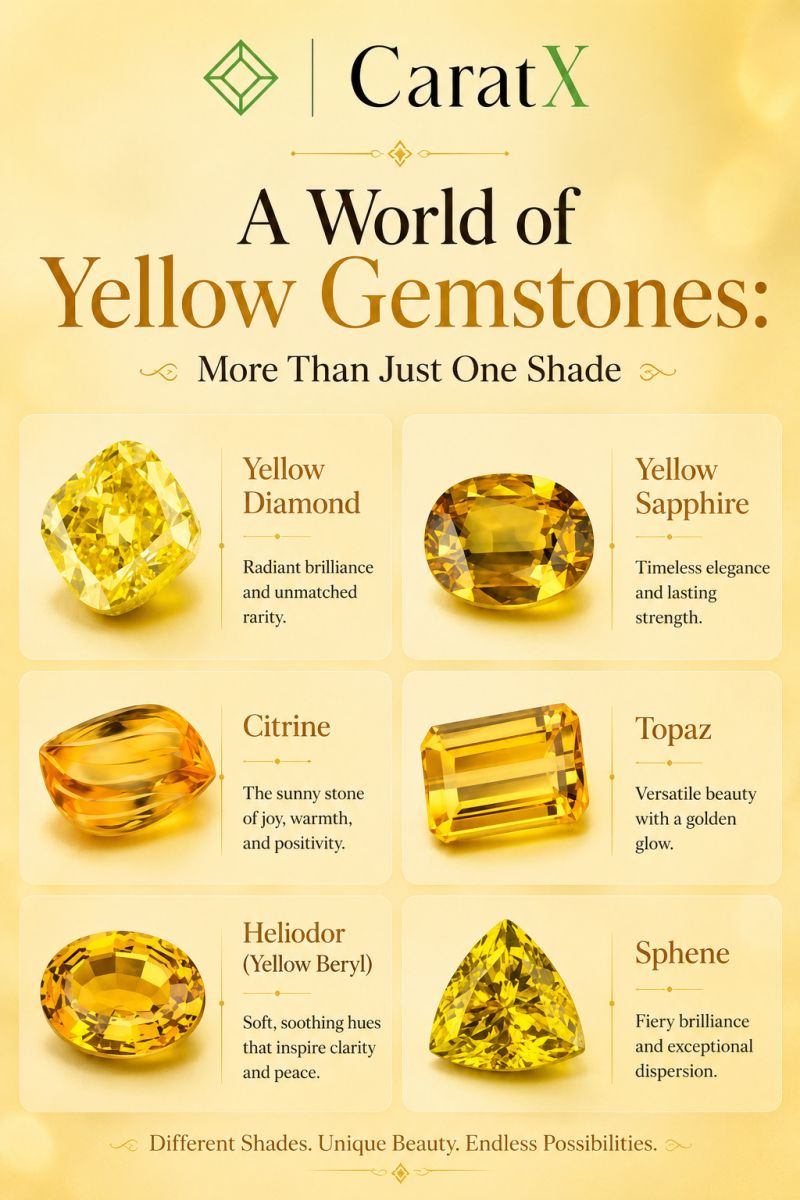
In this guide, we explore six of the most beloved yellow gemstonesYellow Diamond, Yellow Sapphire, Sphene, Citrine, Golden Topaz, and Heliodor breaking down their unique properties, durability, value factors, and ideal uses. By the end, you'll know exactly which golden gem deserves a place in your collection.
The Science of Yellow: What Gives Gemstones Their Golden Glow?
Before diving into individual stones, it's worth understanding what creates that signature yellow color in the first place. The answer lies in trace elements microscopic impurities that interact with light in fascinating ways.
Yellow diamondsowe their color to nitrogen atoms that substitute for carbon in the diamond's crystal lattice. When nitrogen atoms are evenly distributed, they absorb blue light and allow yellow to shine through with remarkable intensity.Yellow sapphires, members of the corundum family, get their golden hues primarily from trace amounts of iron.Citrine, the yellow variety of quartz, is colored by iron impurities as well, though its formation process differs significantly.
Heliodor (golden beryl) derives its warm color from iron, making it a cousin to emerald and aquamarine. And sphene (titanite), with its extraordinary fire, contains titanium and often iron or rare earth elements as chromophores.
Each gemstone's unique chemical composition not only determines its color but also its physical properties hardness, durability, refractive index, and dispersion, which in turn dictate how the stone performs in jewelry and how it should be cared for.
Yellow Diamond:
When it comes toyellow gemstones, nothing commands attention quite like a yellow diamond. These gems range from muted brownish hues to vivid yellows with hints of orange or green, combining beautiful color with the legendary durability and brilliance of diamond.
Formation and Rarity -
Natural yellow diamondsform deep within the Earth's mantle, where temperatures exceed 1,000°C and pressure reaches around 45 to 60 kilobars. Nitrogen atoms trapped in the crystal lattice during growth create the yellow color. Interestingly, yellow hues aren't as uncommon as other diamond colors, but they can reach higher levels of saturation than most fancy colored diamonds.
TheGemological Institute of America (GIA)classifies yellow diamonds into six categories based on color strength: Fancy Light, Fancy, Fancy Dark, Fancy Deep, Fancy Intense, and Fancy Vivid. Stones with "Vivid" saturation are exceptionally rare and command premium prices. The famous Tiffany Diamond a 128.54-carat cushion-cut Fancy Yellow diamond remains one of the most celebrated examples of yellow diamond brilliance.
Durability and Wearability -
With a perfect 10 on the Mohs scale of hardness,yellow diamondsare the most durable gemstone on Earth. They resist scratching from virtually any material and can withstand daily wear in any jewelry setting from engagement rings to bracelets toeveryday pendants. This exceptional durability, combined with their brilliant sparkle, makes yellow diamonds a popular choice for heirloom-quality pieces.
Value Factors -
For yellow diamonds, color is the most important value factor, unlike colorless diamonds where cut takes precedence. Secondary green or orange hues may be present; orange hues are generally preferable and can raise the stone's value, while green hues occur more commonly and can impart a murky appearance. A tone of about 20% is optimal for yellow hues, yielding a bright stone in well-saturated specimens.
Best Uses -
Yellow diamonds are ideal for:
Engagement rings(adding a colorful twist to tradition while retaining diamond's unmatched durability).
Statement necklaces andpendants.
Heirloom pieces meant to last generations.
Any jewelry requiring maximum scratch resistance.
Yellow Sapphire:
Yellow sapphireoffers perhaps the best all-around value among yellow gemstones stunning color, excellent durability, and more accessible pricing than diamond.
Composition and Properties -
Yellow sapphireis a variety of corundum (aluminum oxide), the same mineral family as ruby. Its hardness of 9 on the Mohs scale makes it the second-hardest gemstone after diamond. This exceptional hardness, paired with excellent toughness, makes yellow sapphires highly durable and suitable for use in all types of jewelry.
The color ofyellow sapphiresranges from light yellow to canary yellow, golden yellow, honey yellow, and light brownish yellow.Stones from Sri Lanka (Ceylon)are particularly prized for their low iron content, which produces purer, more vibrant yellow hues.
Value Factors -
Color is the most important factor in determining a yellow sapphire's value even more important than clarity. The most valuableyellow sapphiresdisplay a pure, vivid yellow primary hue with good saturation.
Unlike some other gems,yellow sapphiresreach their maximum color saturation at relatively light tones typically only 20-30% tone depth. This means extremely light yellow sapphires may appear simply as off-color white stones, reducing their value.
Durability and Care -
Yellow sapphiresare among the toughest gems you can wear. They withstand abrasion from ordinary surfaces without wearing down or scratching. This makes them ideal for everyday jewelry, including rings that will encounter frequent contact with surfaces.
Best Uses
Yellow sapphires excel in:
Engagement rings and wedding bands.
Daily-wear rings and bracelets.
Astrological jewelry (known as Pukhraj in Vedic tradition).
Fine jewelry requiring both beauty and longevity.
Sphene (Titanite):
Sphene also known by its mineralogical name titanite is perhaps the most underappreciated gemstone in the yellow spectrum. Its claim to fame? Exceptional dispersion (fire) that actually surpasses that of diamond.
What Makes Sphene Special -
Sphene is a calcium titanium silicate (CaTiSiO5) with a dispersion value of 0.051 considerably higher than diamond's 0.044. This means that when light enters a faceted sphene, it splits into spectral colors with an intensity that rivals and often exceeds diamond's famous fire. The effect is like holding a tiny rainbow in your hand.
The name "sphene" comes from the Greek word for "wedge," describing its typical wedge-shaped monoclinic crystals. The International Mineralogical Association officially adopted "titanite" in 1982, but "sphene" remains the name used in gemology.
The Catch:
Here's where sphene's story takes a turn. With a Mohs hardness of only 5 to 5.5, sphene is significantly softer than most jewelry gemstones. It also has distinct cleavage, making it susceptible to chipping and scratching. This means sphene is generally better suited for:
Earrings and pendants (where abrasion risk is low).
Collector's pieces and display specimens.
Protected settings in rings (such as bezel settings).
It is not recommended for everyday rings or bracelets that will encounter regular wear and tear.
Color Range and Sources -
Sphene comes in yellow, green, brown, and orange colors, with the rich chrome-green stones being the most prized. The most desirable color has traditionally been green, while yellow-green stones with brownish tinges are more common. Major sources include Madagascar, Brazil, Pakistan, Myanmar, Mexico, and more recently Zimbabwe.
Best Uses -
Sphene is ideal for:
Collector's gemstone collections.
Earrings and pendants.
Special-occasion jewelry.
Anyone who prioritizes fire and color over durability.
Citrine:
Citrineis the golden member of the quartz family and arguably the most accessible yellow gemstone on the market. Its warm yellow-to-golden hues bring sunshine to anyjewelrycollection at a fraction of the cost of more precious gems.
Composition and Properties -
Citrine is a variety of quartz (SiO2) with a Mohs hardness of 7. While this makes it durable enough for many types of jewelry, it's softer than sapphire or diamond and can scratch if subjected to rough wear.Natural citrineis actually quite rare most citrine on the market is heat-treated amethyst or smoky quartz.
Value and Affordability -
Citrineoffers exceptional value for budget-conscious buyers. It provides the warm yellow color that many seek, at price points that make it accessible for everyday jewelry. Stones without color zoning or visible inclusions are highly sought after.
Metaphysical Properties -
In crystal healing traditions,citrineis known as the premier crystal for abundance, manifestation, and confidence. It activates the Solar Plexus Chakra, boosting personal power and motivation. Unlike most crystals, citrine does not absorb negative energy, so it rarely needs cleansing. It's also believed to promote optimism, prosperity, and mental clarity.
Best Uses
Citrine works beautifully in:
Fashion jewelryand everyday pieces.
November birthstone jewelry.
Pendants, earrings, andcocktail rings.
Budget-friendly alternatives to yellow sapphire or topaz.
Golden Topaz: Rich Honey and Golden Shades
Goldentopazdistinct from the more common blue or colorless topaz is beloved for its rich honey and golden shades. With a hardness of 8 on the Mohs scale, it offers good scratch resistance while remaining susceptible to chipping due to perfect basal cleavage.
Key Characteristics -
Topazis a silicate mineral with a specific gravity around 3.5 noticeably heavier than quartz or beryl. Its perfect basal cleavage means it can split cleanly if struck at the right angle, which jewelers must account for when setting the stone.
Yellow topazranges from pale yellow to rich golden and honey tones. The most prized shades are those with warm, saturated golden hues. Unlike citrine, which can sometimes appear too orange or brown, quality golden topaz displays a pure, sunny yellow.
Distinguishing Topaz from Similar Stones -
Topazcan be confused with citrine, heliodor, and yellow sapphire. Key differentiators include:
Hardness: Topaz (8) is harder than citrine (7) but softer than sapphire (9).
Cleavage: Topaz has perfect basal cleavage; beryl lacks strong cleavage.
Density: Topaz is significantly denser (SG ~3.5) than beryl (~2.7) or quartz (~2.65).
Best Uses -
Golden topaz is suitable for:
Rings and pendants (with care taken to protect from sharp impacts).
Birthstone jewelry(November birthstone alternative).
Pieces where warm golden tones are desired.
Heliodor:
Heliodor, whose name derives from the Greek word for "sun" is the yellow-to-golden variety of beryl, the same mineral family as emerald and aquamarine. Its bright, elegant glow has made it a favorite among collectors and jewelry enthusiasts alike.
Composition and Properties -
Heliodor is beryllium aluminum silicate (Be₃Al₂Si₆O₁₈) with a hardness of 7.5–8 on the Mohs scale. This places it above quartz but slightly below topaz and sapphire. Its color ranges from pale lemon-yellow through rich golden-yellow to greenish-yellow, caused by iron impurities.
One of heliodor's distinctive features is its crystal habit long hexagonal prisms with vertical striations along the faces. This makes it relatively easy to identify compared to look-alikes like citrine.
Heliodor vs. Citrine:
Heliodor and citrine are frequently confused, but they are entirely different minerals:
Heliodor is beryl (hardness 7.5–8, hexagonal crystals).
Citrineis quartz (hardness 7, trigonal crystals).
The decisive test: heliodor will scratch citrine, but citrine cannot scratch heliodor. Additionally, heliodor has a slightly higher specific gravity (~2.7) than quartz.
Sources -
Notable heliodor sources include Ukraine (the classic Volyn pegmatites), Brazil, Madagascar, Namibia, Russia, Tajikistan, and the United States (Connecticut and Maine).
Best Uses -
Heliodor is well-suited for:
Pendants and earrings.
Collector's gemstone specimens.
Rings (with reasonable care).
Anyone seeking a warm, elegant yellow with good durability.
Questions to Ask Yourself:
How often will I wear this piece? Daily wear demands harder stones like diamond or sapphire.
What type of jewelry is it? Rings endure more abuse than earrings or pendants.
What's my budget? Citrine offers beautiful color at accessible prices; diamond commands premium pricing.
Do I prioritize brilliance, color, or fire? Diamond offers brilliance; sphene offers unmatched fire; sapphire offers balanced beauty.
Caring for Your Yellow Gemstone Jewelry -
Different gemstones require different care approaches:
Diamond and Sapphire: These hardest gems can be cleaned with warm soapy water and a soft brush. Ultrasonic cleaners are generally safe but check with your jeweler first.
Topaz and Heliodor: Clean with warm soapy water and a soft cloth. Avoid ultrasonic cleaners and steam cleaning, as heat or vibration could damage the stone or exploit cleavage planes.
Citrine: Clean with warm soapy water. Avoid sudden temperature changes, as quartz can be sensitive to thermal shock.
Sphene: Handle with extra care. Clean gently with a soft, damp cloth. Avoid ultrasonic cleaners, steam cleaning, and any abrasive materials. Store separately to prevent scratching from harder gems.
Shop Natural Diamonds – Explore our collection of certified natural diamonds at unbeatable prices -https://caratx.com/search?query=Natural
Sell Your Jewelry Internationally – Register as a seller on CaratX and start selling to B2B and B2C buyers across 18+ countries.www.caratx.com/register
Shop Loose Gemstones – Browse our marketplace for a wide selection of yellow sapphires, citrines, and other colored gemstones -https://caratx.com/search?query=gemstones
Seller Plans & Pricing – Learn more about launching your products on CaratX and reaching international buyers -https://caratx.com/sell-on-caratx
Follow CaratXfor insightful and educational content on gemstones, diamonds, and the jewelry industry. Start your journey with CaratX today, whether you're buying your dream gemstone or selling to customers around the world.
Recommended Reads from CaratX -
In-Depth Blog Articles -
The Ultimate Guide to Yellow Diamonds: Types, Value & Market Insights – A deep dive into the science of yellow diamonds, GIA grading, and investment potential.https://caratx.com/blog/the-ultimate-guide-to-yellow-diamonds-types-value-market-insights
The Guide to Colored Diamonds: Rarity, Value, and Investment Potential of Every Hue – Understand where yellow diamonds fit in the broader spectrum of fancy colored diamonds.https://caratx.com/blog/the-guide-to-colored-diamonds-rarity-value-and-investment-potential-of-every-hue
Why Testing Small Yellow Diamonds is One of the Hardest Jobs in Gemology – An exclusive look at the challenges gemologists face when grading melee-sized yellow diamonds.https://caratx.com/blog/why-testing-small-yellow-diamonds-is-one-of-the-hardest-jobs-in-gemology-an-in-depth-exploration
Fancy Sapphires: The Colorful Side of the Sapphire World – Dedicated to yellow sapphires and other fancy sapphire varieties, including their origins and value factors.https://caratx.com/blog/fancy-sapphires-the-colorful-side-of-the-sapphire-world
Birthstones by Month: A Complete Guide to Colors, Meanings & History – Learn about yellow-toned birthstones like citrine (November) and golden topaz (November).https://caratx.com/blog/birthstones-by-month-a-complete-guide-to-colors-meanings-history
Sri Lanka: The Island of Beautiful Gemstones – Explore the prime source of some of the world's finest yellow sapphires.https://caratx.com/blog/sri-lanka-the-island-of-beautiful-gemstones
More Related Blog Content (Extra Reading) -
If you wish to expand your knowledge further, these articles also touch upon facets of colored gemstones, durability, and sourcing that complement the yellow gemstone discussion:
The Allure of Purple Gemstones – Discusses color saturation and mineral chemistry, directly comparable to yellow gems.https://caratx.com/blog/the-allure-of-purple-gemstones-a-guide-to-natures-royal-hues
One Ruby, Many Origins – Explores how geography affects gemstone quality, a key factor for yellow sapphire sourcing.https://caratx.com/blog/one-ruby-many-origins-how-geography-sculpts-natures-most-captivating-red-gem
Zircon: The Ancient Earth Keeper – Another brilliant gemstone with high fire (dispersion), offering a comparison to sphene.https://caratx.com/blog/zircon-the-ancient-earth-keeper-gemstone-beyond-diamonds
Why Red Diamonds Are the Rarest – A complementary read on rarity in the diamond world, putting yellow diamonds' availability into perspective.https://caratx.com/blog/why-red-diamonds-are-the-rarest-of-all-natural-colored-diamonds
Blue Topaz: From Clear Crystal to Iconic Gem – Discusses topaz properties, clarity, and treatments highly relevant to golden topaz.https://caratx.com/blog/blue-topaz-from-clear-crystal-to-iconic-gem
Frequently Asked Questions -
Q: What is the most durable yellow gemstone? A: Yellow diamond, with a perfect 10 on the Mohs scale, is the most durable. Yellow sapphire (9) is a close second and offers excellent durability at a more accessible price point.
Q: Which yellow gemstone has the most "fire" or sparkle? A: Sphene (titanite) has dispersion of 0.051, which exceeds diamond's 0.044, giving it the most intense fire of any yellow gemstone.
Q: Is citrine a natural gemstone? A: Natural citrine is actually quite rare. Most citrine on the market is heat-treated amethyst or smoky quartz.
Q: What's the difference between heliodor and citrine? A: Heliodor is golden beryl (hardness 7.5–8), while citrine is yellow quartz (hardness 7). Heliodor will scratch citrine, but citrine cannot scratch heliodor.
Q: Can I wear a yellow sapphire every day? A: Absolutely. With a hardness of 9 on the Mohs scale, yellow sapphire is second only to diamond in durability and is excellent for daily wear.
Q: Are yellow diamonds rare? A: Yellow hues aren't as uncommon as other diamond colors, but stones with "Fancy Vivid" saturation are exceptionally rare and command premium prices.
Q: What is the best yellow gemstone for an engagement ring? A: Yellow diamond and yellow sapphire are the top choices due to their exceptional durability. Yellow diamond offers unmatched brilliance, while yellow sapphire provides beautiful color at a more accessible price.