
A clasp is the small part that helps close anecklaceorbracelet. It may be the smallest component of apiece of jewelry, but it is arguably the most important. It is the critical point where security meets design, a tiny engineering marvel that keeps your most cherished pieces safe while contributing to their overall aesthetic.
Different clasps offer different levels of security, style, and ease of use, and choosing the wrong one can mean the difference between a treasured heirloom and a lost investment.
In this guide, we explore every major jewelry clasp type, break down their strengths and weaknesses, and help you make an informed decision whether you are buying a delicatependantor a heavy diamond bracelet.
Why the Clasp Deserves Your Full Attention -
When selecting a necklace or bracelet, the eye naturally gravitates toward the centerpiece: the glittering gemstone, the intricate metalwork, or thebold pendant. However, seasoned jewelers know that the true test of a piece's quality, security, and wearability often lies in its smallest component, the clasp.
TheGemological Institute of America (GIA), the world's foremost authority on gemology, emphasizes that the integrity of a piece's findings, the collective term for clasps, catches, and joints is essential for its longevity. Beyond sheer security, the right clasp affects:
Comfort: It should feel smooth against the skin, never pinching or catching on clothing.
Design: It can be a discreet hidden mechanism or a bold decorative statement.
Ease of Use: For those with dexterity challenges, a difficult clasp can make a favorite piece unwearable.
Durability: The metal quality and mechanism determine how well it withstands daily wear.
The global jewelry market, valued at approximately $77.5 billion in 2025 with 80% of that share held by fine jewelry made from gold, platinum, and diamonds, underscores the importance of understanding these small but mighty components.
As the market shifts toward premium buying and self-purchased luxury, consumers are becoming more educated about every aspect of their jewelry including the clasp.
A Detailed Guide to Common Jewelry Clasps -
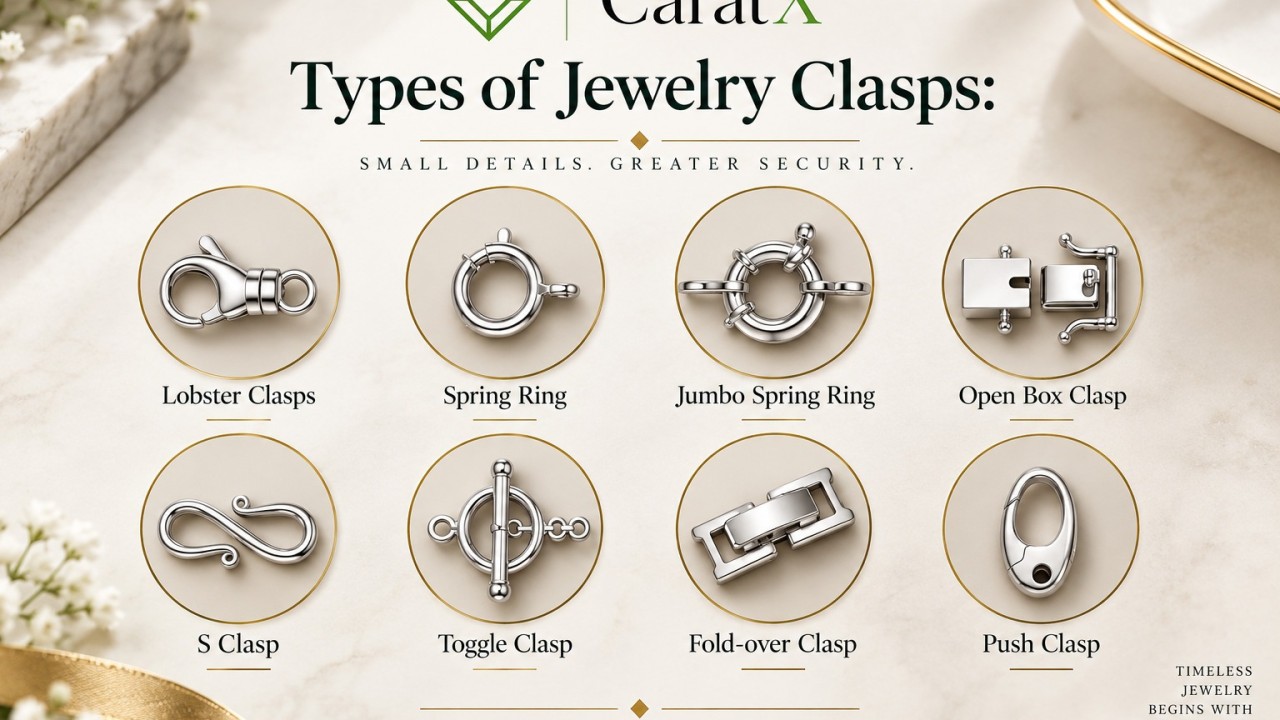
1. Lobster Clasp -
Strong and easy to use, making it popular for everyday jewelry.
The lobster clasp is named for its physical resemblance to a crustacean's pincher and is one of the most widely used clasps in thejewelryindustry. It features a spring-loaded mechanism where a small lever opens and closes a hook.
Best For: Virtually anynecklaceor bracelet, from medium to heavy weight. It is especially well-suited for pieces that are particularly heavy.
How It Works: A spring-loaded mechanism allows a small lever to open and close a hook. The "double" version uses two interlocking lobster claws for added security on valuable pieces.
Pros: Highly secure, easy to use with one hand once mastered, and widely available. The self-closing design makes it an excellent option for pieces intended for daily wear.
Cons: The spring mechanism can wear out over many years. If you have arthritis or mobility issues with your hands, you might find a lobster claw clasp challenging to use.
For your most precious pieces, such as ourSolitaire Diamond Necklaces, sellers use high-quality lobster clasps to ensure your investment is safe. Explore ourNecklace Collectionto see these clasps in action.
2. Spring Ring Clasp -
Small and simple, often used with lightweight necklaces and bracelets.
The spring ring clasp, created in the early 1900s, is one of the most recognizable jewelry clasps. It functions in much the same manner as the lobster claw clasp, with a spring-loaded lever, but is typically smaller and more delicate.
Best For: Delicate chains, pendants, and lightweight jewelry.
How It Works: A small, circular clasp with an internal spring retracts a tiny hook when a lever is pressed.
Pros: Lightweight, discreet, and inexpensive. It doesn't compete visually with the jewelry design.
Cons: Can be challenging to open and close, since the lever is smaller than that of a lobster claw clasp. If you have larger fingers or arthritis issues, you may want to opt for a different design.
Comparison Note: Compared to a lobster claw clasp, the spring ring is subtler in size but less forgiving for quick on-and-offs. Spring rings work best for lightweight, price-sensitive, or aesthetically minimal designs, while lobster claws are the better default for anything heavier or more premium.
3. Box Clasp -
A metal piece that fits into a box-shaped holder for a secure closure.
The box clasp is a stylish and refined option, most commonly found ontennis braceletsand necklaces. It consists of two components: a tab that is inserted into a box-shaped frame, often with an additional safety mechanism for extra security.
Best For: Tennis bracelets, diamond necklaces, and any piece where security is non-negotiable.
How It Works: One end of the jewelry has a tab that's inserted into the box-shaped frame on the other end. A box clasp with safety features an additional mechanism usually a figure-8 safety latch for extra security.
Pros: Extremely secure, clean and polished appearance, often with built-in safety mechanisms.
Cons: Can be bulkier than other options and may require two hands to fasten.
The box clasp is the go-to choice for securing statement pieces like ourDiamond Tennis Bracelets. Browse ourBracelet Collectionto find pieces featuring this ultra-secure closure.
4. Toggle Clasp -
Uses a bar and a ring. It is stylish and easy to open.
The toggle clasp, also called a bar-and-ring clasp or T-bar clasp, consists of a ring at one chain end and a short bar at the other. To close, you turn the bar sideways and push it through the ring.
Best For: Chunkier necklaces and bracelets, charm bracelets, and designs where the clasp is meant to be seen.
How It Works: The bar passes through the ring to sit across it, securely fastening the two ends together.
Pros: Stylish, decorative, easy to operate with one hand. Often found in higher-end jewelry pieces as a focal design element.
Cons: Relies on tension and weight to stay closed, which means it may not be ideal for fine chains or very active wear. Toggles are usually on the heavier side of closures.
5. Magnetic Clasp -
Uses magnets to connect the two ends, making it very easy to use.
The magnetic clasp is the easiest clasp to operate, relying on active magnets to secure a piece of jewelry. It snaps shut on contact and requires just a small tag to pull apart.
Best For: Lightweight pieces and those who prioritize ease of use, especially individuals with limited dexterity.
How It Works: Magnets on each end of the jewelry connect when brought together.
Pros: Extremely convenient, ideal for those with dexterity challenges, and increasingly in demand among consumers frustrated with small latches.
Cons: Magnetic clasps tend to be on the heavy side, so it's important to ensure they aren't the heaviest item on a finished piece or they will always wiggle their way to the front, bottom point on the necklace. They are best reserved for lightweight pieces; heavier chains or high-value pendants may require a more secure option.
Important Safety Note: Magnetic clasps contain small magnets. Swallowed or inhaled magnets can attract through and squeeze intestines or other body tissue, causing serious injury or death. They are for adult use only (13 years of age and older) and must be kept away from children.
6. Fold-Over Clasp -
Folds into place and adds extra security, often used in bracelets and watches.
The fold-over clasp, sometimes called a foldover clasp or deployment clasp, features a flat, hinged piece that folds over a bar and secures with a small safety latch.
Best For: Bracelets, watches, and heavier necklaces.
How It Works: A flat, hinged piece folds over a bar and secures with a small safety latch. This double-locking mechanism offers exceptional security.
Pros: Extremely strong and reliable; the safety latch provides peace of mind. This is the gold standard for securing high-value bracelets.
Cons: Can be bulkier and may require two hands to fasten.
The fold-over clasp is the ideal choice for luxury watches and statement bracelets. Explore ourBracelet Collectionto see this clasp in action.
7. S Hook Clasp -
Uses an S-shaped hook that connects to a ring, giving jewelry a decorative look.
The S hook clasp is a simple yet elegant closure used for bracelets and necklaces. It is referred to as an S hook because the wire is shaped in the form of the letter "S".
Best For: Handcrafted and artisan jewelry, as well as vintage-inspired designs.
How It Works: The S-shaped hook connects to a ring on the opposite end of the jewelry piece.
Pros: Decorative, easy to use, and adds a handmade, artisanal aesthetic to a piece.
Cons: Less secure than mechanical clasps, as it relies on tension and gravity to stay closed. Best for lightweight pieces and those worn during low-activity occasions.
8. Hook and Eye Clasp -
A traditional closure with a hook that latches through a ring.
The hook and eye clasp is one of the simplest and most traditional jewelry closures. One end resembles a fishhook, and the other end resembles an eye.
Best For: Moderate to heavy neckpieces that will keep tension on the clasp since it is not securely latched closed. Commonly found in pearl strands and vintage-inspired designs.
Pros: Simple, elegant, and easy to use.
Cons: Not as secure as spring-loaded clasps. If you have an active lifestyle, consider whether your daily activities could cause an accidental undoing of the clasp, especially if the piece carries significant weight.
9. Barrel Clasp (Screw Clasp) -
A screw-like mechanism that provides a clean, finished look.
The barrel clasp, also called a screw clasp or torpedo clasp, employs a screw-like mechanism to close the piece of jewelry around your neck or wrist.
Best For: Necklaces where a clean, uninterrupted design flow is desired.
How It Works: Insert one end of the clasp inside the other end and twist to firmly secure the piece.
Pros: Provides a nice, clean, and finished look to jewelry. Symmetrical ends.
Cons: May be difficult to fasten with one hand.
As a general rule: if security is your top priority, opt for lobster or box clasps. If you need something easy to operate with one hand, toggle or magnetic clasps shine. Personal preference, lifestyle, and dexterity all factor in.
What to Consider When Choosing a Clasp -
1. Weight and Value of the Jewelry
Heavier and more valuable pieces demand more secure clasps. A lightweight pendant may be perfectly safe with a spring ring, but a diamond tennis bracelet worth thousands of dollars should always have a box clasp with a safety latch.
2. Lifestyle and Activity Level
If you wear your jewelry during sports or other physical activities, you need a clasp that won't accidentally open. Lobster clasps and fold-over clasps with safety latches are excellent choices for active lifestyles.
3. Dexterity and Ease of Use
For individuals with arthritis, limited hand mobility, or larger fingers, magnetic clasps and toggle clasps are far more accessible than spring ring clasps or barrel clasps.
4. Material Quality
The metal used in the clasp should match or exceed the quality of the jewelry itself. Gold clasps are standard for fine jewelry, while sterling silver and platinum are also common. Lower-quality base metals may tarnish or weaken over time.
5. Design Aesthetic
Some clasps are meant to be hidden, while others are designed as decorative elements. Toggle clasps and S hook clasps, in particular, can serve as focal points that enhance the overall design of a piece.
For consumers, these standards provide assurance that clasps on commercially sold jewelry have been tested for basic safety. However, it is always wise to inspect clasps for sharp edges, loose mechanisms, or signs of wear, and to replace clasps on high-value pieces if they show any signs of weakness.
The Role of Clasps in Jewelry Quality and Market Value -
In the competitive global jewelry market, where US independent jewelers report 7-9% year-over-year sales growth and domestic jewelry manufacturing jobs have increased 5.3%, the quality of components like clasps directly impacts consumer confidence and brand reputation.
As more jewelry sales move online with buyers purchasing pieces from international sellers on marketplaces like CaratX the ability to accurately describe and assess clasp quality becomes a crucial part of the buying decision. A well-made clasp signals a well-made piece. Conversely, a flimsy clasp on an otherwise beautiful piece suggests corners were cut elsewhere.
The rise of "quiet luxury" where 30% of buyers prioritize stone quality and ethical sourcing over carat weight reflects a broader trend toward informed, quality-conscious purchasing. Understanding clasps is part of that education.
Frequently Asked Questions About Jewelry Clasps -
Q: Which jewelry clasp is the most secure?
A: The box clasp and fold-over clasp with safety latches offer the highest level of security. The lobster clasp is also highly secure for everyday wear. For high-value pieces like diamond tennis bracelets, a box clasp with a figure-8 safety is the industry standard.
Q: Which clasp is easiest to use with arthritis?
A: Magnetic clasps are the easiest to operate, requiring only that the two ends be brought close together. Toggle clasps are also relatively easy to use with one hand. Spring ring clasps and barrel clasps are typically the most difficult for those with dexterity challenges.
Q: Can I replace a clasp on my jewelry?
A: Yes, clasps can be replaced by a qualified jeweler. If your clasp is worn, damaged, or simply difficult to use, upgrading to a more secure or user-friendly option is a worthwhile investment, especially for valuable pieces.
Q: Are magnetic clasps safe?
A: Magnetic clasps are safe for adult use when properly manufactured and secured to the jewelry. However, they contain small magnets that can be dangerous if swallowed. They should be kept away from children and not used on jewelry intended for children under 13.
Q: What is the difference between a lobster clasp and a spring ring clasp?
A: Both use spring-loaded mechanisms, but the lobster clasp is larger, more durable, and better suited for heavier jewelry. The spring ring is smaller, more discreet, and best for lightweight pieces. Lobster clasps are generally more expensive due to the additional metal weight.
Q: How do I know if my clasp needs replacing?
A: Signs include a spring that no longer snaps back firmly, a clasp that opens unexpectedly, visible wear or deformation, or difficulty opening and closing. If your clasp shows any of these signs, have it inspected by a jeweler before wearing the piece again.
Recommended Reads from CaratX -
Expand your jewelry knowledge with these in-depth guides from CaratX:
The Unsung Hero of Jewelry Design: A Detailed Guide to Choosing the Perfect Necklace Clasp— A deep dive into clasp selection, materials, and design considerations.
The Hero of Jewelry: A Deep Dive into Chain Clasps and Their Impact on Quality— Explore how chain clasps influence the quality and value of fine jewelry.
The Mohs Scale Decoded: The Ultimate Guide to Gemstone Hardness and Durability in Fine Jewelry— Understand how gemstone hardness affects jewelry design and wearability.
The Global Diamond & Jewelry Market: Trends, Challenges, and Opportunities in 2025— Market intelligence for buyers and sellers in the international diamond and jewelry trade.
Start Selling with CaratX -
FollowCaratXfor such insightful and educational content. Ready to take your jewelry business global?
Start selling to diamonds in 18+ international countries —www.caratx.com/register
Sellers register on the CaratX marketplace to start selling to B2B and B2C buyers —www.caratx.com/register
Shop gemstones from the CaratX marketplace at unbeatable prices —https://caratx.com/search?query=gemstones
Shop natural diamonds —https://caratx.com/search?query=Natural
More details about pricing —https://caratx.com/sell-on-caratx