
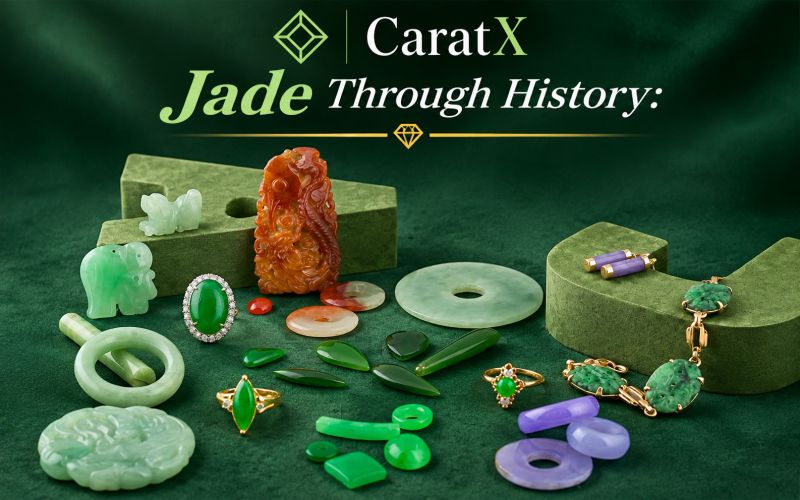
Jadeis not a single stone. It is a story carved into Neolithic axes, worn by Chinese emperors, buried in Maya temples, and passed down as Māori heirlooms. Few gemstones carry as much cultural weight, and fewer still have remained desirable for eight millennia. Yet the word “jade” describes two distinct minerals with radically different histories, geologies, and markets. Understanding that distinction is the first step toward buying, collecting, or selling jade with confidence.
What Is Jade, The Two Minerals Behind One Name -
In gemology, “jade” is a generic term for two tough, carveable materials: nephrite and jadeite. They look similar in finished carvings, but they are chemically unrelated. Nephrite is a magnesium-rich amphibole; jadeite is an aluminum-rich pyroxene. Nephrite is slightly softer and less glassy, while jadeite is harder and can achieve the vivid emerald-green transparency that collectors prize.
This difference matters commercially and historically. The Chinese carved nephrite for millennia before jadeite ever crossed the border from Burma in the late 1700s. In Mesoamerica, the Maya and Aztecs were working jadeite, a material that would not reach China until the Qing dynasty. When you browse jade on a modern marketplace, you are looking at two separate supply chains, two value systems, and two cultural inheritances that share a name but little else.
Shop certified gemstones, including jade and other colored stones, on the CaratX gemstone marketplace.
The Symbolic Language of Jade:
One reason jade remains commercially vital is that its symbolism is legible across generations and borders. Some of the ancient motifs still used in modern jade carvings both nephrite and jadeite include:
Bat — happiness
Butterfly — long life
Dragon — power, prosperity, and goodness
Peach — immortality
Bi (flat circular disk with a central hole) — heaven
These are not arbitrary decorations. They are compressed narratives, and they give jadejewelrya gifting logic that few other gemstones possess. A jade pendant is rarely just a green stone; it is a wish for longevity, protection, or good fortune. That narrative density is part of why jade has never lost its fascination for Asian consumers and why non-Asian buyers are now drawn to it as never before.
For sellers, jade’s symbolism is a marketing asset. Learn how to position heritage gemstones and jewelry internationally by registering as a CaratX seller and reviewing our seller plans and pricing.
The Stone Age Origins of Nephrite Jade -
Nephrite’s cultural roots reach back to prehistoric shelters in China, Europe, and beyond. Stone Age workers shaped this toughest of minerals into weapons, tools, ornaments, and ritual objects. Their carvings were not decorative in the modern sense; they invoked the powers of heaven and earth and the mystic forces of life and death.
In China, nephrite was already being carved as early as 1000 BC, and the Chinese called ityu, a term that would eventually encompass jadeite as well. The material’s fibrous crystal structure gives nephrite exceptional toughness, making it ideal for everything from axe heads to ceremonial blades. Major nephrite sources today include Russia, New Zealand, Taiwan, and British Columbia, but the cultural center of gravity has always been China.
The ancient relationship between nephrite and humanity persisted into modern times among native societies in New Zealand and parts of North America. In China, however, it evolved into an artistic tradition that has flourished for more than 3,000 years and arguably closer to 8,000.
China:
No culture has done more to shape the meaning of jade than China. The character for jade is one of the oldest in written Chinese, dating to roughly 2950 BC, and Neolithic knife and axe heads were often made of nephrite. Over time, jade moved from utilitarian tool to ritual object to emblem of moral virtue.
During the Zhou dynasty, the pairing ofguiandbijades became the core of Chinese jade ritual. Thebia flat circular disk with a hole in the center symbolized heaven, a motif still used in modern carvings. Under the influence of Confucianism, jade’s perceived “spiritual nature” was moralized: the stone came to represent beauty, purity, nobility, perfection, constancy, and durability. The Chinese associate jade with clarity of mind and purity of spirit, an association that persists in contemporary jewelry marketing and collecting.
The Qing dynasty, particularly under the jade-loving Emperor Qianlong, saw jade carving reach unprecedented heights. And then, in the late 1700s, jadeite arrived from Burma and changed the aesthetic landscape forever.
Late eighteenth- and early nineteenth-century carvers created masterpieces in jadeite that are still unsurpassed in concept, design, and technical execution. For the first time, Chinese connoisseurs had access to a jade that could be translucent, vividly green, and glassy, a material that would eventually command prices rivalingfine diamondsat auction.
Explore jade and other heritage gemstones alongside modern certified stones on CaratX. Sellers can register here to reach buyers in 18+ countries.
Mesoamerica:
In Central America, jadeite had a different but equally profound meaning. The Maya and Aztecs prized jadeite for jewelry, ornaments, and religious artifacts and also for medicinal purposes. Classic Maya religion ascribed multiple meanings to jade: maize, centrality, rulership, and a material embodiment of wind and the vitalizing breath soul. In the Maya region, jade was used to representk’ulel, the living spirit in all animate things, and becausek’ulelwas thought to reside in blood, jade was also associated with bloodletting rituals.
The very name “jade” comes from this encounter. Spanish explorers saw natives holding pieces of the stone to their sides to cure or relieve aches and pains, and they called itpiedra de ijadaliterally “stone of the pain in the side”. The Aztecs called the materialchalchihuitl, and it was valued above all other precious stones. Jadeite also symbolized prosperity, success, and good luck, associations that survive in modern Asian and global markets.
Browse jade-toned and green gemstone jewelry on the CaratX jewelry marketplace, or compare value across colored stones using our guide to the world’s most valuable gemstones.
Aotearoa New Zealand:
The Maori of New Zealand developed one of the world’s most distinctive jade traditions around pounamu, a nephrite jade found only in specific rivers and boulders on the South Island. Pounamu is atāongaa treasure and the subject of extensivemātaurangaMāori knowledge. Maori classify pounamu varieties by color, translucency, and mineral inclusions, not simply by geological category.
The most prized pounamu objects weremere pounamu, teardrop-shaped hand clubs made for the chiefly elite and passed down within families as heirlooms. These were not merely weapons; they were symbols of martial prowess and supernatural power. Some chiefs, captured in battle, reportedly handed theirmere pounamuto their enemies and requested to be slain with them rather than with ordinary weapons. Greenstone pendants and ear ornaments likewise marked the wearer as a person of wealth and status.
For contemporary buyers, pounamu represents a rare intersection of gemological value and living Indigenous cultural heritage. Its toughness, color range, and carving tradition make it one of the most collectible forms of nephrite outside China.
Buying Jade Today:
Modern jade buyers face a market that is broad, lightly regulated in some segments, and full of imitations. TheGemological Institute of America (GIA)recognizes jadeite and nephrite as the only true jades, and it has expanded its jade reports to provide greater clarity on jade type (A, B, or C) and species. That matters because treatments bleaching, polymer impregnation, and dyeing are common in jadeite and can dramatically affect durability and value.
For nephrite, value often peaks when the stone is white and resembles “mutton fat,” a creamy, suet-like appearance prized in Chinese carving. For jadeite, the ideal is a semi-transparent, vividemerald greenwith even color distribution, the so-called Imperial Jadeite that can rival fine diamonds at auction. Rarity, color saturation, transparency, texture, and carving quality all interact; there is no single “best” jade, only the best expression of a given type.
Because jade spans such a wide range of prices and treatments, certification is non-negotiable. A GIA jade report or an equivalent independent gemological report is the baseline for any serious transaction. The same principle applies whether you are buying a $200 nephrite pendant or a six-figure jadeite bangle.
Start with certified inventory. Shop natural diamonds and colored gemstones on CaratX, or read our guide to diamond fluorescence and certification to understand how modern gemological screening works.
Jade in the Modern Marketplace: Why CaratX Matters for Buyers and Sellers
Jade’s dual identity spiritual heirloom and tradeable commodity makes it an ideal case study for how gemstones move through modern commerce. Buyers need transparent certification, comparable pricing, and access to sellers who understand the material. Sellers need international reach without losing the cultural specificity that makes jade desirable.
CaratXconnects the diamond, gemstone,jewelry, and pearl industry across 16 countries, with a marketplace designed specifically for serious gemstone and jewelry transactions rather than general consumer goods. Sellers can register to reach buyers in 18+ international countries, and buyers can shop loose gemstones,finished jewelry, andnatural diamondsin a specialized environment.
For jade specifically, that means an opportunity to position nephrite and jadeite alongside other heritage and colored stones not buried in a general crafts category, but in a gemstone-focused marketplace where provenance, certification, and material identity matter.
Ready to sell? Register on CaratX to start selling to B2B and B2C buyers. Buyers can shop the marketplace or review pricing and listing details.
Recommended Reads from CaratX -
The Ultimate Guide to the World’s Most Valuable Gemstones: Rarity, Value, and Investment— how jadeite compares with diamonds, rubies, and sapphires at the top of the market.
The World’s Most Famous & Expensive Gemstones, Ranked by Color— why green stones, including imperial jadeite, occupy a unique place in collector demand.
The Ultimate Guide to Wedding Anniversary Gemstones: Symbolism, History, and Buying Guide (Years 1–12)— jade as a symbolic gift stone within the broader anniversary tradition.
Beyond the Sparkle: Unveiling the Secret of Diamonds with Deep UV Light— how modern gemological screening protects buyers, a principle that applies directly to jade certification.
Frequently Asked Questions About Jade -
Is jade always green? No. Nephrite ranges from creamy white to green to almost black, and jadeite can be white, lavender, yellow, brown, and the prized emerald green. “Imperial Jade” refers specifically to top-quality green jadeite, not to all jade.
What is the difference between jadeite and nephrite? They are different minerals. Nephrite is a tougher, slightly softer amphibole; jadeite is a harder pyroxene that can be more transparent and vividly colored. Both are called jade in the trade, but they have separate value structures and histories.
Why is jade associated with China if jadeite came from Burma? China’s jade tradition is primarily a nephrite tradition that extends back thousands of years. Jadeite arrived from Burma only in the late 1700s, but Chinese carvers quickly elevated it to an important artistic medium.
Is jade a good investment? Top-quality jadeite and fine nephrite carvings have strong auction records, but jade is not a liquid asset and value depends heavily on certification, color, texture, and carving quality. It should be treated as a collectible, not a guaranteed financial instrument.
How do I avoid treated or fake jade? Insist on an independent gemological report from a recognized laboratory such as GIA, and buy from sellers who disclose treatments. Be cautious of unusually transparent “jade” at low prices; it may be serpentine, glass, or polymer-treated jadeite.