
Morganitehas moved from a niche collector’s stone to one of the most talked-about alternatives in bridal jewellery. Its soft pink-to-peach palette feels romantic without being flashy, and it offers a distinctly different look from a traditional diamond. For couples who want a ring that feels personal, warm and a little unconventional, morganite is often the first coloured gem that comes to mind.
This guide goes deeper than the usual “pretty pink stone” summary. It covers what morganite actually is, how colour and treatment affect value, how it holds up to daily wear, which metals and settings protect it best, and what to verify before you buy. It is written for buyers who want to understand the trade-offs not just the aesthetic.
What Is Morganite?
Morganiteis the pink-to-peach variety of beryl, the same mineral species that gives usemeraldandaquamarine. Its colour comes from trace amounts of manganese, not from a dye or coating. The Smithsonian’s National Gem Collection describes morganite as ranging from pink and rose to peach and light violet, and notes that it was named in 1911 by George F. Kunz after financier J. P. Morgan.
Chemically, morganite is beryllium aluminium silicate. The Gemological Institute of America (GIA) classifies it alongside aquamarine and emerald in the beryl family, with a hardness of 7.5 to 8 on the Mohs scale. That hardness is important: it is soft enough to require thoughtful setting choices, but hard enough for regular jewellery wear when treated with care.
Where Morganite Comes From -
Most faceted morganite on the market today comes from Minas Gerais, Brazil. Brazil remains the dominant commercial source, but morganite is also mined in Afghanistan, Pakistan, Mozambique, Namibia, Madagascar and the United States. Madagascar is historically significant because its early deposits set the standard for the finest pink material, even though it is no longer a major producer. The AGTA also lists Russia and Mozambique among current sources.
For buyers, origin is generally less important than colour, clarity and treatment disclosure. Morganite is not currently subject to the kind of origin-based pricing premiums that affectrubyorsapphire, so a beautiful stone from Brazil can be just as desirable as one from Madagascar.
Colour:
The GIA is unambiguous on this point: colour is the most important morganite quality factor. Morganite’s colour range includes soft pink, rose, peach, salmon and purplish pink. In today’s market, pink and rose tints are the most fashionable, while peach and salmon hues are less popular, although some collectors specifically value untreated peach material.
Strong, saturated pink is rare. Most morganite is pastel, and the GIA notes that stones usually have to be fairly large to achieve the finest colour. This is why a 1-carat morganite can look noticeably lighter than a 3-carat stone of similar cut and clarity. Depth of colour rises with size, so if rich pink is your priority, you may need to shop in larger carat weights.
Heat Treatment and Colour Stability -
The vast majority of morganite is heat-treated to improve its pink colour. Heating drives off yellow and orange tinges, leaving a purer pink. The treatment is not detectable by standard gemmological methods, and the resulting colour is stable under normal light exposure. The GIA notes that the colour will not fade unless the stone is exposed to temperatures above 400 °C.
This matters for two reasons. First, heat treatment is an accepted and almost universal practice in the morganite trade, it is not a sign of a “fake” or low-quality stone. Second, because the treatment is stable, you do not need to worry about your ring changing colour on a sunny honeymoon or under everyday lighting.
The exception is irradiation, a less common enhancement that can produce different colour effects; if a stone has been irradiated, a reputable seller should disclose it. The GIA has documented electron irradiation of morganite from Mozambique to improve colour and clarity, and the treatment can take years to complete. Disclosure is the key issue, not the treatment itself.
If you prefer an untreated stone, you can ask for one but expect a peachier or salmon-like hue rather than a pure pink. Untreated morganite is not inherently “better”; it is simply a different colour preference.
Clarity and Cut: What to Look For
Clarity
Faceted morganite is usually eye-clean. The GIA notes that faceted morganite often does not have eye-visible inclusions, although inclusions are more likely in larger stones. Stones with numerous visible inclusions are typically carved or cut as cabochons rather than faceted.
Two types of internal features can occasionally be visible: liquid inclusions (irregularly shaped pockets trapped during crystal growth) and fractures (bright, flat reflective surfaces). If a stone has liquid inclusions or fractures, it should not be cleaned in an ultrasonic or steam cleaner, because the vibration and heat can worsen the fracture. This is a practical reason to ask your jeweller about the stone’s clarity characteristics, not just its colour.
Cut and Shape -
Morganite is cut in all standard shapes, includingoval,cushion,round,pearand emerald cut. The GIA notes that the shape should have minimal effect on beauty, but light-coloured material is sometimes cut slightly deep to help intensify the colour. In practice, the choice of cut is largely aesthetic but it also affects how the stone performs in a setting.
Oval and pear cutselongate the finger and often show colour well.
Cushion cutshave a soft, romantic outline that suits morganite’s pastel palette.
Round cutsmaximise brilliance but can make a light-coloured stone look even lighter unless the cut is well proportioned.
Emerald cuts offer a clean, architectural look and can make a slightly deeper-toned stone appear more refined.
Because morganite has distinct pleochroism pale pink in one direction and deeper bluish-pink in another, the cutter must orient the rough carefully. A well-cut stone will show a more consistent and attractive face-up colour.
Carat Weight and Value:
Morganite crystals can be very large, so large faceted stones are more common than with many other gemstones. This has two consequences for buyers.
First, morganite is relatively affordable in larger sizes compared with diamond,sapphireorruby. A 2- to 3-carat morganite can be accessible without the steep price jumps that occur at those weights in other gemstones. Second, because colour intensity increases with size, a larger stone often delivers the saturated pink that buyers associate with premium morganite. In other words, morganite rewards buying a slightly larger stone if colour is your priority.
That said, size should not come at the expense of cut quality or clarity. A large but poorly cut stone can look dull, and a large stone with visible inclusions can be distracting. The best approach is to balance colour, clarity, cut and carat within your budget and to remember that morganite’s value is driven primarily by colour, not by the same rigid carat-price grids used for diamonds.
Durability and Daily Wear:
Morganite rates 7.5 to 8 on the Mohs hardness scale, which is genuinely durable for everyday jewellery but it is not diamond-hard. The GIA explicitly states that morganite is suitable for everyday wear, while noting that it is more vulnerable to chipping and breakage than harder gems like diamond, ruby or sapphire. Diamond is a 10 on the Mohs scale; the difference is not linear, because the steps between Mohs numbers are not evenly spaced. Diamond is many times harder than a 7.5–8 stone.
What does this mean in practice?
Morganite is safe for most everyday activities, but it should be removed before gardening, heavy cleaning, sports, or any activity where the ring could strike a hard surface.
It is more resistant to scratching than softer gems such as opal orpearl, but it will show abrasion over years of constant wear more readily than a sapphire or diamond.
Heat exposure is not recommended. Morganite is stable in normal light, but heat can damage it. This is another reason to avoid steam cleaners and to remove the ring before cooking or using a hot styling tool near the stone.
Hydrofluoric acid can attack morganite, so harsh chemical cleaners should be avoided.
A protective setting makes a real difference. A bezel setting, where a thin metal rim encircles the stone, or a secure prong setting with well-shaped tips, reduces the risk of chipping the girdle. If you lead an active lifestyle, a bezel or a halo with protective prongs is a smarter choice than a high, exposed solitaire.
Metal Choice: How the Setting Changes the Stone
Morganite’s colour is sensitive to its surroundings. The metal you choose can make the stone look warmer, cooler, more pink or more peach.
Rose Gold -
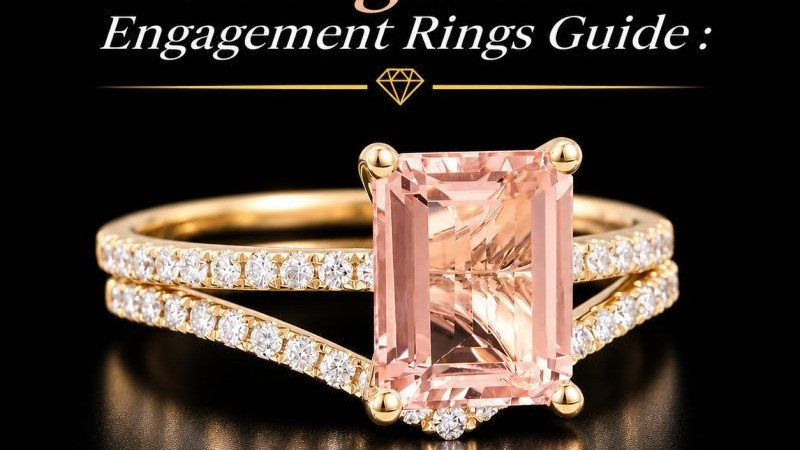
Rose gold is the most natural pairing for morganite. Its warm, pink-toned metal echoes the stone’s blush and peach hues, creating a cohesive, romantic look. The GIA notes that rose gold settings have been central to morganite’s popularity inengagement rings. If you want the ring to feel soft, vintage-inspired or overtly romantic, rose gold is the obvious choice.
Yellow Gold -
Yellow gold adds warmth and can make peach and salmon morganite look richer. It can also make a light pink stone appear slightly more golden, which some wearers prefer. Yellow gold is a good option if you want a classic, heirloom-like feel and you are not trying to cool down the stone’s colour.
White Gold and Platinum -
White metal creates contrast. The GIA suggests that white gold or platinum can be used to make the morganite stand out, especially with white prongs or a white band. White metal can also make a pale pink stone look slightly cooler and more “blush” than “peach.” It is a strong choice if you want a modern, crisp look or if you plan to pair the ring with white-metal wedding bands.
Two-Tone and Mixed Metal -
Two-tone designs for example, a rose gold band with white gold prongs can combine the warmth of rose gold with the contrast of white metal. This is a practical way to get the best of both worlds, and it is increasingly common inbridal jewellery.
Setting Styles:
Morganite works in virtually every popular engagement ring setting, but some styles protect the stone better than others.
Solitaire -
A solitaire setting lets the morganite be the centre of attention. It is clean, classic and often the most affordable setting style. However, a high solitaire with exposed prongs offers less protection against knocks. If you choose a solitaire, ask for well-shaped prongs and consider a slightly lower profile.
Halo -
A diamond halo surrounds the morganite with a ring of smaller stones. The GIA describes the halo as a “can’t-fail” choice for morganite because the diamonds create contrast and add brilliance without overwhelming the pastel centre stone. A halo also adds a layer of protection around the girdle, although it does not make the stone invincible.
Bezel -
A bezel setting encircles the stone with a metal rim. It is one of the most protective settings for a softer stone because the metal absorbs impact that would otherwise reach the girdle. The GIA specifically notes that morganite is “artfully framed and protected” in a bezel setting. If you are hard on your hands or want a low-maintenance ring, a bezel is worth serious consideration.
Three-Stone and Side-Stone Designs -
Morganite flanked by diamonds or pink sapphires creates a balanced, romantic look. Diamond side stones add sparkle and contrast; pink sapphires create a tonal pink story. The GIA notes that diamonds in a halo or as side stones are two reliable choices, and that diamonds may pick up a pinkish reflection from the morganite. This is not a flaw it is part of the charm but it is something to be aware of if you are matching side stones.
Shop and Sell on CaratX -
Browse loose gemstones and morganite options in the CaratX Gemstone Marketplace:caratx.com/search-results/gemstones
Explore natural diamonds for side stones and halos:caratx.com/search-results/Natural
Shop engagement ring settings and finished rings:caratx.com/search-results/Rings
Register as a seller to reach B2B and B2C buyers in 18+ countries:www.caratx.com/register
Compare seller plans and pricing:caratx.com/sell-on-caratx
Recommended Reads from CaratX -
If you are exploring coloured gemstone engagement rings, these CaratX guides go deeper into the alternatives and design considerations:
The Ultimate Guide to Pink Gemstones: Different Types, Beauty, Meaning and Investment — a broader look at pink diamonds, sapphires, spinels and morganite, with sourcing and care notes.Read the CaratX pink gemstone guide
The Solitaire Diamond Ring: A History of the World's Most Iconic Engagement Ring —https://caratx.com/blog/the-solitaire-diamond-ring-a-history-of-the-world-s-most-iconic-engagement-ring
Tanzanite Engagement Ring Guide: Rarity, Romance, and the Science of Violet-Blue Brilliance —https://caratx.com/blog/tanzanite-engagement-ring-guide-rarity-romance-and-the-science-of-violet-blue-brilliance
The Complete Pink Sapphire Engagement Ring Guide: Symbolism, Durability, Buying Tips, and Expert Care —https://caratx.com/blog/the-complete-pink-sapphire-engagement-ring-guide-symbolism-durability-buying-tips-and-expert-care
The Ultimate Guide to Pink Sapphire vs. Pink Diamond: Rarity, Value & Choosing Your Perfect Gem" —https://caratx.com/blog/the-ultimate-guide-to-pink-sapphire-vs-pink-diamond-rarity-value-choosing-your-perfect-gem
Frequently Asked Questions -
Is morganite a good choice for an engagement ring?
Yes, for many wearers. It is hard enough for everyday wear with care, and it offers a romantic, distinctive look at a more accessible price than diamond or sapphire. The main trade-off is that it is softer than diamond and should be protected in a bezel or secure prong setting and removed during rough activity.
Does morganite fade in sunlight?
No, under normal light exposure the colour is stable. Heat-treated morganite will not fade unless exposed to temperatures above 400 °C. Prolonged intense sunlight is not a practical concern for a ring worn in everyday life, but heat such as a hot oven, a stovetop or a steam cleaner should be avoided.
Is morganite always heat-treated?
Almost always, yes. The GIA states that morganite is almost always heat-treated to improve its pink colour, and the treatment is not detectable. Untreated morganite exists, but it tends to be peachier or salmon-toned rather than pure pink.
Can morganite be cleaned in an ultrasonic cleaner?
Only if the stone has no liquid inclusions or fractures. The GIA notes that ultrasonic and steam cleaning are usually safe for clean morganite, but stones with liquid inclusions or fractures should be cleaned only with warm, soapy water. If you are unsure, warm water and mild dish soap with a soft brush is the safest method.
Does morganite scratch easily?
It is more scratch-resistant than softer gems, but less scratch-resistant than diamond, sapphire or ruby. Over years of daily wear, a morganite surface can show abrasion. Removing the ring during heavy manual work and storing it separately from harder stones will help preserve its polish.
What is the best metal for a morganite ring?
Rose gold is the most popular choice because it echoes the stone’s warmth, but white gold and yellow gold both work well depending on the look you want. White metal creates contrast; yellow metal adds warmth. Two-tone settings can combine both.