
Introduction:
In thejewelrybusiness, the memo enables goods to flow between suppliers and retailers in a way that would otherwise be impossible for most businesses. Cash is absent from the process until a sale is made a practice so fundamental that industry experts suggest that without memos, the jewelry industry as we know it would not survive.
The nearly indispensable practice, deemed too risky by banks and other lenders, has been used by generations of jewelers.
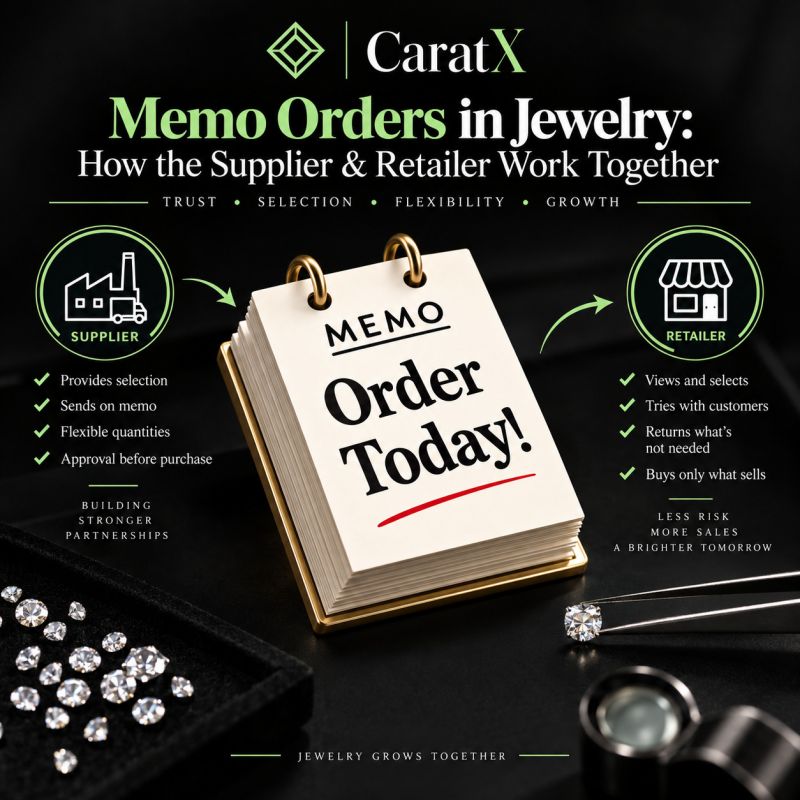
A memo order (short for memorandum) is a temporary arrangement where a jewelry supplier sends products to a retailer without requiring immediate payment. The retailer can display and sell the pieces, paying the supplier only for the items that are sold, and returning unsold goods after an agreed timeframe.
Think of it as inventory on loan: retailers gain access to products they couldn’t otherwise afford to stock, and suppliers get their goods in front of more customers.
How Memo Orders Work: A Step-by-Step Breakdown
The Supplier's Role -
The supplier sendsjewelryto the retailer under agreed terms and typically retains ownership until the item is sold or purchased. This means the supplier bears the majority of the financial risk, effectively lending the retailer the agreed-upon cost of the goods.
The Retailer's Role -
The retailer displays thejewelryin the showroom or store and offers it to customers. They do not pay for the items upfront, conserving capital that can be used for other business expenses like rent, payroll, or marketing.
The Sale Process -
When a memo item sells, the retailer reports the sale and pays the supplier the agreed amount. This is where accurate inventory management and regular communication become critical.
The Return Process -
Unsold items are normally returned to the supplier before the memo period ends. Items are generally expected to be returned in the same condition as they were received.
Typical Memo Order Timeframes -
Memo periods vary by supplier and agreement, but common business arrangements include:
Timeframe Typical Use Case
7–30 days Short-term testing or special customer appointments.
30–60 days Common for regular retail programs.
60–90 days Often used for higher-value or seasonal jewelry.
90+ days Possible for selected luxury pieces, major shows, or special arrangements.
According to industry experts, terms are often determined on a per-client basis rather than following rigid guidelines.
The more expensive the piece, the quicker suppliers typically expect a response. For stones exceeding $15,000 or $20,000, suppliers often ask when the item will be shown and expect payment when their client gets paid sometimes within 10 days, or up to 30 days for custom designs.
Why Memo Orders Are Essential for the Jewelry Trade -
Benefits for Retailers -
1. Improved Cash Flow – You don't pay until it sells. A retailer can display $500,000 worth of memodiamondswhile keeping that capital available for rent, payroll, or marketing. This is especially valuable for seasonal businesses, new stores, and those looking to grow without major upfront investments.
2. Reduced Risk – Precious metal anddiamondprices fluctuate. When you own inventory, you bear the risk of price drops. With memo, that risk stays with the supplier. Should prices substantially drop, retailers with goods on memo can renegotiate before buying them.
3. Expanded Selection – Customers expect variety. Memo lets you offer a broader selection than your capital allows.
4. Test New Products – Not sure if a new style will resonate? Memo lets you test without commitment.
5. Access Higher-Value Pieces – Few independent jewelers can afford to own a $100,000 diamond. Memo arrangements let you show and sell pieces far above your typical price point.
6. No Impact on Credit Profile – Memo does not impact the retailer's tax liability and actually helps its credit profile. Since the items are not the property of the consignee, they are not recorded as a purchase and are therefore not an accounts-payable liability.
Lenders trained to calculate risk tend to frown on those who take on extra accounts payable and tie up too much working capital in inventory but goods on memo are excluded from the credit-line application process.
Benefits for Suppliers -
1. Broader Product Placement – Every retailer carrying your goods on memo extends your showroom.
2. Faster Turnover – Products get in front of end consumers faster. A piece that might sit for months could sell within weeks when placed with the right retail partner.
3. Stronger Relationships – Offering memo builds loyalty. Retailers remember suppliers who help them grow without demanding large upfront purchases.
4. Market Intelligence – Memo programs reveal what sells, what doesn't, which retailers perform, and which markets are strong.
The Risks of Memo Transactions -
While memo orders offer tremendous benefits, they also carry significant risks particularly for suppliers.
The Supplier's Risk -
Most of the risk falls on the supplier, who is in effect lending the merchant the agreed-upon cost of the goods. As the Jewelers Vigilance Committee (JVC) explains inThe Essential Guide to Memo Transactions, memo transactions can be very risky for a supplier, especially in an economic downturn.
One critical reason: while goods are held on memo, the law may give the holder the same rights and title to the goods as those of the supplier. This becomes critically important if the holder fails to pay for the goods or enters bankruptcy proceedings while in possession of them.
In a bankruptcy scenario, courts will ask whether the supplier properly perfected its consignment by filing a UCC-1. If not, the goods or any proceeds from them may be used to satisfy the holder's debts. Banks and other secured creditors will be first in line to collect, and the supplier will be at the back of the queue, standing at the same priority level as all general unsecured creditors.
Common Scams and Fraud -
Theft and fraud do occur in memo transactions. Common scams include building a retail relationship on lower-priced items and then swindling the supplier in a variety of ways once higher-priced goods have been delivered. Some suppliers report that less than 1% of their memo deals have backfired, largely due to exercising extreme caution when selecting retailers.
Legal Protection: Making Your Memo Bulletproof
To be enforceable, credit memos must comport with the Uniform Commercial Code (UCC) the law governing business transactions. The key documents necessary for a successful credit memo are a written agreement the memo itself and a UCC-1 financing statement to let creditors know that the supplier has a security interest in thejewelry.
Five Essential Elements of an Enforceable Memo -
1. Names and Addresses – All jewelry consignment memoranda must be in writing, must identify the parties correctly, and must be signed by the merchant. Without this signature, the memo will not be enforceable.
2. Payment Terms – Payment terms must be set forth in exacting detail, including amount, form of payment, date payment is due, and interest terms, if any.
3. Description of the Property – A detailed description of the property should appear on the face of the memo. Photograph thejewelry, if possible, and append it to the credit memo as an exhibit.
4. Losses and Insurance – The memo should establish liability in the event of inventory getting lost, stolen, or damaged. It can stipulate whether the supplier or merchant bears responsibility if any of those occurs in transit.
5. Merchant Bankruptcy – Suppliers should include a clause specifying that thejewelryshall remain the property of the supplier in the event that the merchant files for bankruptcy, and that the supplier will file a UCC-1 financing statement.
The UCC-1 Filing -
To document ownership of the jewelry once it's in the merchant's hands, the supplier must file a UCC-1 financing statement with the secretary of state in the jurisdiction where the merchant is incorporated and does business. This is known in legal parlance as "perfecting the security interest" meaning that should the merchant go bankrupt while in possession of the jewelry, it will not be mislabeled as an asset of the merchant.
The UCC-1 form requires the merchant's name and mailing address and a description of the memo items the financing statement covers. The form is valid for five years.
Additional Safeguards -
The Jewelers Vigilance Committee (JVC) and Jewelers Board of Trade (JBT) advocate several additional safeguards:
Insurance – Before consigned goods are delivered, insurance should be in place, naming the supplier as the loss payee. A jeweler's block insurance policy can cover losses arising from most memo-related mishaps.
Credit Checks – Perform credit checks and background checks on parties with whom you have not previously done business.
References – Always ask for at least three references.
JBT Credit-Watch – Suppliers should join the Jewelers Board of Trade and place consignees on the JBT's customized credit-watch list.
Short Payment Terms – Both the JBT and the JVC advocate short payment terms of 15 to 30 days.
Best Practices for Successful Memo Partnerships -
For Retailers -
Treat memo goods with the same care as owned inventory – Some retailers have been criticized for being too lax with memo goods. Since they have not paid for them, they may not be as concerned about selling them as they are about goods they've purchased.
Give memo goods a fair test – Retailers need to give consigned goods a fair test in terms of advertising, key POS locations, and in-store promotion.
Communicate regularly – Both parties need to understand terms and conditions and communicate regularly before and during the consignment period so no surprises occur at the end of the agreement.
Report sales promptly – The memo should be converted to an invoice as soon as an item sells.
For Suppliers -
Exercise extreme caution when selecting retailers – This is the primary reason some suppliers report less than 1% of memo deals backfiring.
Never take shortcuts when drafting a memo – Even if you are doing business with a counterparty you know well.
File the UCC-1 – This is essential for protecting your interest in the goods.
Confirm insurance – Always confirm that your counterparty has insurance and that you are named as the loss payee.
Consult an attorney – When in doubt, consult an attorney with experience drafting credit memos.
Memo vs. Consignment: What's the Difference?
In thejewelryindustry, these terms are used interchangeably. Both describe the same arrangement: goods placed with a retailer where ownership stays with the supplier until sale. For practical purposes, they mean the same thing in thejewelrybusiness.
However, legally speaking, under the UCC, a delivery of goods to a merchant for the purpose of sale is deemed a consignment. Article 9 of the UCC defines "consignment" at § 9-102(a)(20) and treats the consignor's interest as a security interest that must be perfected.
Insurance Considerations -
Insurance is a critical component of any memo arrangement. A jeweler's block insurance policy can cover losses arising from theft, robbery, fire, shoplifting, and several other causes of loss or damage, including coverage for salespeople, transit, customers' goods, and goods on memo.
However, fluctuating values can sometimes make it difficult to settle on the value of a lost or stolen item. If the price of precious metals anddiamondsrises while the memo is outstanding, the risk of loss increases, and so the level of insurance should increase as well.
Specialty insurance for jewelry wholesalers can include consignment-specific clauses and require proper documentation to ensure coverage at every step of the chain.
Technology and Inventory Tracking -
Accurate inventory management is essential for successful memo operations. An accounting firm with jewelry-industry expertise can add efficiency to the memo process, providing regular updates regarding the status of goods on memo, the length of time they've been with a retailer, customer contact information, and tracking that includes prompt notification of when an item is sold so the memo can be converted to an invoice.
Modern jewelry inventory software can:
Track memo stock separately from owned stock.
Manage consignments and memos with digital signatures and due date tracking.
Provide memo aging and status reports.
Handle both memo-in (receiving from suppliers) and memo-out (sending to retailers).
Conclusion -
Memo orders are the lifeblood of thejewelryindustry a time-honored practice that enables goods to flow between suppliers and retailers, conserving capital and expanding market reach. While the arrangement carries significant risks particularly for suppliers these can be effectively managed through proper documentation, UCC-1 filings, insurance, and careful selection of trading partners.
The memo is a simple agreement, typically between a wholesaler and retailer, with minimal paperwork involved. The arrangement is largely based on time and trust. In an industry as deeply rooted in tradition as the jewelry business, it's common for people to have worked with each other's firms and/or families for generations.
Start Selling to Diamonds in 18+ International Countries– Register on CaratX marketplace to start selling to B2B and B2C buyers.
Sell Jewelry Internationally– Through our CaratX seller plan, you can now sell jewelry internationally.
Shop Gemstones– Find gemstones at unbeatable prices on our CaratX marketplace.
Shop Natural Diamonds– Browse our collection of natural diamonds.
CaratX Pricing– More details about our pricing plans.
Recommended Reads from CaratX -
Directly Related to Memo / Consignment & Market Dynamics
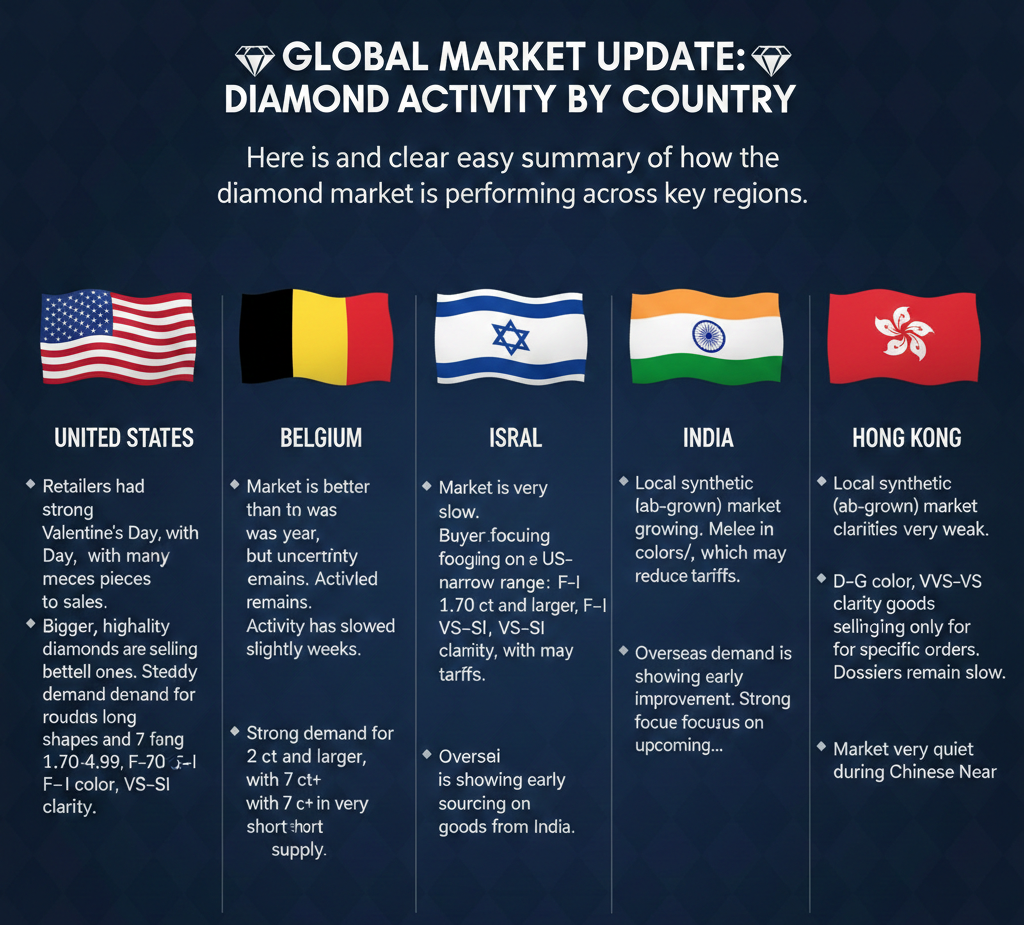
Global Diamond Market Pulse: Tariffs, Trends, and Navigating Turbulent Times– This article highlights the strong memo demand for 2–4 carat, F-I color, VS-SI clarity diamonds in the US market.
It also discusses how classic items like tennis bracelets continue to flow through memo arrangements, giving retailers insight into what sells best on consignment.
Global Diamond Market Update: Regional Analysis and Key Trends– A deep dive into regional market performances.
It specifically notes that memo goods (consignment diamonds) have been underperforming in certain regions, reflecting how retailers are becoming highly selective with their inventory heading into peak seasons, a critical insight for suppliers managing memo risk.
Diamond Market Deep Dive: July 2025 – Strategic Insights– This report shows a 27% decline in the traditional memo system, as retailers pivot toward more efficient inventory turnover models. Essential reading for understanding why the memo landscape is shifting.
Supplier & Retailer Operational Resources -
Start Selling to 18+ International Countries – Seller Registration– Register on the CaratX marketplace to start selling diamonds and jewelry to B2B and B2C buyers across 18+ countries. Perfect for suppliers looking to expand their wholesale network beyond traditional memo relationships.
Launch Your Products on CaratX – Pricing & Seller Plans– Detailed breakdown of CaratX seller plan pricing, commission structures, and how to list your inventory for international buyers.
Shop Natural Diamonds– Browse our extensive inventory of GIA-certified natural diamonds to stock your retail showroom.
Shop Gemstones– Source high-quality gemstones at competitive prices for your jewelry collections.
Additional CaratX Blog Posts Relevant to Jewelry Memo & Trade -
The following internal articles provide valuable context on market conditions, retail strategies, and industry shifts that directly affect how suppliers and retailers manage memo orders:
The Diamond Market Right Now: What's Trending & What is Hot Read Full Article
Understand current consumer preferences so retailers know which memo items to request and suppliers know which pieces to push.
India's Diamond Export: A 20-Year Low, Global Shifts, and the Lab-Grown Diamond Surge Read Full Article
Explains global supply chain constraints that impact memo inventory availability and pricing. More stores, more revenue? Not always in Jewelry Retail Read Full Article
Crucial for retailers using memo to test new locations without overcommitting capital to owned inventory.
Why Red diamonds are the rarest of all natural colored diamonds Read Full Article
Highlights high-value, low-volume luxury items often placed on extended (90+ days) memo terms.Blue Topaz: From Clear Crystal to Iconic Gem Read Full Article
Covers mass-market gemstone trends that drive high-volume, short-term memo programs. GIA Expands International Lab Services Amid U.S. Tariffs Read Full Article
Facets of a Diamond: The Star Facet Read Full Article
Educational content to help retailers better present and sell memo diamonds to endcustomers.Top 10 Rarest Diamonds in the World Read Full Article
Insight into ultra-high-end pieces typically moved through exclusive memo arrangements between top-tier suppliers and luxury retailers.
Frequently Asked Questions -
1. What is a jewelry memo order?
A jewelry memo order is a temporary arrangement where a supplier sends jewelry to a retailer without requiring upfront payment. The retailer pays only for items that sell and returns unsold goods.
2. Who owns the jewelry during a memo?
The supplier retains ownership until the item is sold and paid for.
3. How long does a typical memo period last?
Memo periods typically range from 7 to 90 days, depending on the supplier, the type of merchandise, and the relationship between the parties.
4. What happens if a retailer goes bankrupt with memo goods?
If the supplier has properly perfected its security interest by filing a UCC-1, the goods remain the supplier's property. If not, the goods may be used to satisfy the retailer's debts.
5. Do I need insurance for memo goods?
Yes. Before consigned goods are delivered, insurance should be in place, naming the supplier as the loss payee.
6. What's the difference between memo and consignment?
In the jewelry industry, these terms are used interchangeably.
7. Can memo terms be negotiated?
Yes. Terms are often determined on a per-client basis and can be flexible depending on the relationship and volume of business.