
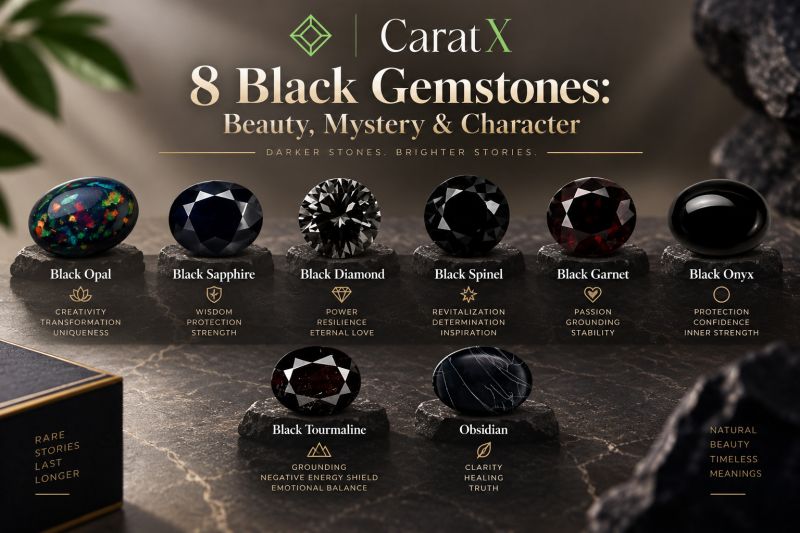
Black gemstones occupy a unique space in the world offine jewelryand gem collecting. They are bold yet elegant, mysterious yet endlessly versatile. Unlike their transparent or brightly colored counterparts, black gems command attention through depth and contrast, offering a sophistication that transcends trends and seasons.
Once relegated to mourning jewelry or carved intaglios, black gemstones have undergone a remarkable renaissance. Today, they appear on red carpets, in contemporaryengagement rings, and in the collections of serious investors who recognize their rarity and enduring appeal. This guide explores eight remarkable black gemstones, delving into their geological origins, unique properties, historical significance, and practical considerations for collectors and buyers alike.
Why Black Gemstones Matter:
Across cultures and centuries,black gemstoneshave carried profound symbolic weight. In ancient Rome, black stones were associated with protection and grounding. Persian soldiers carried onyx statuettes into battle as talismans of courage, while in India, black onyx was used for rosaries and believed to restrain passion and foster spiritual discipline.
In Victorian England,black gemstonesbecame central to mourning jewelry, a tradition that elevated jet, onyx, and black garnet to symbols of remembrance and dignity.
In contemporary fashion, black gems represent the epitome of chic minimalism. Their neutrality makes them incredibly wearable, complementing every skin tone and wardrobe palette while seamlessly transitioning from day to night. The gender-neutral appeal of black gemstones has made them particularly sought after in modern masculine jewelry design, though their versatility knows no boundaries.
Metaphysical traditions associate black gemstones with protection, grounding, and resilience. Blacktourmaline, in particular, is revered for its purported ability to ward off negative energy, while obsidian has been used as a protective stone across diverse spiritual practices.
1. Black Diamond:
What Is a Black Diamond?
Black diamonds, scientifically known as carbonados, are distinct from their colorless counterparts in both structure and origin. While conventional diamonds are single crystals of pure carbon, black diamonds possess a polycrystalline structure, they are composed of countless tiny diamond crystals fused together, interspersed with graphite, amorphous carbon, and other mineral inclusions.
This unique composition gives them their opaque, jet-black appearance and a luster that is more metallic than adamantine.
Most natural black diamonds are found only in Brazil and the Central African Republic, a distribution that has puzzled geologists for decades. Unlike conventional diamonds, which form deep within the Earth's mantle and are brought to the surface by volcanic eruptions, black diamonds show isotopic signatures suggesting an extraterrestrial origin.
Properties and Durability -
Black diamonds share the same exceptional hardness as conventional diamonds, 10 on the Mohs scale making them extraordinarily resistant to scratching and ideal for daily-wear jewelry. Their toughness, combined with their dramatic appearance, makes them superb choices for engagement rings and bold statement pieces.
Unlike transparent diamonds, black diamonds are graded by theGemological Institute of America(GIA) using a Colored Diamond Identification and Origin Report, which confirms whether the color is natural or the result of treatment.
Buying Considerations -
Natural black diamondscommand premium prices, particularly those with uniform color and minimal surface-reaching fractures. Treated black diamonds, created by heat-treating or irradiating lower-quality diamonds, offer a more affordable alternative but should be clearly disclosed at the point of sale. When evaluating a black diamond, prioritize uniform color, a smooth surface polish, and a cut that maximizes the stone's natural luster.
Explore CaratX's collection of natural diamonds and gemstonesto find certified black diamonds and other exceptional stones.
2. Black Opal:
What Is Black Opal?
Black opal represents the pinnacle of opal beauty and value. While all precious opals display the phenomenon known as "play-of-color" flashes of spectral hues caused by the diffraction of light through microscopic silica spheres black opal is distinguished by its dark body tone, ranging from dark gray to jet black. This dark background provides dramatic contrast, making the play-of-color appear more vivid and intense than in lighter opals.
The most celebrated source of black opal is Lightning Ridge in New South Wales, Australia, where miners have extracted these treasures for over a century. Black opal also occurs in smaller quantities in Ethiopia, Honduras, and other locations, though Australian material remains the benchmark for quality.
Geological Formation -
Black opal forms through a fascinating geological process. Unlike crystalline minerals, opal is amorphous, it has no crystal structure. It consists of hydrated silicon dioxide (SiO₂·nH₂O) with a water content typically ranging from 3% to 21%. Black opal's dark body tone results from organic matter pigmentation, a process documented in research on opal formation in Volyn, Ukraine, where scientists used scanning electron microscopy to investigate the interaction of silica with organic matter.
At Lightning Ridge, black opal formed through the weathering of sedimentary rocks over millions of years. Silica-rich solutions percolated through the rock, depositing opal in nodules and seams. The presence of organic matter likely derived from ancient plant material, imparted the dark body tone that makes these stones so distinctive.
Properties and Care -
Black opal has a Mohs hardness of 5.5 to 6.5, making it significantly softer than diamond, sapphire, or spinel. It also contains water and is sensitive to sudden temperature changes and dehydration, a phenomenon known as "crazing" that can cause internal fractures. Black opal jewelry should therefore be worn with care, protected from harsh chemicals and extreme temperature fluctuations, and ideally set in protective bezel settings.
Buying Considerations -
When evaluating black opal, consider three factors: body tone, play-of-color, and pattern. The finest stones have a deep, dark body tone (N1 to N4 on the industry scale), bright and saturated play-of-color, and a distinct pattern, whether harlequin, flagstone, or rolling flash. Larger stones with red play-of-color command the highest premiums. Always purchase from reputable dealers who provide clear disclosure of any treatments, as opal is sometimes treated with oil, resin, or sugar-acid to enhance its appearance.
3. Black Sapphire:
What Is Black Sapphire?
Blacksapphireis a variety of corundum, the same mineral species as ruby and blue sapphire that exhibits an opaque to nearly opaque black appearance.
While fineblue sapphiresachieve their color through trace amounts of iron and titanium, black sapphires typically contain abundant inclusions of hematite or ilmenite that darken the stone to the point of opacity. Some black sapphires are so dark that they appear to absorb all light, creating a mysterious, light-absorbing quality that is both striking and sophisticated.
Black sapphire is found in several locations worldwide, including Australia, Thailand, Sri Lanka, and Africa. Many black sapphires on the market are the result of heat treatment applied to geuda, a milky, undesirable corundum, which transforms the stone into a dark, saleable gem.
Properties and Durability -
With a Mohs hardness of 9, black sapphire is one of the most durable gemstones available, surpassed only by diamond. This exceptional hardness makes it ideal for everyday wear, including rings, bracelets, and other pieces that receive significant wear. Black sapphire also exhibits a vitreous to sub-adamantine luster, giving it a subtle shine that belies its dark color.
Buying Considerations -
Because black sapphire is opaque, traditional clarity grading does not apply. Instead, focus on the uniformity of color, the quality of the polish, and the overall cut. Stones with a smooth, even black color and a high polish are most desirable. Avoid stones with visible surface pits or uneven color distribution. Certified black sapphires from reputable laboratories provide assurance of authenticity and treatment status.
For those interested in the broader world of sapphire colors, CaratX's guide to fancy sapphires explores the colorful side of the sapphire family.
4. Black Spinel:
What Is Black Spinel?
Blackspinelis a magnesium aluminum oxide (MgAl₂O₄) that crystallizes in the cubic system, producing stones with exceptional brilliance and a sharp, vitreous luster. Unlike many black gemstones that are opaque, high-quality black spinel can be slightly translucent, giving it a depth and liveliness that sets it apart. Black spinel is typically untreated, a significant advantage for buyers who prefer natural gemstones without enhancement.
The primary source of gem-quality black spinel is the Bo Phloi district in Kanchanaburi Province, Thailand, where it occurs in alluvial deposits alongsideblue sapphire. Additional deposits exist in Myanmar, Sri Lanka, and parts of Africa. Historically, black spinel was known as "pleonast," a name derived from the Greek word for "abundant," though high-quality material is now recognized as rare and valuable.
Properties and Durability -
Black spinel ranks 8 on the Mohs hardness scale, making it harder thanemerald,tanzanite, and most other colored gemstones. This durability, combined with its natural beauty and affordability, has made black spinel an increasingly popular alternative to black diamond in fashion jewelry. It is isotropic (singly refractive), meaning it does not exhibit the optical fuzziness sometimes seen in doubly refractive stones like sapphire.
Buying Considerations -
Black spinel is valued for its uniform black color, high luster, and absence of visible inclusions. Because it is typically untreated, buyers can be confident that the stone's appearance is entirely natural. When shopping for black spinel, look for stones with a bright, mirror-like polish and even color throughout. Black spinel is an excellent choice for bracelets, necklaces, and earrings, where its durability and sparkle can be fully appreciated.
5. Black Garnet:
What Is Black Garnet?
Black garnet, also known as melanite, is a titanium-rich variety of andradite garnet. Its name derives from the Greek word "melas," meaning black, a reference to its deep, opaque color. While most garnets are prized for their red, green, or orange hues, black garnet offers a dramatic alternative, a jet-black to brownish-black stone with a brilliant resinous luster that catches the light in unexpected ways.
Black garnet forms in metamorphic rocks and volcanic environments. Notable deposits have been found in Southern Africa, Mali, and parts of Europe. Historically, melanite was used in mourning jewelry during the Victorian era, valued for its somber elegance and durability.
Properties and Durability -
With a Mohs hardness of 6.5 to 7.0, black garnet is suitable for most jewelry applications, though it is somewhat softer than sapphire or spinel. It has no cleavage, meaning it fractures with a conchoidal (shell-like) break, and its density, higher than most gemstones gives it a satisfying heft in the hand. Black garnet is typically opaque, though thin edges may appear dark red or brown when backlit.
Buying Considerations -
Black garnet is an excellent choice for collectors seeking a natural, untreated black gemstone with historical significance. Its relative affordability makes it accessible to a wide range of buyers, while its distinctive luster sets it apart from other black gems. When evaluating black garnet, look for uniform color, a smooth polish, and well-proportioned cutting. Stones with visible brownish or reddish undertones may be less desirable to those seeking a true black appearance.
6. Black Onyx:
What Is Black Onyx?
Black onyx is a variety of chalcedony, the microcrystalline form of quartz that has been prized for its deep, uniform black color for thousands of years. While natural onyx occurs in banded layers of black and white (and other colors), the solid black material used in jewelry is typically gray chalcedony that has been dyed or sugar-acid treated to achieve a uniform black appearance.
Onyx has a rich history dating back to ancient Egypt, Rome, and India. The Romans favored onyx for high-contrast intaglio carvings, while Persian soldiers carried onyx statuettes into battle as a source of courage. In India, black onyx was considered the stone for rosaries, its attributes being to restrain passion and foster spiritual discipline. In more recent history, black onyx became a staple of Art Deco design, its sleek, monochrome appearance perfectly suited to the geometric aesthetic of the 1920s and 1930s.
Properties and Durability -
Black onyx has a Mohs hardness of 6.5 to 7.0, making it durable enough for everyday wear in rings, bracelets, and necklaces. Its smooth, polished surface and opaque black color make it an excellent choice for signet rings, cameos, bead bracelets, and as an accent stone in more elaborate designs. Onyx is relatively affordable, making it accessible to a wide range of buyers.
Buying Considerations -
Because most black onyx on the market is dyed, buyers should be aware that the color may fade over time with exposure to sunlight or chemicals. However, the treatment is stable under normal wear conditions and is accepted as standard practice in the industry. When shopping for black onyx, look for uniform color, a high polish, and well-cut stones free of visible cracks or pits.
CaratX's exploration of jewelry design history highlights how onyx and lacquer created stark contrasts in Art Deco geometric designs.
7. Black Tourmaline (Schorl):
What Is Black Tourmaline?
Black tourmaline, scientifically known as schorl, is the most common variety of tourmaline, accounting for approximately 95% of all tourmaline found in nature. It is an iron-rich sodium aluminum borosilicate that forms in prismatic crystals with distinctive vertical striations. The name "schorl" derives from the village of Schorl in Saxony, Germany, where the mineral was mined as early as 1400.
Unlike gem-quality tourmalines that exhibit a rainbow of colors, schorl is exclusively black and typically opaque. However, high-quality schorl can be highly lustrous and form beautiful, well-developed crystals that are prized by mineral collectors. Significant deposits exist in Brazil, Pakistan, Afghanistan, and parts of Africa.
Properties and Durability -
Black tourmaline ranks 7 to 7.5 on the Mohs hardness scale, making it suitable for jewelry use. It exhibits piezoelectric and pyroelectric properties meaning it generates an electrical charge when subjected to pressure or temperature changes, a characteristic that has made it useful in industrial applications beyond jewelry.
In metaphysical traditions, black tourmaline is revered as a powerful protective stone, believed to repel and protect against negative energy. This reputation has made it a popular choice for those seeking both aesthetic beauty and spiritual significance in their gemstones.
Buying Considerations -
Black tourmaline is generally more affordable than many other black gemstones, making it an excellent choice for budget-conscious buyers. When evaluating schorl for jewelry, look for stones with a uniform black color, high luster, and minimal surface-reaching fractures. Crystal specimens with well-formed, striated prisms are highly sought after by collectors.
For an exploration of the tourmaline family, CaratX's guide to tourmaline covers everything from schorl to the rare and valuable Paraíba variety.
8. Obsidian:
What Is Obsidian?
Obsidian is not a mineral in the strict sense, it is a naturally occurring volcanic glass formed when silica-rich lava cools so rapidly that crystals do not have time to form. The result is a smooth, amorphous solid with a vitreous luster and a conchoidal fracture that produces sharp edges. Obsidian has been used by humans for thousands of years as a tool, weapon, and ornamental material. Ancient peoples crafted obsidian into arrowheads, blades, and mirrors, while more recent cultures have used it for jewelry and decorative objects.
Obsidian is found in volcanic regions worldwide, including the American West (notably Glass Buttes, Oregon), Mexico, Iceland, Italy, and Japan. Variations include rainbow obsidian (with iridescent layers), snowflake obsidian (with white cristobalite inclusions), and mahogany obsidian (with reddish-brown streaks).
Properties and Care -
Obsidian has a Mohs hardness of 5 to 5.5, making it relatively soft compared to most gemstones. It is also brittle and can chip or fracture if struck. For these reasons, obsidian is best suited for earrings, pendants, and other jewelry that is less exposed to impact. With care, however, obsidian's glossy black surface and sharp reflectivity make it a striking and affordable choice.
Buying Considerations -
Obsidian is one of the most affordable black gemstones, making it an excellent entry point for those new to collecting black gems. When shopping for obsidian jewelry, look for pieces with a smooth, highly polished surface free of cracks or chips. Rainbow and snowflake obsidian varieties offer additional visual interest and are particularly prized by collectors.
The Oregon State University Volcano World resource provides additional information on obsidian formation and notable deposits.
Symbolism and Cultural Significance of Black Gemstones -
Black gemstones have accumulated layers of meaning across cultures and centuries. In Western traditions, black is associated with mourning, formality, and sophistication. The Victorian era saw a proliferation of black jewelry, as Queen Victoria's prolonged mourning for Prince Albert popularized jet, onyx, and black glass as symbols of remembrance and devotion.
In Eastern traditions, black stones often carry different associations. In India, black onyx was used for rosaries and believed to restrain passion. In China, black stones were sometimes associated with water and the north, representing wisdom and introspection. In metaphysical circles today, black gemstones are often linked to protection, grounding, and the release of negative energy.
Modern jewelry designers have embraced black gemstones for their versatility and dramatic visual impact. Whether set in yellow gold for warm contrast, white gold or platinum for sleek minimalism, or rose gold for a contemporary edge, black gems offer endless design possibilities.
Buying Guide: How to Choose the Right Black Gemstone
When selecting a black gemstone, consider the following factors:
Durability: For everyday-wear rings and bracelets, prioritize stones with a Mohs hardness of 7 or higher black diamond (10), black sapphire (9), and black spinel (8) are excellent choices. Softer stones like black opal (5.5–6.5) and obsidian (5–5.5) are better suited for earrings, pendants, or occasional-wear pieces.
Treatment Status: Some black gemstones are commonly treated to enhance their color. Black onyx is almost always dyed, while many black sapphires are heat-treated. Black spinel and black garnet are typically untreated. Always ask your dealer about treatment status and disclosure.
Color Uniformity: For opaque black gemstones, uniform color is generally preferred. Stones with visible color zoning, brownish undertones, or uneven blackness may be less desirable, though some buyers appreciate these natural variations.
Cut and Polish: A well-cut and polished black gemstone will exhibit a smooth, reflective surface that enhances its beauty. Look for stones free of visible surface pits, scratches, or uneven facets.
Certification: For significant purchases, certification from a reputable laboratory such as GIA, IGI, or AGL provides assurance of authenticity and treatment status.
Recommended Reads from CaratX -
A Comprehensive Guide to the Power, Beauty, and Mystique of Black Gemstones —Read the full guide
Tourmaline: The Rainbow Gemstone That Comes in Every Color —Read the full guide
39 Gemstones to Know: A Colorful Guide for Gem Lovers —Read the full guide
The Mohs Scale Decoded: The Ultimate Guide to Gemstone Hardness and Durability in Fine Jewelry —Read the full guide
The Ultimate Guide to Colored Gemstone Valuation: Beyond Carats and Into the Rainbow —Read the full guide
The Ultimate Guide to Diamond Color: How to Choose a Brighter, More Valuable Stone —Read the full guide
Blue Gemstones: Nature's Most Beautiful Shades of Blue —Read the full guide
White Gemstones: Properties, Value, and Buying Guide —Read the full guide
Frequently Asked Questions -
What is the most valuable black gemstone?
Black opal is generally considered the most valuable black gemstone, particularly top-quality material from Lightning Ridge, Australia. Natural black diamonds also command high prices, especially those with uniform color and minimal inclusions.
Are black diamonds real diamonds?
Yes, natural black diamonds are genuine diamonds with a polycrystalline structure. However, the market also includes treated black diamonds, which are conventional diamonds that have been heat-treated or irradiated to achieve a black color. Both are real diamonds, but natural black diamonds are rarer and more valuable.
Is black onyx always dyed?
Most commercial black onyx is gray chalcedony that has been dyed or sugar-acid treated to achieve a uniform black color. Natural solid black onyx exists but is less common. The treatment is stable under normal wear conditions and is accepted as standard industry practice.
Can I wear black gemstones every day?
Yes, but durability varies by stone. Black diamond, black sapphire, and black spinel are durable enough for daily wear in rings and bracelets. Softer stones like black opal and obsidian should be worn with care and are better suited for earrings or pendants.
What is the difference between black tourmaline and black spinel?
Black tourmaline (schorl) is an iron-rich borosilicate mineral with a Mohs hardness of 7–7.5, while black spinel is a magnesium aluminum oxide with a Mohs hardness of 8. Black spinel typically has a higher luster and is more often used in jewelry, while black tourmaline is prized for its metaphysical properties and crystal specimens.
Do black gemstones have healing properties?
Many metaphysical traditions attribute protective and grounding properties to black gemstones. Black tourmaline, in particular, is believed to repel negative energy, while obsidian is considered a powerful grounding stone. These beliefs are not scientifically proven but are widely held in spiritual communities.
Ready to explore the world of black gemstones? Visit CaratX to shop our curated collection of certified diamonds and gemstones, or register as a seller to tap into a global marketplace of opportunity.