
Introduction:
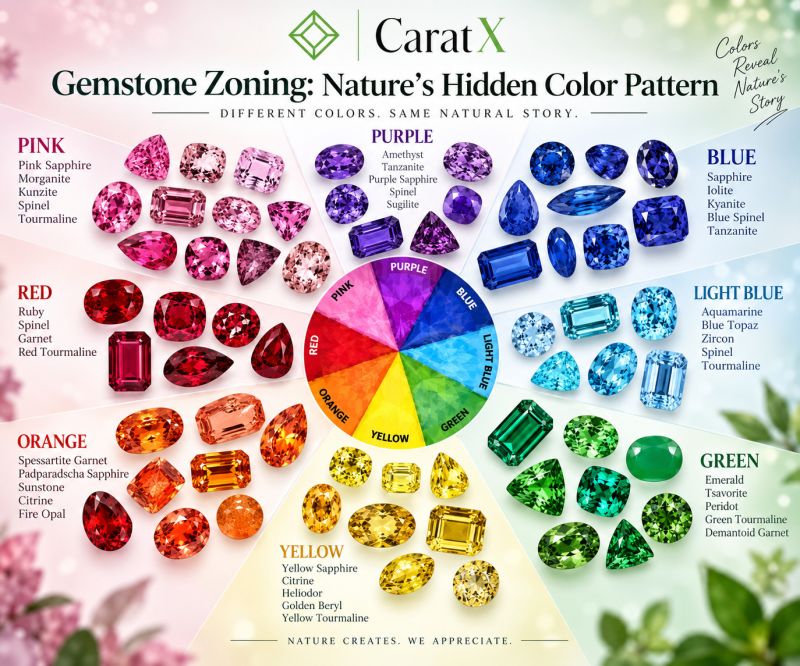
Everygemstonetells a story, a chronicle of geological forces, chemical transformations, and the passage of deep time. Perhaps no feature reveals this narrative more eloquently than color zoning. When you look at a gemstone that displays bands, patches, or sectors of different colors, you are witnessing nature’s own recording device: a crystalline archive of the conditions under which the stone grew.
Color zoning occurs when a gemstone exhibits different colors or different intensities of the same color in various parts of the same stone. As the crystal grows, the availability of chromophores, the trace elements that create color can fluctuate, leaving behind a visible record in the form of bands, patches, or zones.
These patterns are not imperfections in the conventional sense; they are nature’s fingerprints, offering gemologists and geoscientists an unparalleled window into the Earth’s history.
In this guide, we will explore the science behind color zoning, examine its manifestations in different gemstones, and understand why this phenomenon matters to collectors, jewelers, and anyone who appreciates the hidden beauty of natural crystals.
The Science Behind Color Zoning -
What Causes Color Zoning?
At its core, color zoning is a direct reflection of changes in chemical composition during crystal growth. As a gemstone crystal forms over thousands or even millions of years, the chemistry of the surrounding fluid or melt can shift due to:
Temperature fluctuations during crystallization.
Changes in pressure within the geological environment.
Variations in the availability of trace elements like iron, titanium, chromium, vanadium, and manganese.
Oscillations between consecutive periods of crystal growth.
These chromophores diffuse very slowly in crystals once incorporated, meaning that abrupt changes in their concentrations create sharp color zone boundaries that preserve the conditions of the moment they were formed.
Over geological timescales, slow diffusion can gradually smooth out some initially sharp boundaries, providing scientists with information about cooling rates and annealing times.
According to theGemological Institute of America (GIA), this process is critical for understanding the metamorphic or igneous history of the host rock.
Types of Zoning -
Gemologists distinguish between several types of zoning:
1. Growth Zoning (Concentric Zoning) This occurs when the composition of the growth medium changes over time, creating bands that follow the crystal’s growth habit.
The color zoning in most gemstones fromtourmalinetosapphirefollows the crystal habit of the mineral, appearing as concentric or radial hexagonal zones or along the crystallographic axes.
2. Sectorial Zoning This refers to different coloration between adjacent growth sectors of the same crystal. Different crystallographic faces can incorporate trace elements at different rates, leading to distinct color sectors within a single stone. Some chrysoberyls, for example, show distinct sectorial growth zoning combined with color zoning.
3. Oscillatory Zoning When growth conditions oscillate repeatedly, the crystal develops alternating bands of different compositions much like tree rings recording seasonal changes.
4. Diffusion-Controlled Zoning In some unusual cases, such as Oregon sunstone, color zoning is not growth-controlled but results from the extraordinarily rapid diffusion of elements like copper through the crystal lattice.
Color Zoning in Iconic Gemstones -
Sapphire:
Sapphireis perhaps the gemstone most famous for its color zoning. The blue color of sapphire is commonly related to the presence of iron and titanium impurities replacing aluminum in the corundum (Al₂O₃) structure. When these elements are unevenly distributed, the result is striking color variation.
Kashmir sapphires, among the most prized in the world, are virtually all characterized by a sharp, well-defined color zonation. The zoning typically consists of alternating blue and near-white, or "milky," layers that contribute to the reduced transparency the famous "velvetiness" of these legendary stones. As early as 1904, Bauer noted that even within low-quality Kashmir material, "single crystals often show a difference of color in different portions; thus the center of a crystal may be of fine blue color, and the two ends colorless".
Trapiche-like sapphires from Shandong Province, China, display a remarkable hexagonal color zoning on cross-sections perpendicular to the c-axis. These stones show a combination of a blue-black hexagonal "core" with six silvery fibrous "arms".
Manysapphiresalso display blue and yellow hexagonal color zones, with the color intensity primarily related to the content of Fe, Ti, Si, and Mg. Some green sapphires from Australia and Thailand, when viewed under magnification, reveal that the green color is actually a function of blue and yellow color zoning.
Explore our collection of natural sapphires atCaratX Gemstone Marketplaceand discover the unique color patterns that make each stone one-of-a-kind.
Tourmaline: The Rainbow Gem
Tourmalinestands alone in the gemstone world for its extraordinary color diversity. Its complex crystal structure a borosilicate with the general formula (Na,Ca)(Li,Mg,Al)₃(Al,Fe,Mn)₆(BO₃)₃(Si₆O₁₈)(OH)₄ allows it to incorporate a remarkable range of chromophores:
Blue: Usually caused by Fe²⁺, though copper (Cu²⁺) produces the famous neon blue of Paraíba tourmaline.
Green: Comes from Fe²⁺-Ti⁴⁺ intervalence charge transfer, or from Cr³⁺ or V³⁺ alone.
Pink and red: From Mn³⁺
Yellow to yellow-brown: From Mn²⁺-Ti⁴⁺ IVCT
Color zoning is common intourmaline, with some crystals displaying multiple color zones that can run the length of the crystal or be concentric. Popular examples include:
Parti-color tourmaline: Color zoning perpendicular to the c-axis.
Watermelon tourmaline: Pink and green color zoning parallel to the c-axis.
Windmill zoning: A more peculiar type showing abundant colorless zoning with windmill structures.
Tourmalineis particularly adept at recording the host-rock environment in which it grew, whether that be a melt, a marble, or a former subduction zone. A crystal that exhibits sector zoning can provide the complete temperature history of its growth, serving as a single-mineral thermometer.
According to theInternational Gem Society (IGS), some tourmaline grains retain chemical growth zones from their formation in early Earth, dating back approximately 3.7 billion years.
The geological significance oftourmalinezoning cannot be overstated. Because of its widely varying chemistry and its ability to resist attack by corrosive fluids, tourmaline contains unparalleled information on the environment in which it grew and the geologic processes responsible for it.
Discover the rainbow of tourmaline varieties at CaratX. OurTourmaline: The Ultimate Guide to Earth's Rainbow Gemstoneprovides an overview of this remarkable gem family, including detailed sections on watermelon and parti-color varieties where zoning is the main value driver.
Emerald:
Emerald, the green variety of beryl (Be₃Al₂Si₆O₁₈), gets its color primarily from chromium and vanadium. Color zoning in emerald typically manifests as differences in color intensity from one area to another, with some zones appearing darker or more saturated green while others are lighter or even near-colorless.
The arrangement of cations and other molecules within the channels and various crystallographic sites of beryl affects the color and other properties of the stone.
Colombian trapiche emeralds display a remarkable growth structure: during crystal growth, textural sector zoning occurs, sometimes associated with chemical sector zoning. The emeralds continue their growth, pushing matrix material away from the growing faces, creating the distinctive six-rayed star pattern that collectors covet.
Shop natural emeraldsfrom our curated collection atCaratX. For those interested in investment-grade stones, explore our collection for options that combine beauty with documented provenance and minimal treatment.
The Value of Color Zoning: Asset or Liability?
When Zoning Decreases Value -
For many gemstones particularly sapphires color zoning is usually regarded as a less than desirable trait. A fine sapphire ideally exhibits a uniform and consistent distribution of color, and a break in that smooth gradation can result in a significant loss in value.
As one industry observer noted, "color zoning originates through the concentration of color generating trace elements during the formation of the crystal over several thousands of years".
Visible color zoning can range from minor to obvious, and the impact on value depends on location and contrast. An experienced cutter can often mute the face-up effects of color zoning by arranging uneven color zones to run parallel to the girdle or by placing a small bit of concentrated color at the culet, which spreads that color throughout the face-up appearance.
When Zoning Creates Value -
However, color zoning is not always a detractor. Some gemstones are valued specifically because of their distinctive color zoning:
Ametrine: Combines amethyst and citrine in the same crystal, with color zoning due to differing oxidation states of iron.
Multicolored tourmaline: Displays well-defined zones of color that are prized by collectors.
Watermelon tourmaline: The pink center with green rind is among the most sought-after tourmaline varieties.
Color zoning can also serve as evidence of natural origin. Many natural gems will exhibit some degree of color zoning, which is often an indicator that they are not synthetic. Synthetic gems are often engineered to have an even color dispersion, making zoning a valuable tool for identification.
Learn more about gemstone valuation in ourUltimate Guide to Colored Gemstone Valuation, which covers how factors like color zoning, hue, saturation, and tone affect market prices across different species.
Zoning as a Geographic Origin Indicator -
Color zoning patterns can be diagnostic of geographic origin. For example:
Kashmir sapphires: The sharp, well-defined alternating blue and milky layers are distinctive.
Burmese sapphires: Typically have uniform color with diffuse or "fuzzy" zoning without sharp boundaries.
Australian sapphires: Often display blue and yellow hexagonal color zones.
Using color zoning to provide information on geographic origin is essentially using information about the spatial distribution of trace elements. PL mapping has been used to delineate the crystal growth history of rubies and blue sapphires from various localities.
TheGemological Institute of America (GIA)maintains detailed databases on these geographic characteristics, which are crucial for provenance authentication.
The Cutting Challenge: Working with Zoned Material
Color zoning presents both challenges and opportunities for gem cutters:
Challenges -
Preserving color uniformity in the finished stone.
Maximizing yield while working around uneven color distribution.
Balancing weight retention against aesthetic appeal.
Strategies -
Arranging color zones to run parallel to the girdle.
Placing concentrated color at the culet to spread color throughout the face-up appearance.
Creating bicolor or tricolor gems that celebrate the zoning rather than hiding it.
As the GIA notes, "the location and contrast are important" when assessing the impact of color zoning on value. An experienced cutter can transform what might seem like a liability into a unique selling point.
Historical and Scientific Significance -
Color zoning is more than an aesthetic feature, it is a scientific treasure trove. The study of zoning has contributed to our understanding of:
Crystal growth mechanisms: How minerals incorporate elements during formation.
Geological history: The conditions that existed during crystal formation.
Geospeedometry: Estimating cooling rates from diffusion profiles.
Thermobarometry: Determining temperature and pressure conditions of formation.
Geochemical zoning of major and trace elements, as well as stable and radiogenic isotopes in minerals, has been extensively studied, with implications for understanding crystal growth, diffusion, and dissolution-reprecipitation processes.
TheBoise State Universitygeosciences department has published extensively on how these zoning patterns inform us about ancient geothermal systems.
Frequently Asked Questions -
Q: Is color zoning a sign of poor quality? A: Not necessarily. While uniform color is generally preferred in sapphires and some other gems, zoning is highly prized in tourmaline, ametrine, and certain other stones. The impact on value depends on the gem type and how prominently the zoning is visible.
Q: Can color zoning be treated or removed? A: Heat treatment can sometimes reduce the visibility of zoning or alter colors, but the underlying compositional differences usually remain. Treatment should always be disclosed. Learn more about treatments in our guide toUnderstanding Diamond Color, which explains similar principles.
Q: How can I tell if color zoning is natural? A: Natural zoning typically follows the crystal habit of the mineral, appearing as straight or angular bands. Synthetic corundum, by contrast, often displays curved color banding.
Q: Does color zoning affect durability? A: No. Color zoning is a compositional feature, not a structural weakness. It does not affect the gemstone's hardness or toughness.
Q: Are there gemstones where color zoning is particularly common? A: Yes. Tourmaline, sapphire, amethyst, citrine, and Oregon sunstone are among the gemstones most noted for color zoning.
Recommended Reads from CaratX -
Expand your gemstone knowledge with these curated resources from CaratX. These articles directly relate to the topics of color, quality, and specific gem families discussed in this guide and all links are verified to direct to the actual live blogs:
The Complete Guide to Gemstone Verification: How to Check Authenticity, Quality, and Value– Learn exactly how gemologists use angular color zoning as a primary litmus test to differentiate natural sapphires from synthetic curved-banded imitations.
The Ultimate Guide to Colored Gemstone Valuation: Beyond Carats and Into the Rainbow– Understand how color zoning directly impacts the three pillars of color grading: Hue, Tone, and Saturation, determining the final market price.
The 31‑Hue Wheel: The Ultimate Guide to Gemstone Colour Grading– Master the precise color terminology needed to describe the distinct yellow, blue, and green zones found in multicolored sapphires and tourmalines.
Fancy Sapphires: The Colorful Side of the Sapphire World– Explore how iron, titanium, and chromium variations create the stunning yellow, pink, and blue zones within a single corundum crystal.
Why Do Sapphires Come in So Many Colors? The Complete Scientific Guide– Dive into the atomic-level science of intervalence charge transfer (IVCT) and crystal field theory that explains the uneven distribution of color in corundum.
Tourmaline: The Ultimate Guide to Earth's Rainbow Gemstone– Discover the gem family where zoning is the primary driver of beauty—featuring in-depth sections on Watermelon and Parti-color varieties where distinct chemical zones are highly sought after.
Tsavorite: The Rare Green Garnet with a Natural Glow– Compare how chromium and vanadium zoning creates intensity variations in one of the world's most vibrant green gemstones, offering a contrast to the zoning seen in emeralds.
Shop at CaratX -
Ready to find your perfect gemstone?CaratXconnects buyers with a global marketplace of natural gemstones, diamonds, and fine jewelry:
Shop Natural Gemstones at unbeatable prices –CaratX Marketplace
Shop Natural Diamonds –CaratX Diamonds
Sellers: Register to start selling to B2B and B2C buyers in 18+ international countries –Sellers Registration
Sell Jewelry Internationally through our CaratX seller plan –Learn More
Pricing Details –Launch Your Products on CaratX
Follow CaratXfor insightful and educational content about the fascinating world of gemstones, diamonds, and fine jewelry.
You can now sell Jewelry Internationally to buyers through our CaratX seller plan –www.caratx.com/register