
Why Pear-Shaped Fancy-Color Diamonds Are Having a Moment -
Thepear-shaped diamondalso known as the pendeloque or teardrop, is one of the most distinctive and emotionally resonant diamond cuts in existence. Its rounded head and pointed tip create a silhouette that combines the brilliance of theround brilliantwith the elongated elegance of themarquise. When you layer natural fancy color on top of that geometry, you get something extraordinary: a gemstone that is simultaneously a feat of cutting artistry and a geological anomaly.
Fancy-color diamonds are not a niche curiosity. They represent an increasingly significant segment of the global diamond trade. Some experts estimate that only about 2% of total rough diamond production qualifies as fancy colored, and only around one in every 10,000 gem-quality natural diamonds possesses a naturally occurring fancy color.
Within that tiny fraction, pear-shaped fancy-color diamonds occupy a particularly special position, a shape that naturally holds color with exceptional depth, paired with hues that occur nowhere else in the natural world.
AtCaratX, we connect sellers and buyers across 18+ international countries, and we have watched the demand forfancy-color pear diamondsrise steadily. This guide is designed to give you everything you need to understand, evaluate, and acquire these remarkable stones, whether you are a trade professional sourcing inventory or a collector building a portfolio.
What Makes a Pear-Shaped Diamond Different?
The Anatomy of the Pear Cut -
Thepear shapeis a hybrid geometry. Mathematically, it can be modeled as the combination of a marquise and an oval, sharing geometric elements with the round brilliant while introducing complexities that are unique to its outline. This hybrid nature is precisely why the pear is both so beautiful and so demanding to cut well.
A well-proportionedpear diamondhas several distinct anatomical zones:
The Head (Round End): The curved, semicircular portion of the stone. It should form a smooth, continuous arc. If the head is flat or lopsided, the diamond loses the concentrated light return that makes the round brilliant so captivating.
The Shoulders: These are the transitional curves connecting the head to the widest point of the stone. Well-defined shoulders create a sense of balance and guide the eye smoothly from the rounded end toward the point.
The Belly: The widest part of the diamond. Its vertical placement determines whether the stone appears elegant or awkward. A belly that sits too high makes the diamond look bulbous; too low, and it appears stretched and thin.
The Wings: The gentle side curves that lead from the belly down to the tip. They should be smooth and symmetrical.
The Tip (Pointed End): The most fragile part of the diamond. The point concentrates mechanical stress, making it vulnerable to chipping if struck. This is why a V-prong setting is universally recommended for pear-shaped stones, it protects the point while holding the diamond securely.
GIA diamond graders evaluate the symmetry of pear shapes by examining the balanced and even outline of these anatomical zones. Asymmetries such as high shoulders, flat wings, bulged wings, or undefined points are considered by most in the jewelry trade to have a negative effect on appearance.
The Bow-Tie Effect:
Manypear-shaped diamondsexhibit a dark, bow-shaped shadow that runs across the width of the stone from the center of the table. This is known as the "bow-tie" effect, and it occurs because fancy shapes display more complex face-up appearance patterns than standard round brilliants, including bow ties and areas of crushed ice.
A bow-tie is not inherently a flaw, all pear cuts will show some degree of it but a well-cut stone minimizes this dark area. When evaluating a pear diamond, examine it under multiple lighting conditions and from different angles. If the bow-tie is dark and visually dominant even in favorable lighting, the stone may be poorly proportioned. As GIA notes, the bow-tie on a well-cut pear shaped diamond should be minimal.
The Size Illusion:
One of the most commercially significant characteristics of the pear shape is its ability to appear larger than its carat weight suggests. The elongated outline distributes the diamond's visual mass across a greater surface area. Pear-shaped diamonds can appear 8% larger on their top surface than round diamonds of comparable carat weight, and some estimates suggest a well-proportioned pear can appear 10–15% larger.
This size illusion has a direct economic implication. Becausepear cutstend to be in less demand than some other popular cuts likecushionoroval, the price per carat is often significantly lower than for more "mainstream" shapes. When you combine that pricing advantage with the elongated silhouette's visual impact, the pear becomes one of the most cost-effective ways to achieve a dramatic, large-looking diamond.
For a deeper dive into pear-shaped diamond anatomy and cut quality, explore CaratX's comprehensivepear-shaped diamond guide.
The Color Spectrum: Understanding Fancy-Color Diamonds
How Fancy Color Diamonds Are Graded -
Fancy-color diamonds are graded on an entirely different scale from colorless diamonds. When a diamond falls outside of GIA's D-to-Z color scale either because it is yellow or brown beyond the Z range, or because it exhibits any other color face-up, it is classified as a fancy-color diamond.
GIA's colored diamond grading system is three-dimensional, evaluating hue (the dominant color), tone (lightness or darkness), and saturation (strength or intensity of color). The resulting grades, in order of increasing color strength, include: Faint, Very Light, Light, Fancy Light, Fancy, Fancy Intense, Fancy Vivid, Fancy Dark, and Fancy Deep.
Crucially, the value logic is inverted compared to colorless diamonds. In the D-to-Z range, value decreases as color becomes more pronounced. In fancy-color diamonds, value increases with the strength and purity of color. GIA evaluates fancy-color diamonds less for their brightness or fire and more on color intensity and hue.
The International Gemological Institute (IGI) provides parallel certification services for fancy-color diamonds, with its own colored diamond grading reports that document color grade, clarity, and cut. IGI is the world's first institute to hold ISO Accreditation in both natural and lab grown diamond grading.
The Major Fancy Colors in Pear Shape -
Each fancy color carries its own personality, rarity profile, and market dynamics. Here is how the major colors perform in pear-shaped diamonds:
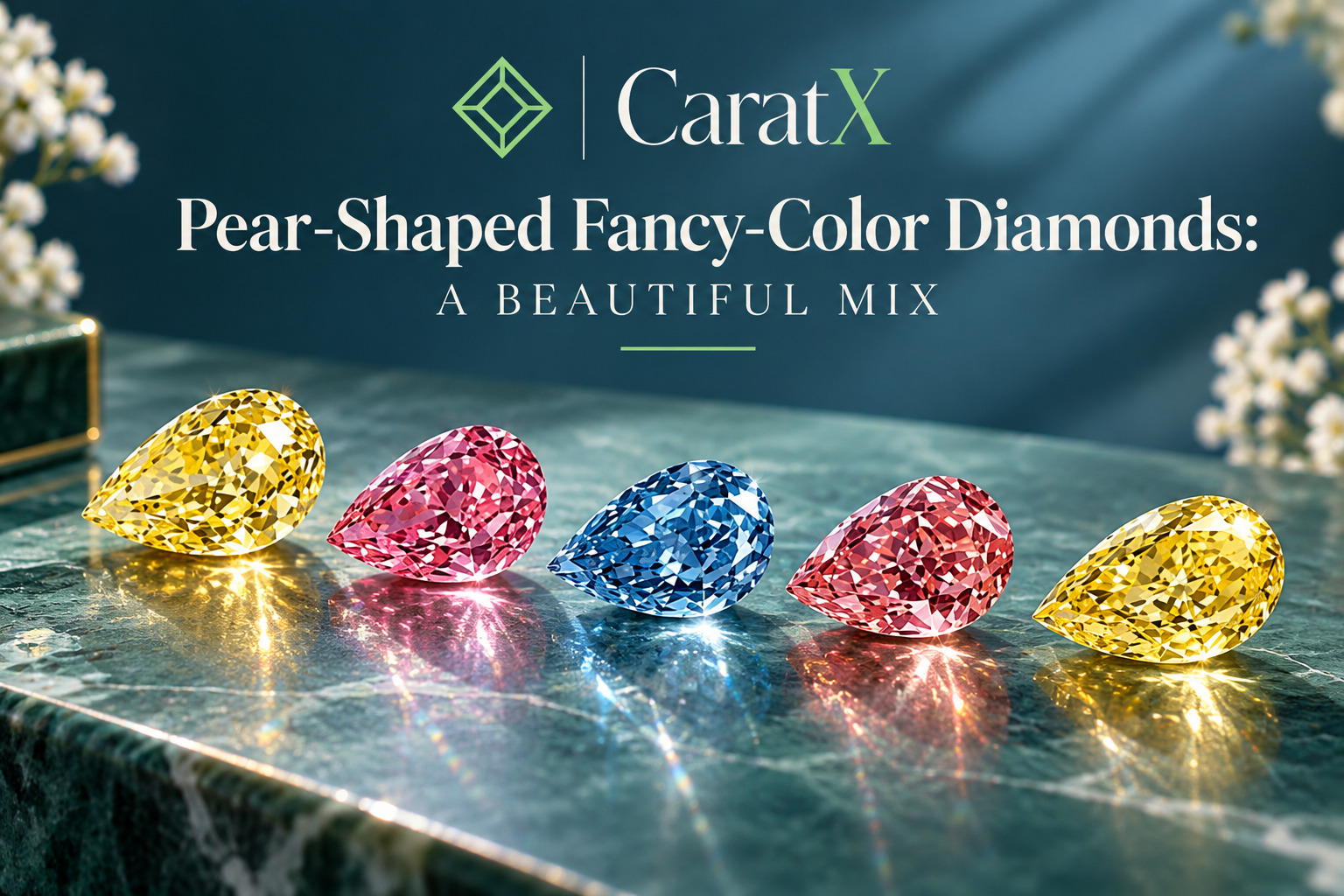
Yellow: Bright and warm. Yellow is the most common fancy color, but that does not diminish its beauty. Fancy yellow diamonds occur in a wide range of saturations, from Fancy Light to Fancy Vivid. Pear-shaped yellow diamonds are particularly striking because the elongated form amplifies the warm glow, and the price point is more accessible than for rarer hues. In a pear shape, yellow diamonds can be sourced at a fraction of the cost of comparable pink or blue stones.
Pink: Soft, beautiful, and rare.Pink diamondsare among the most sought-after fancy colors. Since 2005, pink diamonds have appreciated by 393.5%, making them a remarkable store of value as well as objects of beauty.
The pink color in natural diamonds is believed to result from plastic deformation of the crystal lattice during the diamond's journey to the surface, a process that is not yet fully understood. Apear-shaped fancy pink diamondcombines this rare hue with an elegant silhouette that distributes the pink throughout the stone's surface.
Blue: Cool, elegant, and highly rare. Only about 0.6% of all fancy color diamonds are blue, and just 0.0001% of those blue diamonds fall into the 20–24 carat weight category. The blue color in natural diamonds is caused by trace amounts of boron substituting for carbon atoms in the crystal lattice, a geochemical anomaly that requires extremely specific formation conditions. Natural Fancy Vivid Blue diamonds regularly command prices exceeding US$3–5 million per carat.
Green: Fresh and eye-catching. Naturalgreendiamonds are extraordinarily rare. The green color is typically caused by exposure to natural radiation over geological time, which displaces carbon atoms from their normal positions in the crystal lattice.Greendiamonds are among the most scientifically fascinating fancy colors because their color is a record of the diamond's radiation history.
Orange: Bright and energetic.Orange diamondsare in the rarest category of fancy colors. The color is related to the same nitrogen impurities that produce yellow, but with a different absorption pattern that shifts the hue toward orange. Orange diamonds are exceptionally uncommon in any shape, making a pear-shaped orange diamond a genuine collector's item.
The Rarity Hierarchy -
When discussing fancy-color diamonds, rarity translates directly into value. GIA identifies red, green, purple, and orange as generally the most rare fancy colors, followed by pink and blue. Yellows and browns are the most common fancy colors. However, "common" is relative, even fancy yellow diamonds are vastly rarer than colorless diamonds of equivalent size and clarity.
The most valuable fancy colors are saturated pinks, blues, and greens, with slight color differences capable of causing dramatic shifts in value. A Fancy Vivid grade commands a significant premium over Fancy Intense, which in turn commands a premium over Fancy. For collectors and investors, understanding this hierarchy is essential.
Why Pear Shape Works Exceptionally Well with Color -
Not all diamond shapes showcase color equally. The pear shape has a natural advantage: like many other fancy shapes such as the marquise orheart shape, a pear-shaped diamond tends to hold more color than a round brilliant.
This is a function of light path geometry. In a round brilliant, light enters and exits the stone through a precisely engineered pattern of reflections designed to maximize brilliance and fire. In a pear shape, the elongated pavilion and asymmetrical outline create longer light paths, which allows color to accumulate and become more visually saturated as the light travels through the stone.
For fancy-color diamonds, this is a tremendous advantage. A pear-shaped fancy pink diamond may appear one or even two grades more saturated in color than a round brilliant of the same color grade. The same principle applies to yellow, blue, and green diamonds.
This means that if you are shopping for a fancy-color diamond and want to maximize visual color impact while managing budget, a pear shape can deliver exceptional value. The elongated form does the "work" of intensifying the color, allowing you to potentially choose a lower color grade (and therefore lower price) while still achieving a satisfying depth of hue.
Explore CaratX's collection ofcertified natural pear-shaped diamondsto see how different colors perform in this distinctive silhouette.
How to Evaluate a Pear-Shaped Fancy-Color Diamond -
Symmetry:
Symmetry is the single most important quality factor for any pear-shaped diamond. Draw an imaginary line down the length of the gem and examine the two halves, the more closely they mirror each other, the better the symmetry. Both the table on the top and the culet on the bottom should be centered along this line of symmetry.
When GIA diamond graders evaluate pear-shaped symmetry, they look for a balanced and even outline. Specific problems to avoid include high shoulders, flat wings, bulged wings, and undefined points. These asymmetries not only affect beauty but also indicate cutting compromises made to preserve weight rather than optimize appearance.
The Ideal Length-to-Width Ratio -
The length-to-width ratio of a pear diamond determines its overall character. Most experts prefer a ratio in the range of approximately 1.50–1.75:1. At the lower end of this range, the pear is fuller and rounder, a shape that works well for smaller carat weights. At the higher end, the pear becomes dramatically elongated, an aesthetic that maximizes the finger-elongating effect and the visual size illusion.
For fancy-color diamonds specifically, a slightly more elongated pear can help distribute the color more evenly across the stone. A very squat pear may concentrate color near the belly, while a more elongated shape allows the color to flow from head to tip.
Clarity Considerations -
Fancy-color diamonds have a different relationship with clarity than colorless diamonds. Because the color is the dominant visual characteristic, inclusions are often less noticeable. However, clarity still matters, particularly for pear shapes, where inclusions near the point can be more visible and can also weaken the already delicate tip.
Pay particular attention to inclusions near the tip of the pear. This is the area most sensitive to damage, and a significant inclusion in this region can compromise both beauty and durability. Also consider the table facet, if it is large, inclusions beneath it may be more apparent.
Color Quality: Hue, Tone, and Saturation
When evaluating the color of a fancy-color pear diamond, assess three dimensions simultaneously:
Hue is the dominant color blue, pink, yellow, green, orange, or one of the modifier categories. For pear-shaped diamonds, the elongation can sometimes create subtle hue shifts across the stone, so examine the diamond from multiple angles.
Tone is the lightness or darkness of the color. Some collectors prefer lighter tones for pink and blue diamonds, while yellow and orange diamonds often look their best at medium tones.
Saturation is the strength of the color. This is the factor that most directly correlates with value in fancy-color diamonds. A Fancy Vivid diamond has strong, saturated color that is visible from across a room; a Fancy Light diamond has a subtle, delicate presence.
The Setting: Protecting the Point
The pointed tip of a pear diamond is its most vulnerable feature. The point concentrates stress and can chip if struck. This is why a V-prong setting is not merely aesthetic, it is functional. A V-prong wraps around the point, distributing impact forces and protecting the stone's most fragile area.
For fancy-color pear diamonds, the setting choice also affects how the color is perceived. A yellow gold setting can enhance the warmth of a yellow diamond, while a platinum or white gold setting provides neutral support that allows pink, blue, or green color to speak for itself. Consider how the setting metal interacts with the diamond's hue before making a final decision.
The Market for Fancy-Color Pear Diamonds -
Rarity and Appreciation -
The rarity of fancy-color diamonds has translated into remarkable price performance over the past two decades. Market data shows that fancy color diamond prices have increased at a compound annual rate of 5.7% over the past 20 years. Since 2005,pink diamondshave appreciated by 393.5%, blue by 242.4%, and yellow by 49.3%.
This appreciation is driven by fundamental supply constraints. Fancy-color diamonds are geological accidents, they form only under specific conditions of trace element inclusion or crystal lattice deformation. Unlike colorless diamonds, which can be found in relative abundance, fancy-color diamonds are the rarest output of diamond formation.
The most expensive fancy color diamond ever sold at auction is the Pink Star, a 59.60-carat fancy vivid pink diamond that achieved $71.2 million. While stones of this caliber are beyond the reach of most collectors, the appreciation trend applies across size ranges and price points.
Why Pear Shape Offers Value -
For buyers seeking entry into the fancy-color diamond market, the pear shape offers several practical advantages:
Lower per-carat pricing: Pear cuts generally cost less per carat than round brilliants or other popular shapes, which means you can acquire more carat weight or higher color grade for the same budget.
Natural color enhancement: The pear's light path geometry naturally intensifies color, so a Fancy Intense pear may look as vibrant as a Fancy Vivid round brilliant.
Visual size advantage: The elongated silhouette creates a larger visual footprint, maximizing the impact of your investment.
Growing demand: Pear-shapedengagement ringsand fancy-color diamonds are both trending upward, which suggests that the pear fancy-color combination is positioned for continued market interest.
CaratXconnects sellers of fancy-color pear diamonds to buyers in over 18 international countries. Sellers can register to start selling to B2B and B2C buyers through the CaratX marketplace, reaching a global audience that is actively seeking rare colored diamonds.
Sourcing and Authenticity: What to Look For
Certification Is Non-Negotiable -
Every fancy-color diamond should be accompanied by a grading report from a reputable gemological laboratory. GIA and IGI are the two most widely recognized certifying bodies for fancy-color diamonds. A GIA Colored Diamond Grading Report will document the diamond's color grade (hue, tone, and saturation), clarity, carat weight, and proportions.
If a diamond does not come with a grading report from a recognized laboratory, that is a significant red flag. Without certification, you have no independent verification of the diamond's color origin (natural versus treated) or quality characteristics. Treatment can affect value, and only a reputable laboratory can determine whether a color is natural.
Natural vs. Treated vs. Laboratory-Grown -
Not all fancy-color diamonds are natural. Some colorless diamonds are treated through irradiation, high-pressure high-temperature (HPHT) processing, or other methods to introduce color. These treated diamonds can be beautiful, but they should be priced accordingly and clearly disclosed.
Laboratory-grown fancy-color diamonds are also increasingly common. They offer the same visual characteristics as natural stones at a fraction of the cost, but they do not carry the same rarity premium. The distinction matters enormously for investment purposes.
Always verify that a fancy-color diamond is natural before paying a natural-diamond price. Reputable sellers will provide full disclosure and certification.
Browsecertified natural diamondson CaratX to explore verified fancy-color options.
Frequently Asked Questions -
Are pear-shaped fancy-color diamonds more expensive than round fancy-color diamonds?
Generally, no. Pear cuts typically cost less per carat than round brilliants of comparable color, clarity, and carat weight. The lower demand for pear shapes relative to rounds means you can often acquire a larger or more vibrantly colored stone for the same budget.
Do pear-shaped diamonds chip easily at the point?
The pointed tip does concentrate stress and is more vulnerable than the rounded sections of the diamond. However, a properly set V-prong virtually eliminates the risk of chipping during normal wear. The key is proper setting, not avoiding the shape altogether.
Which fancy color looks best in a pear shape?
All fancy colors work beautifully in pear shapes, but yellow and pink are particularly popular. Yellow diamonds in pear shapes offer excellent value because the warm color is enhanced by the elongated light paths. Pink pear diamonds are prized for their elegance and rarity.
How do I know if a fancy-color diamond's color is natural?
Only a grading report from a reputable laboratory such as GIA or IGI can confirm that a diamond's color is natural. These laboratories use advanced instrumentation to detect treatments and synthetic origin. Never purchase a fancy-color diamond without independent certification.
What is the ideal length-to-width ratio for a fancy-color pear diamond?
Most experts prefer a ratio between 1.50 and 1.75:1. For fancy-color stones, a slightly more elongated pear can help distribute color more evenly. Ultimately, the "ideal" ratio is the one that appeals to your eye and suits your intended setting.
Can I sell fancy-color pear diamonds internationally?
Yes. CaratX connects sellers to B2B and B2C buyers in over 18 international countries. Sellers can register on the CaratX marketplace to list fancy-color pear diamonds and reach a global audience of collectors, retailers, and investors.
Recommended Reads from CaratX -
Continue your diamond education with these related guides from the CaratX blog:
The Guide to Pear-Shaped Diamonds: Anatomy, Cut Quality, and Why They Dazzle— A comprehensive breakdown of pear diamond anatomy, history, and buying strategy.
The Rose Cut Diamond: Historical & Modern Styles— Explore another antique cut that pairs beautifully with colored diamonds.
Start Your Fancy-Color Pear Diamond Journey with CaratX -
Whether you are a trade professional sourcing inventory, a retailer building a fancy-color collection, or a collector seeking a rare pear-shaped treasure, CaratX provides the marketplace infrastructure to connect you with the right diamonds and the right buyers.
For sellers: Register on the CaratX marketplace to start selling to B2B and B2C buyers in over 18 international countries. List your fancy-color pear diamonds and reach a global audience actively seeking rare colored stones.
For buyers: Shopcertified natural diamondsandpear-shaped gemstoneson the CaratX marketplace. Compare certified options, verify grading reports, and acquire fancy-color diamonds at competitive prices.
For designers: Sell jewelry internationally through the CaratX seller plan. Whether you are creating a pear-shaped fancy pink engagement ring or a yellow diamond pendant, CaratX connects you with buyers who appreciate exceptional gemstones.
Launch your products on CaratXand join a global marketplace built for the diamond and gemstone trade.