
A data-driven deep dive into why a 0.37 ct pear-shapedpink diamondis rare, but a round one of the same colour, clarity, and weight ismore than twice as rareand what that means for buyers, sellers, and investors navigating the post-Argyle pink diamond market.
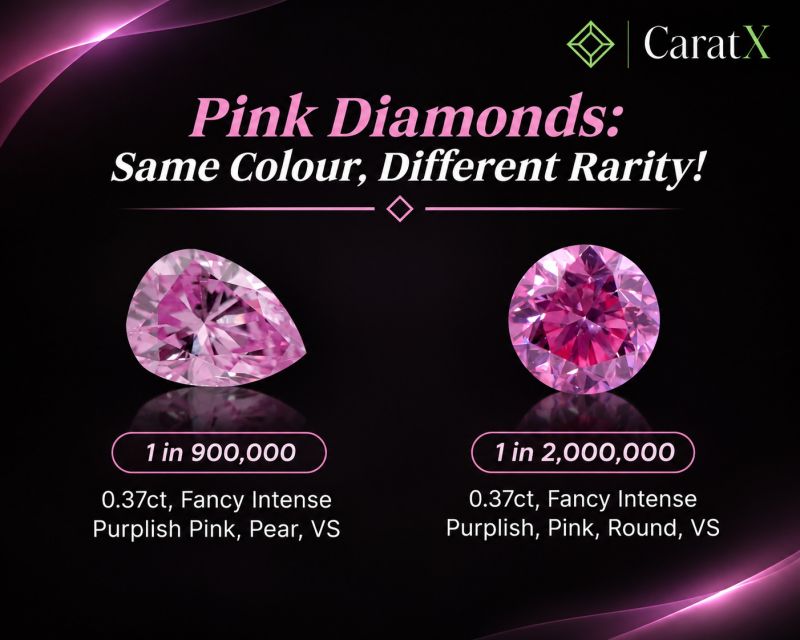
Two pink diamonds sit side by side. Both weigh 0.37 carats. Both are graded Fancy Intense Purplish Pink. Both carry VS clarity. On paper, they look identical.
They are not.
Thepear-shaped stoneis a rarity of roughly 1 in 900,000. Theround stoneis a rarity of roughly 1 in 2,000,000. Same colour. Same weight. Same clarity. One is more than twice as rare as the other and the difference comes down to shape.
This is the central insight of the Fancy Color Research Foundation’s rarity analysis: in the world of fancy-colour diamonds, rarity is never a single variable. It is a matrix of weight, colour intensity, clarity, and critically shape. Understanding that matrix is the difference between buying a beautiful stone and acquiring a genuinely scarce asset.
This guide unpacks the data, the geology, and the market mechanics behind pink diamond rarity. It explains whyround pink diamondsare vanishingly scarce, why the Argyle mine’s closure changed the supply equation forever, and how platforms likeCaratXare giving buyers and sellers direct access to a market where shape and supply now drive value as much as colour.
The FCRF Rarity Framework: Rarity Is Not a Feeling, It Is a Calculation
The Fancy Color Research Foundation (FCRF) introduced the industry’s first systematic rarity evaluator for fancy-colour diamonds, assigning rarity grades based on carat weight, colour, colour intensity, clarity, and shape. Its reports translate those variables into a simple, powerful statement:how often does a diamond with these exact characteristics enter the global market?
The answer can range from “once every few years” to “once every 25 years or more” or, in extreme cases, 1 in approximately 60,000,000 diamonds.
Two data points frame the pink diamond conversation:
Only about 3% of all diamonds above 1 carat submitted to grading labs are classified as fancy colour.
Pink diamonds represent only about 8.2% of all fancy-colour diamonds.
Pink is already a minority within a minority. But the FCRF data shows that even within that tiny population,shapecreates enormous variation in how rare a stone truly is.
The Shape Penalty: Why Round Pink Diamonds Are Disproportionately Scarce
The numbers that matter -
The FCRF rarity report cited in the briefing compares two 0.37 ct Fancy Intense Purplish Pink VS diamonds:
Characteristic Pear-Shaped Pink Diamond Round Pink Diamond
Weight 0.37 ct 0.37 ct
Colour Fancy Intense Purplish Pink Fancy Intense Purplish Pink
Clarity VS VS
Rarity 1 in 900,000 1 in 2,000,000
Share of pink / purplish-pink production~19% ~2.3%
The round stone is more than twice as rare as the pear, even though every other graded characteristic is identical. The reason is structural, not cosmetic:pear shapesaccount for roughly 19% of pink and purplish-pink diamonds entering the market, while round cuts represent only about 2.3%.
Why cutters avoid rounds in pink rough -
Diamond cutting is an exercise in yield optimisation. Rough diamonds are extraordinarily expensive, and every fraction of a carat lost during polishing is money lost. For colourless diamonds, the round brilliant is the standard because its proportions maximise light return and fire. But for fancy-colour diamonds and especially for pink diamonds the priority shifts frombrillianceto colour retention.
Pink colour in natural diamonds is not caused by a trace element like nitrogen (yellow) or boron (blue). In the vast majority of cases, it comes from plastic deformation a distortion of the diamond’s crystal lattice that produces a broad absorption band centred around 550 nanometres, absorbing green light and allowing pink to dominate.
That colour is often concentrated in parallel bands or graining within the stone. Cutters therefore orient the rough to maximise the face-up colour, even if that means sacrificing the symmetrical proportions of a round brilliant.
The result is a classic supply-chain trade-off: pear shapes, ovals, cushions, and emerald cuts preserve more pink colour per carat of rough, so they dominate pink diamond production. Round cuts require a different yield calculation one that most cutters of rare pink rough are unwilling to make. The 2.3% figure is not a matter of consumer preference. It is a structural consequence of how pink rough is cut.
Browse live pink diamond inventory by shape on the CaratX marketplaceincluding round, pear, oval, and fancy-cut pink stones from verified sellers.
The Geology Behind the Rarity: Why Pink Diamonds Should Not Exist at All
Pink diamonds are a geological paradox. Most coloured diamonds owe their hue to impurities: nitrogen for yellow, boron for blue, radiation damage for green. Pink diamonds are different. TheGemological Institute of America (GIA)has confirmed that 99.5% of pink diamonds derive their colour from distortion in their crystal structure not from trace elements.
That distortion plastic deformation occurs when a diamond is subjected to immense pressure and heat deep in the Earth, causing its carbon atoms to shift out of their normal positions. The process is associated with ancient continental collisions and mountain-building events.
The Argyle mine in Western Australia, which produced more than 90% of the world’s pink diamonds before its closure in November 2020, sits in a region that experienced exactly this kind of ancient tectonic activity.
The geological implication is profound. Pink diamonds are not merely rare because few are found. They are rare because the conditions that create them are rare and because those conditions cannot be replicated in a laboratory in the same way that yellow or blue diamonds can be grown or treated. GIA researchers have stated that there is no known method of replicating the plastic deformation responsible for natural pink colour through laboratory treatment or growth.
This is why the FCRF’s rarity grades carry so much weight. When the report says a diamond enters the market once every 25 years or more, it is not describing a marketing scarcity. It is describing a geological bottleneck.
Learn more about the science of fancy-colour diamonds in CaratX’s Complete Guide to Natural Fancy Color Diamonds.
The Argyle Closure: A Supply Shock That Rewrote the Pink Diamond Market
For nearly four decades, the Argyle mine was the backbone of the pink diamond supply chain. At its peak, it produced over 42 million carats of rough diamonds in a single year, representing 40% of global diamond production by volume.
But pink diamonds were always a tiny fraction of that output. Even in a good year, pink diamonds represented fewer than 10,000 carats out of 25–30 million carats of rough production. Rio Tinto reported that less than 0.1% of Argyle’s total production of 865 million carats was pink.
When Argyle closed in November 2020, the pink diamond market lost its primary source. There is no new Argyle. No comparable deposit has been discovered. Secondary sources the Williamson mine in Tanzania, sporadic production from Russia’s Mir deposit, and small finds elsewhere produce pink diamonds in quantities so small they do not meaningfully replace Argyle’s output.
The market response has been dramatic. Pink diamond prices have risen sharply since 2020, with some analysts noting double-digit annual growth in the years following the closure. Auction records tell the same story: the 11.15-carat Williamson Pink Star sold for US$57.7 million in 2022, and the 59.60-carat Pink Star remains one of the most valuable gemstones ever sold at auction.
But the closure did more than raise prices. It changed the nature of the market. Pink diamonds are no longer a primary-supply business. They are a secondary-market asset class a finite, known inventory that is traded among collectors, investors, and dealers. That shift has profound implications for how rarity is assessed, priced, and communicated.
If you hold pink diamonds or other rare coloured stones, the current market conditions favour sellers. Register as a CaratX seller to list your inventory to B2B and B2C buyers in 18+ international countries.
From Rarity to Value: How the Market Prices Pink Diamonds
Rarity is the foundation of value in fancy-colour diamonds, but it is not the only variable. The GIA grades fancy-colour diamonds on three dimensions hue, tone, and saturation and the difference between Fancy Intense and Fancy Vivid can be the difference between a six-figure stone and a seven-figure stone.
Pink diamonds follow the same logic. The GIA’s colour grading scale for pinks runs from Faint and Very Light through Fancy Light, Fancy, Fancy Intense, and Fancy Vivid. Fancy Vivid pinks are the most saturated and the most valuable, while pure pinks (without secondary hues like purple, orange, brown, or grey) command premiums over their modified counterparts.
Clarity matters too, but differently than it does for colourless diamonds. In pink diamonds, VS and VVS clarities are considered high grades precisely because the colour often masks inclusions that would be more visible in a colourless stone. The FCRF rarity report cited in the briefing uses a 0.37 ct Fancy Intense Purplish Pink VS as its benchmark a specification that is already rare, but whose rarity multiplies when the shape is changed from pear to round.
The market implications are clear:
Shape is a value lever. A round pink diamond of a given weight, colour, and clarity is rarer than a pear-shaped equivalent, and the market prices that scarcity accordingly.
Size magnifies rarity. The FCRF data shows that rarity accelerates with carat weight. A 0.37 ct pink is rare; a 5-carat pink of comparable colour is a once-in-a-decade event.
Colour intensity is non-linear. Moving from Fancy Intense to Fancy Vivid can produce a disproportionate jump in per-carat value, because the supply of vivid pink stones is a fraction of the supply of intense stones.
Explore certified natural pink diamonds across colour intensities and shapes on CaratX. For buyers seeking investment-grade stones, CaratX’s curated natural pink selection includes Fancy Intense and Fancy Vivid specimens with documented grading reports.
What This Means for Buyers: A Practical Framework for Assessing Pink Diamond Rarity
If you are buying a pink diamond whether as a collector, an investor, or a jeweller sourcing for a client, the FCRF framework gives you a disciplined way to evaluate scarcity beyond the four Cs.
1. Start with the shape–rarity ratio -
Ask a simple question: what percentage of pink diamonds are cut into this shape? Pear shapes and ovals are relatively more common (though still rare in absolute terms). Round brilliants are exceptional, accounting for only about 2.3% of pink and purplish-pink diamonds. If you are comparing two stones of similar colour and clarity, the round stone carries a measurably higher rarity premium.
2. Verify the colour grade and the modifier -
A “Fancy Intense Purplish Pink” is not the same as a “Fancy Intense Pink.” The secondary hue (purplish, orangy, brownish, grayish) affects both the stone’s appearance and its rarity. Pure pinks are rarer than modified pinks, and the GIA’s grading language captures that distinction precisely. Always buy with a GIA or equivalent laboratory report that states the full colour grade, including modifiers.
3. Check the clarity in context -
In pink diamonds, VS and VVS clarities are genuinely high grades because the colour can conceal inclusions. But clarity should be assessed alongside colour: a stone with exceptional colour and VS clarity is rarer than a stone with the same colour and SI clarity, because the combination of high colour and high clarity is less frequently encountered in nature.
4. Understand the supply backdrop -
Every natural pink diamond now comes from a fixed, non-replenishing supply. The Argyle mine is closed. No new source of comparable scale has emerged. That means the rarity grades assigned by the FCRF today are not static they are likely to becomemorerestrictive over time as existing inventory is absorbed by collectors and investors.
5. Buy from a transparent marketplace -
Rarity claims are only as good as the data behind them. Look for sellers who provide GIA or IGI grading reports, disclose the full colour grade (including modifiers), and can explain the shape–rarity relationship for the specific stone. Platforms that connect verified sellers directly to buyers likeCaratXreduce the information asymmetry that has historically made the fancy-colour diamond market opaque.
Shop natural pink diamonds with certified grading on CaratX. For lab-grown pink diamonds and other fancy-colour stones, explore theCaratX diamond search.
What This Means for Sellers: Positioning Pink Diamonds in a Secondary-Market World
If you are a seller a dealer, a jeweller, or a private collector, the post-Argyle market rewards evidence-based positioning. The old approach of describing a pink diamond as “rare” is no longer sufficient. Buyers now have access to rarity frameworks, grading databases, and market data. The sellers who succeed are those who can quantify what makes their stone scarce.
The FCRF rarity report gives you a vocabulary for that conversation. Instead of saying “this is a rare pink diamond,” you can say:“This is a 0.37 ct Fancy Intense Purplish Pink VS round diamond a shape that represents only about 2.3% of pink diamond production, with a rarity of approximately 1 in 2,000,000.”That is a fundamentally different sales proposition. It moves the conversation from aesthetics to asset characteristics.
Sellers on CaratX can reach B2B and B2C buyers in 18+ international countries through a marketplace designed for coloured stones and fine jewellery. The platform offers tiered seller plans from a free entry tier to Professional and Enterprise accounts with API access, custom domains, and priority search placement, so sellers can scale their presence as their inventory and customer base grow.
Ready to list pink diamonds, coloured gemstones, or fine jewellery? Request a CaratX seller accountaccount creation is free and takes less than a minute. For high-volume operations, compareCaratX seller plans and pricingto find the tier that matches your inventory and sales volume.
Recommended Reads from CaratX -
Beyond Volume: How Australia Dominates the Premium Tier of Diamonds, Pearls, and Gemstones— The full story of the Argyle legacy and what it means for buyers and sellers of Australian pink diamonds.
The Guide to Colored Diamonds: Rarity, Value, and Investment Potential of Every Hue— A colour-by-colour breakdown of the fancy-colour diamond market, including pricing dynamics and investment considerations.
Diamonds in Every Shade: The Complete Guide to Natural Fancy Color Diamonds— The science of diamond colour, from nitrogen-doped yellows to boron-blue stones and plastically deformed pinks.
Browse the full CaratX blog for more market intelligence, buying guides, and seller resources: CaratX Blog.
Frequently Asked Questions (FAQs) -
Why is a round pink diamond rarer than a pear-shaped pink diamond of the same colour and weight?
Because round cuts represent only about 2.3% of pink and purplish-pink diamond production, while pear shapes account for around 19%. The disparity is a consequence of how cutters prioritise colour retention over brilliance when working with rare pink rough. The FCRF data translates this supply difference into a rarity ratio: roughly 1 in 900,000 for the pear versus 1 in 2,000,000 for the round.
What causes pink colour in natural diamonds?
The overwhelming majority of natural pink diamonds about 99.5% derive their colour from plastic deformation of the crystal lattice, not from trace elements. This distortion creates a broad absorption band around 550 nanometres that absorbs green light and allows pink to dominate. The process is associated with ancient tectonic activity and cannot currently be replicated in a laboratory.
Did the Argyle mine closure really change the pink diamond market?
Yes. Argyle produced more than 90% of the world’s pink diamonds before it closed in November 2020. Pink diamonds were always a tiny fraction of its output less than 0.1% of total production but that fraction represented the vast majority of global supply. With the mine closed and no comparable source discovered, pink diamonds have shifted from a primary-supply market to a secondary-market asset class, with prices rising accordingly.
Are lab-grown pink diamonds as rare as natural pink diamonds?
No. Lab-grown pink diamonds can be produced through controlled processes, whereas the specific plastic deformation responsible for natural pink colour has no known laboratory replication. Natural pink diamonds are therefore geologically scarce in a way that lab-grown stones are not. Lab-grown pink diamonds offer an accessible alternative for jewellery, but they do not carry the same rarity profile as natural pink diamonds.
How can I verify the rarity of a pink diamond before buying?
Look for a GIA or IGI grading report that states the full colour grade (including modifiers such as Purplish or Orangy), clarity, carat weight, and shape. Then cross-reference those specifications against a rarity framework such as the FCRF’s rarity evaluator to understand how frequently a stone with those exact characteristics enters the market. Buying from a transparent marketplace with verified sellers, such asCaratX, reduces the risk of inaccurate rarity claims.
What is the most valuable pink diamond colour grade?
Fancy Vivid Pink is the most saturated and valuable pink grade on the GIA scale. Within that grade, pure pinks (without secondary hues) command the highest premiums, and stones with VVS clarity and round or fancy shapes are exceptionally rare. Auction records for top-tier pink diamonds have exceeded US$5 million per carat, reflecting the intersection of colour, clarity, size, and shape scarcity.