
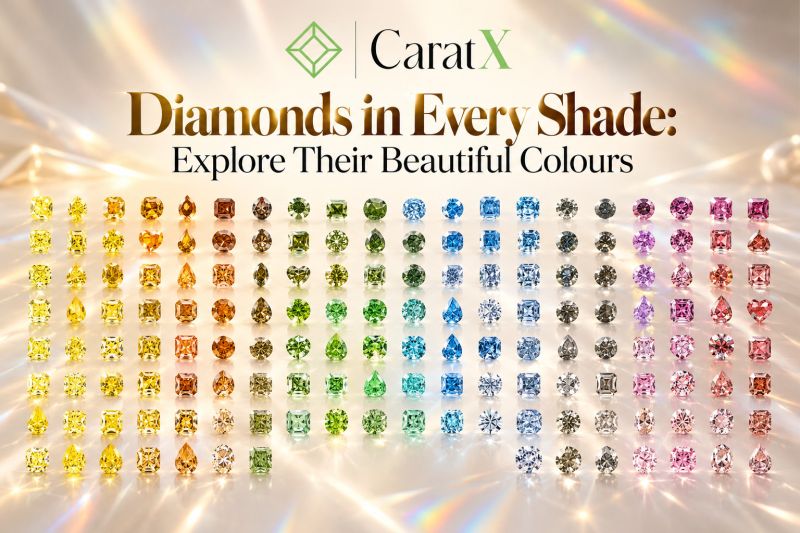
Diamonds are not only white or colourless. Nature creates them in a breathtaking spectrum of colours from the icy purity of a D‑colour stone to the electric fire of a Fancy Vivid Pink. These fancy colour diamonds are among the rarest and most valuable treasures on Earth, formed by quirks of geology that scientists are still unravelling.
This guide explores the science, rarity, and market of every major diamond hue, with direct links to certified inventory on theCaratX marketplacewhere you can explore these stones for yourself.
The Science of Diamond Colour:
A perfect diamond is pure carbon, arranged in a rigid lattice. But perfection is rare. Most diamonds contain trace impurities or structural flaws and these “defects” are precisely what create colour.
TheGemological Institute of America(GIA), the world’s foremost authority on diamond grading, classifies colour causes into three broad categories:
Trace‑element impurities introduced during crystallisation deep in the mantle. Nitrogen is the most common, producing yellow; boron produces blue.
Structural distortions plastic deformation of the crystal lattice under immense pressure which create pink and red hues without any foreign element.
Radiation damage, where natural irradiation displaces carbon atoms from their normal positions, creating green colour centres.
The geological history of a diamond also matters.Blue diamonds, for instance, originate at extreme depths 410 miles or more into the lower mantle where boron is scarce but present in minute quantities. This deep origin helps explain their legendary rarity.
Colour‑by‑Colour: The Spectrum of Nature’s Rarest Gems
Colourless (D–Z): The Classic Benchmark
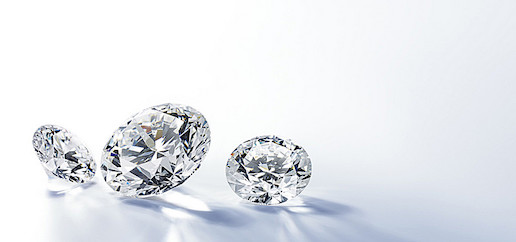
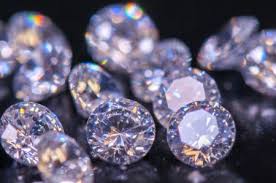
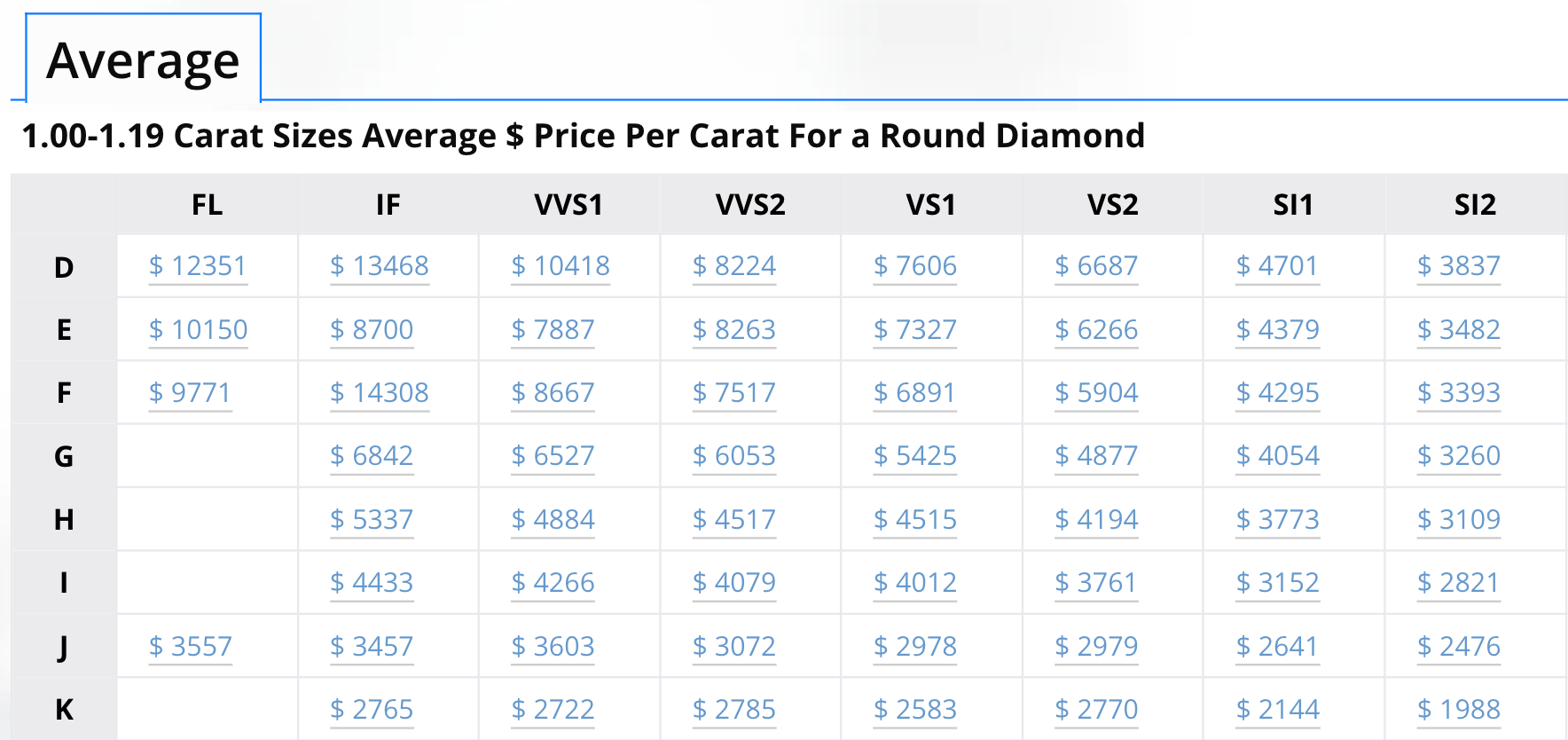
Strictly speaking, colourless diamonds are not “fancy” colours. They are graded on the D‑to‑Z scale, where D is perfectly colourless and Z is light yellow or brown. Their value lies in the absence of colour, allowing maximum light return and brilliance.
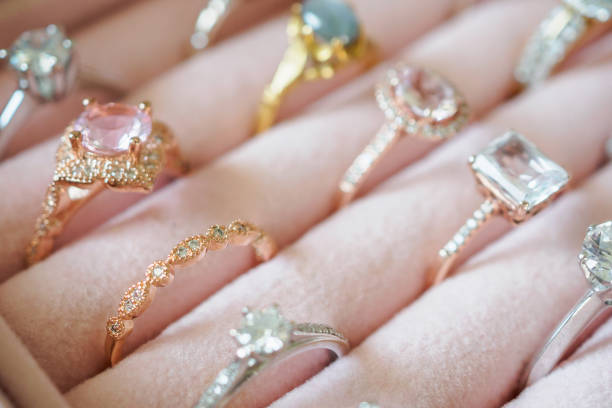
Most gem‑quality diamonds fall into this range, and they remain the universal standard forengagement ringsandfine jewellery. Explore certified colourless and near‑colourless stones in thenatural diamonds collection on CaratX.
Yellow Diamonds:
Yellow is diamond’s second most common fancy colour. The hue comes from nitrogen atoms incorporated into the crystal lattice, which absorb blue light and allow yellow to be reflected. The intensity depends on the concentration and arrangement of nitrogen centres.
Highly saturated stones sometimes marketed as “canary” are the most desirable. While yellow diamonds are the most accessible entry point into fancy colours, Fancy Vivid yellows still command significant premiums.
Browse theyellow diamond selection on CaratXto see live inventory.
Blue Diamonds:
Blue diamonds are among the rarest and most valuable. Their colour is caused by boron impurities substituting for carbon atoms less than one boron atom per million carbon atoms is enough to produce a blue hue.
The more boron, the deeper the blue. The legendary 45.52‑carat Hope Diamond, housed at the Smithsonian, is the world’s most famous example of a Fancy Deep grayish‑blue diamond, and its colour is indeed due to trace boron.
Blue diamondsalso tend to have a slight grey modifier, so they rarely approach the saturation ofblue sapphires. Discover rare blue stones through theCaratX diamond search.
Pink and Red Diamonds:
Pink diamondsare a geological paradox. Unlike yellow or blue stones, their colour is not caused by a chemical impurity. Instead, it arises from plastic deformation, a physical warping of the crystal lattice under immense pressure and heat deep in the mantle. This distortion creates defects that absorb green light and reflect pink to red. The now‑closed Argyle mine in Australia produced over 90% of the world’s pink diamonds, and its closure in 2020 has made existing stones even more collectible.
Red diamondsare the absolute rarest of all fancy colours. Fewer than thirty true red natural diamonds are known to exist worldwide, and they are believed to result from an extreme version of the same lattice distortion that causes pink. The 5.11‑carat Moussaieff Red is the largest known.
Green Diamonds:
Naturalgreen diamondsget their colour from radiation exposure over millions of years. As diamonds reside in alluvial deposits near radioactive rocks, alpha particles displace carbon atoms, creating colour centres that absorb red light and reflect green. The colour is often confined to the surface, so a uniformly green bodycolour is exceptionally rare.
The famed 41‑carat Dresden Green is one of the largest and most celebrated natural green diamonds. Because irradiation can also be done artificially, green diamonds are scrutinised with particular care in gemological laboratories.
See availablegreen diamonds on CaratX.
Orange Diamonds:
Pureorange diamonds, without brown or yellow modifiers, are extraordinarily rare. Their colour is linked to a combination of nitrogen and specific structural defects, often involving the 480 nm absorption band.
Stones with strong, pure orange saturation are almost exclusively found at high‑profile auctions. When they appear, they are highly collectible.
Browse theCaratX gemstone and diamond marketplacefor exceptional stones.
Brown Diamonds:
Brown is the most common fancy diamond colour. Its hue is linked to plastic deformation and internal grain lines, sometimes combined with nitrogen. Once relegated to industrial use, brown diamonds were rebranded in the 1980s as “champagne” and “cognac,” creating a vibrant market for affordable, fashionable jewellery.
While more abundant than pinks or blues, fine brown diamonds with warm, golden tones remain popular.
Explorebrown diamonds on CaratX.
Beyond the Rainbow: Black, White, Grey, and Violet
Black diamonds owe their opacity to dense inclusions of graphite or other minerals, not to trace elements. Fancy white diamonds have a milky, translucent appearance caused by submicroscopic inclusions.
Grey and violet diamonds can result from boron, hydrogen, or structural defects, often with secondary hues. These colours offer unique alternatives for collectors seeking something outside the traditional spectrum.
The GIA Fancy Colour Grading Scale: Hue, Tone, Saturation
Fancy colour diamonds are not graded on the D‑to‑Z scale. Instead, GIA evaluates them on three dimensions:
Hue: the dominant colour (e.g., pink, blue, yellow).
Tone: the lightness or darkness of the hue.
Saturation: the strength or intensity of the colour.
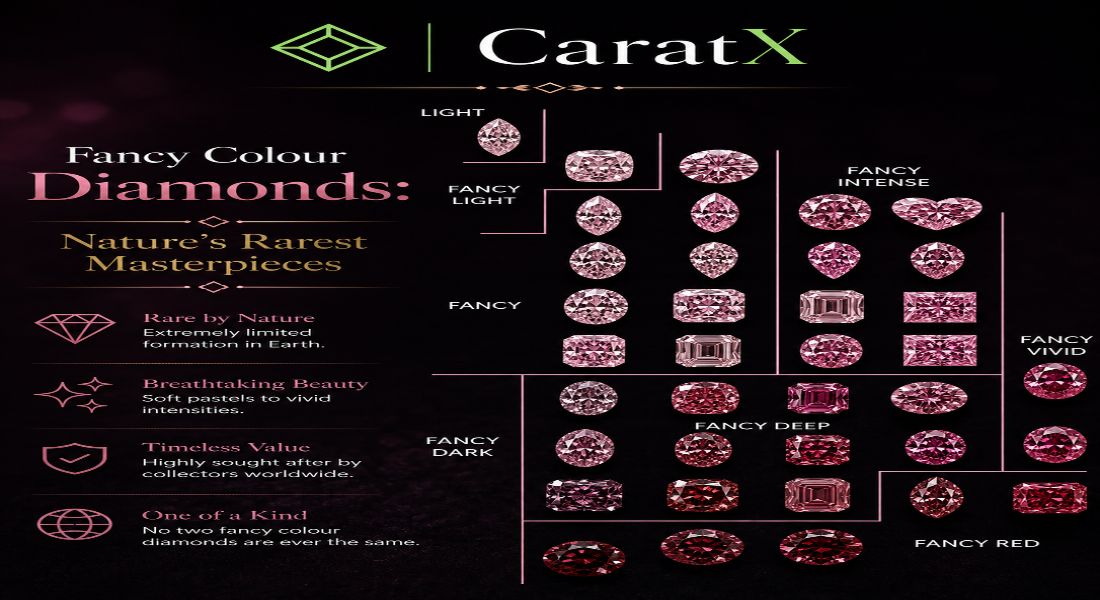
The GIA uses a nine‑step scale of colour intensity, from Faint and Very Light through Fancy Light, Fancy, Fancy Intense, Fancy Vivid, Fancy Deep, and Fancy Dark.
Fancy Vivid and Fancy Intense generally command the highest prices because they represent the pinnacle of colour saturation. Even slight differences in colour can have a dramatic impact on value.
Rarity, Value, and the Investment Case -
Fancy colour diamonds are staggeringly rare. According to GIA, only one in 10,000 carats of fashioned diamonds displays a fancy colour, and the odds of an intense, vivid colour drop to one in 25,000. The rarest and most valuable hues are saturated pinks, blues, and greens, followed by reds and oranges.
Auction records illustrate the market’s appetite:
The CTF Pink Star, a 59.60‑carat Fancy Vivid Pink diamond, sold for US$71.2 million in 2017, becoming the most expensive gem ever auctioned at the time.
The Hope Diamond, a 45.52‑carat Fancy Deep grayish‑blue stone, remains the world’s most famous blue diamond.
Red diamonds are so rare that GIA did not issue a single report for a diamond with “red” as its only descriptive term between 1957 and 1987.
This combination of geological scarcity and growing collector demand has made fancy colour diamonds an increasingly compelling alternative asset class. The Fancy Color Research Foundation has reported that overall fancy colour prices have risen 205% since 2005, outpacing many traditional assets.
Buying Fancy Colour Diamonds with Confidence -
When purchasing a coloured diamond, certification is non‑negotiable. A GIA Colored Diamond Grading Report verifies the stone’s colour grade and confirms whether the colour is natural or the result of treatment. Because treatments irradiation, HPHT annealing, and coating can mimic natural colour, buying from a transparent, vetted marketplace is critical.
CaratXis the exclusive diamond and gemstone hub connecting B2B sellers to buyers in over 18 international countries. For buyers, the platform offers a curated inventory of natural coloured diamonds and gemstones at wholesale prices.
For sellers, CaratX provides the infrastructure to reach a global audience of B2B and B2C buyers.
Shop natural diamonds: https://caratx.com/search?query=Natural
Browse gemstones: https://caratx.com/search?query=gemstones
Register as a seller to start selling to 18+ international countries:https://www.caratx.com/register
Learn more about pricing and launching your products: https://caratx.com/sell-on-caratx
Frequently Asked Questions (FAQs)
What causes diamond colour? Colour arises from trace‑element impurities (nitrogen for yellow, boron for blue), structural distortions of the crystal lattice (pink, red, brown), or radiation damage (green). Each colour has a distinct geological story.
Are coloured diamonds more expensive than colourless diamonds? Not always—brown and yellow diamonds can be more affordable than high‑colourless stones. However, rare colours such as pink, blue, green, and red command extreme premiums because of their scarcity. A Fancy Vivid pink or blue diamond can sell for many times the price of a colourless diamond of similar size and clarity.
What is the rarest diamond colour? Red is the rarest, followed by blue, pink, and green. Fewer than thirty true red diamonds are known to exist. Pure orange and violet are also exceptionally rare.
How does GIA grade fancy colour diamonds? GIA grades fancy colours on hue, tone, and saturation using a nine‑step scale from Faint to Fancy Vivid, Fancy Deep, and Fancy Dark. Fancy Intense and Fancy Vivid generally command the highest prices.
Can coloured diamonds be treated? Yes. Irradiation, HPHT treatment, and coating can alter or enhance colour. Always insist on a GIA report that states whether the colour is natural or treated. Natural‑colour stones are significantly more valuable.
Recommended Reads from CaratX -
Expand your knowledge with these in‑depth guides from the CaratX blog:
The Guide to Colored Diamonds: Rarity, Value, and Investment Potential of Every Hue— A comprehensive breakdown of rarity, formation, and market dynamics for every major colour.
Pink Diamonds: From Soft Blush to Deep Red-Pink, The Complete Guide to Nature’s Rarest Treasures— The science of plastic deformation, the Argyle legacy, and the legendary stones that have shattered auction records.
The Types of Natural Diamond Colors: A Complete Guide— A colour‑by‑colour reference covering white, yellow, brown, blue, pink, red, green, and more.
Red Diamonds: The World’s Rarest and Most Valuable Fancy Color Diamonds— Why fewer than thirty true red diamonds are known to exist, and what makes them the peak of scarcity.
Why Fancy Color Diamonds Are Capturing Attention in 2026: The Complete Investor & Collector’s Guide— Market trends, grading insights, and the investment case for coloured diamonds.
Sources and Citations -
This article draws on authoritative gemological research and industry data. Sources are cited in accordance with modern editorial standards.
Gemological Institute of America (GIA). (n.d.).Fancy color diamond.https://www.gia.edu/fancy-color-diamond
Gemological Institute of America (GIA). (n.d.).Fancy color diamond quality factors.https://www.gia.edu/fancy-color-diamond-quality-factor
Gemological Institute of America.The timeless intrigue of colored diamonds. 4Cs Blog.https://4cs.gia.edu/en-us/blog/timeless-intrigue-colored-diamonds/
Gemological Institute of America (GIA). (n.d.).Fancy‑color diamonds. 4Cs Blog.https://4cs.gia.edu/en-us/blog/fancy-color-diamonds/
Gemological Institute of America (GIA). (2024). Lab notes.Gems & Gemology, 60(1).https://www.gia.edu/doc/spring-2024-lab-notes.pdf
Breeding, C. M., et al. (2022). Diamond spectroscopy, defect centers, color, and treatments.Reviews in Mineralogy and Geochemistry, 88(1), 637. GeoScienceWorld.https://pubs.geoscienceworld.org/msa/rimg/article/88/1/637/614938/Diamond-Spectroscopy-Defect-Centers-Color-and
Cape Town Diamond Museum. (2019, September 2).White/colourless diamonds vs fancy colour diamonds.https://www.capetowndiamondmuseum.org
Natural History Museum. (n.d.).Fascinating facets: The Pink Starburst diamond.https://nhm.org
Smithsonian Magazine. (2020, November 12).Get to know the Hope Diamond’s keeper.https://www.smithsonianmag.com
CaratX. (2026).The guide to colored diamonds: Rarity, value, and investment potential of every hue.https://caratx.com/blog/the-guide-to-colored-diamonds-rarity-value-and-investment-potential-of-every-hue
CaratX. (2026).Pink diamonds: From soft blush to deep red‑pink.https://caratx.com/blog/pink-diamonds-from-soft-blush-to-deep-red-pink-the-complete-guide-to-nature-s-rarest-treasures
CaratX. (2026).Red diamonds: The world’s rarest and most valuable fancy color diamonds.https://caratx.com/blog/red-diamonds-the-worlds-rarest-and-most-valuable-fancy-color-diamonds
Follow CaratXfor more insightful and educational content on diamonds, gemstones, and the global jewellery trade.
Start selling to buyers in 18+ international countries register today atwww.caratx.com/register.