
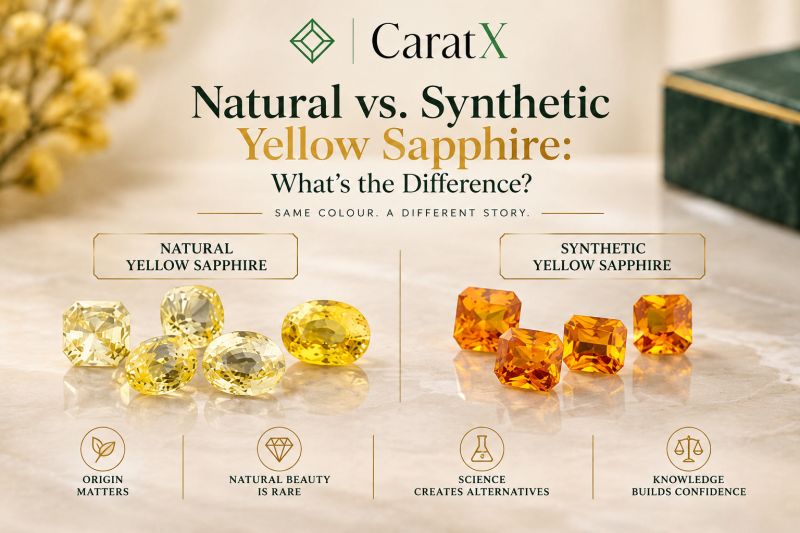
Yellowsapphireis one of the most beloved gemstones in the world prized for its warm, sunlit hue, exceptional hardness, and deep cultural significance. In India, it is the gemstone of Jupiter (Guru), worn for wisdom, prosperity, and marital harmony. In Western markets, it has become a top choice forengagement ringsandfine jewelry, offering a vivid alternative to blue sapphire at a more accessible price point.
But as demand has grown, so has the presence of synthetic yellow sapphire in the market. To the untrained eye, a lab-grown yellow sapphire can look identical to a natural one. Yet the differences in origin, formation, inclusions, value, and long-term investment potential are profound.
This definitive guide, brought to you byCaratX, breaks down everything you need to know about natural vs. synthetic yellow sapphire: the science, the identification techniques, the market pricing, and the ethical considerations. Whether you are a jeweler, a collector, or a first-time buyer, this article will give you the knowledge to make confident, informed decisions.
What Is Yellow Sapphire?
Sapphire is a variety of the mineral corundum, which in its purest form is composed of crystallized aluminum oxide (Al₂O₃). Pure corundum is completely colorless. Color arises when trace elements substitute for aluminum atoms in the crystal lattice during formation.
In the case of yellow sapphire, the primary color-causing element is iron (Fe³⁺). As the Gemological Institute of America (GIA) explains, natural yellow sapphires are colored by one of two entirely different chromophores or by a combination of the two: the iron (Fe³⁺) chromophore and a trapped hole paired with iron (h•-Fe³⁺). Low-iron-content natural yellow sapphires such as those from Sri Lanka are colored solely by the h•-Fe³⁺ chromophore, while high-iron sapphires from Australia and Thailand are colored by both.
For a deeper dive into the science of sapphire color, see our guide:Why Do Sapphires Come in So Many Colors? The Complete Scientific Guide.
Sapphire ranks 9 on the Mohs scale of mineral hardness, second only to diamond. This exceptional durability makes it ideal for everyday jewelry, including engagement rings andwedding bands. To understand how hardness impacts jewelry longevity, read our detailed analysis:The Mohs Scale Decoded: The Ultimate Guide to Gemstone Hardness and Durability in Fine Jewelry.
Natural Yellow Sapphire:
Natural yellow sapphire forms deep within the Earth's crust and mantle under extreme heat and pressure, over geological time scales that span millions to billions of years. The gemstone is typically found in two types of geological environments:
Metamorphic deposits (e.g., Sri Lanka, Madagascar) — where corundum forms in marble and gneiss terrains.
Basaltic deposits (e.g., Australia, Thailand, Cambodia) — where corundum is brought to the surface by alkali basalt volcanism.
The geological origin of a sapphire influences its trace element chemistry, which in turn affects its color, clarity, and inclusion profile. GIA field gemologists have documented that yellow sapphires from Sri Lanka tend to be colored by the h•-Fe³⁺ chromophore alone, producing a pure, light-stable yellow, while Australian and Thai sapphires often contain higher iron concentrations and may exhibit a more brownish or greenish secondary hue.
Natural Inclusions:
One of the most reliable ways to distinguish natural from synthetic yellow sapphire is through inclusions, internal features trapped during crystal growth. Natural sapphires often contain:
Mineral inclusions such as spinel, zircon, rutile, and pargasite.
Fingerprint inclusions healed fractures that resemble human fingerprints.
Color zoning straight or angular growth bands that reflect the crystal's natural growth environment.
Silk fine, needle-like rutile inclusions that can produce asterism (star effect) when oriented correctly.
The GIA maintains a comprehensive inclusion chart for natural, synthetic, and treated sapphires, which is an essential reference for gemologists and serious buyers. For a detailed discussion of gemstone zoning, see our article:Gemstone Zoning: Nature's Hidden Color Pattern.
Synthetic Yellow Sapphire:
Synthetic yellow sapphire also called lab-grown or laboratory-created sapphire has essentially the same chemical composition (Al₂O₃) and crystal structure (trigonal) as natural sapphire. The difference lies in how it is made.
The most common production method is the Verneuil process (flame fusion), developed by Auguste Verneuil in the late 19th century. In this method, finely powdered alumina is dropped through a hydrogen-oxygen flame, where it melts and crystallizes into a boule (a synthetic crystal). The Verneuil process can produce synthetic sapphire in a matter of hours, making it inexpensive and widely available.
Other production methods include:
Czochralski pulling — a slower, more controlled method that produces higher-quality crystals.
Hydrothermal growth — mimics natural crystal growth in an aqueous environment, producing synthetic sapphires with fluid inclusions that can resemble natural ones.
Flux growth — uses a molten flux to dissolve and recrystallize alumina, often producing synthetic sapphires with straight growth lines that can be confused with natural ones.
As GIA researchers have documented, synthetic yellow sapphires are not often colored by the same chromophores as natural sapphires. They are usually colored by the Ni³⁺ chromophore or by a combination of Ni³⁺ and Cr³⁺. This chemical difference is one of the key diagnostic features used by gem laboratories to separate natural from synthetic.
Identification:
Distinguishing natural from synthetic yellow sapphire requires sophisticated equipment and expertise. Gem laboratories use a combination of techniques:
1. Microscopic Examination -
Under magnification, gemologists look for growth lines and inclusions. Natural yellow sapphires typically show straight or angular growth bands (color zoning), while Verneuil synthetic sapphires show curved growth lines and spherical gas bubbles. The late Richard W. Hughes developed a technique using a blue filter under immersion to make growth lines visible in yellow sapphires, a method still used in gemological laboratories today.
2. Spectroscopy -
UV-Vis-NIR spectroscopy can detect the presence of specific chromophores. Naturalyellow sapphirescolored by Fe³⁺ show absorption bands at approximately 450 nm, while syntheticyellow sapphirescolored by Ni³⁺ show different absorption patterns.
3. Chemical Analysis -
Laser ablation–inductively coupled plasma–mass spectrometry (LA-ICP-MS) can measure trace element concentrations. Synthetic sapphires often contain elements like nickel (Ni), platinum (Pt) from crucibles, or gallium (Ga) in concentrations that differ from natural sapphires.
4. FTIR Spectroscopy -
Fourier-transform infrared spectroscopy can detect OH-related absorption peaks that are characteristic of hydrothermal synthetic sapphires but absent in natural ones. A 2019 study from the Journal of Gems & Gemmology (China University of Geosciences) confirmed that infrared absorption in the range of 3500–2800 cm⁻¹ by OH or Al-OH stretch vibrations is important evidence for identifying synthetic yellow sapphire.
5. Advanced Isotopic Analysis -
Recent research published in DOAJ (Directory of Open Access Journals) has shown that oxygen isotopic analysis can distinguish natural from synthetic corundum. Synthetic sapphires show oxygen isotope ratios that are atypical for natural corundum, providing a definitive chemical fingerprint.
For a professional identification, always rely on a reputable gem laboratory such as GIA, American Gem Society (AGS), SSEF, or Gubelin.
Price and Market Value:
The price gap between natural andsynthetic yellow sapphireis enormous.Natural yellow sapphiresof fine quality can command $100 to $1,000+ per carat, depending on color saturation, clarity, size, and origin. Exceptional stones such as large, unheated Ceylon yellow sapphires with vivid saturation can sell for $2,000 to $5,000 per carat or more at auction.
Synthetic yellow sapphires, by contrast, typically sell for $5 to $50 per carat. They are produced in unlimited quantities and have virtually no resale value. While they can be a budget-friendly option for fashion jewelry, they are not an investment.
For a deeper understanding of colored gemstone valuation, see our guide:The Ultimate Guide to Colored Gemstone Valuation: Beyond Carats and Into the Rainbow.
The American Gem Trade Association (AGTA) recognizes yellow sapphire as a top-selling fancy color, and market demand continues to rise, particularly in India, the United States, and Europe.
Treatments: Beyond Natural vs. Synthetic
It is important to note that not allnatural yellow sapphiresare untreated. Common treatments include:
Heat treatment — the most common treatment, used to improve color and clarity. Heat-treated yellow sapphires are generally accepted in the trade, provided they are disclosed.
Beryllium diffusion — a more controversial treatment that introduces beryllium into the sapphire lattice to create a yellow or orange color. Beryllium-diffused sapphires can be identified by immersion in 3.32 liquid, which reveals a yellow-orange layer at and just beneath the surface.
Irradiation — used to produce yellow color in some sapphires, though the color may fade over time.
The GIA has published extensive research on yellow sapphire treatments, including a 2023 study that investigated the chromophores responsible for color in natural, heat-treated, beryllium-diffused, and synthetic yellow sapphires.
Synthetic sapphire avoids mining altogether, but it is energy-intensive to produce. The Verneuil process requires high temperatures (over 2,000°C), and the Czochralski and hydrothermal methods are even more energy-demanding. However, synthetic sapphire production has a much smaller land footprint than mining.
For buyers who prioritize environmental and social responsibility, both natural and synthetic sapphires can be ethical choices, provided they are sourced from transparent, accountable supply chains.
Frequently Asked Questions (FAQs) -
1. Can a jeweler tell if a yellow sapphire is natural or synthetic?
A trained gemologist can often identify synthetic yellow sapphire using a microscope (to look for curved growth lines and gas bubbles), spectroscopy, and chemical analysis. However, definitive identification requires a professional gem laboratory.
2. Is synthetic yellow sapphire the same as "lab-grown" or "created" sapphire?
Yes. "Synthetic," "lab-grown," "laboratory-created," and "man-made" are all terms used to describe sapphire that has been produced in a laboratory rather than formed naturally in the Earth.
3. Does synthetic yellow sapphire have any resale value?
Generally, no. Synthetic sapphires are mass-produced and have minimal resale value. Natural yellow sapphires, particularly fine-quality stones, can appreciate over time.
4. Can synthetic yellow sapphire be certified?
Some laboratories will issue reports for synthetic sapphires, but they are typically identified as "synthetic" or "laboratory-grown" on the report. The value of such a report is limited, as synthetic sapphires are not rare or investment-grade.
5. Is yellow sapphire a good choice for an engagement ring?
Absolutely. Yellow sapphire ranks 9 on the Mohs scale, making it highly durable and suitable for everyday wear. Its warm, vibrant color and relative affordability (compared to diamond or fine blue sapphire) make it an excellent choice for engagement rings. Browse our collection ofsapphire rings and fine jewelryon CaratX.
6. How can I verify the authenticity of a yellow sapphire before buying?
Always ask for a certificate from a reputable gem laboratory such as GIA, AGS, SSEF, or Gubelin. The certificate should state whether the sapphire is natural or synthetic, and disclose any treatments.
Recommended Reads from CaratX -
Fancy Sapphires: The Colorful Side of the Sapphire World
Why Do Sapphires Come in So Many Colors? The Complete Scientific Guide
The Mohs Scale Decoded: The Ultimate Guide to Gemstone Hardness and Durability in Fine Jewelry
The Ultimate Guide to Colored Gemstone Valuation: Beyond Carats and Into the Rainbow
39 Gemstones to Know: A Colorful Guide for Gem Lovers
Shop Natural Sapphires and Fine Jewelry on CaratX:
Start Selling on CaratX: