
Introduction:
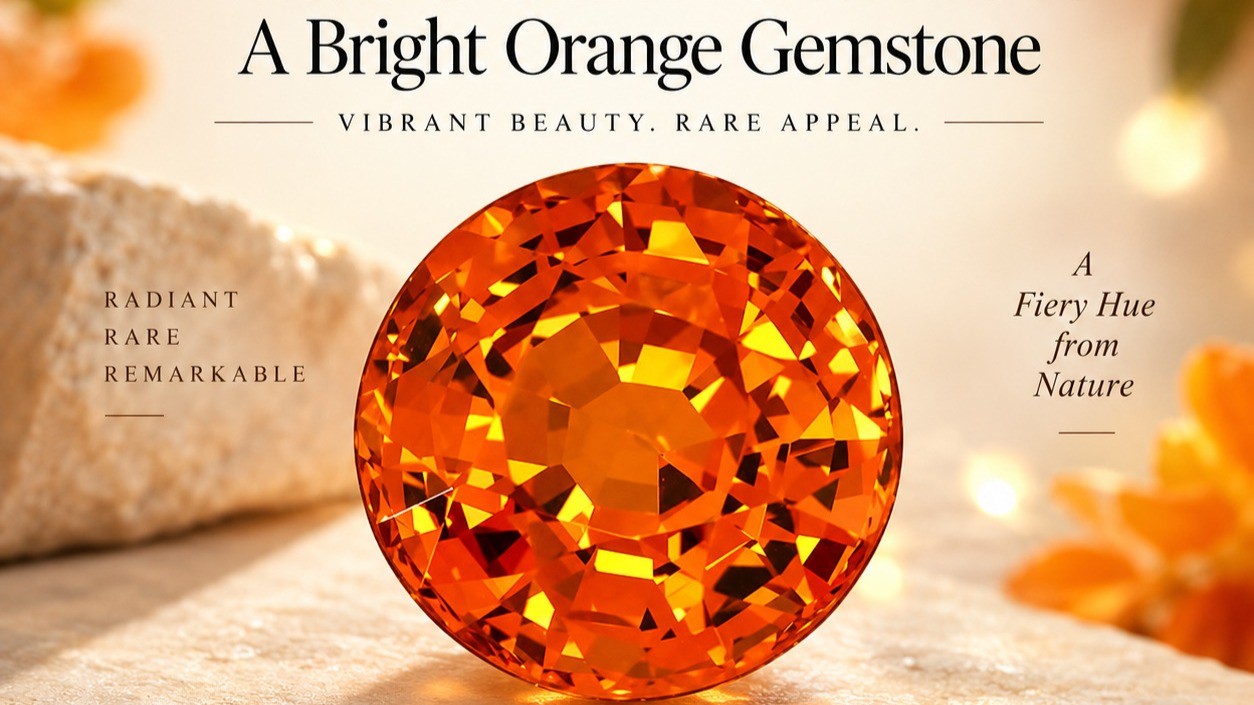
In the early 1990s, deep in the remote Kunene region of northwestern Namibia, a discovery was made that would forever change the world ofcolored gemstones. Miners unearthed a garnet unlike any seen before one that burned with an intense, pure orange fire that seemed almost too vivid to be natural.
This was the birth of MandarinGarnet, a variety of spessartine (also spelled spessartite) garnet that has since become one of the most coveted and collectible gemstones in the world.
Named for its striking resemblance to the vibrant hue of mandarin oranges, this gemstone has captivated collectors, jewelry designers, and investors alike. Its fiery brilliance, remarkable rarity, and completely natural, untreated beauty make it a standout in the gemstone market. But what exactly makes Mandarin Garnet so special? Let's dive deep into the science, history, and market dynamics of this extraordinary gem.
What Is Mandarin Garnet -
Mandarin Garnet belongs to the spessartine species of thegarnetgroup, a manganese aluminum silicate with the chemical formula Mn₃Al₂(SiO₄)₃. The garnet family is one of the most complex and diverse mineral groups, comprising several species that form through solid-solution series.
Spessartine specifically is the manganese-dominant member of the garnet group.Garnetis actually a group of several minerals, with five important gem varieties including pyrope, almandine, spessartine, grossular, and andradite.
The vivid orange color that defines Mandarin Garnet comes from its high manganese (Mn) content. In the mid-1990s, the first Namibian Mandarin Garnets analyzed had an average composition of approximately 85 mol.% spessartine, 12.5 mol.% pyrope, and 2.5 mol.% grossular.
When Nigeria began producing gem-quality spessartine in 1998, the material was even purer, with an average composition of 95 mol.% spessartine. Tanzanian material discovered in 2007 showed a composition of 77.5 mol.% spessartine, 17.9 mol.% pyrope, and 4.6 mol.% grossular.
These chemical variations contribute to subtle differences in color and appearance across different sources, though all share that signature fiery orange character that defines the Mandarin Garnet trade name.
Physical Properties:
One of the reasons Mandarin Garnet has become so popular in jewelry is its excellent physical properties, which combine durability with exceptional optical performance.
Hardness and Durability -
Mandarin Garnet measures 7 to 7.5 on the Mohs scale of hardness. This places it comfortably in the range of durable gemstones suitable for everyday wear inrings, pendants,earrings, andbracelets. For context, this hardness is comparable to quartz and falls just below that of topaz (8) and corundum (9). The mineral's lack of cleavage further enhances its toughness, making it resistant to chipping and breaking during normal wear.
Refractive Index and Brilliance -
The optical properties of Mandarin Garnet are equally impressive. It has a refractive index ranging from approximately 1.770 to 1.820. This relatively high refractive index means that when properly cut, Mandarin Garnet displays exceptional brilliance and light return the sparkle that makes gemstones come alive.
Like allgarnets, Mandarin Garnet is singly refractive and exhibits no pleochroism, meaning it shows the same color regardless of the viewing angle. This optical isotropy is a characteristic that distinguishes garnets from many other gemstone families and contributes to their consistent, uniform color appearance.
Specific Gravity and Density -
The specific gravity of spessartine ranges from approximately 3.6 to 4.2. This relatively high density means that Mandarin Garnet feels substantial and weighty in the hand, a quality that many gemstone enthusiasts appreciate.
Streak and Other Diagnostic Properties -
Mandarin Garnet produces a white streak when rubbed across an unglazed porcelain plate, a property that can aid in identification. It also readily scratches glass, which can serve as a simple field test for hardness.
For a more understanding of gemstone properties and how they're evaluated, explore theCaratX Gemstone Education resources.
The Color of Mandarin Garnet:
Color is the defining characteristic of Mandarin Garnet, and it's what sets this gemstone apart from all others. The ideal Mandarin Garnet displays a pure, vivid orange without any brown, red, or yellow modifiers that might muddy its appearance.
In the trade, the finest Mandarin Garnets are sometimes described as having "Fanta" color a reference to the bright, almost electric orange of the popular soda. This designation is reserved for stones that display the most intense, saturated orange hues with no undesirable color overtones.
The color range of Mandarin Garnet can vary from:
Bright tangerine orange the most prized and sought-after shade.
Golden orange with warm, sunny undertones.
Reddish-orange with subtle hints of red that add depth.
Yellowish-orange lighter, with golden influences.
According to theGemological Institute of America (GIA),garnetscome in almost every color, with orange varieties like Mandarin Garnet representing some of the most sought-after members of the garnet family.
The term "Mandarin Garnet" itself has evolved as a trade designation. Initially used to describe intensely orange garnets from Namibia, it has since been applied to any spessartine garnet displaying that distinctive pure orange hue, regardless of its geographic origin.
Understanding gemstone color grading is essential for any collector or buyer. The31-Hue Wheel: The Ultimate Guide to Gemstone Colour Gradingprovides a comprehensive framework for understanding how gemologists evaluate and grade colors like those found in Mandarin Garnet.
The wheel divides the visible spectrum into 31 distinct hue positions, capturing subtle transitions such as orangy red versus red-orange that are critical in high-value gemstones.
Global Sources:
Gem-quality Mandarin Garnet is exceptionally rare, with only a handful of significant deposits discovered worldwide. The most important sources are concentrated in Africa, though other deposits exist across the globe.
Namibia:
The Kunene region in northwestern Namibia is where the first Mandarin Garnets were discovered in 1991. These Namibian stones set the standard for the variety, displaying that vivid, pure orange color that became synonymous with the Mandarin name. The deposit was located in a remote area near the Kunene River, one of the last untouched places on Earth.
The Namibian material quickly gained attention in the gem trade for its exceptional color and brilliance. However, the deposit was relatively small and was exhausted within a few years. Today, fine Namibian Mandarin Garnets are considered true collector's items and command significant premiums when they appear on the market.
Nigeria:
In 1998, Nigeria began producing gem-quality spessartine from mines near the village of Iseyin in western Nigeria. This material approached the quality of the Namibian stones and quickly became an important source for the market.
The Nigerian deposits have produced some of the largest and purest spessartine garnets ever found. At the 1995 Tucson Gem and Mineral Show, a faceted, cushion-shaped 29.77-carat Mandarin Garnet was displayed a remarkable size for this variety.
Tanzania:
In 2007, gem-quality orange spessartine was discovered in Loliondo, northern Tanzania. The Tanzanian material has a composition very close to the Namibian stones and displays comparable color quality.
Tanzania remains an active source of Mandarin Garnet, though production is limited and inconsistent. Stones from this region are highly prized by collectors and jewelers alike.
Other Sources -
While African sources dominate the Mandarin Garnet market, spessartine has also been found in:
Madagascar producing orange-yellow spessartine that can be classified as Mandarin Garnet
United States particularly California (Ramona, San Diego County) and Virginia.
Brazil
Myanmar (Burma)
Sri Lanka
Mozambique
However, most of these sources produce spessartine in colors that range more toward reddish-brown or yellow-orange, and only the pure orange material qualifies for the "Mandarin" designation.
Rarity and Value:
Mandarin Garnet is one of therarest and most valuable colored gemstoneson the market today. Several factors contribute to its exceptional value.
Supply Constraints -
The scarcity of Mandarin Garnet begins at the source. Gem-quality spessartine is rare to begin with, and facetable material material suitable for cutting into gems is rarer still. The deposits that produce the pure orange color characteristic of Mandarin Garnet are limited to just a handful of locations worldwide.
The Namibian deposit, which set the standard for the variety, was exhausted years ago. Nigerian production, which had been a major source, effectively ceased around 2015-2016. Today, the market relies primarily on limited production from Tanzania and whatever material remains in dealer inventories.
Price Trends -
The price of Mandarin Garnet has seen dramatic increases in recent years. Consider these data points:
Top-quality Mandarin Garnet now commands prices of $3,000 per carat for exceptional material.
Fine Mandarin Garnet in the 1-5 carat range typically sells for $200-$1,200 per carat, with pieces over 5 carats reaching $2,400+ per carat.
The Rarity Premium -
Mandarin Garnets over 5 carats are uncommon, and stones over 10 carats are extremely rare. When large, clean stones do appear on the market, they command extraordinary prices. The 30-carat Harry Winston stone mentioned above demonstrates just how valuable large, fine-quality Mandarin Garnets can be.
The American Gem Trade Association (AGTA) reports that at the 2025 AGTA GemFair Tucson, spessartine was the No. 1 most requested gemstone among dealers. The most sought-after material is described as "a very neon pure orange with a hint of yellow to mandarin color"the top 5% of production.
To understand how colored gemstones like Mandarin Garnet are valued, theUltimate Guide to Colored Gemstone Valuationoffers deep insights into the factors that determine a stone's worth including the critical role of color, which often accounts for over 50% of a colored gemstone's value.
Market Trends:
The growing popularity of Mandarin Garnet is part of a broader trend in thecolored gemstonemarket. Orange, once considered a difficult color to sell in jewelry, has experienced a remarkable surge in demand.
The Chinese Market -
China has emerged as a particularly important market for Mandarin Garnet. In China, the gemstone is sometimes known as "Fanta" garnet, in reference to its vivid orange color. The popularity of Mandarin Garnet has surged in China in recent years, driving demand and prices higher.
Mandarin Garnet in Jewelry:
Mandarin Garnet's vibrant color and excellent durability make it a versatile gemstone for jewelry design. Its warm orange tones complement both yellow and white metals, and it pairs beautifully with diamonds and other colored gemstones.
Jewelry Applications -
Rings - Mandarin Garnet's hardness of 7-7.5 makes it suitable for all types of rings, including engagement rings and everyday wear.
Earrings - The gemstone's brilliance and color saturation create striking statement earrings.
Necklaces and Pendants - Larger stones make dramatic centerpieces.
Bracelets - The stone's durability makes it suitable for bracelets that may experience more wear.
Treatments and Enhancements:
One of the most appealing aspects of Mandarin Garnet is that it is completely natural and untreated. Laboratories haven't successfully synthesized spessartine garnets, and these gemstones don't normally receive any treatments or enhancements.
While orange glass and synthetic yttrium aluminum garnet (YAG) have been used as simulants, these are easily distinguishable from natural Mandarin Garnet by trained gemologists.
For those interested in learning how to verify the authenticity of gemstones, theComplete Guide to Gemstone Verificationprovides professional-level techniques for distinguishing natural treasures from their manufactured counterparts.
Identification and Grading -
Identifying genuine Mandarin Garnet requires attention to several key diagnostic properties.
Key Identification Features -
Color - Saturated, glowing pure orange to reddish-orange.
Hardness - 7-7.5 on the Mohs scale.
Refractive Index - 1.770-1.820.
Specific Gravity - 3.6-4.2.
Optical Properties - Singly refractive, isotropic.
Streak - White.
Quality Factors -
When evaluating Mandarin Garnet, consider these quality factors:
Color—The most important factor. Look for pure, vivid orange without brown or red modifiers.
Clarity—Eye-clean stones are most desirable, though some inclusions are acceptable.
Cut—Precision cutting maximizes brilliance and color saturation.
Carat Weight—Larger stones are exponentially rarer and more valuable.
Mandarin Garnet vs. Other Orange Gemstones -
While several gemstones display orange colors, Mandarin Garnet offers a unique combination of properties that distinguish it from other orange gems.
Mandarin Garnet vs. Orange Sapphire -
Orange sapphires (padparadscha and other orange varieties) are typically more expensive but lack the pure, vivid orange that characterizes Mandarin Garnet.Sapphiresalso have higher hardness (9 on Mohs scale) but may require heat treatment to achieve their color.
Mandarin Garnet vs. Citrine -
Citrineis more affordable and abundant but has lower hardness (7) and typically displays a more golden or yellow-orange color rather than the pure orange of Mandarin Garnet.
Mandarin Garnet vs. Spessartine -
Not all spessartine garnets are Mandarin Garnets. The "Mandarin" designation is reserved specifically for spessartine displaying that pure, vivid orange color without brown or red modifiers.
Recommended Reads from CaratX -
Birthstones by Month: A Complete Guide to Colors, Meanings & History– Discover the fascinating history and symbolism behind each month's birthstone, including January's garnet.
Why Are Some Gemstones Green? The Complete Scientific Guide– Understand the science behind gemstone coloration, from chromium in emeralds to the unique chemistry of demantoid garnet.
The 31-Hue Wheel: The Ultimate Guide to Gemstone Colour Grading– Learn how professional gemologists use the 31-hue system to grade colored stones like Mandarin Garnet with scientific accuracy.
The Ultimate Guide to Colored Gemstone Valuation– Master the art of valuing colored gemstones, where color is king and accounts for over 50% of a stone's value.
The Complete Guide to Gemstone Verification– Learn professional techniques to verify the authenticity and quality of natural gemstones.
The Enduring Power of Birthstones– Explore why personal gemstones continue to dominate modern jewelry design.
Frequently Asked Questions -
Q1: What is Mandarin Garnet?
Mandarin Garnet is a trade name for the most vivid, pure-orange variety of spessartine (spessartite) garnet. It is named for its striking resemblance to the color of mandarin oranges and is prized for its brilliant orange hue, exceptional sparkle, and rarity.
Q2: How hard is Mandarin Garnet?
Mandarin Garnet measures 7 to 7.5 on the Mohs scale of hardness. This makes it durable enough for everyday wear in all types of jewelry, including rings.
Q3: Where does Mandarin Garnet come from?
The most important sources of Mandarin Garnet are in Africa, particularly Namibia, Nigeria, and Tanzania. The original deposit was discovered in Namibia in 1991.
Q4: Is Mandarin Garnet treated or enhanced?
No. Mandarin Garnet is completely natural and untreated. There is no successful treatment known for spessartine garnets.
Q5: How much does Mandarin Garnet cost?
Prices vary widely based on quality and size. Fine Mandarin Garnet in the 1-5 carat range typically sells for $200-$1,200 per carat, with pieces over 5 carats reaching $2,400+ per carat. Exceptional material can command much higher prices.
Q6: Is Mandarin Garnet rare?
Yes, Mandarin Garnet is exceptionally rare. Gem-quality spessartine is rare to begin with, and the pure orange material that qualifies as "Mandarin" comes from only a handful of deposits worldwide.
Q7: Can Mandarin Garnet be used in engagement rings?
Yes. With a hardness of 7-7.5 on the Mohs scale, Mandarin Garnet is durable enough for engagement rings and daily wear.
Q8: What is "Fanta" color Mandarin Garnet?
"Fanta" color is a trade descriptor for Mandarin Garnets that display the most intense, vivid orange hue comparable to the color of orange soda. These are the most prized and expensive Mandarin Garnets.
Conclusion:
Mandarin Garnet represents a perfect storm of factors that make it one of the most exciting gemstones in the market today. Its vivid, pure orange color is unlike anything found in other gemstone families. Its exceptional brilliance and durability make it ideal for jewelry.
Its complete naturalness appeals to collectors who value untreated gems. And its extreme rarity with only a handful of deposits worldwide, most of which are depleted or in decline ensures that fine examples will only become more valuable over time.
As major luxury brands continue to feature Mandarin Garnet in high jewelry collections and as demand grows in emerging markets like China, the trajectory for this remarkable gemstone appears to be firmly upward. For collectors, investors, and jewelry lovers alike, Mandarin Garnet offers a rare opportunity to acquire a piece of gemological history a stone that burns with the fire of a thousand sunsets and captures the imagination like few others can.
Whether you're drawn to its stunning beauty, its investment potential, or its fascinating geological story, Mandarin Garnet is a gemstone that commands attention and rewards those who seek it out.