
Before modern diamond-cutting technology, skilled craftsmen used simple tools, patience, and creativity to shape rough diamonds into beautiful gemstones. Each antique cut tells a story of candlelit ballrooms, of hand-powered grinding wheels, of a time when a diamond's beauty was measured not by laboratory formulas but by the eye of a master cutter. Today, these historic stones are experiencing a remarkable resurgence, as buyers increasingly seek character, individuality, and a tangible connection to the past.
Why Antique Diamond Cuts Matter Today -
Modernround brilliantsare engineered for maximum light return. Their proportions are standardized, their facet patterns optimized by computer modeling, and their beauty measured against a universal cut grade. Antique cuts were not made this way. They were shaped by hand, often with the goal of preserving as much weight as possible from the rough crystal, and they were designed to perform under the warm, flickering light of candles and oil lamps rather than the bright, diffuse light of a jewelry showroom.
AtCaratX, we believe understanding these cuts is essential for anyone buying, selling, or collecting diamonds. Whether you are sourcing a single vintage stone for a custom piece or building an inventory of antique-cut diamonds for international buyers, the more you know about cut history, the better equipped you are to make confident decisions.
OurEducation Blogcovers diamond grading, market trends, and buying strategy in depth, and ourloose diamond buyer’s guidewalks you through the 4Cs from a practical, market-facing perspective.
The Evolution of Diamond Cutting:
Diamond cutting did not develop in a straight line. It advanced in fits and starts, driven by discoveries of new diamond deposits, advances in toolmaking, and the changing tastes of European royalty and aristocracy.
The earliest diamonds worn as jewelry were not cut at all, they were natural octahedral crystals, polished just enough to remove surface imperfections. By the late Middle Ages, cutters had learned that diamond could polish diamond, and the first true faceting techniques emerged. The table cut, developed around the fourteenth century, introduced a flat top facet and marked the beginning of deliberate diamond shaping. The single cut followed, adding a small number of facets around the table, and by the seventeenth century, the first brilliant-style cuts the Mazarin and the Peruzzi had begun to explore the geometry that would eventually lead to the modernroundbrilliant.
The eighteenth and nineteenth centuries saw the dominance of the old mine cut, a cushion-shaped stone with a high crown and a large culet that performed beautifully under candlelight.
Advances in bruting machines and angle gauges in the late 1800s made round outlines and more precise facet arrangements possible, giving rise to the old European cut the direct ancestor of today’sroundbrilliant. The twentieth century brought theAsscher cut, the modern brilliant, and the standardization of cut grading, but interest in the older styles never disappeared.
Today, antique cuts occupy a distinct and growing niche in the global diamond market, appealing to buyers who want something that feels personal, historical, and unmistakably human.
1. Point Cut:
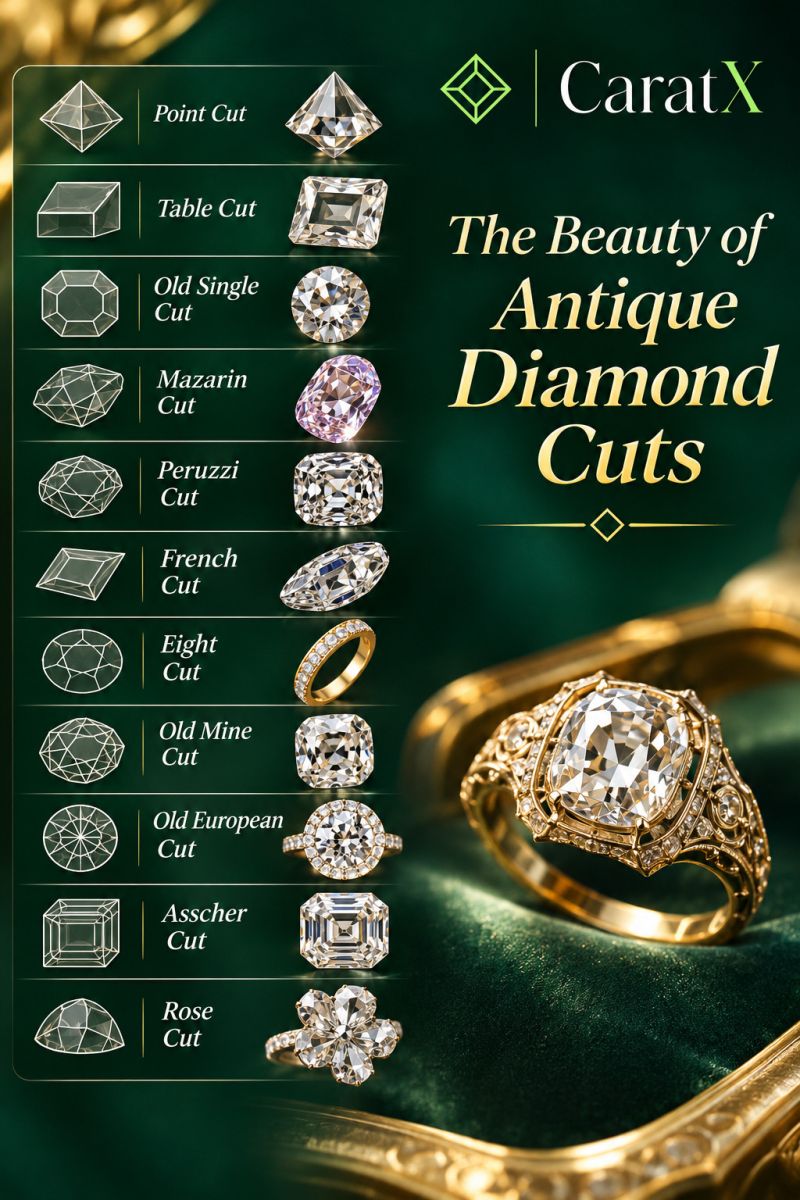
The point cut is not, strictly speaking, a cut at all. It is the natural octahedral shape of a diamond crystal, polished on its natural faces to create even, unblemished surfaces while retaining the stone’s pointed form. This was the dominant way of “finishing” a diamond from roughly the fourteenth century until the development of true faceting techniques, and it reflects an era when the hardness and rarity of diamond were valued more than its brilliance.
Point-cut diamonds were often set in simple rings and were sometimes called “writing diamonds” because the sharp point could scratch glass or metal. Surviving examples are exceedingly rare, and they are of greatest interest to museums, historical collectors, and specialists in early jewelry. For most modern buyers, the point cut is a starting point for understanding how diamond cutting evolved, a reminder that for centuries, the goal was to honor the stone’s natural form rather than to transform it.
Our article on thecomplete history of diamond cutstraces the point cut’s place in the broader evolution of diamond fashioning.
2. Table Cut:
The table cut, developed around the fourteenth and fifteenth centuries, was a breakthrough. By polishing a flat surface the table on the top of the octahedral crystal, cutters created a window into the stone that could reflect light more deliberately than a natural face. The table cut is widely regarded as the first deliberate diamond shaping technique, and it laid the foundation for almost every subsequent cut.
Table-cut diamonds were popular in Renaissance and Mughal jewelry, and they appear frequently in museum collections of sixteenth- and seventeenth-century European and Indian pieces. Their beauty is subtle rather than flashy: a well-preserved table cut has a quiet, glassy elegance, and its simple geometry can be strikingly modern to contemporary eyes. For collectors, table cuts offer a direct connection to the earliest era of diamond faceting.
Explore our analysis ofhow diamond crowns have evolvedfrom the table cut through the rose cut to the modern brilliant.
3. Old Single Cut:
The old single cut refined the table cut by adding a small number of facets typically eight on the crown and eight on the pavilion arranged in a simple, symmetrical pattern. It emerged around the middle of the seventeenth century and became the standard cut for smaller diamonds, particularly accent stones in brooches, rings, and watches.
The single cut is not designed for maximum sparkle. Its appeal lies in its efficiency and its soft, understated brightness. In antique jewelry,single-cut diamondsare often found in pavé settings and as side stones, where their gentle glow complements larger center stones without competing for attention. Today, single cuts remain useful for contemporary jewelers who want a vintage feel without the fragility or rarity of more elaborate antique cuts.
Browse ourloose diamond inventoryto see how small antique and single-cut stones are priced and categorized in the marketplace.
4. Mazarin Cut:
The Mazarin cut, developed in the mid-seventeenth century and often associated with Cardinal Jules Mazarin of France, was one of the earliest attempts to create a brilliant-style diamond. It introduced triangular facets on the crown and typically featured around thirty-four facets in total. The additional facets helped the stone return more light and produce a livelier appearance than the table or single cut.
The Mazarin cut is historically important because it marks the beginning of the brilliant family of cuts. Its facet arrangement was still relatively simple by modern standards, but it demonstrated that careful geometry could enhance a diamond’s optical performance. For collectors, Mazarin-cut diamonds are rare and historically significant, offering a tangible link to the experimental era of seventeenth-century European cutting.
Ourrare and fancy diamond cuts guideplaces the Mazarin cut in the context of other unusual and historically important cuts.
5. Peruzzi Cut:
The Peruzzi cut, developed by the Venetian lapidary Vincenzo Peruzzi in the late seventeenth or early eighteenth century, took the Mazarin concept further. It typically featured fifty-seven to fifty-eight facets, with thirty-two on the crown and twenty-four on the pavilion plus a culet, and it is widely regarded as a direct ancestor of the modern round brilliant.
The Peruzzi cut improved on the Mazarin by distributing facets more effectively between the crown and pavilion, which produced better light return and a more balanced appearance. It represents a crucial stage in the evolution of brilliant cutting, close enough to the modern brilliant to be recognizably related, but still shaped by hand and designed for the lighting conditions of its era. Peruzzi-cut diamonds are exceedingly rare today, and they are of great interest to serious collectors and historians of gemology.
Read our guide towhy the same diamond color looks different across cutsto understand how facet arrangements like those in the Peruzzi cut influence perceived color and brightness.
6. French Cut:
TheFrench cutis distinguished by its square shape and triangular facets, which create a striking geometric appearance. Its origins can be traced to the late medieval period, and it evolved from the table cut as cutters experimented with ways to introduce more facets without abandoning the clean lines of a square outline. The French cut reached the height of its popularity during the Art Deco era, when its bold geometry perfectly matched the aesthetic of the 1920s and 1930s.
French-cut diamonds are often used as accent stones infine jewelry, where their sharp, architectural facets create a beautiful contrast with round or pear-shaped center stones. They are also increasingly sought after by buyers who appreciate Art Deco design and want authentic period details in contemporary pieces.
Explore ourjewelry marketplaceto see how French-cut accent stones are used in finished pieces, or browseloose diamondsif you are sourcing stones for a custom design.
7. Eight Cut:
The eight cut is a simple, round outline cut with fewer facets than a modern brilliant typically eight on the crown and eight on the pavilion. It is closely related to the single cut and was widely used for small diamonds in jewelry throughout the nineteenth and early twentieth centuries.
The eight cut’s advantage is efficiency: it allows cutters to produce small, bright stones from relatively modest pieces of rough without the weight loss associated with more elaborate cuts. In antique jewelry, eight-cut diamonds are commonly found in pave settings, halos, and delicate side-stone arrangements. Their soft, gentle sparkle is well suited to vintage and vintage-inspired designs.
Our article ondiamond side stonesexplains how small cuts like the eight cut contribute to the overall brilliance of a piece.
8. Old Mine Cut:
Theold mine cutis perhaps the most loved of all antique diamond cuts. Popular from the early eighteenth century through the late nineteenth century, it is characterized by a squarish or cushion-shaped outline, a high crown, a small table, a deep pavilion, and a large, visible culet. These proportions were not accidental: they were designed to make the diamond perform beautifully under candlelight, producing soft, broad flashes of light rather than the sharp, pinpoint sparkle of a modern brilliant.
Old mine cuts are found in Georgian and Victorian jewelry, and they are highly sought after today for their romantic, hand-cut character. Because each stone was shaped individually by a cutter working with the natural rough, no two old mine cuts are exactly alike. This individuality is a large part of their appeal each stone feels like a small work of art rather than a mass-produced product.
Our detailed guide to theanatomy of an old mine cut diamondexplains the proportions, facet patterns, and buying considerations in depth. You can also exploreold miner diamondsin our marketplace.
9. Old European Cut:
The old European cut emerged in the late nineteenth and early twentieth centuries, as advances in cutting technology particularly the bruting machine and improved angle gauges made it possible to create round outlines and more precise facet arrangements. It is a rounded antique cut with a high crown, a small table, and large facets, and it is widely considered the most important predecessor of the modern round brilliant.
Old European cuts are typically found in jewelry from the late Victorian, Edwardian, and Art Deco periods. They offer a softer, more romantic sparkle than modern brilliants, and their slightly irregular proportions give them a distinctive old-world charm. For buyers who want the roundness and wearability of a modern brilliant but prefer the character of an antique stone, the old European cut is often the ideal choice.
Browse ournatural loose diamondsand filter for antique and old European cuts, or read ourbuyer’s guide to loose diamondsfor advice on evaluating these stones.
10. Asscher Cut:
TheAsscher cutwas developed in 1902 by Joseph Asscher of the Asscher Diamond Company in Amsterdam. It is a square-shaped step cut with clipped corners, and its layered, straight facets create a distinctive mirror-like effect that is quite different from the sparkle of a brilliant cut. The original Asscher cut had fifty-eight facets, and it became a symbol of Art Deco elegance in the 1920s and 1930s.
The Asscher cut is technically a vintage cut rather than an ancient one, but its strong geometry and architectural character have made it a lasting favorite. GIA refers to the original design as a “square emerald cut,” and the cut is particularly effective for diamonds with high color and clarity, where the step facets can showcase the stone’s transparency and depth.
OurAsscher cut guidecovers the history, proportions, and buying considerations for this distinctive cut.
11. Rose Cut:
The rose cut is one of the most recognizable antique styles. It has a flat bottom and a domed top covered with triangular facets, giving it a soft, rose-like appearance. The cut is believed to have originated in India and was adopted by European cutters by the early sixteenth century. Unlike brilliant cuts, which are designed to return light through the pavilion, rose cuts rely on the crown facets to catch and reflect light, producing a gentle, luminous glow rather than fiery sparkle.
Rose-cut diamondswere popular in the Georgian and Victorian eras, and they are experiencing a strong revival today among buyers who want a vintage, romantic look. They are often set in closed-back settings or used as center stones in rings and pendants where their soft, subtle beauty can be appreciated. Because rose cuts have no pavilion, they are also relatively flat, which makes them well suited to certain antique and contemporary design styles.
Compare rose cuts and brilliants in our guide torose cut vs. brilliant cut diamonds, or explorerose-cut diamond jewelryin our marketplace.
How to Buy Antique-Cut Diamonds:
Buying an antique diamond is different from buying a modern brilliant. Modern diamonds are graded against a standardized cut scale, and a buyer can rely on a GIA or AGS cut grade to predict performance.
Antique cuts, by contrast, are not graded on the same scale. GIA notes that old European and old mine cuts are often challenging to grade according to modern cut conventions because their proportions differ so significantly from modern brilliants. Instead, buyers must evaluate antique stones on their own terms considering outline, facet pattern, culet size, and the overall character of the stone.
Several factors deserve particular attention:
Certification. A GIA report is still valuable for confirming color, clarity, and carat weight, even if the cut grade is not directly comparable to a modern brilliant. Look for reports that identify the stone as an antique or vintage cut, and be cautious of stones with no certification at all.
Proportions. Antique cuts often have higher crowns, smaller tables, and larger culets than modern stones. These proportions are not defects—they are part of the cut’s historical character. The key is to assess whether the stone’s proportions produce a pleasing appearance to your eye, rather than whether they match a modern ideal.
Condition. Antique diamonds may show abrasion at the facet junctions, chips at the girdle, or wear on the culet. Some of this is normal for stones that have been worn for a century or more. Severe damage, however, can affect durability and value.
Individuality. No two antique cuts are exactly alike. This is part of their charm, but it also means that buying an antique diamond requires more visual inspection than buying a modern stone. Whenever possible, view the diamond in person or work with a trusted dealer who can provide detailed video and photographs.
At CaratX, we make it easier to source certified antique and vintage diamonds from verified sellers around the world.
Our platform connects buyers and sellers across 18+ countries, with secure transactions and authenticated products. If you are a dealer with an inventory of antique cuts, you canregister as a sellerand reach a global audience of B2B and B2C buyers. If you are a buyer, start by browsing ourloose diamond marketplaceand using ourbuyer’s guideto evaluate your options.
Recommended Reads from CaratX -
Rose Cut vs. Brilliant Cut Diamonds: Two Different Kinds of Sparkle
From Rough to Radiant: The Complete History of Diamond Cuts & How They Changed Jewelry Forever
The Art of Buying Loose Diamonds: Your Buyer’s Guide
15 Fancy Diamond Cuts You Probably Didn’t Know Existed
CaratX is a global marketplace for diamonds, gemstones, and fine jewelry. Sellers can register to reach buyers in 18+ countries, and buyers can source certified loose diamonds and finished pieces with confidence. To start selling, visit www.caratx.com/register. To shop loose diamonds, visit www.caratx.com/loose-diamonds.
Frequently Asked Questions -
Are antique diamond cuts less brilliant than modern cuts? They are different rather than simply less brilliant. Antique cuts often produce broader, softer flashes of light and a more subtle glow, while modern brilliants are engineered for maximum light return and sharp sparkle. Many buyers prefer the romantic, old-world appearance of antique cuts.
Are antique diamonds graded by GIA? GIA grades antique diamonds for color, clarity, and carat weight, but cut grading is not standardized in the same way as for modern round brilliants. GIA identifies old European and old mine cuts using specific criteria, and buyers should evaluate antique stones visually rather than relying solely on a cut grade.
Which antique cut is best for an engagement ring? Old European cuts and old mine cuts are both popular for engagement rings because they offer a vintage look with good durability. Asscher cuts are also a strong choice for buyers who prefer a square, step-cut appearance. The best choice depends on personal taste, the setting style, and the specific stone’s character.
Are rose-cut diamonds durable? Rose cuts have a flat bottom and a domed top, and they can be more vulnerable to abrasion than brilliant cuts because the girdle is often thin. They are best suited to earrings, pendants, and protected ring settings rather than everyday rings that are subject to hard wear.
Can I sell antique diamonds on CaratX? Yes. CaratX is a global marketplace for diamonds, gemstones, and jewelry, and sellers can list antique and vintage cuts alongside modern stones.Register as a sellerto choose a plan and start reaching buyers in 18+ countries.