
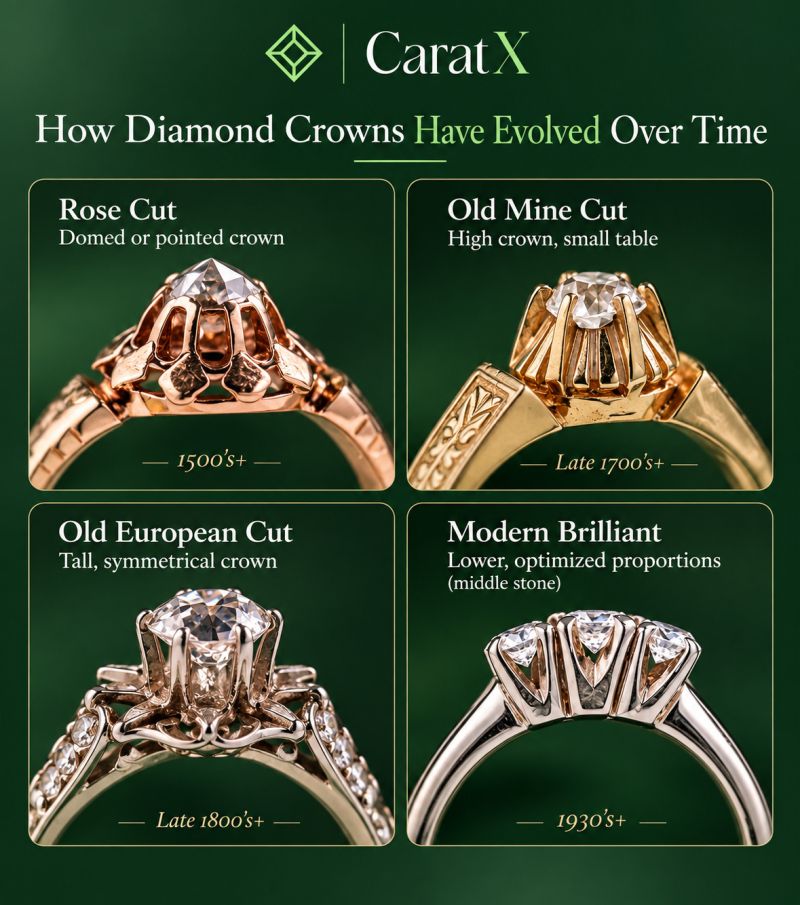
The crown of a diamond, the upper portion above the girdle has undergone a remarkable transformation over more than five centuries. From the simple domed tops of 16th-century rose cuts to the precisely engineered crowns of today's round brilliants, this evolution reflects humanity's growing understanding of light, optics, and the pursuit of maximum brilliance.
For anyone buying or selling diamonds in today's global market, understanding this history isn't just academic, it's essential for appreciating quality, identifying value, and making informed decisions.
AtCaratX, we connect diamond professionals and enthusiasts across 18+ international markets with certifiednaturalandlab-grown diamonds.
Our marketplace features everything fromantique cutstomodern round brilliants. This guide traces the evolution of diamond crowns from the 1500s to the present day and explains why these historical developments still matter today.
What Is a Diamond Crown?
Before diving into the history, let's establish a clear definition. In gemology, the crown is the upper portion of a polished diamond that lies above the girdle the thin, often faceted band that separates the top from the bottom (pavilion). The crown includes the table (the large, flat facet on top), the crown mains (the large kite-shaped facets that slope from the table to the girdle), and various smaller facets such as star facets and upper girdle facets.
The height, angle, and arrangement of these crown facets determine how light enters the diamond, how it reflects internally, and ultimately how much brilliance and fire the stone displays. As theGemological Institute of America (GIA)notes, cut not carat weight, color, or clarity is the most important of the 4Cs because it has the greatest influence on a diamond's sparkle.
The story of diamond crowns is really a story of trade-offs: between preserving weight from rough crystals and maximizing beauty, between what cutters could achieve with the technology of their time and what they could only imagine.
The Rose Cut: The Dawn of Crown Faceting (16th–18th Centuries)
The rose cut represents one of the earliest deliberate attempts to create a faceted crown that could interact with light. Believed to have originated in India in the 15th century and later refined in Europe by the 1520s, the rose cut was a radical departure from earlier "table cuts," which featured only a single large flat facet on top.
Design and Structure -
A rose-cut diamond is immediately recognizable by its distinctive profile: a flat, polished base (effectively a pavilion-less bottom) topped by a domed crown covered in triangular facets. The crown facets radiate from a central apex, creating a form that resembles a rosebud, hence the name. The number of facets on the crown could range from as few as 3 to as many as 24, with the facets typically arranged in two rows: an upper row of triangular facets meeting at the apex, and a lower row of facets that extend toward the girdle.
TheGIAdescribes the rose cut as "a typical product of the sixteenth and seventeenth centuries," employing a cutting process that began with a rough cleavage fragment from a diamond octahedron. The standard appearance generally consisted of a flat base topped by a dome with six triangular facets at the center.
The Crown's Role -
Unlike modern cuts, therose cut'scrown was not designed with precise light-reflection calculations in mind. Instead, it was a pragmatic solution that allowed cutters to work with thin, flat pieces of diamond rough that could not yield a full brilliant-cut stone. As noted in historical records, "the rose-cut diamond is very lively, and makes a great display at a small cost, roses being manufactured from pieces of 'rough' which from their thinness are incapable of forming brilliants".
The crown of a rose cut functions more as a decorative surface than an optical engine. Light entering through the crown facets reflects off the flat bottom and returns to the viewer's eye, but without the systematic internal reflection achieved by later cuts. The effect is a softer, more subtle sparkle, what many describe as a "candlelight" glow, particularly suited to the ambient lighting of Georgian and Victorian interiors.
Historical Context -
Rose cutswere immensely popular throughout the Georgian (1714–1837) and Victorian (1837–1901) eras. They were commonly set inrings, brooches,earrings, and tiaras, often surrounded by smaller rose-cut stones in pave settings. Today, rose-cut diamonds are experiencing a revival among vintage-inspired jewelry designers and collectors who appreciate their unique, understated charm.
AtCaratX, we connect buyers and sellers with authentic, ethically sourced rose cut diamonds across 18+ international markets, and ourRose Cut Diamond guideprovides an overview of this historic cut.
The Old Mine Cut: The Crown Grows Taller (1700s–1830s)
As diamond cutting technology advanced in the 18th and early 19th centuries, cutters began experimenting with taller crowns and more complex facet arrangements. The result was the old mine cut, a style that dominated diamond fashion from roughly the 1700s through the 1830s.
Design and Structure -
The old mine cut is characterized by a squarish or cushion-shaped outline, a high crown with steep crown angles, a small table, and a large, open culet at the bottom. The crown angles on old mine cuts often exceeded 40 degrees, and the table typically measured between 38% and 45% of the diamond's width, significantly smaller than the 53%–58% tables of modern brilliants.
This high crown was not merely an aesthetic choice. In an era before mechanical bruting machines and precision angle gauges, cutters were working with rudimentary tools and were heavily penalized for wasting rough. As theGIA's 4Cs blogexplains, "the less material the cutter removed from the original rough diamond crystal, the more quickly he completed his work.
Diamond cutters' wages were penalized if they took too long or removed too much material. Therefore, the typical cut during this time was actually a squarish, sometimes slightly oval cushion-brilliant".
The high crown allowed cutters to retain more weight from the rough octahedral crystal while still creating a stone with substantial visual presence.
The Crown's Role -
The old mine cut's tall crown serves multiple purposes. First, it creates a larger profile when the diamond is viewed from the side, making the stone appear more substantial than its carat weight might suggest. Second, the steep crown angles create a distinctive pattern of light and shadow that produces what collectors describe as "chunky" or "candlelight" brilliance softer, broader flashes of light rather than the sharp, pinpoint sparkle of modern cuts.
The small table and high crown also mean that old mine cuts tend to show more color than modern cuts. The steeper angles cause light to travel a longer path through the diamond before returning to the eye, which can intensify the stone's natural body color. For this reason, old mine cuts are often favored in warm-colored diamonds (K–Z range) where the cut enhances rather than masks the color.
Historical Context -
The old mine cut was the standard for diamond engagement rings throughout the Georgian and early Victorian periods. The term "old mine" itself is somewhat misleading, it doesn't refer to a specific mine, but rather to the fact that these were the diamonds coming from "the old mines" of India and Brazil before South African deposits transformed the market in the late 19th century.
TheGIA describesthe old mine cut's defining characteristics as "an often squarish shape and the diamond's crown (top) and pavilion (bottom) are both much deeper than today's standards". At CaratX, you can explore our selection ofantique cut diamonds.
The Old European Cut: Toward Balance and Symmetry (1830s–1930s)
The old European cut (sometimes called the old English cut) represents a crucial transitional phase between the hand-crafted antique cuts and the precision-engineered modern brilliant. Emerging in the 1830s and remaining popular through the 1930s, this cut introduced greater symmetry, a more circular outline, and a slightly lower crown than its predecessor.
Design and Structure -
The old European cut retains many characteristics of the old mine cut, a high crown, small table, and large culet but with important refinements. The outline becomes round rather than cushion-shaped, and the facet arrangement becomes more symmetrical and balanced. The GIA Defines the old European cut using specific criteria: a table size of 53% or less, a crown angle of 40 degrees or greater, a culet that is slightly large or larger, and lower half facet length of 60% or less.
As diamond cutting technology improved, the crown height began to decrease slightly, and the table grew marginally larger. Brilliant cut diamonds with round outlines fashioned at this time are called OLD ENGLISH CUT diamonds (in the U.S. the term is OLD EUROPEAN CUT)".
The Crown's Role -
The old European cut's crown represents a middle ground between the extreme height of the old mine cut and the controlled proportions of the modern brilliant. The crown angle remained steep by modern standards (typically 40–45 degrees), but the increased symmetry of the facet arrangement meant that light returned to the eye more consistently and predictably.
During the era of the old European cut, cutters began to understand at least intuitively that the crown angle and table size had a direct relationship to the diamond's brightness. As theGIA notes, "as diamond cutting has been a traditional craft, the shift from cutting old cut diamonds to the modern round brilliants was gradually spread over many decades".
The old European cut's crown also plays a role in the stone's fire, the rainbow-colored flashes of light that are dispersed when white light is broken into its spectral components. The steeper crown angles of old European cuts tend to produce more fire than modern cuts, which prioritize brilliance (white light return) instead.
Historical Context -
The old European cut was the dominant diamond style during the Art Deco period and the Edwardian era. It was the last major cut before the mathematical revolution in diamond cutting that would occur in the early 20th century. As the GIA Explains "the European brilliant cut, often with high crown angles much like the Indian cut diamonds, as well as a more symmetrical pavilion faceting plan, greatly increased the brightness and fire of the diamond".
At CaratX, we offer a curated selection ofold European cut diamondsfor collectors and vintage jewelry enthusiasts. OurOld European Cut guideexplores the history and characteristics of this beloved antique style.
The Modern Brilliant Cut: The Science of Crown Proportions (1919–Present)
The modernround brilliant cutrepresents the culmination of centuries of experimentation and the application of rigorous mathematical analysis to diamond cutting. The crown of the modern brilliant is not merely a decorative surface, it is a precisely engineered optical component designed to maximize the return of light to the viewer's eye.
The Tolkowsky Revolution -
The defining moment in the evolution of the modern diamond crown came in 1919, when Belgian mathematician and diamond cutter Marcel Tolkowsky published his groundbreaking treatiseDiamond Design. Tolkowsky was the first to apply mathematical principles to determine the optimal proportions for around brilliant cut, calculating the precise angles at which light entering the crown would reflect internally and return to the viewer without leaking out the sides or bottom.
Tolkowsky's ideal specifications, still considered the benchmark for modern brilliant cuts, are:
Table size: 53% of the diamond's diameter
Crown angle: 34.5 degrees
Pavilion angle: 40.75 degrees
Total depth: 59.3% (with 16.2% comprising the crown)
Pavilion depth: 43.1%
These proportions represent a dramatic departure from the old mine and old European cuts. The crown angle drops from 40–45 degrees to just 34.5 degrees, and the table grows from 38–45% to 53%. The result is a crown that is lower and flatter but optically far more efficient.
The Crown's Role in Light Performance -
The modern brilliant crown is designed to work in harmony with the pavilion to achieve three key optical effects:
Brilliance (white light return): The crown's facets act as entry points for light. The angle at which light hits the crown mains determines how much light enters the diamond versus how much reflects off the surface. Tolkowsky's 34.5-degree crown angle was calculated to allow the maximum amount of light to enter the stone while still enabling total internal reflection within the pavilion.
Fire (color dispersion): The crown's facets also disperse white light into its spectral components. The precise arrangement of the crown mains, star facets, and upper girdle facets creates multiple opportunities for light to be separated into rainbow colors before it returns to the eye.
Scintillation (sparkle): The crown's many facets create a pattern of light and dark that shifts and dances as the diamond moves. This scintillation effect is what gives a well-cut diamond its "life."
Although WLR varies only a little, indicating little change in brilliance, the pattern of light and dark across the crown changes significantly".
The 57-Facet Standard -
The modern round brilliant crown typically features 33 facets: the table, 8 star facets, 8 crown mains (also called bezel facets), and 16 upper girdle facets. Combined with the pavilion's 24 facets (8 pavilion mains, 16 lower girdle facets) and an optional culet, the complete diamond has 57 or 58 facets.
This standardized facet arrangement ensures consistent light performance across diamonds that meet the criteria for "excellent" or "ideal" cut grades. TheGIA's cut grading systemevaluates diamonds based on their proportions, symmetry, and polish, with crown angle and table size being among the most important measurements.
Modern Variations -
While Tolkowsky's proportions remain the benchmark, modern cutting has seen some variations. The American Gem Society (AGS) uses a slightly wider range for "ideal" cut grades: crown angles from 33.7 to 35.8 degrees, table sizes from 52% to 57%, and pavilion angles from 40.16 to 41.22 degrees. Some cutters have also experimented with "high crown" brilliants that combine modern facet arrangements with steeper crown angles for a different visual effect, though these remain a niche product.
At CaratX, you can browse our extensive selection ofround brilliant cut diamondsfrom certified sellers worldwide. OurDiamond Cut Guideexplains how crown proportions affect light performance, helping you make an informed choice.
How Crown Evolution Reflects Broader Trends in Diamond Cutting -
The evolution of the diamond crown is not an isolated story, it reflects broader shifts in technology, economics, and consumer preferences that have shaped the diamond industry over centuries.
Technology:
Each major advance in crown design was enabled by new technology:
15th–16th centuries: The development of the scaif (a rotating iron plate charged with diamond dust) made it possible to polish facets on a diamond's crown, enabling the rose cut.
17th–18th centuries: The invention of the bruting machine allowed cutters to shape diamonds into more rounded outlines, contributing to the old mine cut.
19th century: Steam-driven cutting factories in Amsterdam and Antwerp introduced mechanization and specialization, leading to the old European cut's greater symmetry.
20th century: Mathematical analysis (Tolkowsky) and computer modeling (GIA's cut research) enabled the precision proportions of the modern brilliant.
21st century: Laser cutting, computer-aided design, and advanced optical measurement tools allow cutters to achieve unprecedented precision in crown angles and facet arrangement.
Economics: The Weight vs. Beauty Trade-off
Throughout history, diamond cutters have faced a fundamental tension: every facet cut from a rough diamond reduces its weight, and weight equals money. The old mine cut's high crown was partly a response to this reality, cutters left more material on the top of the stone to avoid wasting rough. The modern brilliant's lower crown represents the opposite approach: sacrificing weight to achieve superior light performance, which ultimately commands a higher price per carat.
As theGIA notes, the introduction of the circular saw in 1900 "made it far easier to split the typical octahedral-shaped diamond rough crystal into two pieces... making it possible to cut the smaller top piece into a finished diamond, rather than just grinding it away.
By 1902, many in the industry realized that using the saw saved weight from the common octahedral diamond crystals, which meant that the new proportions could be cut without expensive waste of diamond rough, shifting the emphasis from weight recovery to the beauty of the styles that we see today".
Consumer Preferences: From Candlelight to LED
The changing shape of diamond crowns also reflects changing lighting environments. Old mine and old European cuts were designed for candlelight, gaslight, and the dim ambient lighting of pre-electric interiors. Their steeper crown angles and smaller tables produced more fire and a softer, warmer sparkle that looked beautiful in low light.
Modernround brilliants, by contrast, are optimized for bright, directed lighting, the LED spotlights of jewelry stores and the flash photography of social media. Their lower crowns and larger tables maximize white light return (brilliance), creating a brighter, whiter appearance that photographs well and stands out in well-lit environments.
This doesn't mean one style is "better" than the other, they simply serve different purposes and appeal to different aesthetic preferences. AtCaratX, we celebrate both traditions, offering everything fromantique rose cutstomodern ideal-cut brilliants.
Why This History Matters for Today's Buyers and Sellers
Understanding the evolution of diamond crowns is not just an academic exercise, it has practical implications for anyone involved in buying or selling diamonds.
For Buyers -
Antique cuts (rose, old mine, old European) offer unique character and history. Their high crowns and small tables create a distinctive "candlelight" sparkle that modern cuts cannot replicate. If you're considering an antique diamond, ourguide to buying antique cutsexplains what to look for.
Modern brilliants offer maximum brilliance and are the standard for engagement rings and fine jewelry. Understanding crown angles and table sizes helps you evaluate cut quality beyond the basic 4Cs. OurDiamond Cut Guideexplains how crown proportions affect light performance.
Certification matters: Whether you're buying antique or modern, ensure your diamond comes with a grading report from a reputable laboratory likeGIAorIGI. At CaratX, every diamond in our marketplace is certified, giving you confidence in your purchase.
For Sellers -
Know your crown: The crown angle and table size are among the first measurements a potential buyer will examine. Accurate descriptions of these proportions can significantly affect the perceived value of your diamond.
Antique cuts have a growing market: Vintage-inspired jewelry is booming, and well-preserved antique cuts command premium prices. Ourseller plansconnect you with buyers in 18+ international markets who are specifically seeking these stones.
Register today: Sellers canregister on CaratXto start selling to B2B and B2C buyers worldwide. Our platform offersflexible plansfor businesses of all sizes, from individual collectors to large retailers.
For the Industry -
The history of diamond crowns illustrates the industry's ongoing quest to balance art and science, tradition and innovation. Today, that quest continues with lab-grown diamonds, which can be cut to the same exacting standards as natural diamonds, sometimes with even greater precision, since lab-grown rough is more uniform and predictable.
At CaratX, we support bothnatural diamondsandlab-grown diamonds, giving buyers and sellers a comprehensive marketplace for all types of diamonds. OurGlobal Diamond Market Pulseprovides ongoing analysis of market trends, helping professionals navigate the evolving landscape.
Frequently Asked Questions -
What is a diamond crown?
The crown is the upper portion of a polished diamond, located above the girdle (the thin band that separates the top from the bottom). It includes the table (the large flat facet on top), crown mains, star facets, and upper girdle facets. The crown's height, angle, and facet arrangement determine how light enters the diamond and how much brilliance it displays.
Why did diamond crowns get lower over time?
Lower crowns became possible as cutting technology improved and understanding of light behavior increased. Tolkowsky's mathematical analysis in 1919 showed that a 34.5-degree crown angle produced superior brilliance compared to the steeper angles of older cuts. Additionally, the invention of the circular saw made it economically feasible to cut away more rough material without excessive waste, shifting the emphasis from weight preservation to beauty.
Are old mine cut diamonds valuable?
Yes, old mine cut diamonds are highly valued for their historical significance and unique visual character. Their high crowns and small tables produce a distinctive "candlelight" sparkle that modern cuts cannot replicate. Well-preserved old mine cuts with good clarity and color can command premium prices, particularly in the vintage jewelry market.
What's the difference between old European and modern brilliant cuts?
The old European cut (1830s–1930s) has a high crown (crown angle of 40+ degrees), a small table (53% or less), and a large culet. The modern brilliant cut (1919–present) has a lower crown (34.5 degrees), a larger table (53%–58%), and a small or no culet. The modern brilliant is designed for maximum brilliance under bright lighting, while the old European cut produces more fire and a softer sparkle.
How does crown angle affect a diamond's appearance?
Crown angle affects both brilliance (white light return) and fire (color dispersion). Steeper crown angles (40+ degrees) generally produce more fire and a warmer, more colorful sparkle. Shallower crown angles (34–35 degrees) produce more brilliance and a whiter, brighter appearance. The optimal crown angle depends on the pavilion angle and the overall proportions of the diamond.
Can lab-grown diamonds have different crown proportions?
Yes, lab-grown diamonds can be cut to the same proportions as natural diamonds, including the precise crown angles and table sizes specified by Tolkowsky and modern cut grading standards. In fact, because lab-grown rough is often more uniform and predictable than natural rough, cutters can sometimes achieve even greater precision in crown proportions. At CaratX, we offer bothnaturalandlab-growndiamonds across all cut styles.
How do I identify an antique diamond crown?
Antique cuts can be identified by their higher crowns, smaller tables, larger culets, and distinctive facet arrangements. Old mine cuts have squarish or cushion outlines, while old European cuts have round outlines. Rose cuts have flat bottoms and domed crowns with triangular facets. A trained gemologist or appraiser can definitively identify antique cuts, and certification from a reputable laboratory provides additional assurance.
Recommended Reads from CaratX
Explore more of our in-depth guides and educational resources:
The Rose Cut Diamond: Historical & Modern Styles— A comprehensive guide to the oldest faceted diamond cut still in use today.
The Ultimate Guide to Diamond Carat Size and Cut— How cut quality and carat weight interact to determine a diamond's visual size and value.
Global Diamond Market Pulse— Ongoing analysis of regional trends, challenges, and opportunities in the global diamond trade.
Start Selling on CaratX -
Ready to reach buyers in 18+ international markets? Whether you're selling loose diamonds, finished jewelry, or antique collectibles, CaratX provides the platform you need.
Register as a Seller:www.caratx.com/register— Start selling to B2B and B2C buyers worldwide.
Explore Seller Plans:CaratX Seller Plans— Flexible pricing for businesses of all sizes.
Shop Natural Diamonds:CaratX Natural Diamonds— Certified natural diamonds at unbeatable prices.
Shop Gemstones:CaratX Marketplace— Discover gemstones, pearls, and jewelry from 200+ artisan sellers.