
When you compare a rose cut and a brilliant cut diamond side by side, you are not just looking at two different shapes. You are looking at two entirely different philosophies of light. One is quiet, soft, and steeped in centuries of history. The other is engineered for maximum brilliance, fire, and scintillation.
Understanding the difference between these two cuts is essential for anyone buying, selling, or simply appreciating diamonds, whether you are a jeweler sourcing stones on a marketplace likeCaratXor a buyer looking for theperfect engagement ring.
This guide breaks down the rose cut and the brilliant cut from every angle: their history, their faceting, how they handle light, their durability, their value, and who they are best suited for. By the end, you will know exactly which kind of sparkle speaks to you.
What Is a Diamond "Cut"? (It Is Not Just Shape)
Before diving into the two cuts, it is important to clarify a common confusion. In the diamond industry, "cut" refers to two different things:
Cut style: The arrangement and pattern of facets, how the stone is designed to interact with light. Brilliant, step, rose, and mixed are all cutstyles.
Cut grade: A quality rating (Excellent, Very Good, Good, Fair, Poor) assigned to round brilliant diamonds by laboratories like GIA, based on proportions, symmetry, polish, and light performance.
Adiamondcan be an oval (shape) with a brilliant cut (style) and an Excellent cut grade (quality). The rose cut is a distinct cutstyle, not a grade. Because rose cuts are not round brilliants, they do not receive a GIA cut grade, a detail that matters when you are comparing value.
The Rose Cut:
Origins and History -
The rose cut is believed to have originated in India in the 15th century and was adopted by European cutters by the 1520s. It was the dominant diamond cut for nearly two centuries, particularly during the Georgian and early Victorian eras. The name comes from the arrangement of triangular facets on the crown, which resemble the petals of a rose.
Historical texts from the 19th century describe the rose cut as being "most advantageous for thin and flat stones, since it involves but little waste of material and at the same time permits the full display of the lustre of the stone". In other words, it was an economical and practical choice when diamond rough was flat or shallow.
Faceting and Structure -
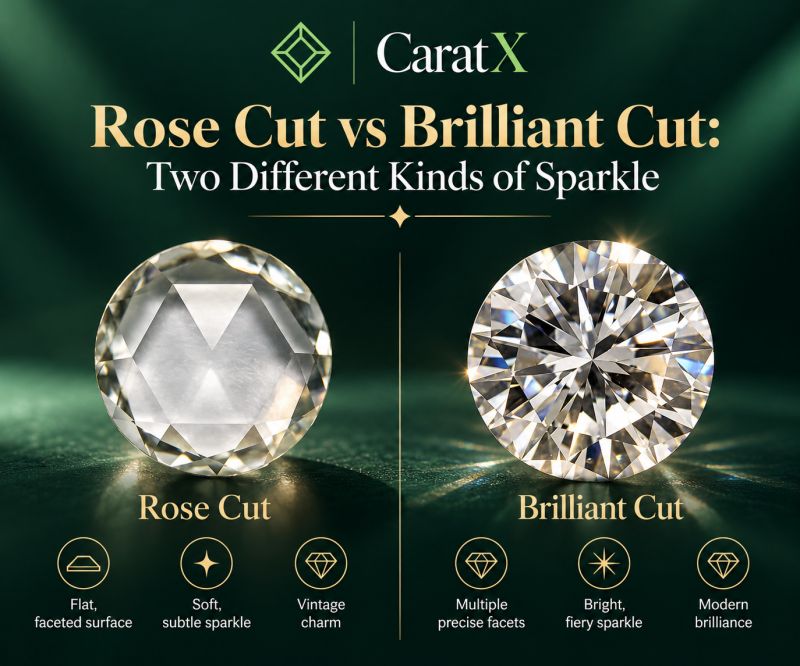
A rose cut diamond has a completely different anatomy from a brilliant cut:
Flat bottom (no pavilion): The stone sits flat, with no pointed pavilion to reflect light back from below.
Domed top (crown): The crown is covered in triangular facets that rise to a point or a small table.
Facet count: Early rose cuts had as few as 6 facets; a "full rose cut" typically has 24 triangular facets.
Because there is no pavilion, the rose cut does not rely on internal reflection from below. Instead, light enters through the crown, bounces around the triangular facets, and returns to the eye as a soft, diffused glow.
How It Handles Light -
The rose cut is not designed for brilliance in the modern sense. It does not produce the sharp, bright flashes of white light that a brilliant cut does. Instead, it creates:
Soft, gentle glow: Light is scattered rather than sharply reflected.
Vintage scintillation: The triangular facets create a subtle, candlelight-friendly sparkle.
Less fire: Because there is no pavilion to disperse light into spectral colors, rose cuts show less colorful fire than brilliants.
As one jewelry education source puts it, rose cuts "create a soft, gentle glow and a vintage look" rather than "bright sparkle and colorful flashes". This is not a flaw; it is the defining characteristic of the cut.
Aesthetic and Practical Considerations -
Appears larger for its weight: Because rose cuts are shallow, a 1-carat rose cut can have a larger face-up surface area than a 1-carat brilliant cut.
Low profile: The flat bottom makes rose cuts ideal for bezel settings,stacking rings, and designs where a low profile is desired.
Requires protection: The exposed crown and lack of pavilion make rose cuts more vulnerable to chipping than brilliant cuts. Bezel settings or protective prongs are recommended.
The Brilliant Cut:
Origins and Evolution -
The brilliant cut was developed in the 17th century, with the double-cut brilliant introduced around the mid-1600s and the triple-cut brilliant (with 32 facets on the crown) introduced by Vincent Peruzzi of Venice at the end of the 17th century. Over the following centuries, mathematicians and gemologists refined the proportions to maximize light return. The modern round brilliant cut, with 57 or 58 facets, is the result of that evolution.
Faceting and Structure -
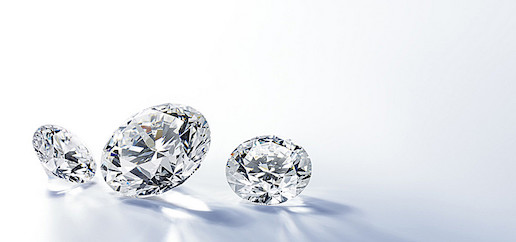
Theround brilliantcut has a carefully engineered three-part structure:
Crown: The top portion, with facets including the table, star facets, and bezel facets.
Girdle: The thin band separating crown and pavilion.
Pavilion: The bottom portion, with facets designed to reflect light back through the crown.
The angles and proportions of these facets are not arbitrary. They are calculated to ensure that light entering the crown reflects off the pavilion facets and returns to the viewer's eye instead of leaking out the bottom. GIA's cut grading system evaluates seven components: brightness, fire, scintillation, weight ratio, durability, polish, and symmetry.
How It Handles Light -
The brilliant cut is designed to maximize three optical effects:
Brightness (brilliance): The total internal and external reflection of white light. A well-cut brilliant returns a high percentage of light to the viewer.
Fire: The dispersion of light into spectral colors. Diamond's high refractive index (n = 2.42) causes white light to split into rainbow flashes.
Scintillation: The pattern of light and dark areas, and the sparkle when the diamond moves.
The American Gem Society Laboratories (AGSL) developed a light performance model that evaluates diamonds based on these factors, using ray tracing to assess brightness, contrast, and light leakage. An AGS Ideal diamond, for example, "remains bright from edge to center while minimizing the amount of light leakage" and has "high fire potential from edge to center".
Aesthetic and Practical Considerations -
Maximum sparkle: The brilliant cut is the standard for engagement rings precisely because it outperforms all other cuts in brilliance and fire.
Hides inclusions: The busy facet pattern of a brilliant cut makes it more forgiving of inclusions than step cuts or rose cuts.
Requires depth: The pavilion adds depth, so a brilliant cut of the same carat weight will have a smaller face-up surface area than a rose cut.
Durable: The rounded shape and protected girdle make the round brilliant less prone to chipping than a rose cut.
Why the Science of Light Matters -
To truly understand the difference, it helps to understand a little diamond optics. Diamond has an exceptionally high refractive index (2.42) and a low critical angle (24° 26'), which means light that enters the stone is likely to be internally reflected rather than escape. In a brilliant cut, the pavilion facets are angled so that light bounces back through the crown. In a rose cut, there is no pavilion, so light simply passes through the stone or scatters off the crown facets.
This is why a rose cut can look almost glassy in some lighting conditions, while a brilliant cut maintains a bright, lively appearance even in low light. It is also why rose cuts were historically favored for candlelight: their soft, diffused glow was more flattering than the sharp flashes of an early brilliant cut in dim lighting.
Modern Trends and Market Position -
For most of the 20th century, the brilliant cut dominated the diamond market. Rose cuts were considered antique curiosities, often recut into brilliants when they were brought to cutters for repair. As one 19th-century source notes, "Brilliant cut Diamonds are so infinitely superior to the others, that of late many rose-cut stones from Holland have been recut into brilliants".
That trend has reversed in recent years. The rise ofvintage-inspired jewelry, the popularity of alternative engagement rings, and a general appetite for uniqueness have brought rose cuts back into demand. Today, rose cut diamonds are sought after by designers who want a soft, romantic look that stands out from the sea of brilliant-cut solitaires.
On a B2B marketplace likeCaratX, where jewelers sourcenatural diamondsandgemstonesfrom sellers across 18+ countries, both cuts have their place. Brilliant cuts remain the volume drivers for engagement andbridal jewelry.Rose cuts appeal to a niche but growing segment of buyers looking for antique-style pieces, stackable rings, and one-of-a-kind designs.
How to Choose: A Buyer's Guide
Choose a Rose Cut If:
You love vintage, antique, or bohemian aesthetics.
You want a low-profile ring that will not snag on clothing.
You prefer a subtle, understated sparkle over maximum flash.
You are setting the stone in a bezel or a design where the flat bottom is an advantage.
You want a larger face-up appearance for the carat weight.
Choose a Brilliant Cut If:
You want the maximum sparkle, fire, and brilliance.
You are buying an engagement ring and want the classic, recognized look.
You need a stone that performs well in all lighting conditions.
You want the reassurance of a GIA cut grade (Excellent to Poor) as a quality benchmark.
You want a durable stone for everyday wear.
For Sellers on CaratX -
If you are listing stones on theCaratX marketplace, your product descriptions should clearly state the cut style. Do not assume buyers know the difference. Highlight the light performance characteristics: "soft, romantic glow" for rose cuts, "maximum brilliance and fire" for brilliants.
If you are selling rose cuts, consider pairing them with bezel settings or vintage-inspired mountings in your photography. If you are selling brilliants, provide GIA cut grades and light performance information whenever possible.
For sellers looking to expand their international reach,registering on CaratXgives you access to B2B and B2C buyers in 18+ countries.
Shop Natural Diamonds on CaratX— Browse certified natural diamonds in a range of cuts, including rose and brilliant.
Shop Gemstones on CaratX— Explore colored gemstones that pair beautifully with rose cut diamonds.
Register as a Seller on CaratX— Start selling to B2B and B2C buyers in 18+ countries.
CaratX Pricing and Seller Plans— Compare plans and find the right fit for your inventory.
Frequently Asked Questions -
Is a rose cut diamond less valuable than a brilliant cut?
Not inherently. Value depends on carat weight, color, clarity, and market demand. Rose cuts are not graded by GIA for cut quality, which can make comparison difficult. In general, rose cuts may sell at a discount to comparable brilliant cuts because they are less standardized, but rare or antique rose cuts can command premium prices.
Do rose cut diamonds sparkle?
They sparkle differently. Rose cuts produce a soft, diffuse scintillation rather than the sharp, bright sparkle of a brilliant cut. Some people find this more romantic and subtle; others prefer the flash of a brilliant.
Are rose cut diamonds durable?
The lack of a pavilion makes the crown more exposed. Rose cuts are more vulnerable to chipping than brilliant cuts, especially at the pointed apex of the dome. A bezel setting or protective prongs are strongly recommended for everyday wear.
Can a rose cut diamond be certified?
Yes, rose cuts can be certified for color, clarity, and carat weight by laboratories like GIA or IGI. However, they do not receive a cut grade because GIA's cut grading system applies only to round brilliants.
Which cut is better for an engagement ring?
The brilliant cut is the traditional choice for engagement rings because of its superior sparkle and durability. Rose cuts are better suited for buyers who want a vintage or alternative look and are willing to trade some durability and brilliance for that aesthetic.
Does a rose cut diamond face up larger?
Yes. Because rose cuts are shallow with no pavilion, a rose cut of a given carat weight will have a larger face-up surface area than a brilliant cut of the same weight.
Recommended Reads from CaratX -
The Rose Cut Diamond: Historical & Modern Rose Cut Diamond Styles
How Diamond Crowns Have Evolved Over Time: From Rose Cuts to Modern Brilliance
Round vs. Square Diamond Cuts: A Detailed Guide to Brilliance, Geometry, and Value
Why the Same Diamond Colour Looks Different Across Cuts: A Gemologist's Guide
Why Your Antique Diamond Looks Different Under Modern LED Lights
The Anatomy of an Old Mine Cut Diamond: A Collector's Guide to Antique Brilliance
From Rough to Radiant: The Complete History of Diamond Cuts
The Fancy Shape Diamond Market: Navigating the Polarization of Demand in 2026