
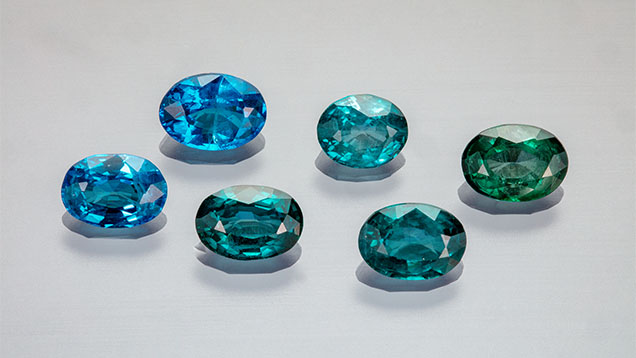
For millennia, gemstones have symbolized power and beauty, but colour-change spinel transcends mere ornamentation. It’s a geological symphony where quantum physics meets artistry, a stone that rewrites its identity under shifting light.
Below, we unveil its molecular secrets, global origins, market realities, and profound symbolism.
Spinel –
Spinel’s story begins in royal betrayal. For over 1,000 years, legendary "rubies" like the Timur Ruby (352.5ct) in the British Crown Jewels were actually spinels. This misidentification stems from:
Shared geological environments: Formed in marble-hosted deposits alongside rubies/sapphires (e.g., Mogok, Myanmar).
Identical crystal habits: Both crystallize in trigonal systems, creating visual twins.
Pre-scientific gemology: Renaissance lapidaries lacked spectroscopes to detect atomic differences.
Modern Recognition:
Hardness (8 Mohs): Surpasses emerald (7.5) and tanzanite (6.5).
Refractive Index (1.718): Higher than garnet (1.79), yielding intense brilliance.
Single-refraction: Unlike doubly-refractive sapphires, spinel avoids optical fuzziness.
Discover unheated spinels in our Ethically Sourced Gem Collection.
The Alchemy of Colour Change –
Colour-change isn’t magic, it’s crystal field theory in action. Here’s the atomic breakdown:
Elemental Actors:
Element Role in Colour Shift Light Response Chromium (Cr³⁺)
Absorbs yellow-greenDominates in blue-rich light (daylight)
Vanadium (V³⁺)Absorbs red-blueTriggers purple in red-rich light (incandescent)
Iron (Fe²⁺)Modifies blue tonesEnhances grey undertones
Light Wavelength Dynamics:
Daylight (5500K+): Rich in 450–485nm blue wavelengths. Cr³⁺ absorbs green, reflecting blue.
Incandescent Light (2700K): Peak emission at 650nm red wavelengths. V³⁺ absorbs blue, emitting violet.
Peer-Validated Research:
MIT’s Mineral Spectroscopy Database documents spinel’s absorption bands.
The Gemological Institute of America (GIA) confirms chromium-vanadium synergy drives the shift.
Global Prospecting –
Only 1 in 10,000 spinels show strong colour-change. Prime sources reveal stark contrasts:
Origin Signature Shift Mining Challenges Sri Lanka
Slate blue → Lavender Artisanal river gravel sifting; >10 tons processed per 1ct gem
Vietnam (Luc Yen)Electric blue → RaspberryTunnel collapses; 90% of stones <1.5ct
Tanzania (Mahenge)Teal → MagentaMonsoon floods; political instability
Notable Specimens:
The "Neptune’s Shift" (8.04ct, Sri Lanka): Sold for $320,000 at Sotheby’s 2023.
Mahenge’s "Midnight Mirage" (3.21ct): Displayed at the Smithsonian.
Valuation Science –
Value Drivers:
Shift Intensity: "AA" grade = >50nm difference (e.g., blue→purple vs. blue→gray).
Saturation: Vivid hues command 200% premiums over pastels.
Cut Precision: Oval and cushion cuts maximize color play.
Origin Premium: Vietnamese stones fetch 30% more than Tanzanian.
2024 Price Benchmarks (Per Carat):
Size Low Shift Medium Shift High Shift
1-2ct $1,800 $3,500 $8,000
3-5ct $12,000 $25,000 $60,000
5ct+Auction-Only>$100,000
Data: International Gem Society (IGS)
The Human Connection –
Colour-change spinel embodies profound metaphors:
Adaptability: Shines brilliantly in any "environment" (light).
Duality: Reconciles opposing identities (blue/violet = logic/passion).
Resilience: Formed under extreme pressure, yet flawless.
Engagement Rings: Symbolizes evolving love. See CaratX Bespoke Designs.
CEO Signet Rings: Represents strategic adaptability.
Buyer’s Survival Guide
3 Critical Verification Steps:
Light Testing: Use a GIA Spectroscope to confirm Cr/V absorption.
Inclusion Check: Natural spinels contain octahedral crystals; synthetics are flawless.
Certification: Demand reports from GIA, Gübelin, or CaratX GemLab.
Avoid These Traps:
Diffusion-Treated Stones: Surface-enhanced color fades in years.
"Cobalt Blue" Imitations: Glass fills lack spinel’s RI (1.72).
Ready to Elevate Your Business? Register as Seller