
India’s Lab‑Grown Diamond Exports Cross Natural Diamonds by Volume in 2026
Home
Our Favorite Articles India’s Lab‑Grown Diamond Exports Cross Natural Diamonds by Volume in 2026 SHOP NOWHome
Our Favorite Articles India’s Lab‑Grown Diamond Exports Cross Natural Diamonds by Volume in 2026 SHOP NOWMay, 23, 2026 by Archit Mohanty 0 Comments
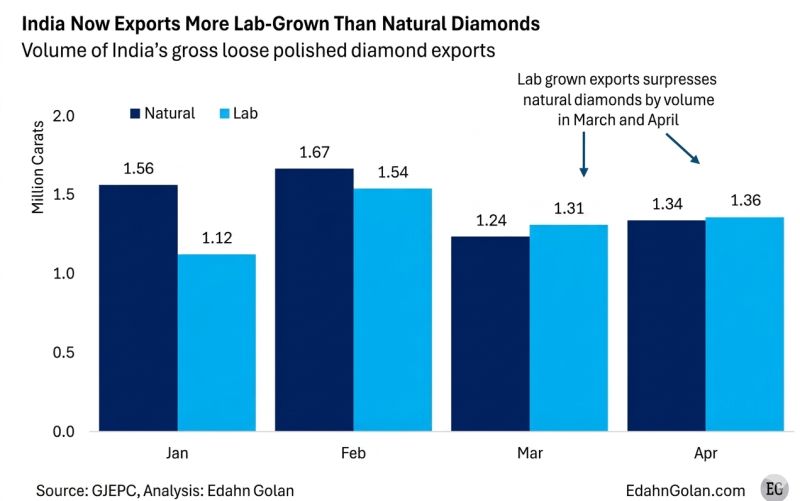
The Indian diamond industry has arrived at a landmark moment. In 2026, for the first time in history, polished lab‑grown diamonds (LGDs) have surpassed natural diamonds in export volume from India’s two main hubs, Surat and Mumbai.
The shift is not a one‑off blip: the crossover first occurred in March 2026 and was repeated in April 2026, confirming a sustained change in the global trade.
Yet the story is completely different when you look at the value side of the equation. Despite the huge jump in carat volume, lab‑grown diamonds still account for less than 9 % of India’s wholesale diamond export value. This huge gap points to one of the most important structural truths of 2026: volume does not equal value.
In this article, we will unpack the numbers, examine the drivers behind the explosion in lab‑grown exports, and show how natural diamonds are doubling down on rarity and luxury.
For the whole of FY 2025‑26 (April 2025 to March 2026), India exported:
Category Volume (million carats)
Lab‑grown polished diamonds 18.8 million
Natural cut & polished diamonds 16.0 million
This marks a volume lead of 2.8 million carats for lab‑grown stones.
A decade ago the picture was radically different. In FY 2015‑16, India exported 33.51 million carats of natural polished diamonds while lab‑grown exports were barely 0.1 million carats (100,000 carats). In only ten years the lab‑grown segment has grown from a negligible base to overtake an industry built over more than fifty years.
The crossover continued on a monthly basis:
Month Lab‑grown exports (carats) Natural exports (carats)
March 2026 ~1.30 million ~1.20 million
April 2026 ~1.40 million ~1.30 million
Source: provisional GJEPC data cited by Edahn Golan and various trade publications.
Value is where the two categories diverge almost completely.
Category Average export price (per carat)
Natural diamonds ~US$ 760
Lab‑grown diamonds ~US$ 60
The price differential is more than 12 : 1. This explains why, even after gaining volume leadership, lab‑grown diamonds still account for less than 9 % of India’s total wholesale diamond export value. One carat of natural diamond carries the same wholesale value as more than twelve carats of lab‑grown stone.
The most powerful driver of the lab‑grown export surge is price. Lower per‑carat costs have created demand in countries and consumer segments where natural diamonds had little or no presence at all. Vallabh Lakhani, chairman of Kira Diam, says: “Due to good quality of LGDs and affordable prices, they are becoming popular in new markets. There is demand from countries where there was no market for natural diamonds.”
A concrete example: a 1‑carat natural diamond of premium quality can cost around ₹7.5 lakh in retail. The chemically identical lab‑grown equivalent can be priced at roughly ₹45,000. That is a gap of over 90 % in upfront price. This price advantage has made diamonds genuinely accessible to millions of new buyers for the first time.
Many traditional Indian diamond houses with decades of experience in cutting, polishing, manufacturing and global distribution have entered the lab‑grown segment.
They bring the same high‑precision skills to laboratory‑grown stones, giving India a huge head start over other producing nations. Surat, already known as the world’s diamond‑cutting capital, has become the leading centre for LGD production and innovation.
Geopolitical tensions have disrupted parts of the natural diamond trade (especially rough diamonds from certain regions), while LGDs have remained largely unaffected. For many mid‑tier buyers, lab‑grown stones offer a reliable, conflict‑free alternative with stable pricing.
One of the most important behind‑the‑scenes stories is the transformation of Surat from a natural‑diamond‑only processing hub into the world’s largest LGD production centre. The city now hosts hundreds of advanced CVD (Chemical Vapour Deposition) and HPHT (High‑Pressure High‑Temperature) units.
The same workers who once cut and polished only natural stones now work on parallel lines: natural diamonds on one side, lab‑grown destined for American and European retailers on the other.
While lab‑grown diamonds have taken the volume crown, natural diamonds remain the dominant force in premium luxury and in any scenario where long‑term value matters.
Natural diamonds occupy a unique position defined by rarity, geological origin and long‑term value.
Industry experts point to several enduring advantages of natural stones:
Rarity & Finite Supply – New major diamond discoveries are becoming extremely rare, and several of the world’s largest mines are approaching the end of their productive lives. This geological scarcity is not replicated in the lab.
Investment & Heritage Value – Natural diamonds have historically shown stronger resale potential and relative price stability, especially in high‑quality, well‑certified stones. They continue to be the clear choice for wealth preservation within the diamond category.
High‑End Bridal & Heirloom Demand – In the most emotionally significant purchases – engagement rings, bridal jewellery, multi‑generation heirlooms, natural diamonds remain the gold standard. Even as lab‑grown volumes grow, industry data shows natural stones still dominate in value and in traditional luxury contexts.
Pricing Reset, Not Collapse – Some commentators have pointed to recent price declines in natural diamonds. However, leading analysts argue that what we are seeing is a structural reset, not a collapse. As one industry note puts it: “Periods of correction often reshape industries in productive ways. For natural diamonds, this phase may ultimately reinforce what has always defined the category: rarity, craftsmanship and enduring emotional value.”
One of the most important conclusions of 2026 is that lab‑grown and natural diamonds are not replacing each other. Instead they are serving two completely different consumer intentions and coexisting in a dual‑category market.
This structural split is echoed by the Gemological Institute of America (GIA), which has noted that both natural and lab‑grown diamonds now have well‑defined, parallel paths in the global market.
Volume growth for lab‑grown diamonds will continue. Manufacturing capacity in Surat is still expanding, and export volumes are expected to rise year‑on‑year. Some projections put India’s total LGD exports at well over 25 million carats annually by 2028.
Average LGD prices are stabilising after a long slide. Many experts believe the price correction that started in 2024‑25 has largely run its course, and a stable floor has been established for premium lab‑grown stones (especially those with IGI and GIA certification).
Natural diamonds will double down on differentiation. The natural diamond trade is investing heavily in traceability (including blockchain provenance), marketing focused on geological rarity, and a clear segmentation away from “commodity” grades.
At CaratX we track these shifts in real time because they directly affect how you buy and sell diamonds. Whether you are a B2B wholesale buyer, a jewellery retailer, an international exporter or an individual consumer, the divergence between volume and value presents both opportunities and risks.
Sellers – If you are a manufacturer, wholesaler or jewellery brand, you can now list both natural and lab‑grown diamonds on CaratX and reach buyers in more than 18 countries. Registering on the marketplace takes a few minutes and connects you to a global audience that is actively searching for both categories.
Buyers – Whether you need certified natural diamonds for high‑end bridal collections, or IGI‑graded lab‑grown diamonds for everyday jewellery and design‑led ranges, CaratX gives you direct access to verified sellers at competitive, transparent prices.
Jewellery sellers – If you want to sell finished jewellery internationally, CaratX’s seller plan makes it straightforward to list products, manage international payments and ship to customers around the world.
Use the links below to start or grow your diamond business on CaratX:
Register as a seller on CaratX – Start selling B2B and B2C to buyers in 18+ countries.
Shop gemstones on CaratX – Unbeatable prices on a wide range of gemstones.
Shop natural diamonds – Certified natural stones for every requirement.
Launch your products on CaratX – Pricing details – Understand our plans and get started quickly.
Sell jewellery internationally – Use the CaratX seller plan to reach global buyers directly.
Q: Are lab‑grown diamonds real diamonds? Yes. Lab‑grown diamonds are chemically, physically and optically identical to natural diamonds. Both are pure crystallised carbon (C) with the same hardness, brilliance, and thermal conductivity. The only difference is origin: one formed over billions of years underground, the other in a laboratory over several weeks using CVD or HPHT technology.
Q: Do lab‑grown diamonds have resale value? Generally, lab‑grown diamonds have minimal resale value because they can be produced in unlimited quantities, and prices have been trending downward for several years. They are best thought of as consumption products – bought for “wear and enjoyment” rather than for wealth preservation. Natural diamonds, especially well‑graded stones, continue to have stronger secondary‑market liquidity.
Q: Can a jeweller tell the difference between a natural diamond and a lab‑grown diamond? To the naked eye even for most professional jewellers the two are indistinguishable. Specialised equipment (such as a diamond‑testing device that measures nitrogen impurities or growth‑pattern anomalies) is needed to confirm origin. Both types pass standard diamond testers because they are both genuine diamonds.
Q: Which country is the biggest exporter of lab‑grown diamonds? India is currently the world’s largest exporter of polished lab‑grown diamonds. In FY 2025‑26, India exported 18.8 million carats of LGDs, far ahead of any other country. China is the second major producer of rough lab‑grown diamond material, but India’s cutting, polishing and distribution infrastructure makes it the global hub for finished lab‑grown stones.
Q: What is CaratX and how does it help diamond sellers and buyers? CaratX is a global diamond and jewellery marketplace that connects sellers (manufacturers, wholesalers, jewellery brands) with B2B and B2C buyers in more than 18 countries. Sellers can list natural diamonds, lab‑grown diamonds and finished jewellery. Buyers get direct access to certified stones at competitive, transparent prices. Register on CaratX here to start selling or buying today.
Q: How do I sell jewellery internationally through CaratX? You can sign up for the CaratX seller plan, list your jewellery products, and start reaching international buyers. CaratX handles cross‑border logistics, payment integration and customer verification. Click here to register as a seller and expand your jewellery business globally.Conclusion
India’s diamond industry in 2026 is now a two‑speed market. One lane is about volume, affordability and new‑market creation – that is the lab‑grown story. The other lane is about rarity, luxury, emotional value and long‑term price stability – that remains the natural diamond story.
Neither lane is replacing the other. In fact, they are expanding the total diamond market together by serving different buyer intentions. For anyone involved in the diamond trade – whether you are a manufacturer, wholesaler, jewellery brand, or individual consumer – the most important task today is to understand both worlds and know where to source and sell each category effectively.
CaratX exists precisely to help you navigate this dual market. With a single marketplace, you can reach buyers and sellers across both natural and lab‑grown diamonds, in B2B and B2C segments, and in more than 18 countries worldwide.
Ready to start? Register as a CaratX seller now – click here
Shop gemstones at unbeatable prices
May, 26, 2026
Aug, 06, 2022
Aug, 06, 2022

0 Comments
Please login to leave a reply.